

Basic Arithmetic Questions with Solutions: 12 Solved MCQs
Practise 12 arithmetic MCQs, inspect every worked step, and diagnose whether each miss came from order, scale, fraction base or translation.
KnowledgeGate Team
Exam prep & CS education
Updated 20 Nov 20267 min read

Basic arithmetic errors usually begin with one missed bracket, one misplaced decimal, or one fraction applied to the wrong quantity. Attempt all 12 MCQs without a calculator before reading the solutions, then use the worked steps to locate the exact operation that failed.
The set moves through order of operations, decimal scaling, fractions, ratios and mixed word problems. If you want to turn such sets into a daily habit, use this 30-day aptitude practice routine alongside the questions.
Use a four-check method for every arithmetic question
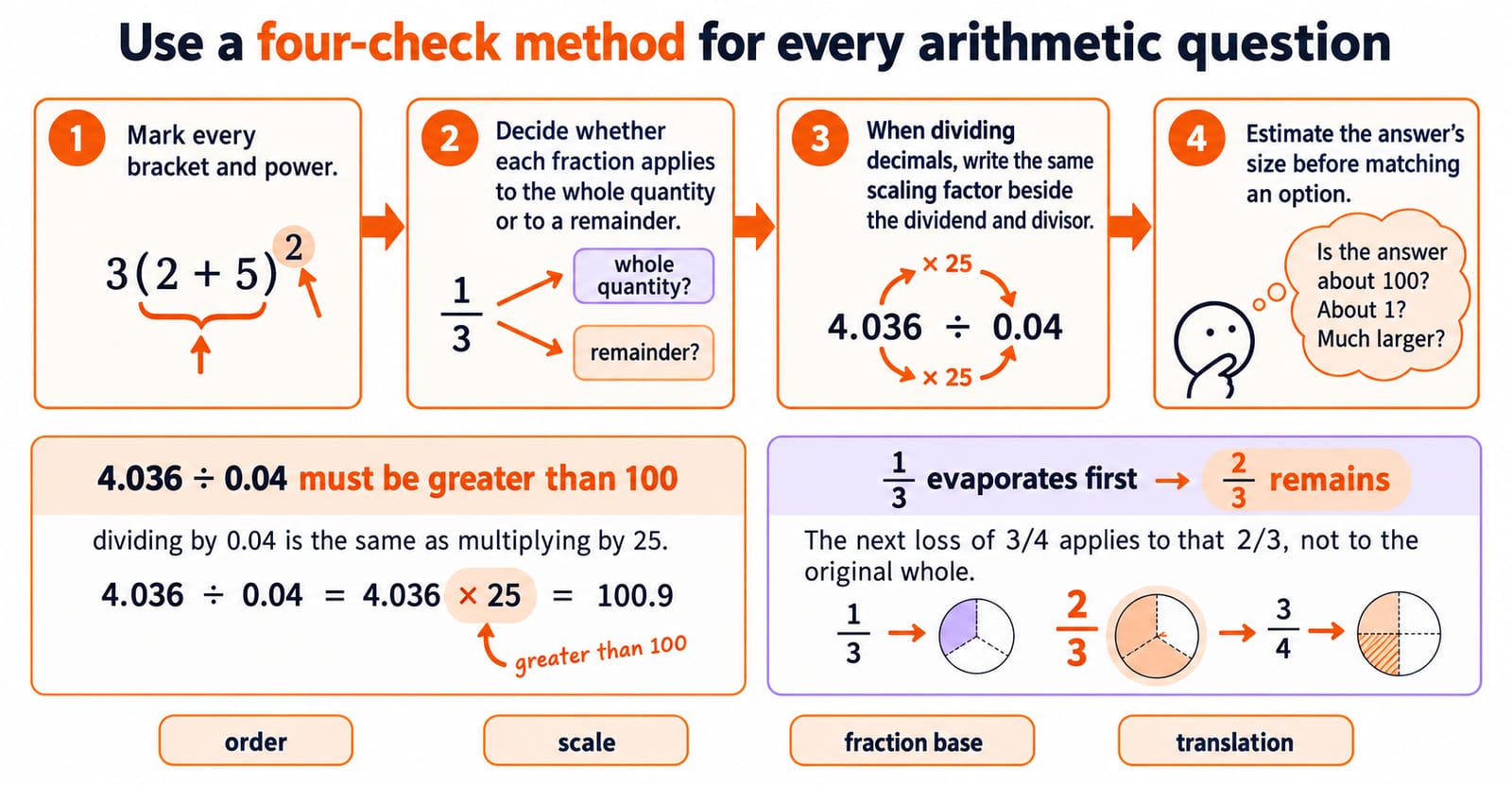
Before calculating, make four checks:
Mark every bracket and power.
Decide whether each fraction applies to the whole quantity or to a remainder.
When dividing decimals, write the same scaling factor beside the dividend and divisor.
Estimate the answer's size before matching an option.
For example, 4.036 / 0.04 must be greater than 100 because dividing by 0.04 is the same as multiplying by 25. For a successive-remainder problem, if 1/3 evaporates first, 2/3 remains. The next loss of 3/4 applies to that 2/3, not to the original whole.
Record each miss under one label: order, scale, fraction base or translation. Structured aptitude lessons and practice can help placement learners rebuild weak areas systematically. Use GATE aptitude preparation when that is your target, or browse the wider Placement Preparation and Coding for the broader track.
Questions 1 to 3: multiplication, brackets and fraction operations
Question 1
What is 333 times 135?
(a) 46323
(b) 43623
(c) 43290
(d) 44955
Split 135 into 100 + 30 + 5:
333 x 100 = 33,300
333 x 30 = 9,990
333 x 5 = 1,665
Therefore, 33,300 + 9,990 + 1,665 = 44,955. Cross-check: 333 x (140 - 5) = 46,620 - 1,665 = 44,955. The answer is (d) 44955.
Question 2
What should come in the place of question mark (?) in the following question?
95 - 10 x [15 x (80 - 75)] / 25 = ?
(a) 45
(b) 55
(c) 65
(d) 75
Start with the innermost bracket: 80 - 75 = 5, then 15 x 5 = 75. Multiplication and division have equal precedence, so work left to right: 10 x 75 / 25 = 750 / 25 = 30. Finally, 95 - 30 = 65. Do not subtract 95 - 10 before finishing the multiplication and division. The answer is (c) 65.
Question 3
What will come in the place of the question mark ‘?’ in the following question?
{(6/7) x 343} + {(5/8) x 512} = 500 + ?
(a) 214
(b) 114
(c) 314
(d) 414
Cancel before multiplying: (6/7) x 343 = 6 x 49 = 294, while (5/8) x 512 = 5 x 64 = 320. Their sum is 294 + 320 = 614. Since 614 = 500 + ?, the missing number is 614 - 500 = 114. The answer is (b) 114.
Questions 4 to 6: decimal division, cancellation and place count
Question 4
4.036 divided by 0.04 gives:
(a) 1.009
(b) 10.09
(c) 100.9
(d) 6.98
Multiply both dividend and divisor by 100. This preserves the quotient: 4.036 / 0.04 = 403.6 / 4 = 100.9. Check by multiplication: 100.9 x 0.04 = 4.036. The earlier estimate also rejects 1.009, 10.09 and 6.98 before any long division. The answer is (c) 100.9.
Question 5
The value of (3.6 x 0.48 x 2.50) / (0.12 x 0.09 x 0.5) is:
(a) 80
(b) 800
(c) 8000
(d) 80000
Clear decimals with an equal total scale above and below:
(3.6 x 0.48 x 2.50) / (0.12 x 0.09 x 0.5) = (36 x 48 x 250) / (12 x 9 x 5)
Now cancel: 36 / 9 = 4, 48 / 12 = 4, and 250 / 5 = 50. Thus 4 x 4 x 50 = 800. With the original values, the numerator is 4.32, the denominator is 0.0054, and 4.32 / 0.0054 = 800. The answer is (b) 800.
Question 6
How many digits will be there to the right of the decimal point in the product of 95.75 and .02554 ?
(a) 5
(b) 6
(c) 7
(d) 9
The factors contain 2 + 5 = 7 decimal places before simplification. Multiply the integers: 9,575 x 2,554 = 24,454,550. Restoring seven places gives 2.4454550. In standard decimal form, the final zero is dropped, leaving 2.445455, with six digits to the right of the decimal point. The answer is (b) 6.
Questions 7 to 9: fractions of a number and successive remainders
Question 7
If one-third of one-fourth of a number is 15, then three-tenth of that number is:
(a) 35
(b) 36
(c) 56
(d) 54
Let the number be n. Then (1/3) x (1/4) x n = 15, so n/12 = 15 and n = 180. Now (3/10) x 180 = 54. Check backward: one-fourth of 180 is 45, and one-third of 45 is 15. The answer is (d) 54.
Question 8
Sara has 400 marbles. If she gives (1/5)th of her marbles to Sam and Sam gives (3/4)th of his marbles to David, then how many marbles does Sam have left?
(a) 80
(b) 20
(c) 60
(d) 200
Sam receives (1/5) x 400 = 80 marbles. He gives David (3/4) x 80 = 60, so he keeps 80 - 60 = 20. Equivalently, Sam retains one-fourth of his 80 marbles, and (1/4) x 80 = 20. The trap is taking three-fourths of Sara's original 400. The answer is (b) 20.
Question 9
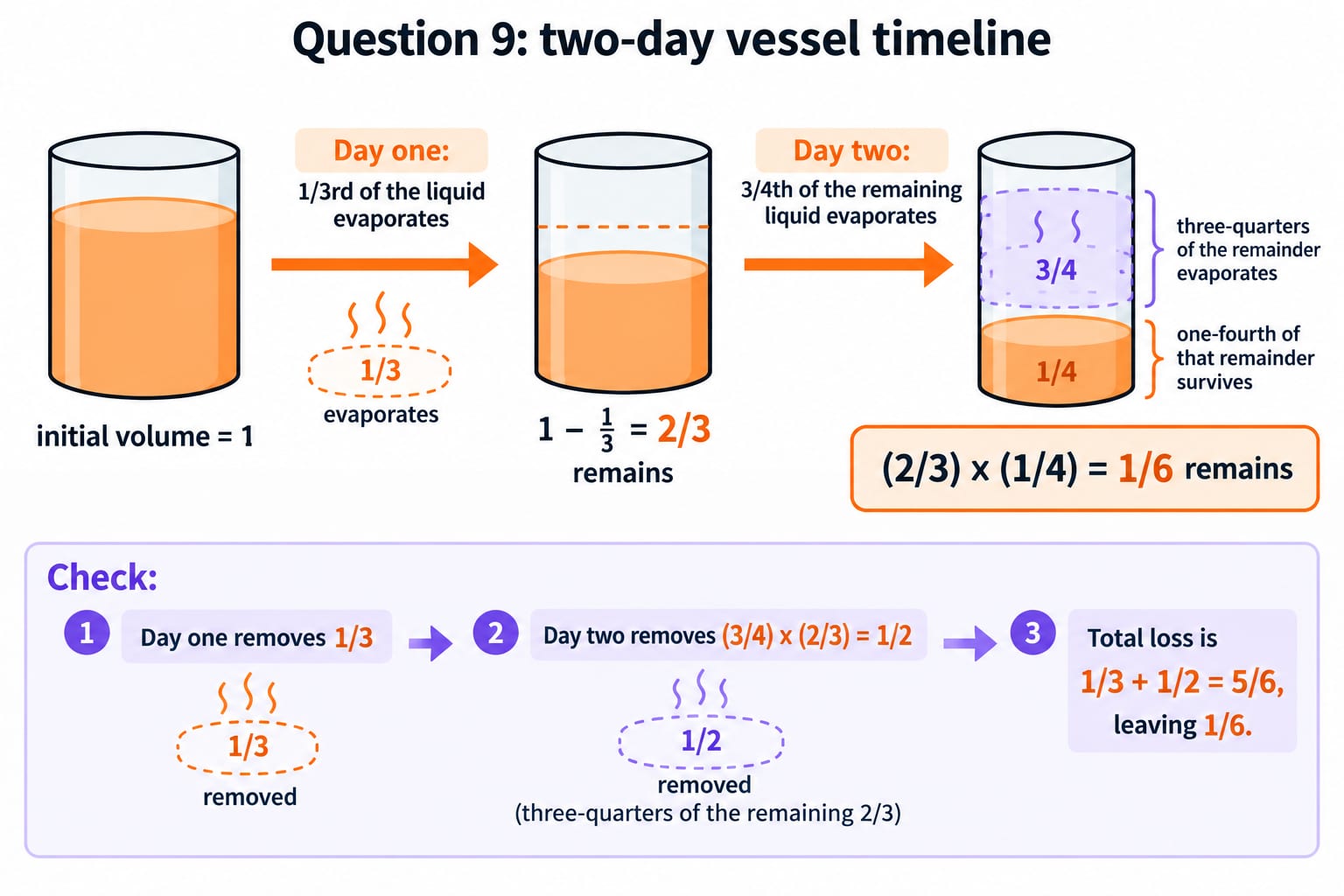
From a vessel, 1/3rd of the liquid evaporates on the first day. On the second day 3/4th of the remaining liquid evaporates. What fraction of the volume is present at the end of the second day?
(a) 1/12
(b) 1/8
(c) 1/6
(d) 1/5
Treat the initial volume as 1. After day one, 1 - 1/3 = 2/3 remains. On day two, one-fourth of that remainder survives, so (2/3) x (1/4) = 1/6 remains. Check the losses: day one removes 1/3; day two removes (3/4) x (2/3) = 1/2. Total loss is 1/3 + 1/2 = 5/6, leaving 1/6. The answer is (c) 1/6.
Questions 10 to 12: ratio scale, roots and fractional time
Question 10
If the ratio of two numbers is 3:4 and their product is 192, what is the sum of the two numbers?
(a) 16
(b) 28
(c) 32
(d) 36
Write the numbers as 3x and 4x. Their product is 12x^2 = 192, so x^2 = 16 and the positive scale is x = 4. The numbers are 12 and 16, giving a sum of 28. Check: 12:16 = 3:4 and 12 x 16 = 192. The answer is (b) 28.
Question 11
What will come in place of question mark (?) in the following question?
(5863 - sqrt(2704)) x 0.5 = ?
(a) 2955.5
(b) 2905.5
(c) 2590.5
(d) 2909.5
Evaluate the root first: sqrt(2704) = 52 because 52 x 52 = 2,704. Then 5,863 - 52 = 5,811. Multiplication by 0.5 is division by 2, so 5,811 / 2 = 2,905.5. As a size check, half of 5,863 is just under 2,932, so the result should be near 2,900. The answer is (b) 2905.5.
Question 12
During a given week, a software developer spends 1/3 of his time on design, 2/5 of his time on installation, and the rest of his time on testing. If he works 45 hours during the week, how many hours did he spend on testing?
(a) 10
(b) 18
(c) 15
(d) 12
Use a denominator of 15: 1/3 = 5/15 and 2/5 = 6/15. Design plus installation takes 11/15, so testing takes 1 - 11/15 = 4/15. Therefore, (4/15) x 45 = 12 hours. Check the full split: design is 15 hours, installation is 18 hours, and testing is 12 hours, totalling 45. The answer is (d) 12.
Diagnose the four traps exposed by this set
An incorrect option is useful when you classify the cause instead of merely recording the score.
Order trap: Questions 2, 3 and 11 require brackets, roots or equal-precedence operations in the correct order. Write one transformation per line.
Scale trap: Questions 4, 5 and 6 require consistent decimal scaling plus an estimate that catches a factor-of-10 error.
Fraction-base trap: Questions 8 and 9 apply the second fraction to a changed quantity. Write the new base, 80 marbles or
2/3of the vessel, before taking the next fraction.Translation trap: Questions 7, 10 and 12 need an equation or common denominator before calculation. Name the unknown and translate the sentence before testing options.
Missed questions | Revise this skill |
|---|---|
2, 3, 11 | Order of operations |
4, 5, 6 | Decimal place and scaling |
7, 8, 9, 12 | Fractions of wholes and remainders |
10 | Ratio scaling |
Answer key and the next practice step
Question | Answer | Value |
|---|---|---|
1 | (d) | 44955 |
2 | (c) | 65 |
3 | (b) | 114 |
4 | (c) | 100.9 |
5 | (b) | 800 |
6 | (b) | 6 |
7 | (d) | 54 |
8 | (b) | 20 |
9 | (c) | 1/6 |
10 | (b) | 28 |
11 | (b) | 2905.5 |
12 | (d) | 12 |
After one day, redo only the questions you missed. Cover the solution and write every intermediate value again, because a score of 12 out of 12 matters less than being able to explain why the other three options fail. For another solved collection, work through these Number System MCQs. When you want a structured sequence instead of isolated sets, return to the Aptitude for Placement course and practise by error type until the same trap stops recurring.
Keep learning

Advance Arithmetic Questions with Solutions: 12 Solved MCQs
Attempt this 12-question mixed set before opening the solutions. Each answer models the story, shows the arithmetic, and finishes with a direct check.
Updated 19 Nov 20268 min readAptitude & Reasoning

Binary Arithmetic Operations MCQs: 12 Solved Questions with Step-by-Step Explanations
Practise 12 real exam MCQs on binary arithmetic with step-by-step solutions covering carry chains, complements, division, BCD, mixed bases and shifts.
Updated 12 Aug 20268 min read54 viewsDigital Electronics MCQs

Simplification Based Problems: 12 Solved Questions with Step-by-Step Solutions
Solve 12 simplification questions step by step, from nested signs and mixed fractions to continued fractions, approximation and structural shortcuts.
Updated 17 Nov 20266 min readAptitude & Reasoning

Polynomials and Algebraic Expressions Questions with Solutions: 12-MCQ Practice Set
Attempt these 12 questions before reading the worked solutions. Each one tests a specific algebra rule, helping you find which methods need revision.
Updated 16 Nov 20268 min readAptitude & Reasoning