

Direction Test: Concepts, Shortcuts and Solved Examples
Stop rotating every turn in your head. Use one fixed compass, coordinates and cancellation to solve direction, distance and relative-position questions reliably.
KnowledgeGate Team
Exam prep & CS education
Updated 16 Nov 20265 min read
Direction Test questions become confusing when you hold every turn in your head. The final facing direction then gets mixed up with the endpoint's position from the start. Translate movement into coordinates, cancel opposite moves, and calculate the final displacement. Standard compass conventions put north at the top, east to the right, south at the bottom and west to the left; the exam's stated convention controls when it differs.
Direction Test Basics: Fix the Compass Before You Move
Keep one compass frame fixed: north at the top, east to the right, south at the bottom and west to the left. Between them are north-east, south-east, south-west and north-west.
The opposite pairs are N and S, E and W, NE and SW, and NW and SE. For movement questions, write the four main directions as coordinate changes:
N = (0, +1)
S = (0, -1)
E = (+1, 0)
W = (-1, 0)
Separate three quantities: route travelled, final facing direction, and shortest distance or direction from the start. After walking 5 m north and 5 m south, the route is 10 m, displacement is 0 m, and final facing is south.
Direction questions sit within the wider puzzle family covered in Logical Reasoning for Placement Tests. The Placement Preparation page gives the broader track.
Left, Right and U-Turn Shortcuts Without Mental Rotation
For the four main directions, remember the clockwise cycle:
N -> E -> S -> W -> N
A right turn moves one step forward, a left turn one step backward, and a U-turn two steps. For an explicit diagonal start, the right-turn cycle is NE -> SE -> SW -> NW -> NE.
Consider a turn-only check. Reena starts facing west, turns left, then left, then right:
W -> S -> E -> S
She faces south. As a net-turn check, two lefts and one right equal one left overall. One left from west is south.
“Turns right and walks east” gives a turn and movement. “A point lies east of another” describes only position. Do not add a turn to a relation.
The Coordinate Method: One Complete Direction-Test Trace
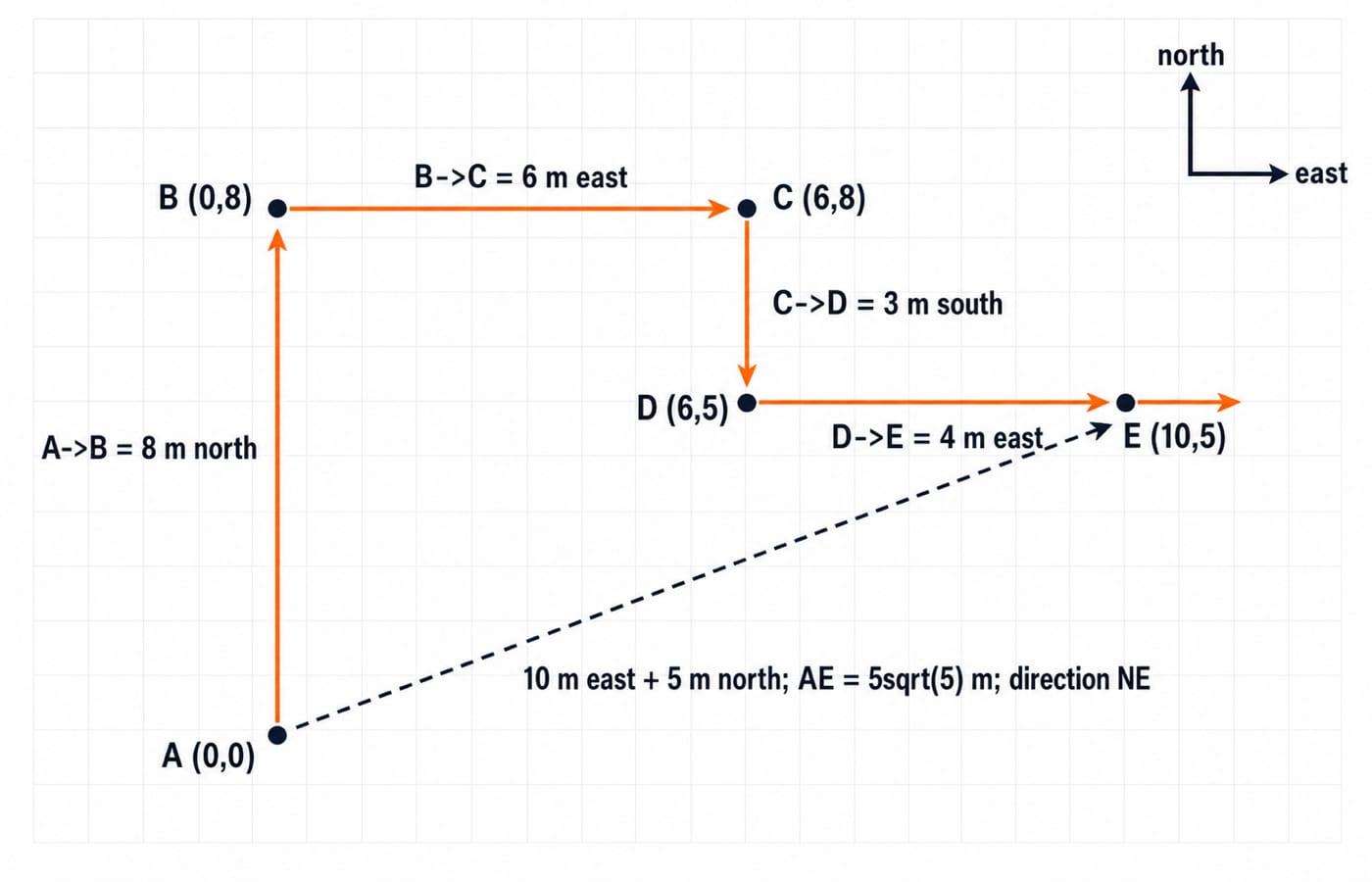
Arun starts at A = (0, 0), facing north.
He walks 8 m north to B = (0, 8).
He turns right, changing from north to east, and walks 6 m to C = (6, 8).
He turns right, changing from east to south, and walks 3 m to D = (6, 5).
He turns left, changing from south to east, and walks 4 m to E = (10, 5).
From A to E, net eastward movement is 6 + 4 = 10 m and net northward movement is 8 - 3 = 5 m. Both are positive, so E is north-east of A.
The shortest distance is:
AE = √(10² + 5²) = √(100 + 25) = √125 = 5√5 m
Arun finally faces east. His route is 8 + 6 + 3 + 4 = 21 m, different from the shortest distance.
Distance Shortcuts: Cancel First, Apply Pythagoras Last
Use a three-line scratch method:
Total east minus total west gives x.
Total north minus total south gives y.
Use √(x² + y²) only if the question asks for straight-line distance.
If x = 0, the endpoint is due north or south. If y = 0, it is due east or west. If x = 0 and y = 0, the person has returned to the start.
For 12 m east, 7 m west, 9 m north and 9 m south, x = 12 - 7 = 5 and y = 9 - 9 = 0. The endpoint is 5 m east of the start.
For 9 m east and 12 m north, the shortest distance is √(9² + 12²) = √(81 + 144) = √225 = 15 m. The endpoint is north-east of the start.
Never add every route leg to obtain displacement. Never apply Pythagoras before cancelling opposite movement.
Relative-Position Statements: Choose One Point as the Origin
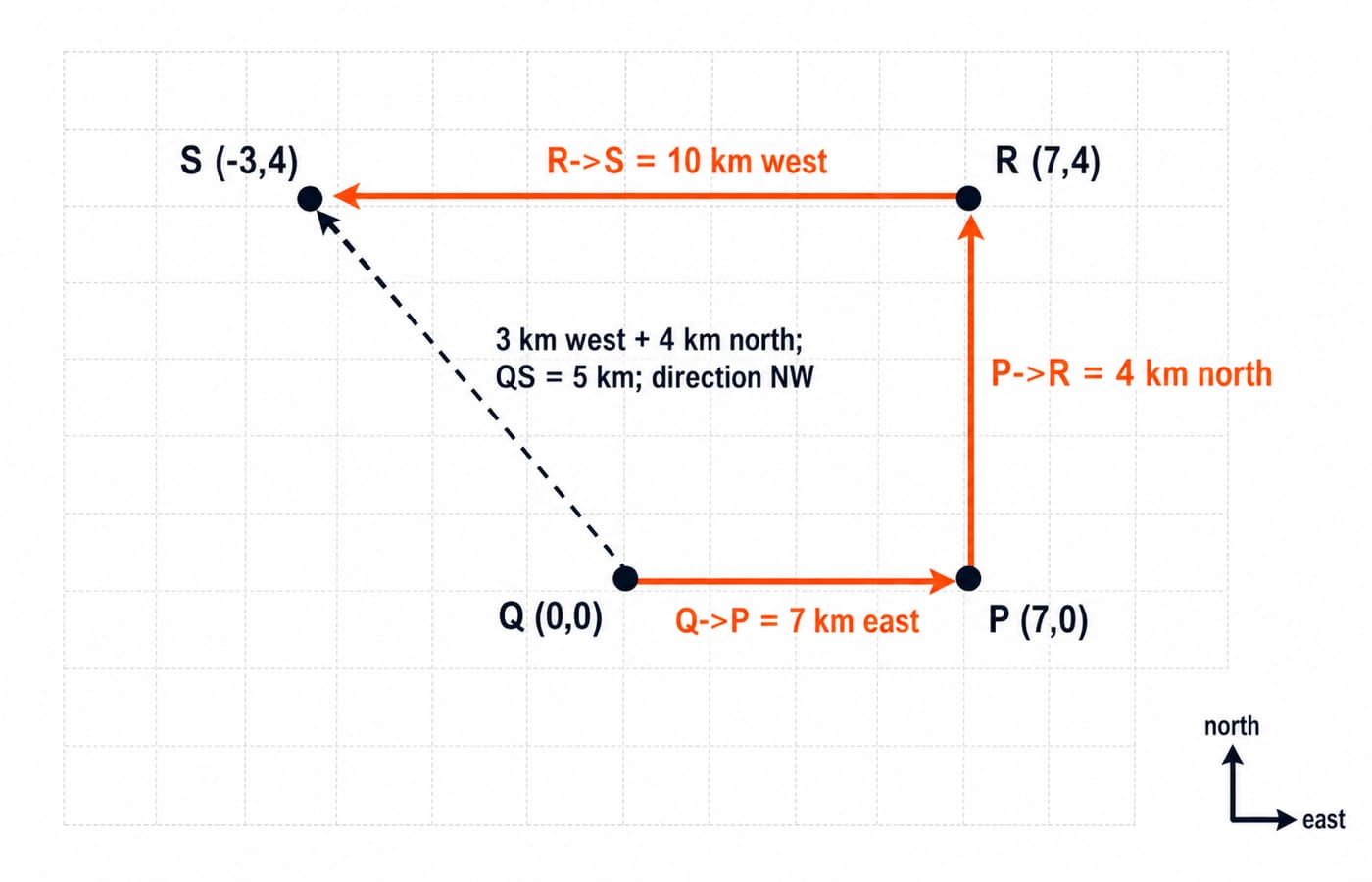
Translate one relation at a time. Take Q = (0, 0). P is 7 km east, so P = (7, 0). R is 4 km north of P, so R = (7, 4). S is 10 km west of R, so S = (7 - 10, 4) = (-3, 4).
Relative to Q, S is 3 km west and 4 km north. Therefore, S is north-west of Q, and:
QS = √((-3)² + 4²) = √(9 + 16) = √25 = 5 km
Relative to S, P is 7 - (-3) = 10 km east and 0 - 4 = 4 km south, so P is south-east of S. Changing the reference point reverses the requested relation.
Shadow Questions and Other Convention-Based Variants
Shadow questions use a simplified convention. In a clear-sky morning setup, the sun is east and the shadow west. In the evening, the sun is west and the shadow east. This reasoning shortcut is not a precise astronomical rule for every place, season and time.
“In the morning, Anita is facing her shadow.” Her shadow is west, so Anita faces west. If Rohit faces Anita, Rohit faces east. “Morning” establishes the orientation.
If a question supplies its own sun position, clock-face convention or diagram, use that information instead of a memorised shortcut.
How Placement and Government Exams Use the Same Idea
Recurring forms include final facing, relative direction, shortest route displacement, coded directions, and shadow orientation. As a practice target, spend the first 20 to 30 seconds making a clean sketch. It is not an official time limit.
Use this attempt order:
Mark the origin and draw a north arrow.
Translate every movement or relation.
Cancel opposite components.
Identify the reference point named in the question.
Calculate distance only if asked.
For a wider study sequence, use the Aptitude for Placements Guide. For government-exam reasoning context, see SSC CGL Reasoning: High-Yield Topics and Solving Order.
Traps, the Short Version and the Next Practice Step
Four mistakes cause most avoidable errors:
Rotating the page mentally: keep north fixed and rotate only the person's facing direction.
Confusing route with displacement: total the x and y components, not every metre travelled.
Answering final facing instead of endpoint direction: read the noun in the question before calculating.
Reversing a relation: if A is east of B, then B is west of A, so swap the reference carefully.
The short version is simple. Set the start to (0, 0), write every move as an x or y change, cancel E-W and N-S, and use the signs of the remaining components to name the direction. Apply Pythagoras only to those remaining perpendicular components.
Practise the broader aptitude, reasoning and verbal-ability track with Aptitude for Placement, then solve direction sets in small timed batches and review every diagram error.
Keep learning

P, NP and Polynomial-Time Reducibility: Definitions, Direction and a Worked Example
Separate solving from verification, learn what A <=p B really says, and follow a complete reduction from Vertex Cover to Independent Set on one five-vertex graph.
Updated 30 Oct 20266 min readTheory of Computation
Fallacy in Logical Reasoning: Types, Shortcuts and Solved Examples
Learn to test fallacy questions by separating the conclusion, evidence and hidden bridge. Includes conditional, survey, analogy, causation and language examples.
Updated 18 Nov 20266 min readAptitude & Reasoning

Data Sufficiency: A 5-Step Method, Shortcuts and Solved Examples
Learn to test each statement independently, prove insufficiency with two valid cases, and stop as soon as the target becomes unique. Three worked problems make the method concrete.
Updated 15 Nov 20266 min readAptitude & Reasoning
Data Arrangement Questions: Concepts, Shortcuts and Solved Examples
Turn names, cities, roles and scores into a clean grid. This guide shows safe shortcuts and solves one complete arrangement from clues to answer.
Updated 11 Nov 20266 min readAptitude & Reasoning