

Persistent Systems Interview Questions: Technical Examples and HR Answers
Practise explaining code outputs, preserving zero-count rows in SQL, and defending a project decision. Use the fictional HR examples as structures for your own truthful answers.
KnowledgeGate Team
Exam prep & CS education
Updated 19 Nov 20266 min read
Recognising OOP or SQL terminology is easier than explaining a working answer while someone challenges its assumptions. For Persistent Systems preparation, use these representative technical questions, project follow-ups and adaptable HR answer structures to practise that explanation. These are practice examples, not verified previously asked questions; use your specific hiring invitation for the applicable process.
Persistent Systems preparation: start with the role, then practise explanations
Persistent's Early Careers and Campus Program page describes campus talent development and structured learning for future engineering graduates. Those programmes provide context for your interest in learning. Its page also names Train and Hire, a two-month self-learning initiative for campus hiring, and Career Compass, a pre-joining enablement journey; mention one only if it matches the role information you received.
Start with the language and skills listed in your actual job description. For each relevant question, follow four steps: clarify the input, state an approach, work an example, and discuss a limitation. The broader Placement Preparation route can help organise your preparation alongside this focused practice set. The published Wipro Technical Interview Questions: Coding, SQL and HR set addresses Wipro-specific prompts; this page keeps the same rehearsal method focused on Persistent Systems and the worked examples below.
Coding question: find the first non-repeating character
Prompt: Given a non-null string containing only lowercase English letters, return its first non-repeating character, or '#' if none exists.
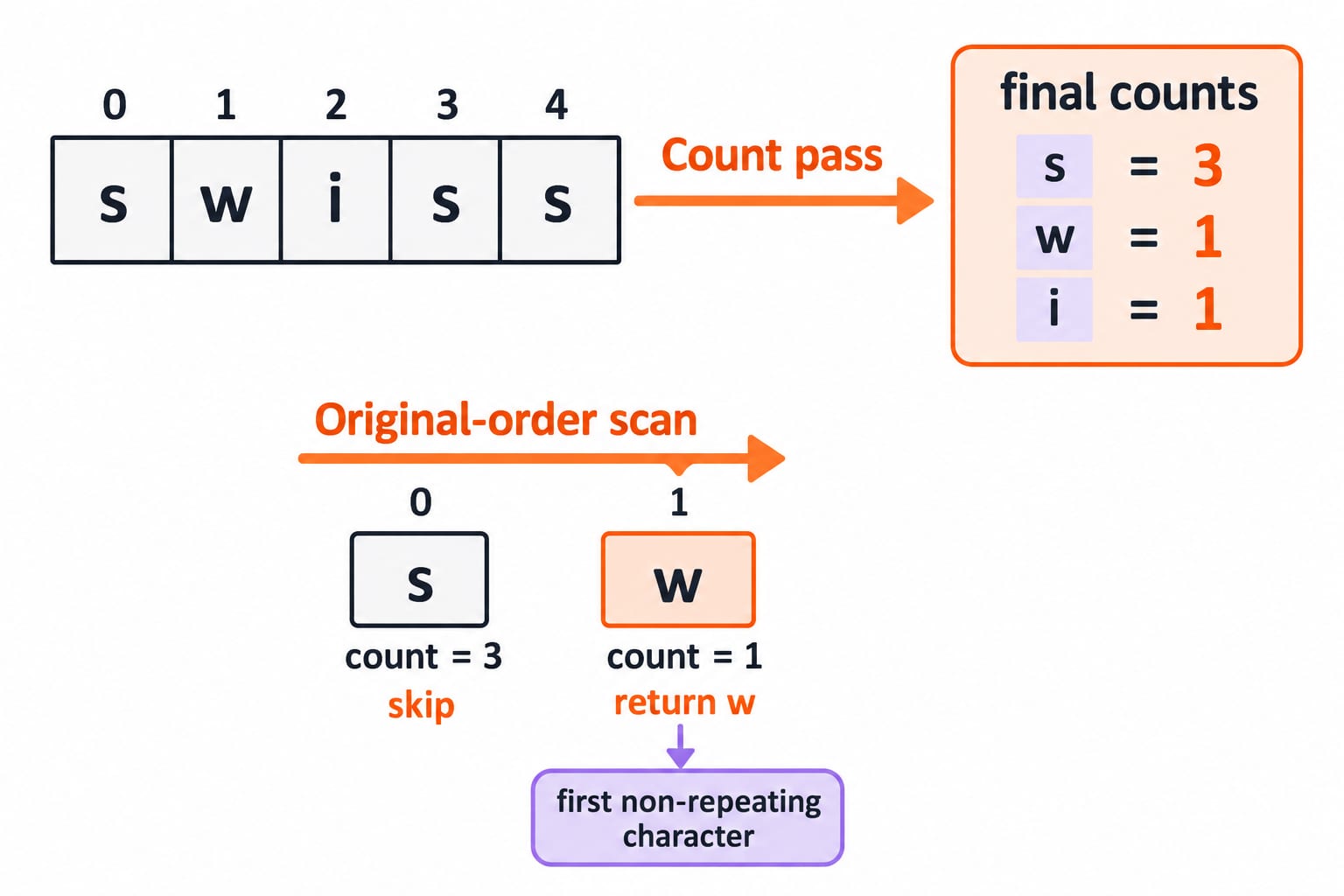
Count all characters first, then scan the original string in order. During the count pass, seeing a character once does not establish uniqueness: it may appear again later.
static char firstUnique(String s) {
    int[] count = new int[26];
    for (int i = 0; i < s.length(); i++) {
        count[s.charAt(i) - 'a']++;
    }
    for (int i = 0; i < s.length(); i++) {
        if (count[s.charAt(i) - 'a'] == 1) {
            return s.charAt(i);
        }
    }
    return '#';
}
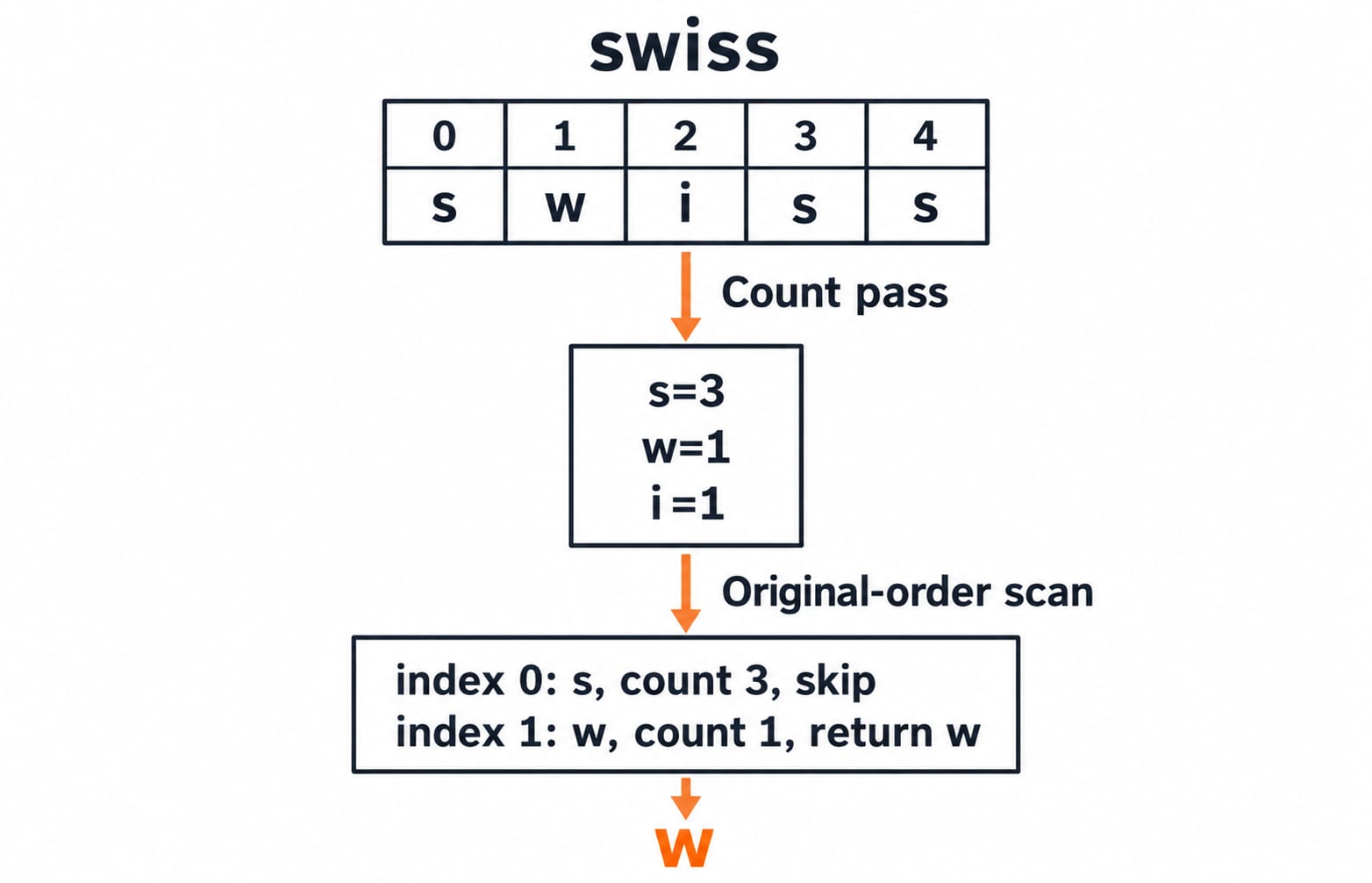
For swiss, the final counts are s=3, w=1, i=1. At index 0, reject s because its count is 3. At index 1, return w because its count is 1. Although i is also unique, w comes first.
The time complexity is O(n). Auxiliary space is O(1) under the fixed 26-letter assumption; indexed charAt access avoids a temporary character array.
Test the empty string → #, aabb → #, a → a, and swiss → w. Uppercase or general Unicode input requires revisiting the contract and representation. If you replace the array with a map, scan the input for order instead of iterating unordered map keys.
OOP question: explain runtime polymorphism with an output
Predict the output before running this Java example:
class Parent {
    String label() { return "parent"; }
}
class Child extends Parent {
    @Override
    String label() { return "child"; }
}
// Inside main:
Parent p = new Child();
System.out.println(p.label());
The output is child. The reference type determines which accessible methods can be called at compile time. The runtime object selects the overriding instance-method implementation. Here, that object is a Child. Keep overriding separate from overloading and static method hiding.
Follow-up: Would inheritance be the best design for swapping notification providers? A Notifier interface with send(String message) lets a service hold a Notifier through composition. A test implementation can record the message. This option fits the requirement to swap providers and test the service independently.
SQL question: include employees with no completed tickets
Prompt: Return every employee and the number of closed tickets, including zero.
Employee:
id | name |
|---|---|
1 | Asha |
2 | Ravi |
3 | Neha |
Ticket:
id | employee_id | status |
|---|---|---|
11 | 1 | closed |
12 | 1 | open |
13 | 2 | closed |
SELECT e.id, e.name, COUNT(t.id) AS closed_count
FROM Employee e
LEFT JOIN Ticket t
  ON t.employee_id = e.id AND t.status = 'closed'
GROUP BY e.id, e.name
ORDER BY e.id;
The result is:
id | name | closed_count |
|---|---|---|
1 | Asha | 1 |
2 | Ravi | 1 |
3 | Neha | 0 |
Asha's ticket 11 contributes 1; her open ticket contributes nothing. Ravi's ticket 13 contributes 1. Neha has no matching ticket, so the left join preserves her with NULL ticket columns.
COUNT(t.id) ignores that NULL and returns 0. COUNT(*) would count the preserved row and return 1. Moving the status condition into WHERE t.status = 'closed' removes Neha's row. Group by employee ID as well as name to keep employees with identical names separate.
Project and CS follow-ups: defend a concrete implementation
Hypothetical project question: Two requests try to book the final seat. How do you prevent overselling?
Start with remaining=1. If both requests read 1 and independently promise success, they can oversell. Use a conditional database update:
UPDATE Event
SET remaining = remaining - 1
WHERE id = 7 AND remaining > 0;
On a transactional database with the required row-update concurrency semantics, the first successful request affects 1 row: 1 - 1 = 0. After it commits, the other affects 0 rows and must report no availability. Insert the booking in the same transaction; roll back the decrement if insertion fails. Java synchronized alone does not coordinate separate application servers.
Explain ownership precisely: “I implemented [actual component], tested [actual failure case], and chose [trade-off] because [constraint].” For supporting subject revision, use Technical Interview Prep: OS, DBMS, CN and OOP Answers.
HR questions: answer with evidence and honest constraints
“Tell me about yourself.” This fictional example connects to the booking problem. Adapt it only where true:
I am a final-year computer science student interested in backend development. In a college ticket-booking project, I implemented the booking endpoint and tested concurrent requests for the last seat. That made me interested in correctness and debugging, and I want to develop those skills in a graduate engineering role.
“Why Persistent?” Connect the careers page to evidence:
The Early Careers page names Train and Hire, a two-month self-learning initiative for campus hiring, and Career Compass, a pre-joining enablement journey. The role's [actual listed responsibility] connects with my work on [real project evidence]. I would like to understand what a new engineer contributes to in the first project.
“Tell me about a disagreement.” A fictional mini-STAR answer: “Two teammates disagreed about adding email reminders before a demo. I proposed finishing and testing the booking flow first. We agreed, deferred reminders and delivered a working demonstration. I learnt to settle scope discussions against the immediate goal.” Replace this with your own situation, task, action and result.
“Can you relocate?” State constraints truthfully: “I can consider [location] from [actual date]; could you confirm the work location and joining expectations?” Find more structures in HR Interview Questions for Freshers: How to Answer Honestly.
Traps that weaken otherwise correct answers
A memorised definition is incomplete when the question asks for output. Trace the Parent reference to the Child object and then explain child.
Happy-path code hides contract errors. Test swiss, aabb, the empty string and a; state the lowercase assumption before indexing the array.
Plausible SQL can exclude required rows. Explain why Neha survives with count 0 and disappears with the misplaced WHERE filter. Likewise, overclaimed project work invites follow-ups you cannot defend. Name your actual contribution and its limits.
The short version: rehearse one answer from start to finish
Try this self-designed 30-minute rehearsal: 10 minutes for coding and edge cases, 8 for OOP and SQL, 7 for project follow-ups, and 5 for HR. The total is 10 + 8 + 7 + 5 = 30 minutes. Mark a question for revision whenever you cannot justify its output or assumption.
For optional general interview preparation, explore the Interview & Resume Preparation Course. Use it to support your practice, while keeping your answers tied to the role and work you can explain.
Keep learning
Hexaware Interview Questions and Answers: Technical, Coding and HR Rounds
Prepare answers that survive follow-up questions. This guide covers CS fundamentals, a worked SQL query, a coding trace, project defence, HR responses and a timed mock.
Updated 11 Nov 20266 min readCompany-Specific Prep
Tech Mahindra Interview Questions: Technical, Coding and HR Model Answers
Practise realistic Tech Mahindra interview question shapes across CS fundamentals, coding, SQL, projects and HR. Each model answer shows the evidence and follow-ups you should be ready to explain.
Updated 5 Nov 20265 min readCompany-Specific Prep
HCLTech Interview Questions: 12 Technical and HR Answers
Practise 12 representative HCLTech interview prompts through measured projects, layered CS answers, exact code and SQL traces, and truthful HR evidence.
Updated 29 Oct 20266 min readCompany-Specific Prep
Capgemini Interview Questions: Technical and HR Rounds with Model Answers
Practise clear technical and HR answers through Java, SQL, a coding trace and one consistent project story. Each example shows what to say and how to support it.
Updated 25 Sep 20265 min read73 viewsCompany-Specific Prep