

Hexaware Interview Questions and Answers: Technical, Coding and HR Rounds
Prepare answers that survive follow-up questions. This guide covers CS fundamentals, a worked SQL query, a coding trace, project defence, HR responses and a timed mock.
KnowledgeGate Team
Exam prep & CS education
Updated 11 Nov 20266 min read
Knowing definitions is not enough when an interviewer asks for an example, changes one condition, or moves from your resume into CS fundamentals. Strong answers explain the rule, demonstrate it with a concrete result and stay consistent when the interviewer follows up. Hexaware hiring conversations vary by role and drive, so use the examples below to rehearse explanations rather than predict a paper.
Hexaware interview question shapes to prepare for
Prepare in four lanes. For each, practise direct answer → concrete example → trade-off or edge case → likely follow-up.
Lane | Sample prompt | What it tests |
|---|---|---|
CS and language fundamentals | Overloading versus overriding | Precision and examples |
Coding and problem solving | First non-repeating character | Approach and complexity |
Resume or project defence | What exactly did you build? | Ownership and evidence |
HR and behavioural judgement | Tell me about yourself | Relevance and communication |
Use Placement Preparation and Coding to organise revision. Before the interview, compare your invitation with the Hexaware careers portal and use its listed responsibilities to choose project examples.
OOP and programming-language questions with model answers
What is the difference between overloading and overriding?
Overloading uses one method name with different parameter lists. Printer.print(int copies) and Printer.print(String text) are resolved from the callable signature. Overriding gives a subclass implementation of an inherited signature. If Animal.sound() returns "animal" and Dog.sound() returns "bark", an Animal reference can execute the Dog implementation at runtime. Static methods are hidden, not overridden.
Interface or abstract class: which would you choose?
Choose an interface for a capability across unrelated types: Payable.pay(int amount) can serve CardPayment and UpiPayment. Choose an abstract class when related types share state or partial implementation: Employee can hold id and name while requiring calculatePay().
Two rapid checks:
Stack versus heap: calls and local data generally use stack frames; objects generally use heap memory.
Checked versus unchecked exceptions in Java: checked exceptions must be handled or declared;
RuntimeExceptionsubclasses do not have that compile-time requirement.
Anchor the terminology to the language on your resume rather than forcing Java into every answer.
DBMS and SQL: a fully worked interview example
Given employees(emp_id, name, department, salary):
emp_id | name | department | salary |
|---|---|---|---|
101 | Asha | DEV | 72000 |
102 | Rohan | DEV | 65000 |
103 | Meera | QA | 68000 |
104 | Kabir | DEV | 58000 |
105 | Isha | QA | 61000 |
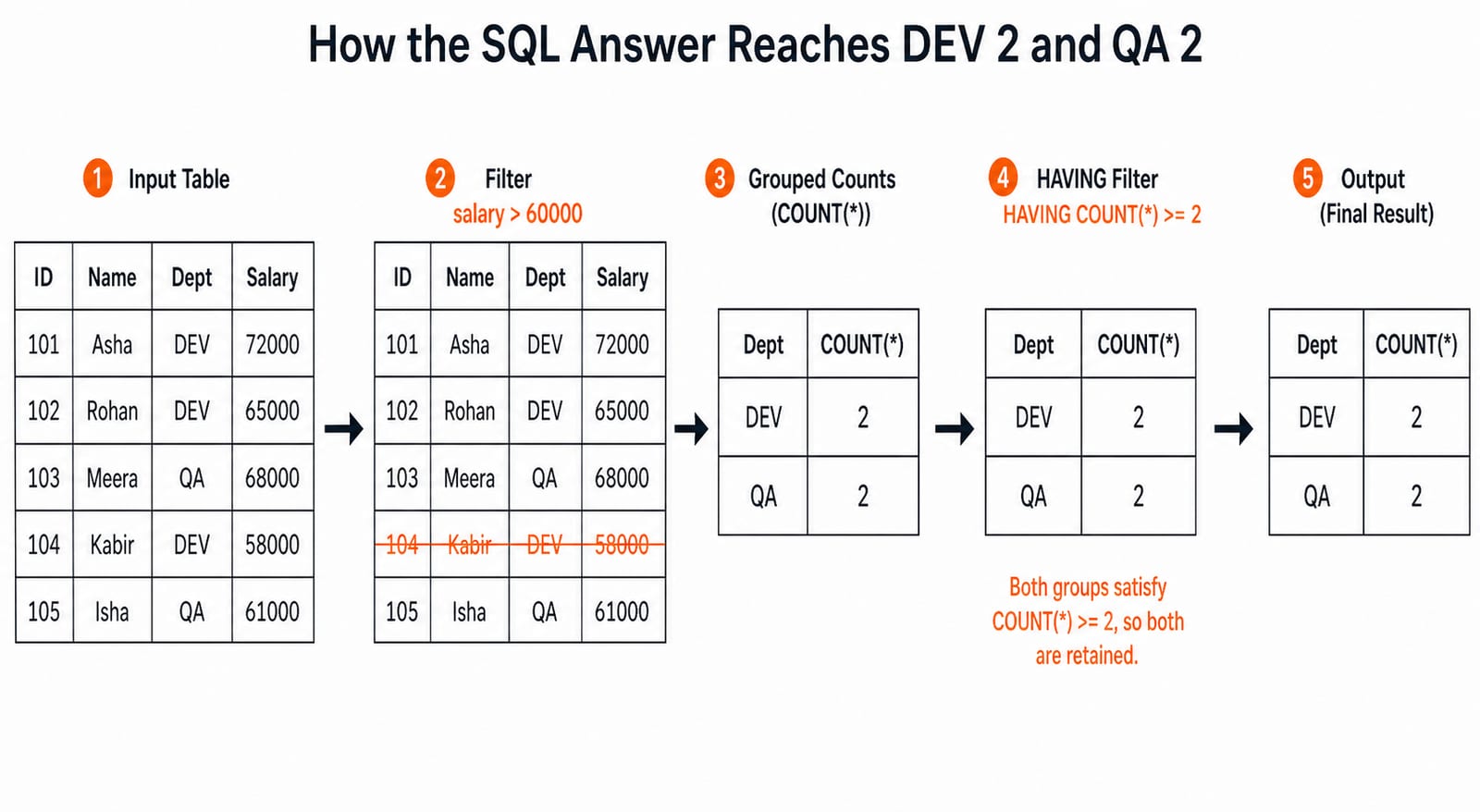
Question: Return departments having at least two employees whose salary is above 60000.
SELECT department, COUNT(*) AS high_earners
FROM employees
WHERE salary > 60000
GROUP BY department
HAVING COUNT(*) >= 2;
WHERE removes Kabir's 58000 row. Groups are DEV = 2 and QA = 2; HAVING keeps both, producing (DEV, 2) and (QA, 2). WHERE filters rows before grouping, while HAVING filters aggregate groups.
With >= 60000, the output is unchanged because no salary equals 60000. With > 65000, only Asha at 72000 and Meera at 68000 remain, one per department, so the result is empty.
Operating systems and networking answers that invite follow-ups
A process has its own address space. Its threads share resources but keep separate stacks. A browser can separate UI and network threads, so a blocked network call need not freeze the UI. Threads are lighter, but shared state needs synchronisation.
Deadlock requires mutual exclusion, hold and wait, no pre-emption and circular wait. If one transaction locks Account A then B while another locks B then A, they can form a cycle. A common A-then-B lock order prevents it.
A 20 MB file transfer needs TCP's ordered, reliable delivery. For live voice, a very late packet may be less useful than a dropped one, making UDP suitable. HTTPS is HTTP over TLS, adding authentication, integrity and encryption in transit.
Coding round model: first non-repeating character
Question: Given teeter, return the first character that occurs once.
Count frequencies: t = 3, e = 2, r = 1. A left-to-right scan skips t and e, then returns r.
count each character
scan the original string left to right
return the first character with count 1
otherwise return no character
This takes O(n) time and O(k) space for k distinct characters. aabb and the empty string return no character; z returns z. For fixed ASCII, an array can replace the map.
A defensible answer states the input and no-answer behaviour, explains the approach, traces teeter, gives complexity, and then notes the fixed-alphabet optimisation.
Resume and project questions: prove every claim
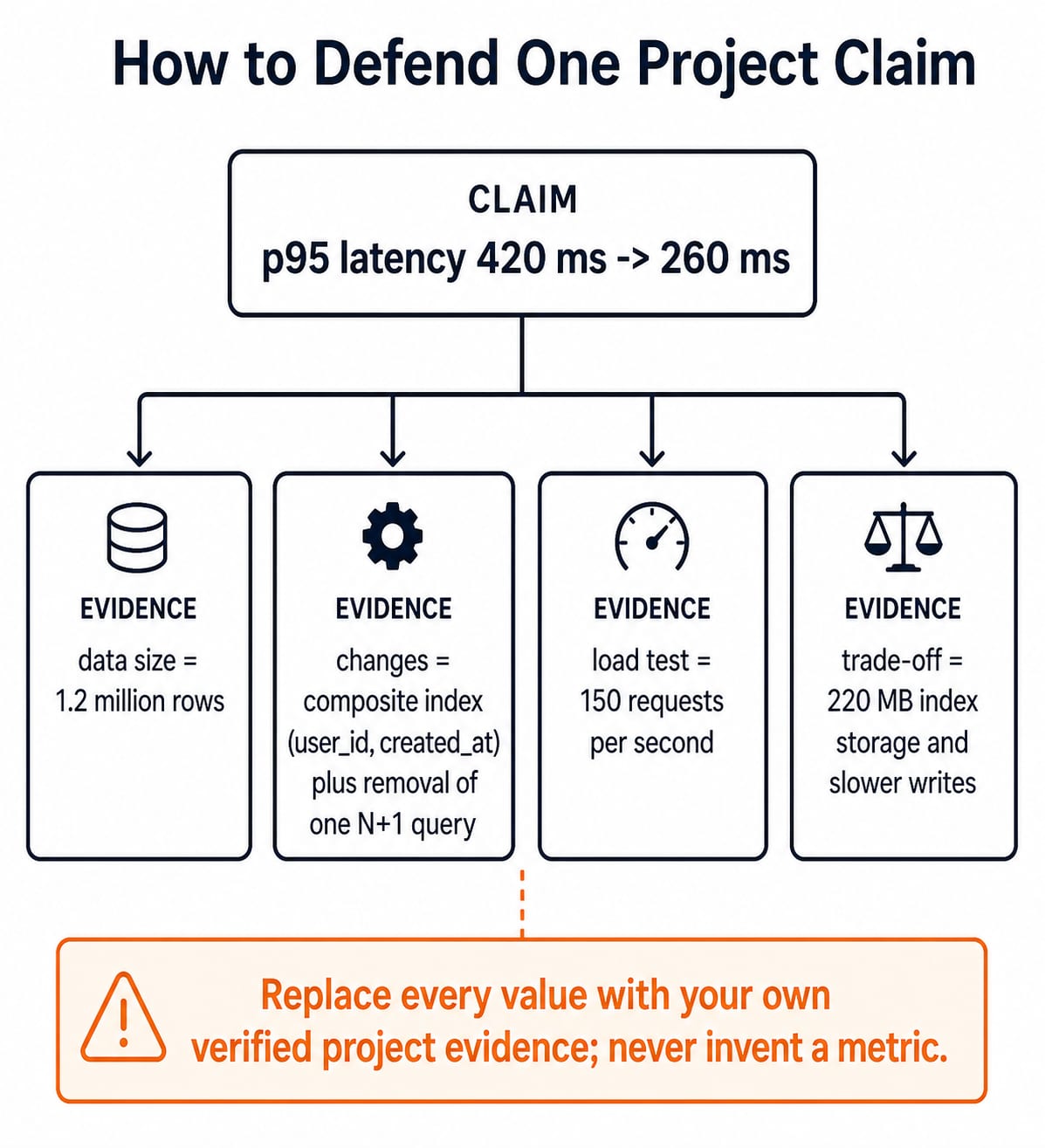
Replace every value in this fictional model with your own truthful evidence:
I improved an order API's p95 latency from 420 ms to 260 ms on a table with 1.2 million rows by adding a composite index on
(user_id, created_at)and removing an N+1 query. We load-tested at 150 requests per second; the index added 220 MB of storage.
This beats “I optimised the backend” because it gives a baseline, action, result, load and trade-off. Prepare for follow-ups:
What query was slow? Show query counts before and after.
Why that index order? Connect it to the filter and sort.
How was 260 ms measured? State p95, data size and 150 requests per second.
What could go wrong? Explain slower writes and 220 MB storage.
Turn each resume bullet into likely follow-ups with Resume-Based Interview Questions: Predict Every Follow-Up. Never invent a metric.
HR round questions without stock answers
For “Tell me about yourself”, fictional candidate Nisha can use four parts:
I am a final-year BTech CSE student focused on Java backend development. In an order API project, I reduced p95 latency from 420 ms to 260 ms at 150 requests per second by improving the query path. Measuring the bottleneck and trade-offs confirmed this strength. I want to contribute to software delivery while learning from production systems.
Adapt that identity, skill, proof and direction to your evidence. HR Interview: Tell Me About Yourself in 60 Seconds explains the same structure.
Prove a strength: “I debug methodically and measure query counts before changing code.” Correct a weakness: “I used to polish alone for too long. I now time-box the attempt to 30 minutes, then ask a focused question with logs and attempted fixes.” Avoid “I work too hard”.
For “Why Hexaware?”, combine the role description, matching evidence and one current company fact verified on Hexaware's official site. Do not invent clients, technologies or values. State real constraints about relocation, shifts or joining date.
Run a 45-minute mock and close the gaps
Use 5 minutes for your introduction and role evidence, 15 for OOP, DBMS, OS and networks, 10 for the coding trace, 10 for project follow-ups, and 5 for HR. Mark each lane as clear, partial or unsupported, then rewrite the weakest answer and repeat after two days.
The TCS interview question set already owns a general 45-minute score-and-replay loop; this post owns a Hexaware role-fit check built around your invitation, the SQL trace and your project evidence.
The TCS interview question set already owns a general 45-minute score-and-replay loop; this post owns a Hexaware role-fit check built around your invitation, the SQL trace and your project evidence.
The short version: know one language deeply, trace one SQL query and one coding problem aloud, defend every resume number, and prepare truthful HR answers. Take the Hexaware Preparation Course as the company-specific next step. Use the Interview & Resume Preparation Course for structured resume review and mock-interview practice.
Keep learning
Tech Mahindra Interview Questions: Technical, Coding and HR Model Answers
Practise realistic Tech Mahindra interview question shapes across CS fundamentals, coding, SQL, projects and HR. Each model answer shows the evidence and follow-ups you should be ready to explain.
Updated 5 Nov 20265 min readCompany-Specific Prep
HCLTech Interview Questions: 12 Technical and HR Answers
Practise 12 representative HCLTech interview prompts through measured projects, layered CS answers, exact code and SQL traces, and truthful HR evidence.
Updated 29 Oct 20266 min readCompany-Specific Prep
Capgemini Interview Questions: Technical and HR Rounds with Model Answers
Practise clear technical and HR answers through Java, SQL, a coding trace and one consistent project story. Each example shows what to say and how to support it.
Updated 25 Sep 20265 min read73 viewsCompany-Specific Prep
Cognizant Interview Questions: Technical and HR Model Answers
Prepare clear technical and HR responses through worked programming, SQL, project and STAR examples, then test them in a timed self-review mock.
Updated 22 Sep 20266 min readCompany-Specific Prep