Capgemini Interview Questions: Technical and HR Rounds with Model Answers
Practise clear technical and HR answers through Java, SQL, a coding trace and one consistent project story. Each example shows what to say and how to support it.
KnowledgeGate Team
Exam prep & CS education
Updated 25 Sep 20265 min read
Knowing Java, SQL and your project differs from explaining them under follow-ups. Capgemini India's official recruitment page lists role-dependent assessments, one or two technical interviews depending on position, and a formal HR behavioural interview after technical evaluation. One fictional candidate models answers; its values are authored practice data.
Read the current Capgemini process before practising answers
Process check: Capgemini India's recruitment-process page says HR screening may precede proctored technical or language assessments. Technical interviews may be by video or in person, with one or two depending on position. A formal HR behavioural interview follows technical evaluation. This does not guarantee campus-drive order, question count, duration, cutoff or scoring.
Check three sources: your invitation, live role description and official page. See Capgemini Technical Interview: Pseudocode to Projects. Use Capgemini Superset for company preparation.
Use one answer shape for core technical questions
Define, exemplify, name one trade-off, then pause for follow-up.
"Differentiate method overloading and overriding in Java." Overloads share a name but use different parameter lists. In one Notifier class, send(String message) and send(String message, int priority) are overloads resolved from parameters. Return type alone cannot distinguish them. A subclass override replaces an inherited implementation: EmailNotifier.send(String message) overrides Notifier.send(String message); runtime polymorphism selects it. Too many overloads reduce API clarity. Overrides specialise behaviour while preserving the contract.
"Find the second-highest distinct salary." For Employee(name, salary) with Asha, 50000; Bharat, 70000; Charu, 70000; and Dev, 65000, use:
SELECT MAX(salary)
FROM Employee
WHERE salary < (SELECT MAX(salary) FROM Employee);
Inner maximum: 70000. Below it, 50000 and 65000 leave 65000. Duplicate 70000 changes nothing. For names or nth distinct salary, use DENSE_RANK().
Revise the surrounding fundamentals with technical interview preparation across OS, DBMS, CN and OOP.
Work a coding question aloud, including the trace
Practise this prompt: "Given integer event IDs [4, 2, 4, 3, 2, 1], return the IDs in first-seen order without duplicates." Restate both constraints: preserve first-seen order, and return [4, 2, 3, 1].
Initialise seen = {} and answer = [], then scan left to right. If an ID is absent from seen, add it to both structures. Otherwise, skip it. At index 0, append 4, giving [4]. At index 1, append 2, giving [4, 2]. At index 2, skip repeated 4. At index 3, append 3, giving [4, 2, 3]. At index 4, skip repeated 2. At index 5, append 1, giving [4, 2, 3, 1].
Hash-set complexity is expected O(n) time and O(k) space, where n = 6 and k = 4. For IDs from 0 to 9, a ten-entry Boolean array can replace the set. Sorting loses first-seen order.
State membership checks aloud; confirm each output ID's earliest input position.
![Duplicate-removal trace for the exact input. Draw a six-row table with columns index, ID, seen before, action, and answer after. The rows must be exactly 0 | 4 | {} | append 4 | [4]; 1 | 2 | {4} | append 2 | [4, 2]; 2 | 4 | {4, 2} | skip 4 | [4, 2]; 3 | 3 | {4, 2} | append 3 | [4, 2, 3]; 4 | 2 | {4, 2, 3} | skip 2 | [4, 2, 3]; 5 | 1 | {4, 2, 3} | append 1 | [4, 2, 3, 1]. Beneath the table show input n = 6, distinct k = 4, output = [4, 2, 3, 1], expected time O(n), and extra space O(k). Do not change the set contents, order, input or output.](https://cdn.knowledgegate.ai/blog-assets/blog_asset_1786682068242_w2xyip.jpg)
Turn one project into evidence, not a feature list
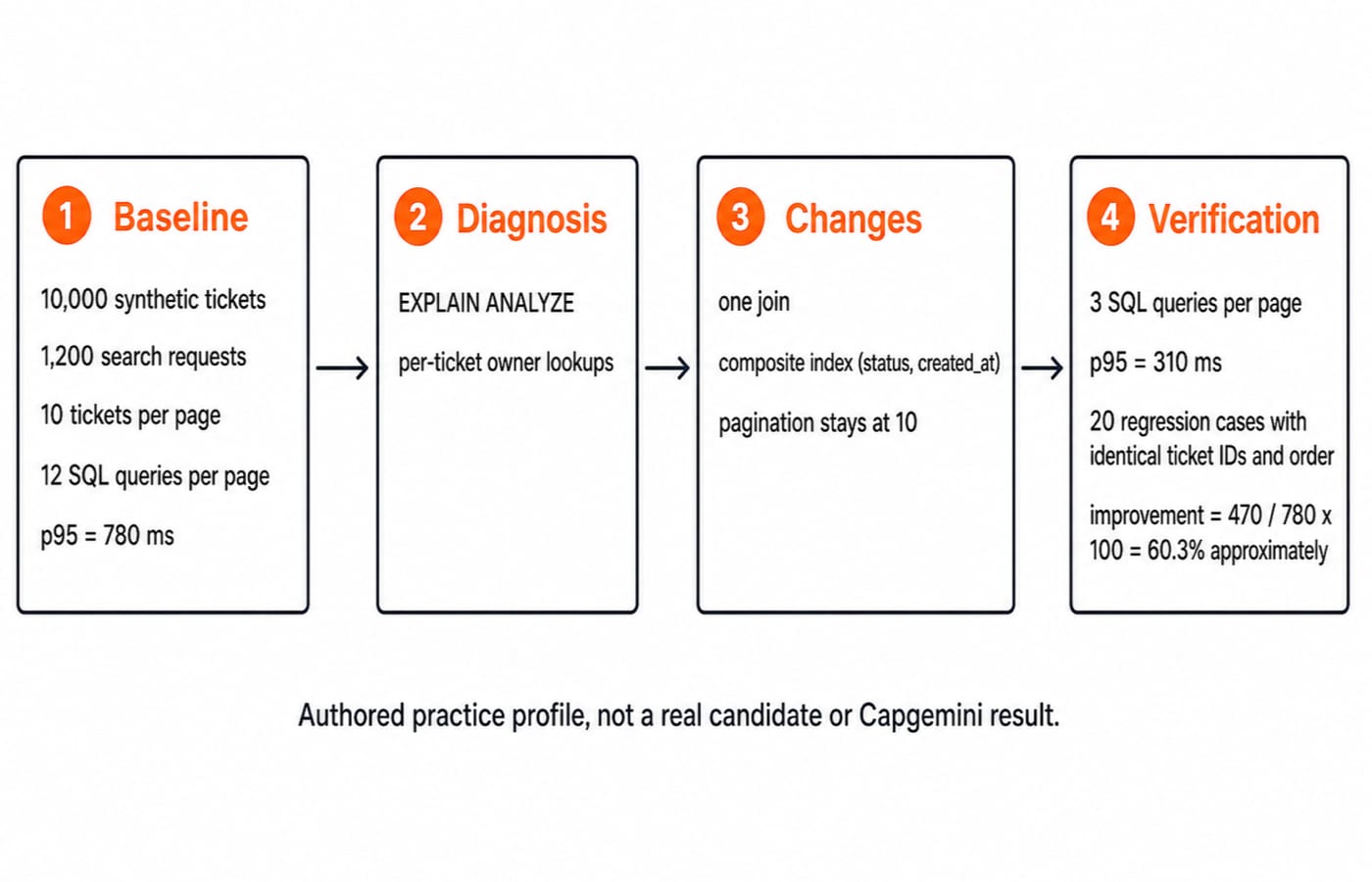
Use one fictional profile: a recent B.Tech IT graduate on a four-person team built CampusFix, a Spring Boot and PostgreSQL grievance tracker, owning ticket search and tests. Pages returned ten tickets. Across 10,000 synthetic tickets and 1,200 search requests, the first version used 12 SQL queries per page with 780 ms p95 response time.
A 75 to 90 second answer could say: "I owned ticket search. EXPLAIN ANALYZE exposed per-ticket owner lookups, so I replaced them with one join, added a composite index on (status, created_at), and retained ten-result pagination. Queries per page fell from 12 to 3. On the same synthetic load, p95 fell from 780 ms to 310 ms, while 20 regression cases returned identical ticket IDs in the same order. That is 780 - 310 = 470 ms, then 470 / 780 x 100 = 60.3% approximately. These are synthetic-load results, not production traffic."
Explain that status serves equality filtering before created_at ordering. Acknowledge storage and write costs. Give measurement method and limitation.
Build HR answers from the same facts
For "Tell me about yourself", use present, proof and direction: "I am a recent B.Tech IT graduate focused on Java and SQL. I owned CampusFix search and tests, reducing synthetic-load p95 from 780 ms to 310 ms while preserving results across 20 regression cases. I seek an entry-level software role using backend fundamentals, testing and communication." Skip marks and family history.
For "Why Capgemini?", connect role requirements to evidence. Here, the role lists Java, SQL and testing: "CampusFix search is my closest evidence: I reduced p95 from 780 ms to 310 ms and preserved results across 20 regression cases. I want to apply that foundation while learning team delivery practices." Replace these requirements from the live role.
For "What is one weakness?", the candidate once led with implementation, not the conclusion. Four weekly conclusion-first updates were capped at 90 seconds; the fourth took 76 seconds without losing the result or limitation. Use the HR Interview Questions for Freshers framework.
Answer a behavioural follow-up with a complete STAR story
For "Tell me about a disagreement or last-minute problem in your team", stay with CampusFix. Two days before the demo, repeated submissions created 18 duplicate tickets in a 200-record seed run. Remove them without delaying the demo.
The candidate reproduced the double-submit with a teammate, proposed an idempotency key and database uniqueness constraint, paired on the change, and deferred a low-priority colour filter. The same 200 submissions produced 0 duplicates. The 20 search regression cases passed, and the demo stayed on schedule.
For "What was the disagreement?", say correctness competed with the colour filter; demo risk prioritised correctness. For "What would you change?", add the idempotency test when building the endpoint, not two days before the demo. Separate team and individual contributions. Avoid blame and indiscriminate "we".
Repair the traps with one scored mock interview
Run one 20-minute rehearsal without stopping: 2 minutes for the introduction, 6 for Java and SQL, 5 for the duplicate-removal code and trace, 4 for CampusFix, and 3 for HR and STAR answers.
Score technical correctness, answer structure, evidence, consistency and delivery from 0 to 2, maximum 10. A 0 is missing or contradicted, 1 unclear, and 2 correct, concise and supported. Redo the lowest-scoring dimension, then repeat the mock.
Repair traps: answer the question before a memorised paragraph; attach dataset and method to each metric; reuse one profile sheet.
The short version and the next step
Verify your invitation, answer in four moves, trace code aloud, support project claims with measurements, keep HR facts consistent, and state uncertainty. Reproduce [4, 2, 3, 1], the 12 to 3 query reduction, and the 60.3% p95 improvement, then explain each result aloud.
Use Capgemini Superset for company-specific practice, the Interview & Resume Preparation Course for coached delivery and mocks, and the Company-Specific Placement Courses category for the wider catalogue. Take current-process questions back to Capgemini's official recruitment page.
Keep learning
Accenture Coding Questions: 4 Patterns with Solved Dry Runs
Stop memorising company-question lists. Learn four reusable coding patterns through precise examples involving strings, arrays, digits, and matrices.
Updated 2 Oct 20265 min readCompany-Specific Prep
Accenture Placement Preparation: 4-Week, 56-Hour Study Plan
Turn four preparation lanes into a practical weekly calendar. Start with a baseline, move hours towards your errors, and recover missed sessions without cramming.
Updated 27 Sep 20265 min readCompany-Specific Prep
Capgemini Drive Mistakes: Stage-by-Stage Rejection Risks and Fixes
Diagnose the controllable evidence gaps behind common Capgemini drive risks. Repair your CV, timed practice, code traces, project proof and behavioural stories with worked drills.
Updated 24 Sep 20266 min readCompany-Specific Prep

Cognizant Interview Questions: Technical and HR Model Answers
Prepare clear technical and HR responses through worked programming, SQL, project and STAR examples, then test them in a timed self-review mock.
Updated 22 Sep 20266 min readCompany-Specific Prep