Wipro Interview Questions and Answers for Technical and HR Rounds
Prepare for realistic Wipro technical and HR interview prompts by practising project explanations, coding traces, SQL results, CS follow-ups and truthful STAR answers.
KnowledgeGate Team
Exam prep & CS education
Updated 13 Sep 20266 min read
One-line questions will not prepare you to explain a project, dry-run code, defend SQL or handle HR follow-ups consistently. This guide covers technical and HR prompts, an exact coding trace, an SQL result and a worked behavioural framework. These are rehearsal shapes, not guaranteed Wipro questions. Use them with the Company-Specific Placement Courses collection.
How to use these Wipro interview questions without memorising scripts
Prepare four answer families: resume and project, CS fundamentals, coding and SQL, and HR and behavioural. Rehearse three layers for each prompt:
A 30-second answer.
A 90-second example, trace or evidence.
A likely follow-up and answer.
Answer first, show evidence or a trace, then stop for the follow-up.
Wipro interview sequencing varies by role, campus and hiring route. Your invitation or recruiter communication controls. These prompts are practice shapes, not an official notice or fixed list. See Wipro Interview Process: Assessment, Coding and Interview for context.
Project questions: explain one system from request to result
Practice: Explain one project you can defend end to end. Learn from this illustrative system, then substitute your work.
Application Tracker uses React -> Node.js/Express -> PostgreSQL. A client sends POST /applications with {"company":"Wipro","role":"Project Engineer","status":"applied"}. Validation accepts only applied, assessment, interview or closed. A successful insert returns HTTP 201 with {"id":104,"status":"applied"}.
Cover the problem, your responsibility, request flow, one design choice and one limitation. Use evidence from your project.
Expect these follow-ups:
Why PostgreSQL? Records have structured fields, relationships and useful uniqueness constraints.
How would you stop duplicate submissions? Add a unique key on
(user_id, company, role)and return HTTP409for an existing tuple.What would you test? A valid request returning
201, an invalid status returning400, and a duplicate returning409.
Present only your real stack, contribution, trade-off, limitation and tests.
Coding question: find the first non-repeating value
Prompt: In [7, 3, 7, 2, 3], return the first value with frequency 1, or -1 if none exists.
Confirm that "first" means the earliest array position and empty input returns -1. Then use two passes:
function firstNonRepeating(values) {
  const frequency = new Map();
  for (const value of values) {
    frequency.set(value, (frequency.get(value) ?? 0) + 1);
  }
  for (const value of values) {
    if (frequency.get(value) === 1) return value;
  }
  return -1;
}
Pass one builds the map. After the first 7: {7:1}. After 3: {7:1,3:1}. After the second 7: {7:2,3:1}. After 2: {7:2,3:1,2:1}. After the final 3: {7:2,3:2,2:1}.
Pass two checks positions in order: 7 -> 2, 3 -> 2, 7 -> 2, then 2 -> 1; return 2. Complexity is O(n) time and O(k) space for k distinct values.
![First non-repeating value in [7, 3, 7, 2, 3]. Panel 1 shows the five first-pass updates exactly: read 7 -> {7:1}, read 3 -> {7:1,3:1}, read 7 -> {7:2,3:1}, read 2 -> {7:2,3:1,2:1}, read 3 -> {7:2,3:2,2:1}. Panel 2 shows the second-pass checks in array order exactly 7: count 2, skip; 3: count 2, skip; 7: count 2, skip; 2: count 1, return 2. Finish with output = 2, time = O(n), space = O(k). Do not reorder the array, omit the repeated second 7, or change any count.](https://cdn.knowledgegate.ai/blog-assets/blog_asset_1786360009524_88grtg.jpg)
Check boundaries: [4,4] -> -1, [5] -> 5, [] -> -1, and [2,1,2,1,9] -> 9. A nested loop takes O(n^2) time; the map is clearer and scales better.
SQL and CS fundamentals: answer with a result
Consider round_scores(candidate_id, round_name, score) with (C1, technical, 72), (C2, technical, 85), (C3, technical, 85), (C4, hr, 78) and (C5, hr, 81).
Find the highest score in each round:
SELECT round_name, MAX(score) AS max_score
FROM round_scores
GROUP BY round_name;
The exact result is technical | 85 and hr | 81. To return all candidates tied for the highest score, rank each round:
WITH ranked AS (
  SELECT candidate_id, round_name, score,
         DENSE_RANK() OVER (
           PARTITION BY round_name ORDER BY score DESC
         ) AS score_rank
  FROM round_scores
)
SELECT candidate_id, round_name, score
FROM ranked
WHERE score_rank = 1;
The result is C2 | technical | 85, C3 | technical | 85, and C5 | hr | 81.
For CS questions, use contrasts:
Process versus thread: Processes have separate address spaces; threads share an address space. Processes isolate better; threads communicate cheaply but require synchronisation.
Primary key versus unique key: A primary key identifies each row. A unique key protects another field; null handling varies by DBMS.
TCP versus UDP: TCP provides reliable, ordered delivery over a connection. UDP sends lower-overhead datagrams without those guarantees.
Overloading versus overriding: Overloading selects signatures at compile time. Overriding dispatches an inherited method by runtime subtype.
Technical follow-ups: definition, example, trade-off and failure case
Use four parts: definition, example, trade-off, and boundary or failure case.
For polymorphism, define one interface with multiple implementations. CardProcessor and UpiProcessor can implement PaymentProcessor.pay(500), so the caller depends on the interface. Runtime dispatch aids extensibility but still needs a contract, validation and error handling.
For database normalisation, define it as controlling redundancy. Split orders(order_id, customer_id, customer_phone) into customers(customer_id, customer_phone) and orders(order_id, customer_id), so a phone update occurs once. Denormalise only when measured read performance justifies it.
Clarify before assuming. State boundaries such as "null behaviour depends on the database." If unsure, explain how you would verify the rest.
HR questions: make every answer truthful and role-linked
Practise six prompts: Tell me about yourself, Why this role?, Why Wipro?, What weakness are you improving?, Describe a team disagreement, and Are you open to the stated work conditions?
For "Tell me about yourself", use three slots: present [degree or role + focus], evidence [real achievement + personal contribution], and direction [skill to apply].
For "Why Wipro?", use the job description or recruiter material. Connect one role responsibility -> one demonstrated skill -> one learning goal. Give a real, non-fatal weakness, its impact and a measurable correction. Answer work-condition questions from the invitation or offer. See HR Interview Questions and Answers for more structures.
Rehearse teamwork with fictional data: four members face a five-day deadline and 12 integration failures after a schema change.
Situation: Four members, five-day deadline, 12 failures.
Task: Restore the API contract and keep the demo date.
Action: Hold a 30-minute triage. Split schema fix, mock updates, API retest and documentation across four roles. Reconvene after 90 minutes.
Result: All
12/12tests pass, and the demo package is ready eight hours before the deadline.
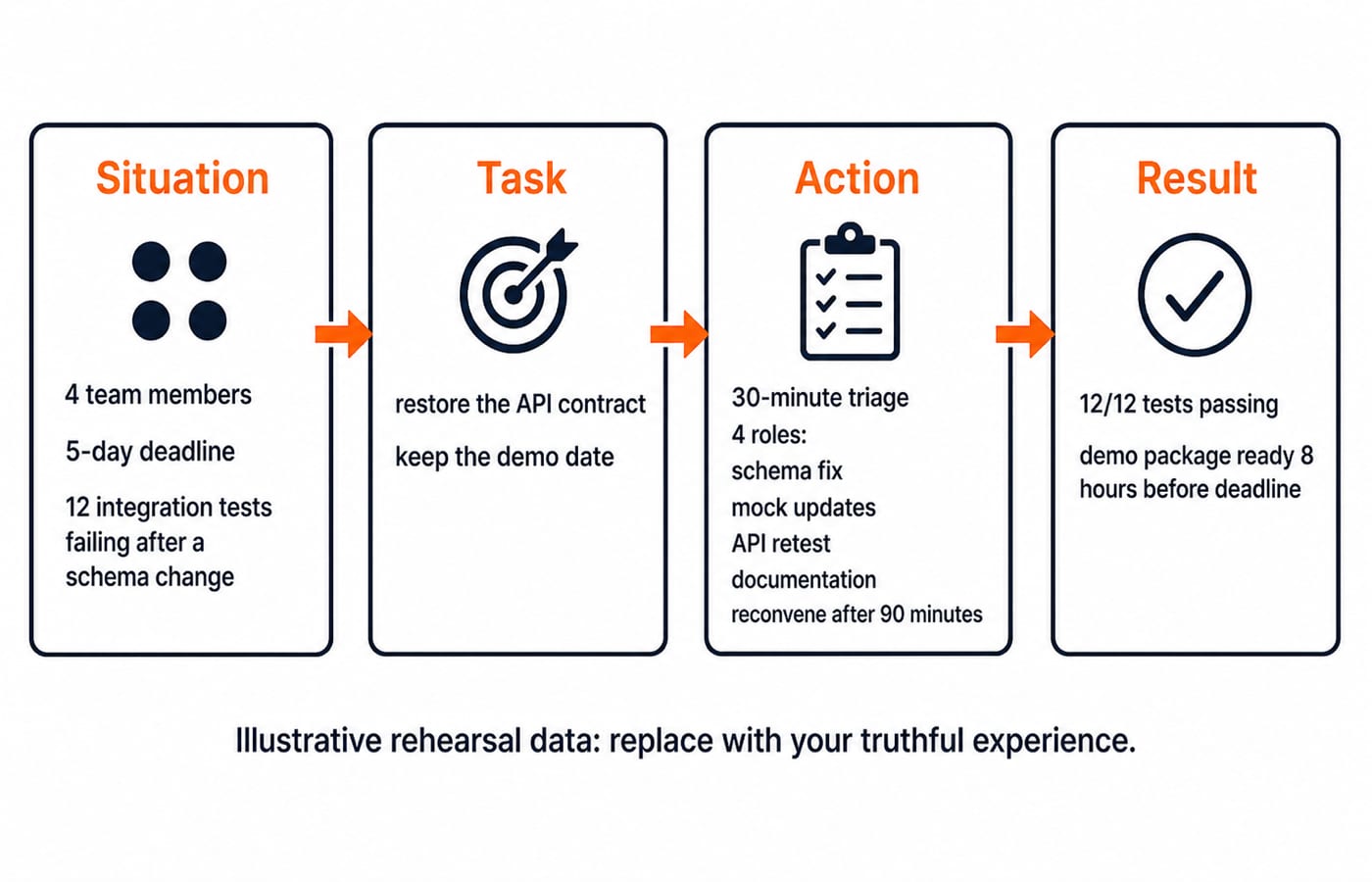
Replace every value and action with truthful evidence; never claim this fictional case as your history.
What weakens otherwise correct answers?
Mistake | What goes wrong | What to do instead |
|---|---|---|
Claiming a fixed Wipro process without current official evidence | May conflict | Follow the invitation |
Presenting a team project as solo work | Ownership blurs | Separate contributions |
Reciting a definition without an example | Understanding unclear | Add example |
Coding silently | Reasoning hidden | Narrate choices |
Skipping the dry run | Errors survive | Trace input |
Giving a memorised HR script | Sounds generic | Use real evidence |
Blaming a teammate | Avoids ownership | Describe your response |
Inventing company facts | Trust weakens | Use role material |
Giving a work-condition answer that contradicts the current invitation | Answer conflicts | Follow the invitation |
Run a 12-minute mock: 2 minutes project, 4 minutes code and dry run, 2 minutes SQL, 2 minutes CS, and 2 minutes HR. Record it. Check the opening answer, numbers and personal claims. For feedback, consider the Interview & Resume Preparation Course.
Wipro interview questions in the shortest useful form
Know one project end to end. Pair CS definitions with examples and limits. State coding assumptions before tracing. Calculate SQL output. Keep HR answers truthful and role-linked. Your invitation controls the sequence.
Next, solve [7,3,7,2,3] -> 2 without notes, then answer one project and one HR prompt aloud. For broader preparation, Wipro Preparation: Elite NTH, Turbo & WILP is an optional structured route.
Keep learning
Accenture Coding Questions: 4 Patterns with Solved Dry Runs
Stop memorising company-question lists. Learn four reusable coding patterns through precise examples involving strings, arrays, digits, and matrices.
Updated 2 Oct 20265 min readCompany-Specific Prep
Accenture Placement Preparation: 4-Week, 56-Hour Study Plan
Turn four preparation lanes into a practical weekly calendar. Start with a baseline, move hours towards your errors, and recover missed sessions without cramming.
Updated 27 Sep 20265 min readCompany-Specific Prep
Capgemini Interview Questions: Technical and HR Rounds with Model Answers
Practise clear technical and HR answers through Java, SQL, a coding trace and one consistent project story. Each example shows what to say and how to support it.
Updated 25 Sep 20265 min readCompany-Specific Prep
Capgemini Drive Mistakes: Stage-by-Stage Rejection Risks and Fixes
Diagnose the controllable evidence gaps behind common Capgemini drive risks. Repair your CV, timed practice, code traces, project proof and behavioural stories with worked drills.
Updated 24 Sep 20266 min readCompany-Specific Prep