OS Types & Evolution MCQs: 12 Solved Questions with Explanations
Solve 12 published OS Types & Evolution questions. Each answer identifies the clue that separates batch, multiprogramming, time sharing and other OS models.
KnowledgeGate Team
Exam prep & CS education
Updated 25 Sep 20268 min read83 views
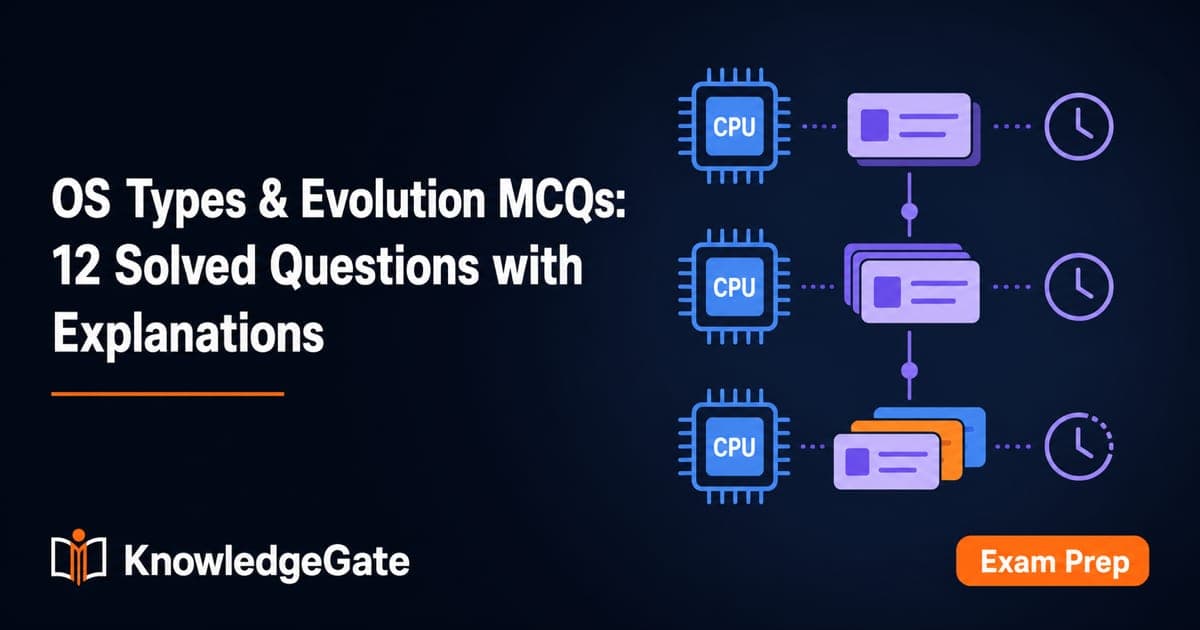
OS-type questions often hide the deciding clue in one phrase: fixed time constraint, multiple jobs in memory, multiple users, or sharing files across a network. Similar labels can describe different scheduling goals, users and machines.
Batch, multiprogramming, time sharing, network, multi-user, real-time, embedded and multiprocessor systems are distinct OS categories, and their evolution can be arranged chronologically. OS/360, spooling and UNIX history form the historical progression in Operating System Evolution MCQs: 12 Solved Questions with Explanations. The deciding contrasts here are network versus multi-user systems, real-time guarantees, embedded constraints and multiprocessor organisation, supported by a CPU-timeline comparison. KnowledgeGate has over 50 questions on OS Types & Evolution available for practice. Answer each one before revealing the explanation, and use the CS Fundamentals page when you want to connect this topic with the wider placement syllabus.
Build one OS-types decision map before solving
Start with the operating goal. Look for sequential jobs without interaction, several jobs in memory to keep the CPU busy, short CPU slices, a timing bound, several users on one machine, or services shared across a network. Then separate scheduling from machine organisation. A multiprocessor has multiple processing units under one OS, while multiprogramming can work on one CPU.
Take three jobs arriving at t = 0. A uses the CPU for 2 ms, waits 4 ms for I/O, then needs 1 ms more. B needs 3 ms; C needs 2 ms. Uniprogramming runs A at 0-2, sits idle at 2-6, finishes A at 6-7, then runs B at 7-10 and C at 10-12. Busy time is 2 + 1 + 3 + 2 = 8 ms; idle time is 4 ms. Utilisation is 8 / 12 x 100 = 66.7%.
Multiprogramming runs A at 0-2, B at 2-5, C at 5-7, and A at 7-8. All 8 ms are busy, so utilisation is 8 / 8 x 100 = 100%, ignoring switching overhead. Time sharing adds a quantum, allowing timer pre-emption for responsiveness.
If the basic goals still overlap in your mind, revise OS Basics MCQs: 12 Solved Questions. For a structured OS study route with practice, use GATE Guidance by Sanchit Sir.
OS types MCQs 1-3: multiprogramming, batch and time sharing
Question 1
Which combination of the following features will suffice to characterize an OS as a multiprogrammed OS? (a) More than one program may be loaded into main memory at the same time for execution. (b) If a program waits for an event such as I/O, another program is scheduled for execution. (c) If a program terminates, another program is scheduled for execution.
A. a only
B. a and b
C. a and c
D. a, b and c
Correct answer: B. a and b.
Statement (a) gives multiple resident programs; (b) makes another run when one blocks. That is why B and C run during A's 2-6 ms wait. Statement (c) also fits sequential processing, so it is not distinctive. The earlier evolution set uses this stem to mark the step beyond simple batch processing; in this decision map, it separates memory residency from the I/O-block switch.
Question 2
Consider the following statements with reference to Batch Processing Systems.
1. They are non-interactive systems.
2. Multiple jobs are submitted and executed sequentially.
A. Only 2
B. Neither 1 nor 2
C. Both 1 and 2
D. Only 1
Correct answer: C. Both 1 and 2.
A batch system collects non-interactive jobs and executes the queue one job after another, so both statements fit. Sequentially describes job flow, not a rule that every batch workload has one processor.
Question 3
Which of the following is an example of a time-sharing operating system?
A. MS-DOS
B. Windows 10
C. macOS
D. UNIX
Correct answer: D. UNIX.
UNIX is the classic time-sharing answer: users or processes receive short CPU turns for interaction. Batch jobs are non-interactive, while exams commonly treat MS-DOS as single-user and single-tasking. The earlier evolution set uses the same stem as the classical time-sharing example; here, the deciding clue is short CPU turns for interaction rather than a familiar desktop-system name.
OS types MCQs 4-6: single-tasking, network and multi-user systems
Question 4
Which of the following type of operating systems does not need CPU scheduling?
A. Multi-Tasking operating systems
B. Time-Sharing operating system
C. Single-User Single-Tasking operating systems
D. Single-User Multi-Tasking operating systems
Correct answer: C. Single-User Single-Tasking operating systems.
CPU scheduling chooses among ready tasks. This simplified model has only one eligible user task. Multitasking and time-sharing systems need scheduling because several runnable tasks compete for the CPU.
Question 5
An operating system that helps in sharing files across a network is known as ______.
A. Network Operating System
B. Real Operating System
C. Time Operating System
D. Coupling Operating System
Correct answer: A. Network Operating System.
Sharing files across a network identifies a network OS, which manages shared resources and access. Real-time concerns deadlines; the other labels are not standard OS types here.
Question 6
The term "multi-user" in an OS context refers to:
A. An OS that can execute multiple programs simultaneously
B. An OS that supports multiple users working on the same machine
C. An OS that can only run on multiple computers
D. An OS with a graphical user interface
Correct answer: B. An OS that supports multiple users working on the same machine.
Multi-user counts users. The OS maintains their sessions, permissions and resources. A is concurrency, C suggests distributed computing, and D describes an interface.
OS types MCQs 7-9: multi-user probability and real-time guarantees
Question 7
In a multiuser operating system, 20 requests are made to use a particular resource per hour, on an average. The probability that no request is made in 45 minutes is:
A. e⁻¹⁵
B. e⁻⁵
C. 1 − e⁻⁵
D. 1 − e⁻¹⁰
Correct answer: A. e⁻¹⁵.
For 45 minutes, the Poisson mean is λ = 20 × (45/60) = 15, so P(X = 0) = e⁻¹⁵ ≈ 3.059 × 10⁻⁷. The earlier evolution set derives the zero-arrival formula step by step; here the deciding task is to reject e⁻⁵ for using the wrong interval and 1 − e⁻ˣ for asking about at least one request. This workload calculation does not itself define a multi-user OS.
Question 8
Which type of operating system reads input and reacts within a fixed time constraint?
A. Batch system
B. Quick response time
C. Real-time system
D. Time-sharing system
Correct answer: C. Real-time system.
Fixed time constraint means a timing bound, so real-time is correct. Time sharing seeks responsive interaction without a deadline guarantee. Quick response time is not an OS type.
Question 9
Which of the following statement is true?
A. Hard real time OS has less jitter than soft real time OS
B. Hard real time OS has more jitter than soft real time OS
C. Hard real time OS has equal jitter as soft real time OS
D. None of the above
Correct answer: A. Hard real time OS has less jitter than soft real time OS.
Jitter is variation in actual timing. Hard real-time design requires tighter predictability; soft real-time work tolerates occasional variation. The answer says less jitter, not zero jitter.
OS types MCQs 10-12: embedded systems, multiprocessing and evolution
Question 10
Which of the following is not a requirement of an embedded system?
A. Efficient use of resources
B. Reliability
C. Low power consumption
D. Large size
Correct answer: D. Large size.
Embedded systems have focused, constrained roles, so efficiency, reliability and low power are plausible requirements. Large size is not. Notice the word not in the question.
Question 11
Which of the following statements with respect to multiprocessor system are true?
(A) Multiprocessor system is controlled by one operating system
(B) In Multiprocessor system, multiple computers are connected by the means of communication lines
(C) Multiprocessor system is classified as multiple instruction stream and multiple data stream system
Choose the correct answer from the options given below:
A. (A) Only
B. (A) and (B) Only
C. (A) and (C) Only
D. (B) and (C) Only
Correct answer: C. (A) and (C) Only.
A places multiple processors under one OS. B instead describes networked computers, the distributed-system picture. C matches the usual MIMD classification. Thus A and C are valid.
Question 12
Arrange the following operating systems in correct chronological order of their development:
A. Linux, B. MS-DOS, C. MAC OS, D. Windows
Choose the correct answer from the options given below:
1. D, B, A, C
2. B, C, D, A
3. A, B, C, D
4. B, A, D, C
A. 1
B. 2
C. 3
D. 4
Correct answer: B. 2.
The intended sequence is MS-DOS, MAC OS, Windows, Linux: B, C, D, A. It is line 2, represented by outer option B. Decode the line numbers before matching letters.
Audit the five OS-type traps before counting your score
Pair | Deciding clue | What the wrong option confuses |
|---|---|---|
Batch vs multiprogramming | Non-interactive sequential jobs vs another resident job running during I/O | Job flow with CPU utilisation |
Multiprogramming vs time sharing | CPU utilisation on blocking vs timer quantum for responsiveness | Blocking switches with pre-emptive turns |
Multi-user vs multitasking | Number of users vs number of active tasks | User sessions with process concurrency |
Real-time vs fast | Specified timing bound vs good average response | A guarantee with a performance preference |
Multiprocessor vs distributed | Multiple processors under one OS vs multiple computers linked by communication lines | Processing units with networked machines |
Try this 20-second routine: underline the noun being counted, classify the clue as users, jobs, CPUs, computers or deadlines, then reject options from another column. Operating Systems for GATE then connects these types to scheduling, deadlocks and memory.
Short version and the next practice step
Keep this recall chain: batch -> non-interactive queue, multiprogramming -> switch when a job blocks, time sharing -> short pre-emptive turns, network OS -> shared network resources, multi-user -> several user sessions, real-time -> timing bound, embedded -> focused constrained system, multiprocessor -> several processors under one OS.
Retry every missed item and state the deciding clue before reading its options. Then solve Process Management & Process States MCQs, where the scheduling distinction becomes process-state reasoning. For interview-focused OS revision alongside DBMS and Computer Networks, continue with Computer Science Fundamentals for Placements by Sanchit Sir. Your next action is simple: close this page, write the eight-part recall chain once, and answer the missed questions again.
Keep learning

Segmentation and Hybrid MCQs: 10 Solved OS Questions with Explanations
Solve ten memory-management MCQs, then check the keyed answers, short reasoning paths, distractor traps, and worked address calculations.
Updated 3 Oct 20267 min readOperating System MCQs

Paging and TLB MCQs: 12 Solved Questions with Step-by-Step Explanations
Solve 12 Paging and TLB MCQs in a sequence that builds from page-table basics to address splits, TLB coverage, timing and fragmentation.
Updated 28 Sep 20268 min readOperating System MCQs

Multilevel Paging MCQs: 12 Solved Questions with Explanations
Solve 10 MCQs and two NATs on multilevel paging. Each answer works through the address bits, table capacity or access-time path that decides the result.
Updated 24 Sep 20268 min readOperating System MCQs

LOOK and C-LOOK Algorithm MCQs: 10 Solved Questions with Explanations
Solve 10 LOOK and C-LOOK MCQs, from core definitions to complete service-order and seek-distance calculations, with a fresh explanation for every answer.
Updated 22 Sep 20267 min readOperating System MCQs