Process Management and Process States MCQs: 12 solved questions
Process management and process states MCQs for GATE, DSSSB and PSU exams: the process lifecycle, legal state transitions, the PCB and TCB, and the schedulers.
KnowledgeGate Team
Exam prep & CS education
Updated 25 Jul 20266 min read92 views
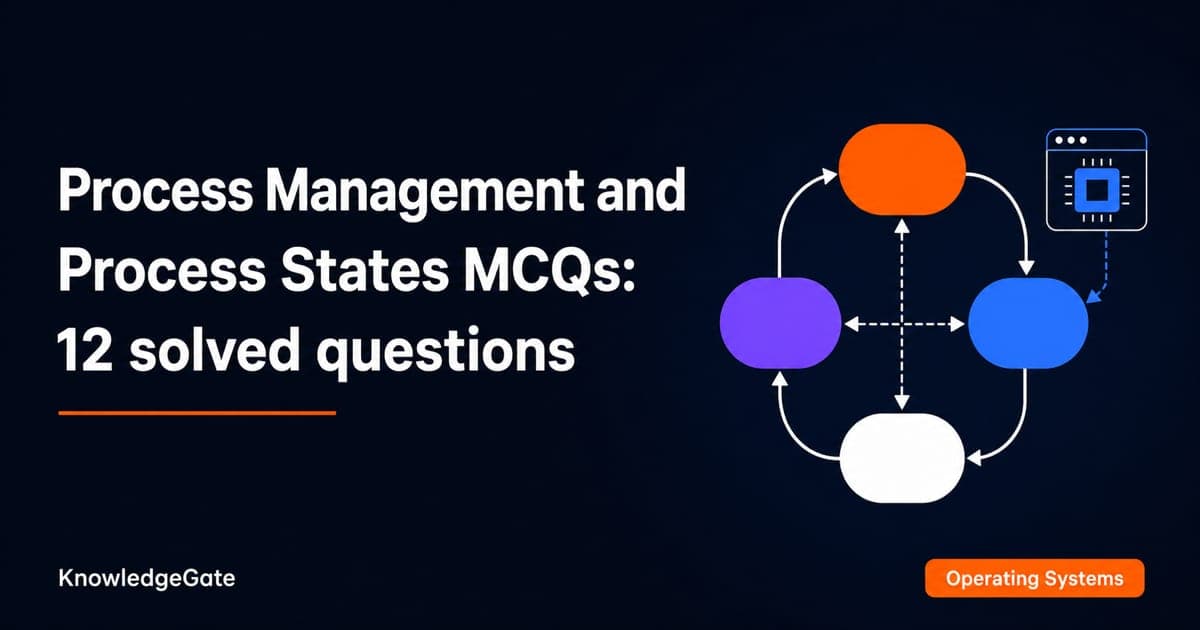
Process management is the foundation the rest of Operating Systems is built on, and examiners treat it that way. The reliable question types are compact: name the standard process states, decide which state transitions are legal, say what the operating system records about each process and each thread, and tell the three schedulers apart. GATE probes the transition diagram and what a Running-to-Ready edge implies; DSSSB, CDAC CCAT and PSU papers reuse the state definitions almost word for word.
Each question below carries the paper it came from and the year. Attempt it before you read the answer, then check your reasoning against the explanation. The full theory sits in the process management learn module.
Related reading: Process lifecycle MCQs and CPU scheduling.
Process states and the lifecycle
Q1. Which of the following is NOT a process state? (BEL 2023)
(a) Ready
(b) Start
(c) New
(d) Running
Answer: (b) Start.
The standard process lifecycle runs through New, Ready, Running, Waiting or Blocked, and Terminated. New means the process is being created, Ready means it is waiting for the CPU, and Running means it is executing. "Start" is not one of these named states, so it is the odd one out.
Q2. In which state is the process waiting to be assigned to a processor? (CDAC CCAT 2017)
(a) New
(b) Running
(c) Waiting
(d) Ready
Answer: (d) Ready.
A process in the Ready state has everything it needs except the CPU, and it sits in the ready queue until the scheduler dispatches it. New means it is still being created, and Waiting means it is blocked on some event such as I/O. Only Ready describes a process that is prepared to run the moment a processor frees up.
Q3. Match the process states with their definitions: I New, II Running, III Ready against 1 waiting to be assigned to a processor, 2 instructions are being executed, 3 the process is being created. (DSSSB 2024)
(a) I-3, II-1, III-2
(b) I-1, II-3, III-2
(c) I-1, II-2, III-3
(d) I-3, II-2, III-1
Answer: (d) I-3, II-2, III-1.
New pairs with "being created", Running pairs with "instructions are being executed", and Ready pairs with "waiting to be assigned to a processor". Lining those up gives I-3, II-2 and III-1. Keeping New and Ready distinct is the trap the other options exploit.
Q4. Which of the following is NOT a process state? (CDAC CCAT 2025)
(a) New
(b) Ready
(c) Running
(d) Compiled
Answer: (d) Compiled.
New, Ready and Running are all genuine states in the process model. "Compiled" describes a stage in building a program, not a runtime state a process occupies. Compilation happens before execution ever begins, so it never appears in the lifecycle. Q1 planted the same trap with a control-flow word; here the decoy is a build-time one.
Q5. When a program is terminated abnormally, it is called ______. (DSSSB 2022)
(a) End
(b) Stop
(c) Abort
(d) Terminate
Answer: (c) Abort.
Abort is the specific term for a program ending abnormally, whether from an error or a forced kill. Normal completion is just termination, and End and Stop are informal words with no precise meaning here. The distinction between a clean exit and an abort is what the question tests.
Q6. Which of the following process state transitions is not possible in a typical operating system? (MPPSC 2025)
(a) Running to Ready
(b) Waiting to Ready
(c) Ready to Waiting
(d) Running to Waiting
Answer: (c) Ready to Waiting.
A process becomes blocked only while it is actually running and then requests something like I/O, so the Waiting state is entered from Running, not from Ready. A ready process has made no such request yet, so it cannot jump straight to Waiting. The other three transitions are all part of the normal five-state model.
The process control block and the thread control block
Q7. Process Control Block of a process in an Operating System does not contain: (CDAC CCAT 2019)
(a) Process number
(b) Process state
(c) Program counter
(d) Program name
Answer: (d) Program name.
The PCB is the kernel's per-process record: it holds the process number, the current state, the program counter, register values and scheduling information, everything needed to pause the process and resume it later. The program's name plays no part in that bookkeeping, so it is the field that does not belong.
Q8. Data structure maintained by the operating system to maintain information for each thread within a process is known as ______. (DSSSB 2021)
(a) Process Control Block
(b) Thread Control Block
(c) Symbol Table
(d) Scheduling Queue
Answer: (b) Thread Control Block.
Each thread gets its own Thread Control Block recording its thread ID, program counter, registers and stack pointer, which is what lets the OS switch between threads inside one process. The PCB describes the process as a whole, a symbol table belongs to compilers, and a scheduling queue holds processes waiting to run rather than describing one.
Schedulers, preemption and multitasking
Q9. Match the schedulers with their functions: I Long-term scheduler, II Medium-term scheduler, III Short-term scheduler against A Swapping, B Job scheduling, C CPU scheduling. (DSSSB 2018)
(a) I-C, II-A, III-B
(b) I-A, II-B, III-C
(c) I-B, II-A, III-C
(d) I-A, II-C, III-B
Answer: (c) I-B, II-A, III-C.
The long-term scheduler admits jobs into the system, so it pairs with job scheduling. The medium-term scheduler suspends and resumes processes by swapping them out of and back into memory, and the short-term scheduler picks the next ready process to receive the CPU. Lining those up gives I-B, II-A and III-C.
Q10. A process state transition diagram that includes a direct Running to Ready transition, in addition to the usual dispatch and block edges, is representative of (GATE 1996)
(a) a batch operating system
(b) an operating system with a preemptive scheduler
(c) an operating system with a non-preemptive scheduler
(d) a uni-programmed operating system
Answer: (b) an operating system with a preemptive scheduler.
The telling edge is Running back to Ready, which means the OS can pull a process off the CPU before it voluntarily gives it up, for example when its time slice expires. Only a preemptive scheduler produces that transition. A non-preemptive system would show a process leaving Running only to block or finish, never to be forced back to Ready.
Q11. What is the name of the technique in which the operating system executes several programs concurrently by switching back and forth between them? (BEL 2007)
(a) Partitioning
(b) Multitasking
(c) Windowing
(d) Paging
Answer: (b) Multitasking.
Multitasking is the illusion of concurrency created when the CPU rapidly switches among several programs. Partitioning and paging are memory-management ideas, and windowing belongs to the user interface. The rapid switch-among-programs description points squarely at multitasking.
Q12. Which statements about process states are true? (i) A running process moves to the ready state when it is interrupted. (ii) A process moves to the waiting state when it has completed its execution. (DSSSB 2022)
(a) Only (i)
(b) Only (ii)
(c) Both (i) and (ii)
(d) Neither (i) nor (ii)
Answer: (a) Only (i).
Statement (i) is correct: an interrupt or an expired time slice sends a running process back to the ready queue so others can use the CPU. Statement (ii) is wrong, because a process that finishes execution moves to the terminated state, not to waiting. Waiting is for a process blocked on an event, so only (i) holds.
How process management is examined
Examiners come at this topic from three angles. The state definitions and legal-transition questions anchor most papers (Q1 to Q6); the control-block items ask what the operating system must record for each process and each thread (Q7 and Q8); and the scheduler, preemption and multitasking questions round out the section (Q9 to Q12). If a transition question stumps you, redraw the five-state diagram from memory and check that Waiting is only ever entered from Running.
For the theory behind every answer, work through the process management learn module and place the topic in context with our Operating Systems for GATE breakdown. GATE aspirants get the full OS sequence inside GATE Guidance by Sanchit Sir; more solved sets across the rest of the syllabus sit on the GATE CS category page. Solve, review the ones you missed, and return to the transition questions a week later.
Keep learning
Process Basics and PCB MCQs: 12 Solved Questions with Explanations
Solve 12 Process Basics and PCB questions, then use each explanation to repair the exact concept boundary behind the correct option.
Updated 20 Oct 20268 min readOperating System MCQs

Critical Section MCQs: 12 Solved Questions on Race Conditions and Mutual Exclusion
Practise critical-section MCQs on race conditions, mutual exclusion, Bakery ordering, stale writes and priority inversion, with explanations and two complete traces.
Updated 16 Oct 20268 min readOperating System MCQs
Hardware Synchronization MCQs: 10 Solved Test-and-Set, Spinlock and Barrier Questions
Attempt 10 hardware synchronization questions, then check concise explanations of atomic instructions, busy waiting, lock failures and barrier races.
Updated 12 Oct 20267 min readOperating System MCQs
SJF and SRTF Scheduling MCQs: 11 Solved Questions with Step-by-Step Explanations
Solve 11 SJF and SRTF questions with ready-queue decisions, Gantt traces, waiting-time calculations and checked explanations.
Updated 7 Oct 20267 min read81 viewsOperating System MCQs