Computer Evolution and History MCQs: 12 Solved PYQs with Explanations
Test the facts that computer-history questions often mix up: pioneers, machine acronyms, chronology and the hardware technology behind each generation. Each of these 12 PYQs includes its answer and a clear explanation.
KnowledgeGate Team
Exam prep & CS education
Updated 29 Jul 20267 min read216 views
Computer-history questions look like pure recall, but most wrong answers come from mixing up a person, a named machine, a year and the switching technology that defines a generation. Babbage and Cray, EDVAC, ENIAC and UNIVAC, a six-point machine chronology and the first four hardware generations are exactly where those mix-ups happen, and the 12 previous-year questions here sit on those four fault lines. Attempt each one before reading its explanation. Every question stem is a link to its own practice page, so you can reattempt it later without hunting for it.
1. Computer evolution timeline and generation map
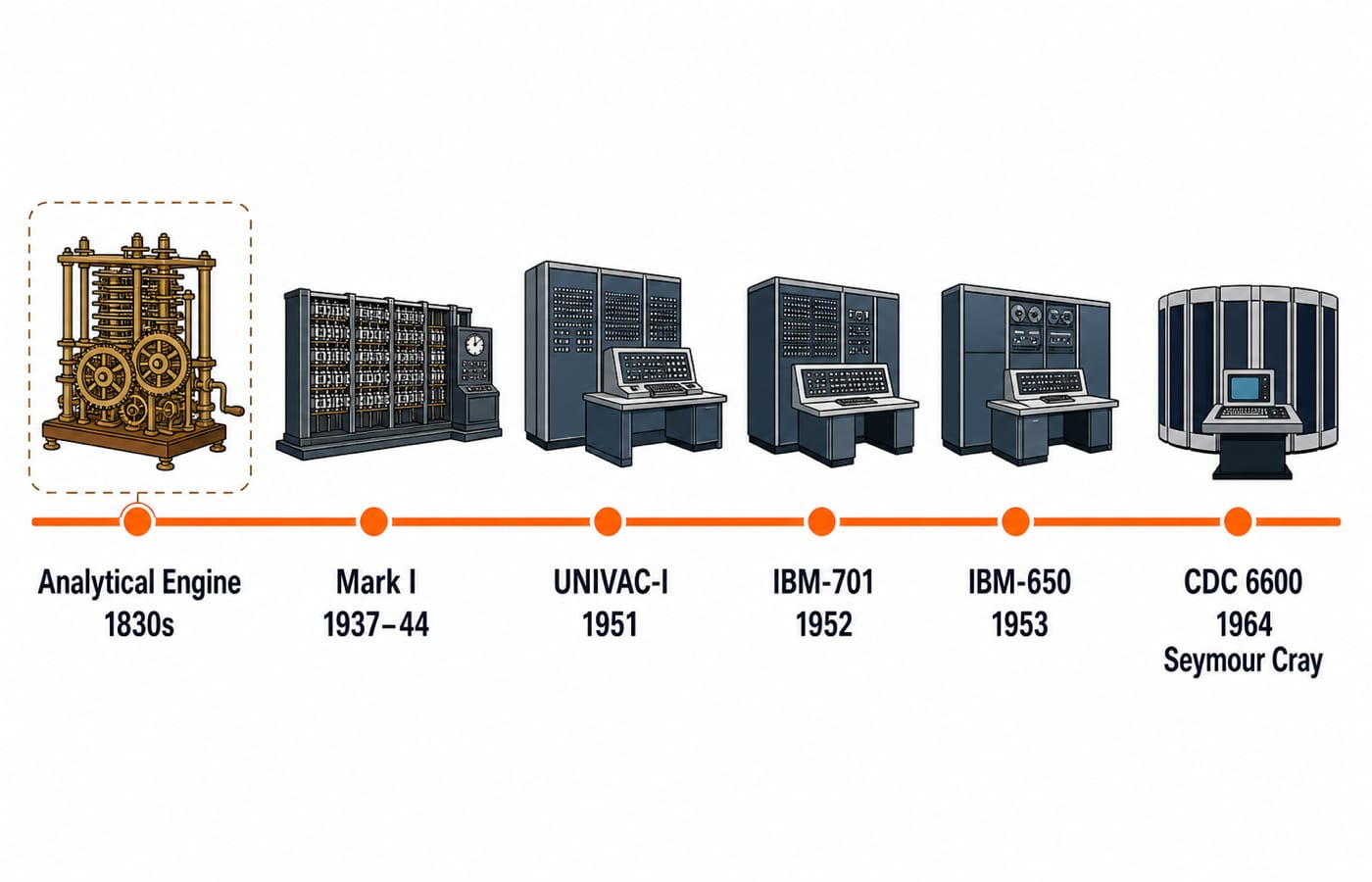
Start with these anchors. They turn a loose collection of names into one ordered story.
Era or milestone | Defining name or technology | Memory cue |
|---|---|---|
Mechanical precursor | Analytical Engine, designed by Charles Babbage | Babbage means Analytical Engine |
1937-44 | Mark I | Earliest dated system in Question 7 |
1951 | UNIVAC-I | Universal Automatic Computer |
1952 | IBM-701 | One year after UNIVAC-I |
1953 | IBM-650 | One year after IBM-701 |
1960s | Seymour Cray's CDC supercomputer work, including CDC 6600 in 1964 | Cray means CDC 6600 |
Generation, however, is determined by the main hardware technology, not a software language or application area.
Generation | Main hardware technology | Memory cue |
|---|---|---|
First | Vacuum tubes or valves | Tube |
Second | Transistors | Transistor |
Third | Integrated circuits, specifically SSI and MSI | IC |
Fourth | VLSI-enabled microprocessors | Processor on a chip |
If you want to connect this history to how machines encode values, use Number Systems and Base Conversions Explained as an optional foundation.
2. Computer pioneers and mechanical precursors: Questions 1-3
Question 1, UP Police 2023
A. Analytical Engine
B. ENIAC
C. UNIVAC 1
D. Colossus
Answer: A. Analytical Engine. Babbage proposed it as a programmable mechanical machine with a processing unit called the mill, memory called the store, and punched-card control. ENIAC, UNIVAC 1 and Colossus were later electronic machines, so none is the mechanical precursor asked for.
Question 2, Bihar STET 2019
Question: Who is known as the father of the computer?
A. Alan Turing
B. Seymour Cray
C. Ada Lovelace
D. Charles Babbage
E. Bill Gates
Answer: D. Charles Babbage. The title follows from his Difference Engine and Analytical Engine designs, especially the latter's separation of calculation, storage and program control. Turing shaped computation theory, Lovelace wrote an early Analytical Engine algorithm, Cray led supercomputer design, and Gates is associated with personal-computer software.
Question 3, UP Police 2013
Question: Who designed supercomputers in 1960s at Control Data Corporation (CDC)?
A. Alan Turing
B. Charles Babbage
C. Tim Berners-Lee
D. Seymour Cray
Answer: D. Seymour Cray. He was the chief designer of the CDC 6600, introduced in 1964 at Control Data Corporation. Babbage belongs to nineteenth-century mechanical design, Turing to foundational computability, and Berners-Lee to the World Wide Web in 1989.
3. EDVAC, ENIAC, UNIVAC and early-machine chronology: Questions 4-7
Question 4, DSSSB 2021
Question: What is the full form of ‘The EDVAC’, the first generation computer?
A. The electronic discrete variable automatic computer
B. The electronic discrete value automatic computer
C. The electronic discrete variable automatic calculator
D. The electronic digital variable automatic calculator
Answer: A. The electronic discrete variable automatic computer. EDVAC expands to Electronic Discrete Variable Automatic Computer. Remember that DV is Discrete Variable and the final C is Computer, which eliminates the altered words in the other options.
Question 5, DSSSB 2021
Question: What is the full form of ‘The ENIAC’ the first all electronics computer?
A. The electronic numerical integrator automatic calculator
B. The electronic numerical integrator automatic computer
C. The electronic numerical integrator and computer
D. The electronic numerical integrator and calculator
Answer: C. The electronic numerical integrator and computer. ENIAC expands to Electronic Numerical Integrator and Computer. Its A means "and", not "automatic", while its C means "computer", not "calculator".
Question 6, Bihar STET 2019
Question: UNIVAC is -
A. Universal Automatic Computer
B. Universal Array Computer
C. Unique Automatic Computer
D. Unvalued Automatic Computer
E. Unified Automated Control
Answer: A. Universal Automatic Computer. UNIVAC expands to Universal Automatic Computer, and UNIVAC-I supplies the 1951 point used in the next question. Array, unique and unified sound technical, but they are not part of the historical name.
Question 7, UGC NET June 2025
A. A–III, B–IV, C–II, D–I
B. A–II, B–III, C–I, D–IV
C. A–I, B–II, C–IV, D–III
D. A–III, B–I, C–II, D–IV
Answer: A. A–III, B–IV, C–II, D–I. Order the machines first: Mark I (1937-44) -> UNIVAC-I (1951) -> IBM-701 (1952) -> IBM-650 (1953). Mapping those years back to the lists gives A-III, B-IV, C-II, D-I, so the result comes from chronology rather than a memorised code.
4. Computer generation sequence: Question 8
Question 8, UGC NET December 2023
A. (D), (C), (B), (A)
B. (D), (C), (A), (B)
C. (C), (D), (A), (B)
D. (B), (A), (C), (D)
Answer: B. (D), (C), (A), (B). Write the ladder before translating the letters: first is vacuum tubes (D), second is transistors (C), third is integrated circuits (A), and fourth is microprocessors (B). Option A is wrong because it places the microprocessor before integrated circuits.
5. First-generation and second-generation computers: Questions 9-10
Question 9, UP Police 2018
Question: The first generation of computer was based on
A. VLSI microprocessor
B. Integrated Circuit
C. Vacuum tubes
D. Transistor
Answer: C. Vacuum tubes. Vacuum tubes were the electronic switching components associated with first-generation machines. The distractors move forward through the ladder: transistor is second generation, integrated circuit is third, and VLSI microprocessor is fourth.
Question 10, DSSSB 2021
Question: Which generation of computer used transistor?
A. First
B. Second
C. Third
D. Fourth
Answer: B. Second. Individual transistors replaced first-generation vacuum tubes and define the second generation. The two-boundary check fixes their position: transistors come after vacuum tubes but before integrated circuits.
6. Third-generation and fourth-generation computers: Questions 11-12
Question 11, Bihar STET 2019
Question: Which of the following IC types were used in third-generation computers?
A. SSI
B. MSI
C. LSI
D. Both (A) and (B)
E. VLSI
Answer: D. Both (A) and (B). SSI means Small Scale Integration and MSI means Medium Scale Integration, and both are the integrated-circuit densities that define the third generation. LSI and VLSI sit later in the progression, so choosing only SSI or only MSI is incomplete.
Question 12, UGC NET September 2024
A. Transistor based
B. Integrated Circuit (IC) based
C. Vacuum Tube based
D. Microprocessor based
Answer: D. Microprocessor based. The fourth generation is identified by the microprocessor, with the CPU integrated on a chip through large-scale integration. Chronological elimination leaves it after the vacuum tube, transistor and integrated circuit technologies of the first three generations.
Next, Pipelining in Computer Architecture Explained shows how later processor designs improve instruction throughput. Pipelining itself does not define any of the four generations.
7. Computer evolution and history MCQ patterns that repeat
Use four exam moves to classify the question before solving it:
Identify a contributor from a machine or institution in Questions 1-3.
Expand an acronym exactly in Questions 4-6.
Place named systems on a timeline in Question 7.
Map the generation number to its switching technology in Questions 8-12.
The compact trap list is just as useful: ENIAC uses "and", EDVAC uses "Discrete Variable", and UNIVAC begins with "Universal". Mark I carries the dates 1937-44. The first-to-fourth order is vacuum tube -> transistor -> integrated circuit -> microprocessor, while SSI plus MSI together form the third-generation answer.
The GATE CS Exam Preparation Courses & Test Series category is the wider route from these recall questions into Computer Organization and the rest of the syllabus.
8. Computer evolution and history: the short version and next step
Write this retrieval chain from memory: Babbage -> Analytical Engine, Cray -> CDC 6600, Mark I -> 1937-44, UNIVAC-I -> 1951, IBM-701 -> 1952, IBM-650 -> 1953. Under it, write vacuum tube -> transistor -> IC -> microprocessor. Then reattempt Questions 3, 7, 8 and 11 without looking, because together they test person, year, sequence and integration level.
After the historical map, Memory Hierarchy and Virtual Memory Explained is a useful next architecture lesson with worked reasoning. For a structured route through Computer Organization lessons and question practice, continue with GATE Guidance by Sanchit Sir.
Keep learning
Instruction Formats and Addressing Modes MCQs: 12 Solved Cross-Concept Questions
Solve 12 cross-concept COA questions that connect addressing-mode choices with PC rules, memory references, opcode fields, and byte-aligned instructions.
3 Oct 20267 min readComputer Organization MCQs
Interrupt-Driven I/O MCQs: 12 Solved Questions with Explanations
Attempt 12 previous-year interrupt-driven I/O questions, then check each answer with a concise explanation. The set covers ISR order, vectoring, priority, and CPU-time numericals.
28 Sep 20268 min readComputer Organization MCQs
Bitmap and Pixmap MCQs: 12 Solved Pixel Depth and Memory Questions
Build a reliable pixel-memory method through 12 live MCQs covering bitmaps, pixmaps, lookup tables, uncompressed storage, refresh rates, masks, and dithering.
Updated 25 Sep 20267 min readComputer Organization MCQs
Assembly & Assembler Design MCQs: 11 Solved PYQs Explained
Attempt 11 published PYQs on assembler directives, language levels, tables, register-pair instructions, debugging and fixed-width arithmetic, then check each worked explanation.
Updated 24 Sep 20267 min readComputer Organization MCQs