Off-Campus Placement Strategy for 2026 Graduates: Drives, Portals and Referrals That Work
Turn off-campus hiring into a weekly operating system that keeps drives, portals, referrals, follow-ups, and skill preparation moving together.
KnowledgeGate Team
Exam prep & CS education
9 Aug 20267 min read
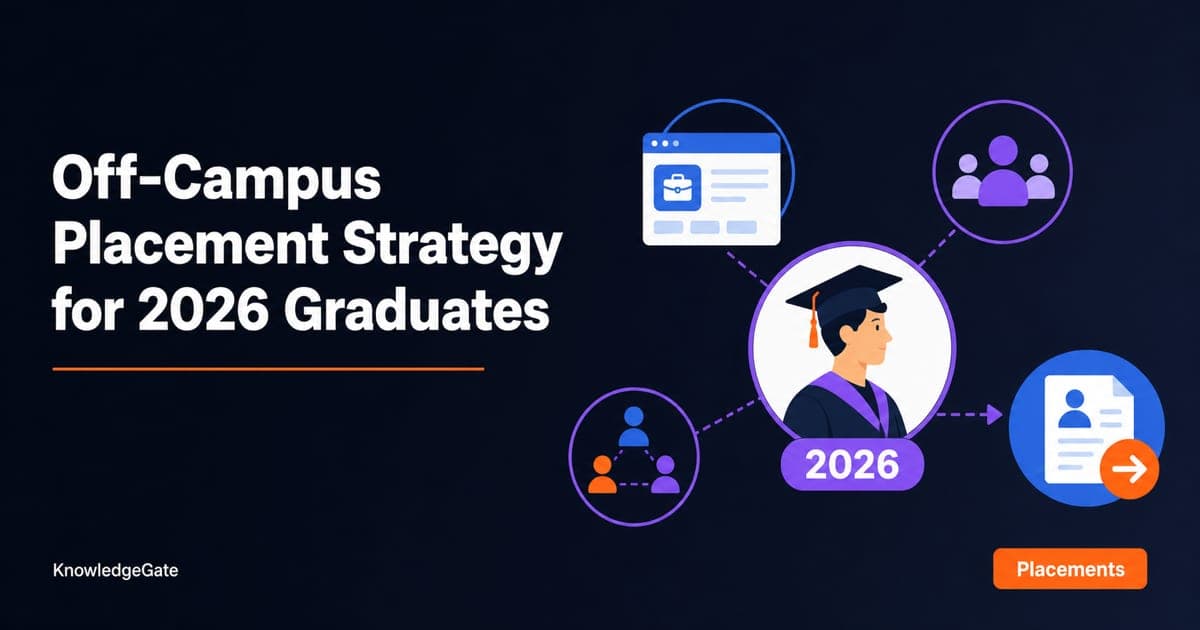
If your campus season was thin, or you have already graduated, off-campus hiring is a full channel rather than a fallback. Applying on one portal for a few days and hearing nothing does not mean the market has closed.
Off-campus hiring runs on three channels at once: open drives, portal and career-page applications, and referrals. Held together by a weekly target of 8 to 10 applications, a six to eight hour search block, and a separate skill block, they keep producing through a quiet fortnight.
The three off-campus channels and what each is for
Off-campus hiring reaches you through three different doors. Each door has a different gate, so relying on only one leaves avoidable gaps.
Channel | What it offers | Main gate | Your job |
|---|---|---|---|
Open drives and hiring challenges | A concentrated intake window | Registration deadline, aptitude and coding rounds | Track the calendar and prepare for timed tests |
Job portals and career pages | A steady stream of role-specific openings | Resume relevance, keywords and recruiter screening | Apply early with a role-matched resume |
Referrals | A warmer route to a listed vacancy | A credible connection and a clear fit | Make a specific, easy-to-forward request |
Mass-hiring drives provide many opportunities in one intake window. Portals create a regular pipeline, though many applications receive no reply. Referrals can improve a relevant application's chance of notice. Run all three in parallel; start referral conversations before portals fail.
A single drive often stacks aptitude, coding, communication, and interview stages inside one fortnight. Accenture placement preparation for 2026 walks through one such sequence: cognitive, technical, and coding rounds, and the study plan each needs.
A weekly application cadence you can sustain
Start with a target of 8 to 10 fresh applications per week. A workable mix is five portal or company-career-page applications, two or three referral requests, and one or two open-drive registrations. In a week with no live drive the total lands at seven or eight, and that is a normal week, not a failed one. Adjust the count to your course load or job, but preserve the mix.
Reserve six to eight weekly hours for finding roles, checking eligibility, tailoring resumes, sending messages, recording applications, and following up. Keep them separate from coding and interview preparation: job searching can quietly replace the work needed to clear assessments.
Use one simple tracker with these columns:
company and role;
job link or requisition ID;
channel used;
date applied;
referral contact, if any;
current status;
next follow-up date.
Review the tracker at the same time each week. Because long silences are normal, judge the process by completed cadence, not by whether a recruiter replied within two days.
Drives and hiring challenges follow a calendar
An open drive is different from an ordinary job listing. It has a registration window, a scheduled assessment, and often a sequence of elimination rounds. Missing the registration date can cost you the entire opportunity, however prepared you are.
Keep a weekly list of recurring company drives, open tests, and challenges matching your graduation year and eligibility. When a window opens, read the current notice, register promptly, save the confirmation, and calendar every round. Do not use an old video or forwarded message for current eligibility rules.
Eligibility turns on your passing-out year before it turns on anything else. Drive notices and portal filters name the batches they accept, so a 2026 graduate should read that line first and skip a form that names only 2027, or only 2024 and 2025. Two related lines cost the same minute: whether an active backlog or arrear is allowed, and whether a minimum aggregate is set. If you finished in 2026 and have been interning, freelancing, or working since, you also qualify for many zero to one year experience listings, which draw a far smaller field than the fresher tag.
Treat the timed aptitude and coding round as the first real filter. Your reusable drive kit should include:
one clean, accurate resume;
a reliable device and test environment;
comfort with aptitude under time pressure;
a coding baseline in one language;
revised CS fundamentals for the interview that follows.
You do not need to rewrite your story for every mass drive. You need to arrive before the deadline and clear the stated gates.
Portals: pass relevance before a human reads
Job portals reward freshness and fit. Set saved searches on three or four suitable platforms, including company career pages. Search for a tight role family such as graduate software engineer, trainee developer, QA trainee, or analyst instead of using only the word "fresher."
Apply within 24 to 48 hours where possible. Before submitting, mirror the honest language of the job description. If the role asks for Java, REST APIs, SQL, and DSA, those exact terms should be visible in your resume only when you can defend them. A resume that says "programming and databases" may hide a real match from both software screening and a hurried recruiter.
Keep a short note template, then change its role title, relevant project, and two-line fit. Resist spraying applications at roles you plainly do not match. Eight targeted applications with visible evidence beat forty submissions that ignore required skills, location, or graduation criteria.
Before the next batch, work through the 7 placement preparation mistakes freshers make that quietly weaken an otherwise suitable application.
Referrals without spam
A referral works best when it points to a real opening. "Please refer me to anything" gives the other person research work. A role-specific message gives them a simple decision.
Use this sequence:
Find a live role that matches your skills and eligibility.
Find one relevant person at the company, preferably an alumnus, senior, former teammate, or genuine professional connection.
Send the role title and link, two lines on why your experience fits, and a clean resume.
Ask whether they would be comfortable referring you. Leave room for a no.
A useful message is short: "I saw the Graduate Developer role, requisition ABC. My final-year project uses Java and REST APIs, and I have solved DSA problems consistently in Java. If you think the fit is reasonable, would you be comfortable referring me? I have attached a one-page resume."
Send two or three thoughtful asks a week. Follow up once after about a week if the role is still open, then move on. Do not send repeated reminders. A network is built by sharing useful information, thanking people, and helping juniors, not by collecting names to extract favours from.
Preparation makes every channel convert
No sourcing channel can compensate for an uncleared round. Drives commonly need aptitude and coding. Portal and referral interviews may add DSA, CS fundamentals, projects, and role-specific tools. A referral can get a resume noticed, but it cannot answer the interview for you.
Protect a separate weekly skill block of eight to ten hours, kept clear of the six to eight search hours. A workable split is three hours of DSA practice, two on the one language you will write the test in, two on core CS revision (operating systems, DBMS, networks), and one on the single project you must be able to explain at design and debugging level. The Placement Preparation category maps those fundamentals to the tests and interviews that ask for them.
When an assessment arrives, revise the relevant company format, but do not rebuild your preparation from zero. The steady block is what lets you accept a short-notice test without panic.
Your off-campus operating system
At the end of each week, check six things: 8 to 10 suitable applications sent, about five of them through portals, two or three referral asks made, every live drive checked against its registration date, every status and follow-up date updated, and the skill block actually taken. Five out of six is a normal week; two out of six for a fortnight means the cadence, not the market, is the problem.
A missed day or week does not invalidate the system: open the same tracker, review the live roles, and restart the next cycle. Cadence matters more than a perfect streak.
The short version
Keep drives, portals, and referrals open at the same time. Protect a fixed weekly search block, track every next action, tailor for relevance, and build the skills that turn an application into an offer.
Your next step is practical: create the tracker today, save three role searches, list two genuine referral contacts, and schedule your first fundamentals block. Use the Zero to Hero complete CS course when you need a structured path through that technical base. One complete week of this system is more valuable than another week of untracked scrolling.
Keep learning
Resume Checklist: What Must Be Included and What Must Be Left Out
3 Oct 20264 min readPlacement Preparation
LDAP Explained: DNs, Bind, Search Filters, and a Developer Login Flow
Build one LDAP mental model from directory tree to login. Trace a service bind, escaped user search, password-verifying user bind, and group-based role check.
Updated 13 Aug 20265 min readPlacement Preparation
Group Discussion Rounds for Placements: How GD Is Scored and How to Prepare Topics
Speaking more is not the same as scoring more in a GD. Learn what panels observe, how to prepare topic notes, and how to practise useful contributions.
11 Aug 20266 min readPlacement Preparation
Pseudocode Questions for Placements: Solved Traces for Arrays, Strings and Loops
Learn a paper-based trace method for placement pseudocode, then apply it to bubble sort, string reversal, digit reversal and 22 more recurring question shapes.
Updated 7 Aug 20265 min readPlacement Preparation