Freshers memorise definitions, then freeze when an interviewer says, "Dry-run this" or "What does this print?" C sits close to memory, so a strong answer explains what exists, where it lives, and when it changes.
The same 40 keep coming back in two rooms. A college viva examiner points at your own lab program and asks what one line does; a placement-drive panel hands you an unfamiliar snippet and times the reply. Neither is satisfied by a definition.
How C interviews are scored, not just recalled
Interviewers use pointers, memory, and undefined behaviour to test runtime reasoning. They may accept a definition, then change one line and ask for the effect. A viva examiner usually stays inside code you wrote, so the follow-ups land on your own array indexing and your own malloc calls. A drive panel works from a fixed snippet list and marks the predicted output, so a clean rule stated quickly beats a long derivation.
Identify each object's type and lifetime, draw the cells, apply the statement, then state the output. If C does not define an outcome, say undefined behaviour instead of guessing. C is one subject in a longer technical round; Technical interview prep: OS, DBMS, CN and OOP questions freshers face covers the rest of that list.
Pointers and memory: the core 10
What does a pointer hold? An address of an object or function of a compatible type, or a null pointer value that points to no object.
What is a pointer to pointer? A pointer whose target is another pointer, such as
int **pp;*ppis anint *and**ppis anint.What does pointer arithmetic do? Adding one to
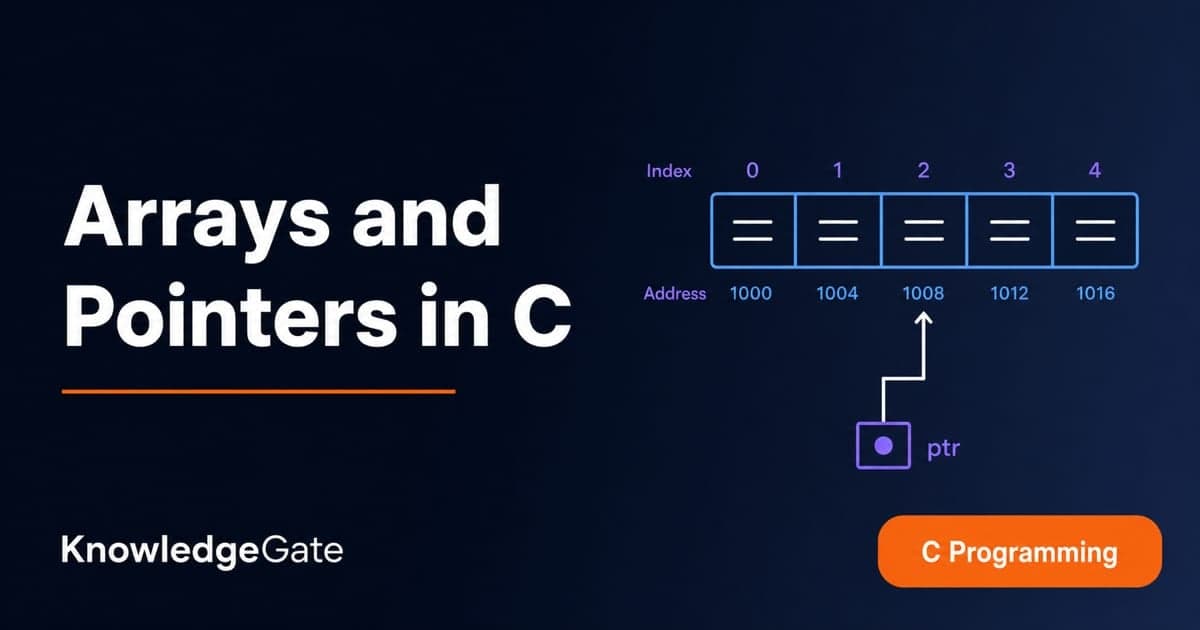
int *padvances by oneint, provided the result stays within the same array object or one past it.What is array-to-pointer decay? In most expressions, an array name converts to a pointer to its first element; important exceptions include operands of
sizeofand unary&.How do
arrand&arrdiffer? They commonly have the same numeric address, butarrdecays to a pointer to the first element while&arrpoints to the entire array and steps by the whole array size.Dangling pointer vs wild pointer? A dangling pointer refers to an object whose lifetime has ended; a wild pointer is uninitialised and holds an indeterminate value.
What is a null pointer? A pointer value guaranteed not to compare equal to the address of any object or function; dereferencing it is undefined behaviour.
What is
void *? A generic object-pointer type that can hold an object address; convert it to an appropriate typed pointer before dereferencing.What is a function pointer? A pointer that stores a function address and can call a function with the matching signature, often used for callbacks.
const int *pvsint * const p? The first prevents changing the pointed value throughp; the second prevents makingppoint somewhere else.
Pointers in C for GATE adds memory diagrams.
Worked example: pass-by-pointer mutation
This is the smallest complete program that separates a value from an address:
#include <stdio.h>

void inc(int *p) {
    (*p)++;
}

int main() {
    int a = 5;
    inc(&a);
    printf("%d\n", a);
    return 0;
}
Trace it in memory:
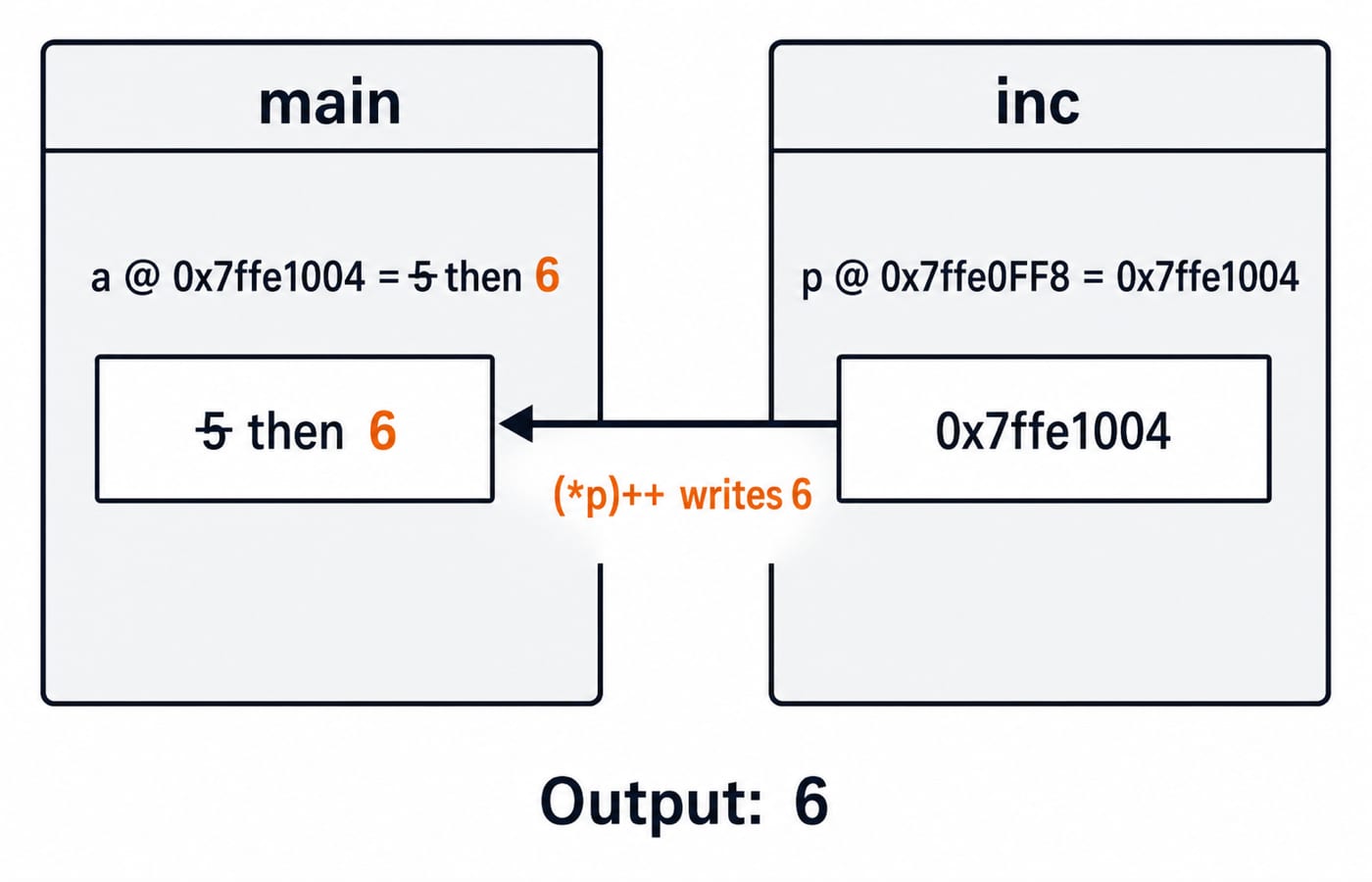
alives inmain's stack frame, say at address0x7ffe1004, holding5.inc(&a)passes that address; insideinc,pholds0x7ffe1004.(*p)++reads the cell reached throughpand writes6to0x7ffe1004.Back in
main,ais now6; the output is6.
If inc took int p by value, a would stay 5 because only a copy would change. Here, the value copied into p is a's address.
Storage, memory layout and lifetime: the core 10
Stack vs heap? Automatic local objects usually have block lifetime and are commonly stack-backed; dynamically allocated objects remain until
freeand come from managed dynamic storage.What does
mallocdo? It allocates an uninitialised byte block and returnsvoid *, or a null pointer on failure.How do
callocandreallocdiffer?callocallocates an array and zero-initialises its bytes;reallocchanges an existing allocation and may move it.Why call
free? It ends the lifetime of allocated storage; using that pointer to access the freed object afterwards is invalid.What is a memory leak? Allocated memory becomes unreachable without being freed, so the program can no longer release or reuse it deliberately.
What is a static local's lifetime? It exists for the entire program and retains its value between calls, although its name remains block-scoped.
staticvsexternat file scope?staticgives internal linkage;externdeclares a name whose definition can have external linkage elsewhere.What causes a segmentation fault? Common causes include invalid dereferences, writing read-only storage, out-of-bounds access, and stack exhaustion; C does not guarantee that particular signal.
sizeofarray vs pointer? In the array's defining scope,sizeof arris the whole array size; after decay or in a function parameter,sizeof pis only the pointer size.Can you modify a string literal or read an uninitialised automatic variable? No safe result is defined: modifying a literal is undefined behaviour, and reading an indeterminate automatic value can also be undefined behaviour.
Language semantics that trip people: the core 10
i++vs++i? Both incrementi; postfix yields the old value while prefix yields the new value.What does
i = i++do? It has undefined behaviour in C because modifications ofiare unsequenced; never offer a numeric answer.How does integer division work? With integer operands, the fractional part is discarded towards zero, so
7 / 2is3.What happens in character arithmetic? A
charis promoted to an integer type before arithmetic, so'A' + 1can be printed as'B'with%con ordinary C implementations.What is implicit type promotion? Narrow integer types commonly promote to
intorunsigned int, and mixed arithmetic then follows the usual conversions.#definevsconst? A macro is token substitution with no C type; aconstobject has a type, scope, and storage semantics.What is the macro argument trap? Write
#define SQR(x) ((x) * (x)); missing parentheses breaks expressions, and passingi++still causes multiple evaluation.Struct vs union size? A struct provides storage for every member plus padding; a union provides shared storage large and aligned enough for its largest-demanding member.
Name two useful bit tricks. XOR can swap two distinct integer objects without a temporary, and positive
nis a power of two when(n & (n - 1)) == 0.Switch fallthrough,
break, andcontinue? A case falls through withoutbreak;breakexits the switch or loop, whilecontinuestarts the next loop iteration.
Output and dry-run rapid fire: the remaining 10
# | Snippet | Interview-safe answer |
|---|---|---|
1 |
| Prints |
2 |
| Increments first and prints |
3 |
| Prints |
4 |
| Prints |
5 |
| Prints |
6 |
| Ends with |
7 |
| Prints |
8 |
| Prints |
9 |
| Undefined behaviour due to unsequenced modifications of |
10 |
| Undefined behaviour; there is no valid output to predict. |
How to answer under pressure: the short version
Reason about memory aloud, distinguish values from addresses, and name undefined behaviour. When C defines no outcome, saying so is the answer, and an interviewer hears that as the stronger one.
Next, work the concept and MCQ sets in the C Programming course. Over 1,200 C Programming practice questions are available there for follow-up work. For the rest of the drive, combine that work with the Mera Placement Hoga Anushasan bundle or browse the Placement Preparation catalogue.