NIMCET Mock Analysis: Balance Mathematics, Reasoning and Speed With a Post-Test Ledger
Stop reducing a NIMCET mock to one total. Diagnose fixed-part timing, accuracy, risky decisions and recoverable skips, then test one change in your next paper.
KnowledgeGate Team
Exam prep & CS education
Updated 12 Aug 20266 min read

A NIMCET mock ends, you see one total, and the easy verdict is “Mathematics is weak” or “I just need more speed”. Neither diagnosis gives you a usable next step. Split the paper instead into four separate readings: part time, negative-marking risk, solvable skips and genuine topic gaps. A ledger built that way turns the attempt you just finished into one measurable experiment for the next one. Use it alongside your wider MCA entrance preparation.
1. Start with the official boundaries, not a flexible time split
The current NIMCET 2026 Information Brochure fixes three sequential computer-based parts: Mathematics, 50 questions in 70 minutes; Analytical Ability and Logical Reasoning, 40 in 30 minutes; and Computer Awareness plus General English, 30 in 20 minutes. You cannot move between parts, so spare Mathematics time cannot be donated to Reasoning. Part III packs 30 questions into 20 minutes, 40 seconds each, which rewards recall over derivation, so its misses belong on a short recall list rather than in the Mathematics and Reasoning ledger.
Correct Mathematics answers earn 12 marks and wrong ones lose 3. In Reasoning, they earn 6 and lose 1.5. Unanswered questions have no deduction. This is the 25 percent negative-marking rule.
In the test, balance means choosing and revisiting inside each part. Between mocks, it means repairing whatever is costing you reliable attempts inside a part you cannot lengthen. Re-check your cycle's official bulletin.
2. Build the ledger before looking at the solution key
Take one worked mock and put your own counts in the same slots:
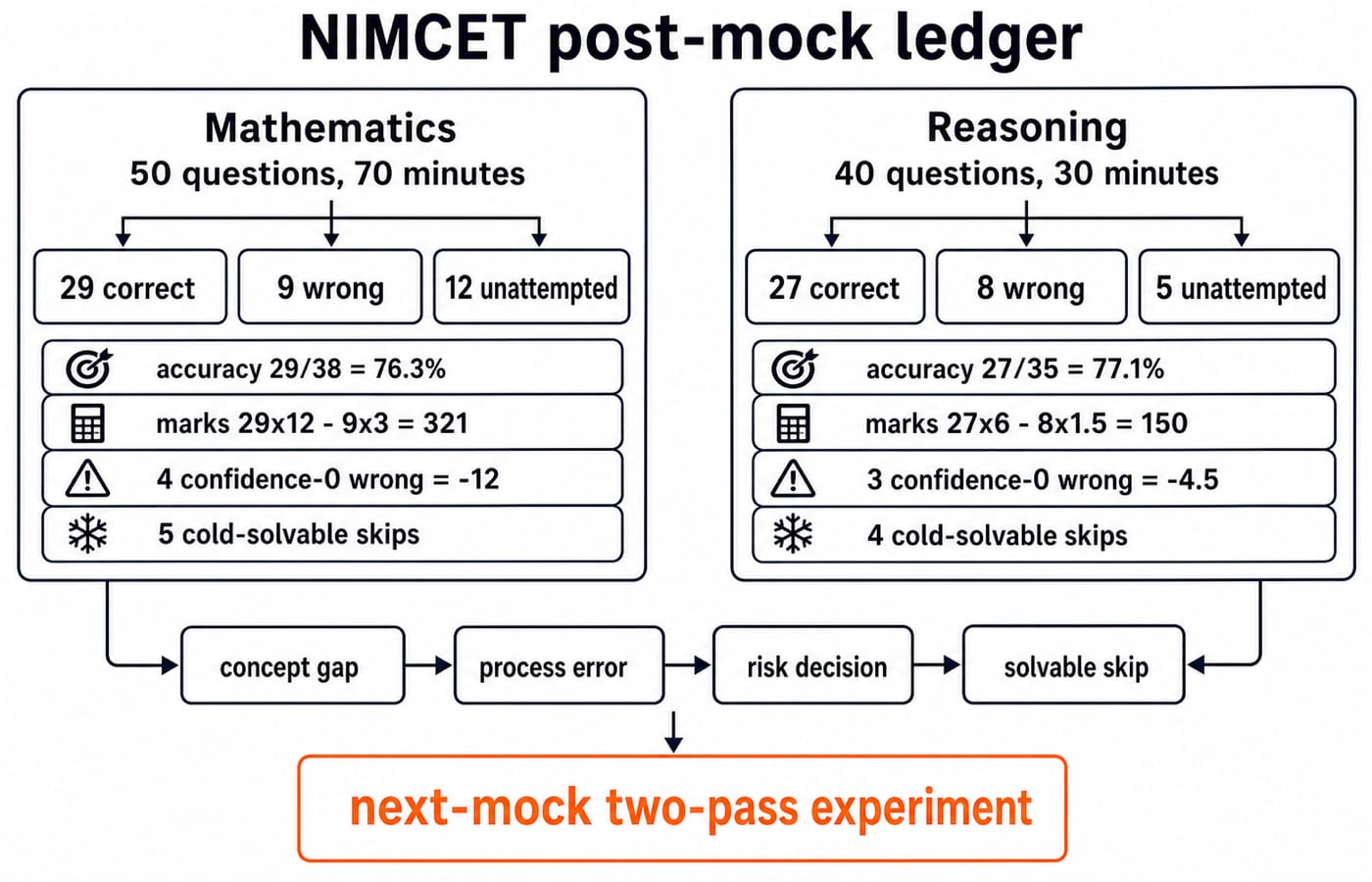
Mathematics: 38 attempted, 29 correct, 9 wrong and 12 unattempted in 70 minutes. Accuracy:
29 / 38 x 100 = 76.3%. Marks:29 x 12 - 9 x 3 = 348 - 27 = 321.Reasoning: 35 attempted, 27 correct, 8 wrong and 5 unattempted in 30 minutes. Accuracy:
27 / 35 x 100 = 77.1%. Marks:27 x 6 - 8 x 1.5 = 162 - 12 = 150.
Before opening the key, create one row per wrong or unattempted item:
question | topic | attempted or skipped | confidence 0-2 | time spent | result | primary cause | cold re-solve result | next action |
|---|
The sample gives 9 + 12 = 21 Mathematics rows and 8 + 5 = 13 Reasoning rows, 34 total. Record the remembered decision first. Hindsight can turn a pacing error into “I knew it”. The SSC CGL mock-test strategy runs the same error-sheet and pace-versus-accuracy review on a different paper, so borrow the routine and keep the NIMCET part timings above.
3. Separate negative-marking risk from a knowledge gap
Suppose four of nine wrong Mathematics attempts had confidence 0. Their penalty is 4 x 3 = 12 marks. Three of eight wrong Reasoning attempts also had confidence 0, costing 3 x 1.5 = 4.5. Together, the cost is 12 + 4.5 = 16.5 marks. That is not an argument for skipping every uncertain question. NIMCET gives four choices, so a Mathematics attempt with one option ruled out averages 1/3 x 12 - 2/3 x 3 = 2 marks, and the flat 25 percent rule keeps that positive in Part II too. Those 16.5 marks went on decisions taken with no elimination at all.
Log lucky answers too. Three correct Mathematics answers and two correct Reasoning answers with confidence 0 remain risky. The pool is 4 + 3 + 3 + 2 = 12 decisions, seven wrong and five right.
Replace “careless” with an observable event: guessed with no elimination, misread NOT, lost a sign, used the wrong relation, or had no first step after 60 seconds. The label selects concept study, an accuracy drill or a timing rule.
4. Find solvable skips by re-solving cold, not by reading solutions
A solvable skip is unanswered but solved closed-book next day, before the solution, within your practice cap of 2 minutes for Mathematics or 75 seconds for Reasoning. Here, five Mathematics skips qualify: two algebra, two calculus and one probability. Four Reasoning skips qualify: two syllogism, one direction test and one data-sufficiency item. The rest are four Mathematics topic gaps, three deliberate hard skips and one Reasoning seating-arrangement gap.
If all nine were reached and correct, their upper-bound value would be 5 x 12 + 4 x 6 = 60 + 24 = 84 marks. This one-paper ceiling is not an expected gain because pressure and fresh wording matter.
M17, M29 and M43 took 11 minutes for one correct and two wrong answers: 11 / 70 x 100 = 15.7% of Part I on 3 of 50 questions. R22, a seating puzzle, took 7 minutes and ended wrong: 7 / 30 x 100 = 23.3% of Part II. You need a move-on trigger, not “be faster”.
5. Turn every unresolved item into one repair action
Do not double-count. The 21 Mathematics items become 6 concept gaps, 3 calculation or reading errors, 4 low-confidence wrong attempts, 5 solvable skips and 3 deliberate hard skips. The 13 Reasoning items become 3 concept gaps, 3 process errors, 3 low-confidence wrong attempts and 4 solvable skips.
Assign one repair:
Concept gap: one 45-minute relearn block plus six fresh questions.
Calculation or process error: a 10-question untimed set with every intermediate line shown.
Low-confidence decision: an elimination note explaining why every rejected option fails.
Solvable skip: a timed two-pass drill.
Deliberate hard skip: no immediate study block unless the topic recurs in two of the next three mocks.
Calculus appears in six Mathematics rows across three mocks: two concept gaps, two process errors and two long attempts. It gets the next 45-minute concept block and six fresh problems. Algebra has three cold-solvable skips but no concept gap, so it gets a timed set, not a reread.
6. Run one two-pass experiment in the next mock
Change one thing. In Part I, finish a first pass by minute 50 and move on if 90 seconds produces no written route, leaving 20 minutes for flags. In Part II, finish by minute 20 and move on if 45 seconds produces no viable setup, leaving 10 minutes.
Reduce cold-solvable skips from 9 to at most 5 and confidence-0 wrong attempts from 7 to at most 4. Keep Mathematics accuracy at or above 76.3 percent and Reasoning at or above 77.1 percent. If skips and accuracy fall, you rushed. If accuracy holds but skips do not fall, you ignored the triggers. Change only one variable in the following mock.
A 7.5-hour week gives 2 hours for a mock, 2 hours 15 minutes for next-day review, 60 minutes for Mathematics repair, 45 for Reasoning repair, 60 for two-pass drills and 30 for cold re-solves. Miss a day? Keep the mock and review, then drop the lower-priority repair. Never stack unanalysed mocks. The UGC NET mock-test strategy sets out the same one mock, one review, one repair block cadence worth copying here.
7. The short version and the next action
Respect fixed parts. Freeze attempt data, quantify risk, cold-test skips, assign one primary cause, then run one measurable two-pass experiment. Your row count comes from your own wrong-and-unattempted list, as 21 and 13 gave 34 here. Build it from your latest mock before you sit the next one.
For a structured route, the MCA Entrance Exam 2026 course prepares NIMCET, CUET PG, MAH CET and the other MCA entrance papers in one plan.
Keep learning
CUET-PG CS vs NIMCET: One Shared-Core Plan for MCA Entrance Prep
Prepare for both MCA entrances with one shared core and two thin exam-specific wrappers: an overlap sheet built from the official documents, a coverage-and-accuracy diagnostic, and a twelve-hour week that survives missed days.
Updated 22 Aug 20266 min readMCA Entrance

CUET PG Computer Science Mock Analysis: Build a Study Plan From Every Error
A mock score cannot tell you what to revise next. Use an error log, timed re-solves, priority weights and fresh-question retests to build a practical seven-day repair plan.
Updated 20 Aug 20266 min readMCA Entrance
NIMCET vs CUET PG MCA: Choose One Exam or Prepare for Both
Compare the two MCA entrance routes, calculate mock scores correctly, and use a personal decision matrix plus a 168-hour bridge plan to choose one or both.
Updated 18 Aug 20265 min readMCA Entrance

CUET PG Computer Science Preparation: 12-Week BCA Bridge Plan
Turn familiar BCA subjects into an entrance-ready system with a baseline audit, two maths routes, mixed objective sets and a realistic recovery calendar.
Updated 16 Aug 20266 min readMCA Entrance