MP Cooperative Bank Mock Analysis: Build a Post-Specific Weekly Preparation Loop
Use an illustrative 54/100 mock audit to build different 14-hour repair weeks for Computer Operator and Society Manager preparation, then recompute priorities after the retest.
KnowledgeGate Team
Exam prep & CS education
Updated 2 Aug 20266 min read
If you record only a total mock score, you may feel relieved or discouraged without knowing what to repair. Taking another mock repeats the same uncertainty. Split the score into five section gaps instead, weight each gap by the post you applied for, and give your next fourteen study hours to the two lanes that cost most. The example uses Riya's own 100-point practice paper, so the marks, question counts, sectional timing and negative marking that actually apply come from the current notice at apexbankmp.bank.in.
MP Cooperative Bank mock analysis starts with five evidence buckets
Score the mock in the five buckets the syllabus already uses: Reasoning Ability, English Language, General Awareness, Quantitative Aptitude and Computer Knowledge. The MP Co-operative Bank Exam Preparation category groups its lessons the same way, so a weak bucket points straight at its repair.
Evidence bucket | Score | Gap | Failure | Example | Repair |
|---|---|---|---|---|---|
Reasoning Ability | 14/20 | 6 | Poor selection | Seating arrangement | Write a selection checklist |
English Language | 12/20 | 8 | Careless execution | Sentence correction | Redo errors |
General Awareness | 9/20 | 11 | Weak recall | Fact recall | Use spaced retrieval |
Quantitative Aptitude | 11/20 | 9 | Slow method | Percentage and ratio | Time a shorter method |
Computer Knowledge | 8/20 | 12 | Concept gap | Excel functions and charts | Repair, then retrieve |
Then label every lost point with one cause: concept gap, slow method, careless execution, weak recall or poor selection. A forgotten shortcut needs retrieval practice; a method that works but runs long needs timed repair. The MP Cooperative Bank exam pattern study map treats the same five sections as separate jobs, and the SSC CGL mock test strategy guide works the labelling habit through on a different exam.
MP Cooperative Bank mock score: work one 54/100 audit completely
Riya's paper carries 100 points in five equal 20-point buckets, one per section, a simplification she chose to keep the gap arithmetic readable.
14 + 12 + 9 + 11 + 8 = 54, so 100 - 54 = 46 points are still on the table.
Bucket gaps are 20 - 14 = 6, 20 - 12 = 8, 20 - 9 = 11, 20 - 11 = 9 and 20 - 8 = 12. Check: 6 + 8 + 11 + 9 + 12 = 46.
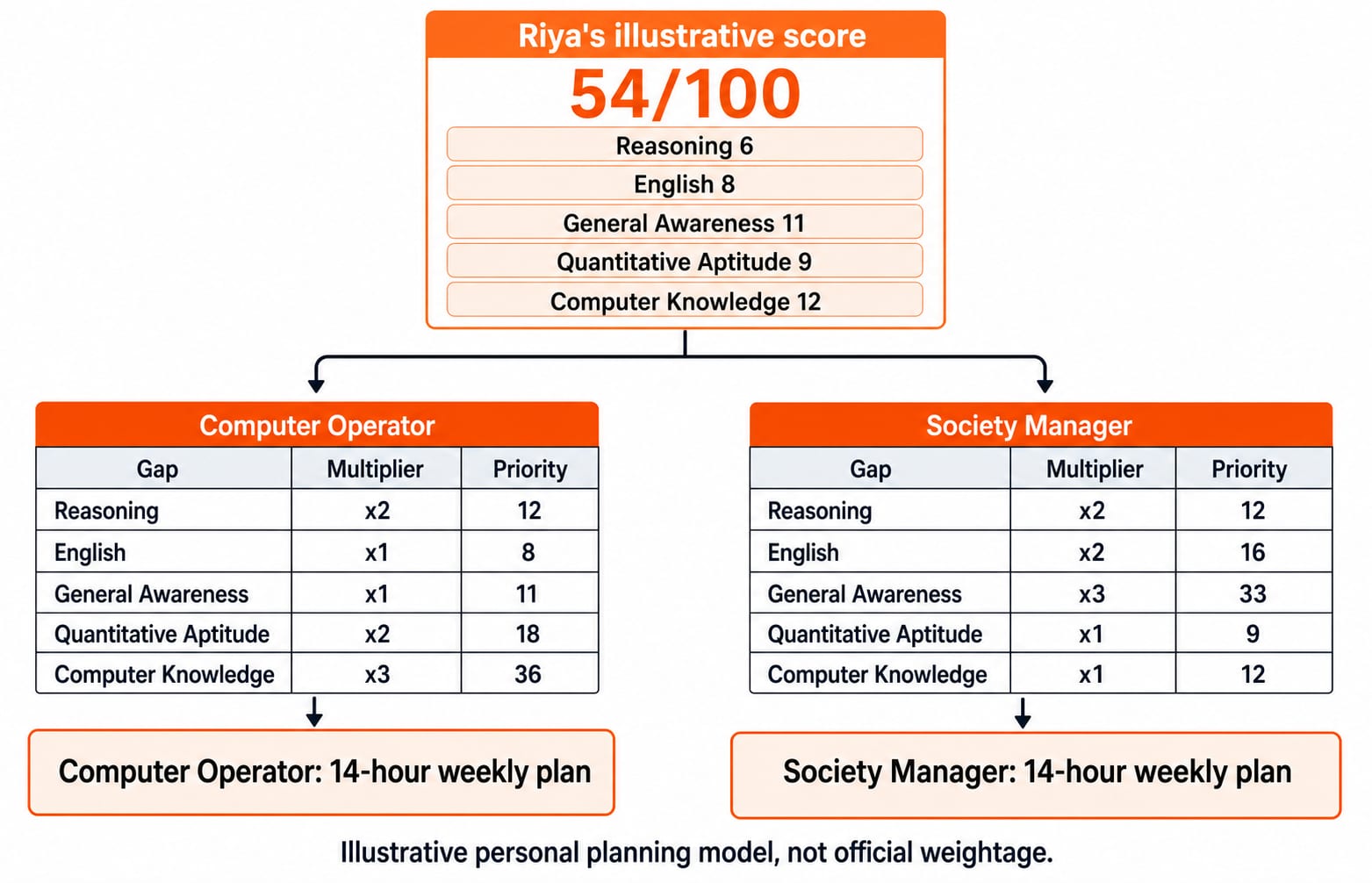
The Failure column names only each bucket's largest cause, so split the gaps. Reasoning's 6 is 4 poor selection and 2 slow method; English's 8 is 6 careless execution and 2 concept gap; General Awareness's 11 is 8 weak recall and 3 concept gap; Quantitative Aptitude's 9 is 6 slow method and 3 careless execution; Computer Knowledge's 12 is 10 concept gap and 2 slow method. Cause totals: concept gap 15, slow method 10, careless execution 9, weak recall 8, poor selection 4, and 15 + 10 + 9 + 8 + 4 = 46 again. Excel functions and charts are 5 of Computer Knowledge's 10 concept-gap points, percentage and ratio all 6 of Quantitative Aptitude's slow-method points, and seating arrangement 3 of Reasoning's 4.
Post-specific mock analysis changes the repair order, not the raw score
Now weight each gap by how much its section matters for the post you applied for. Riya uses 3 for a section the post leans on, 2 for one it uses regularly and 1 for one it barely touches, so each cell reads gap x multiplier = priority.
Bucket | Gap | Computer Operator | Society Manager |
|---|---|---|---|
Reasoning Ability | 6 |
|
|
English Language | 8 |
|
|
General Awareness | 11 |
|
|
Quantitative Aptitude | 9 |
|
|
Computer Knowledge | 12 |
|
|
Orders are Computer Knowledge 36, Quantitative Aptitude 18, Reasoning 12 for Computer Operator; General Awareness 33, English 16, then a 12 tie for Reasoning and Computer Knowledge for Society Manager.
One score sheet, one set of gaps, two different first jobs. Computer Operator opens on Computer Knowledge; Society Manager opens on General Awareness, an 11-point gap a Computer Operator would leave until fourth. That is the whole reason to weight before scheduling.
Computer Operator weekly loop: turn the 36-18-12 order into 14 hours
Day | Work |
|---|---|
Monday | 2 hours Computer Knowledge concept repair |
Tuesday | 2 hours Quantitative Aptitude method repair |
Wednesday | 2 hours Reasoning practice |
Thursday | 1 hour English and 1 hour General Awareness |
Friday | 2 hours Computer Knowledge retrieval and 1 hour mixed transfer set |
Saturday | 90-minute mixed practice mock and 90-minute analysis |
Check: 2 + 2 + 2 + 2 + 3 + 3 = 14 hours. Outputs: corrected Excel note, two timed percentage-and-ratio sets, seating-arrangement checklist, 20-item Computer Knowledge retrieval deck, score sheet and error log. A transfer set is how you prove a repair travelled: fresh questions on the repaired idea, mixed with unrelated ones, attempted without warning. Viewing alone closes nothing.
If the exam date is still unfixed, the three-phase banking exam prep plan spreads the same habit over 10 to 12 hours a week.
Society Manager weekly loop reallocates the same 14 hours
Monday to Wednesday give 2 hours each to General Awareness, English and Reasoning respectively. Thursday gives 1 hour each to Quantitative Aptitude and Computer Knowledge. Friday gives 2 hours General Awareness plus 1 English. Saturday gives a 90-minute mock and 90-minute analysis. Check: 2 + 2 + 2 + 2 + 3 + 3 = 14 hours.
Activity | Computer Operator hours | Society Manager hours |
|---|---|---|
Reasoning | 2 | 2 |
English | 1 | 3 |
General Awareness | 1 | 4 |
Quantitative Aptitude | 2 | 1 |
Computer Knowledge | 4 | 1 |
Mixed mock plus analysis | 3 | 3 |
Transfer set | 1 | 0 |
Total | 14 | 14 |
Notice what did not move: Reasoning keeps 2 hours and the Saturday mock plus analysis keeps 3 in both weeks. Diagnosis and testing are fixed costs; only repair hours follow the post.
Missed study day: recover the loop without creating false backlog
Riya misses Wednesday's 2-hour Reasoning, so 14 hours fall to 12. Adding 30 minutes Thursday and 30 Friday recovers 1 hour and closes at 13. She drops the remainder instead of claiming a 16-hour catch-up.
Protect Saturday's 90-minute mock and 90-minute analysis, plus Computer Knowledge repair. Drop a lower-ranked or improving lane. If Saturday is missed, analyse the latest mock first, not two new mocks back to back. Resume 14 hours next clean week with no rolling debt. Ten or thirteen honest hours with analysis beat fourteen without evidence.
The next MP Cooperative Bank mock decides whether the loop worked
Riya's retest scores, in the same bucket order as the first table, are 15, 13, 11, 13 and 11. So 15 + 13 + 11 + 13 + 11 = 63, and 63 - 54 = 9. The gains are +1, +1, +2, +2 and +3, and 1 + 1 + 2 + 2 + 3 = 9, the largest of them on Computer Knowledge, the lane ranked first.
Recomputed on the Computer Operator multipliers, new gaps 5, 7, 9, 7 and 9 give 5 x 2 = 10, 7 x 1 = 7, 9 x 1 = 9, 7 x 2 = 14 and 9 x 3 = 27. Computer Knowledge stays first, Quantitative Aptitude second, Reasoning third. The loop narrows instead of resetting every subject.
Her three mocks this cycle scored 54, 58 and 63, so the running mean is (54 + 58 + 63) / 3 = 175 / 3 = 58.3, and a three-mock mean is what separates a lane that is moving from one that is bouncing. Keep a lane once the same error appears twice, and cut it only after a clean transfer set.
MP Cooperative Bank mock analysis: the short version and next step
Score by bucket, label the cause of every lost point, multiply each gap by the post's multiplier, schedule 14 honest hours against the order that falls out, then retest and recompute. Riya's cycle moved 54 to 63 that way and the order barely changed, which is what a working loop looks like. The MP Cooperative Bank 2026 course is that route already built for the Computer Operator and Society Manager tracks, with recorded bilingual lessons across all five sections and PYQ-based practice to retest against.
Keep learning
Knowledge of ICT Explained: Digital Divide, Email Fields and MS Word Macros
Connect access, communication and automation through three worked ICT concepts. Practise denominator choice, Bcc visibility and a beginner Word macro trace.
Updated 16 Aug 20266 min readMP Cooperative Bank
MP Cooperative Bank Roles Compared: Clerk, Manager and Technical Work
Compare three broad work families without treating them as a current vacancy list. Use task routing, a role-fit calculation and a notification card to choose a preparation focus.
Updated 14 Aug 20266 min readMP Cooperative Bank
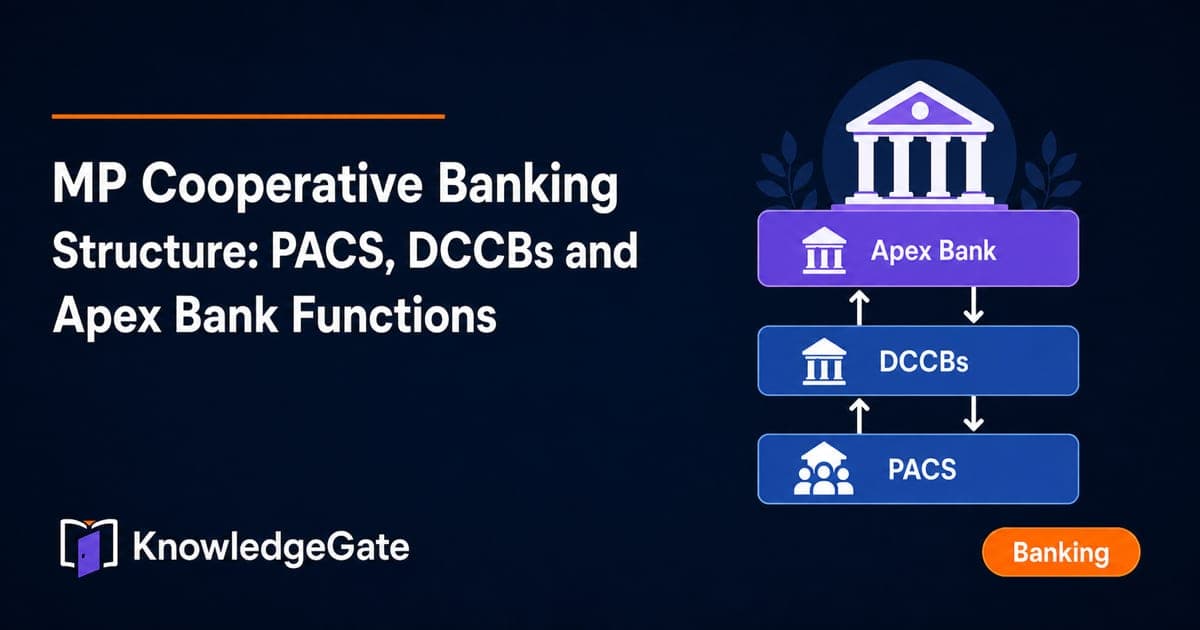
MP Cooperative Banking Structure: PACS, DCCBs and Apex Bank Functions
Learn how demand, finance and repayments move through PACS, DCCBs and MP Apex Bank. A principal-only example makes each tier's function easy to identify.
Updated 12 Aug 20266 min readMP Cooperative Bank
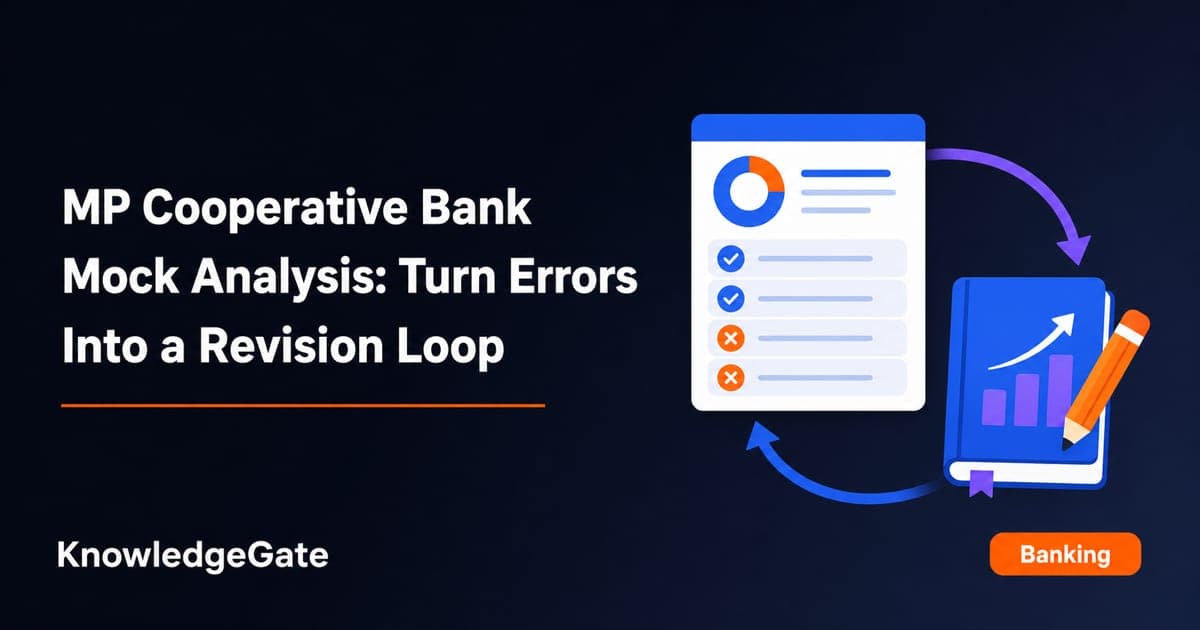
MP Cooperative Bank Mock Analysis: Turn Errors Into a Revision Loop
A mock score cannot show you what to fix next. Use this worked review system to reconcile your section data, identify root causes and retest each repair.
Updated 9 Aug 20268 min readMP Cooperative Bank