Mobile Technology in Computer Networks: Cellular Concepts, GSM, CDMA and Handoff with Worked Examples
Build a clear picture of cellular networks, GSM roles, CDMA decoding, handoff and Mobile IP, then test it with two fully worked numericals.
KnowledgeGate Team
Exam prep & CS education
Updated 19 Aug 20266 min read
Mobile technology often appears as a vague tail-end chapter in Computer Networks: cells, GSM boxes, CDMA maths and handoff types crammed into two pages. Yet exams demand exact cellular and CDMA calculations, while interviews ask you to narrate a call or handoff step by step. Both demands reduce to the same short list of quantities: channels per cell, the reuse ratio Q, the chip-sequence divisor, and which GSM register holds which record.
1. What mobile technology means inside Computer Networks
Mobile technology means wireless last-hop communication in which the host can move. The topic spans cellular generations, GSM architecture, CDMA-style sharing, handoff and Mobile IP. Wi-Fi is also wireless, but 802.11 access is studied separately under MAC protocols.
Mobility creates three problems. Limited spectrum needs frequency reuse. A moving user needs handoff. A moving IP host needs Mobile IP registration.
Use this generation ladder: 1G carried analogue voice with FDMA; 2G brought digital voice and SMS through GSM with TDMA and FDMA; 2.5G added GPRS packet data; 3G UMTS used CDMA-based access; 4G LTE became all-IP with OFDMA; 5G added New Radio and network slicing.
2. Cellular concept and frequency reuse
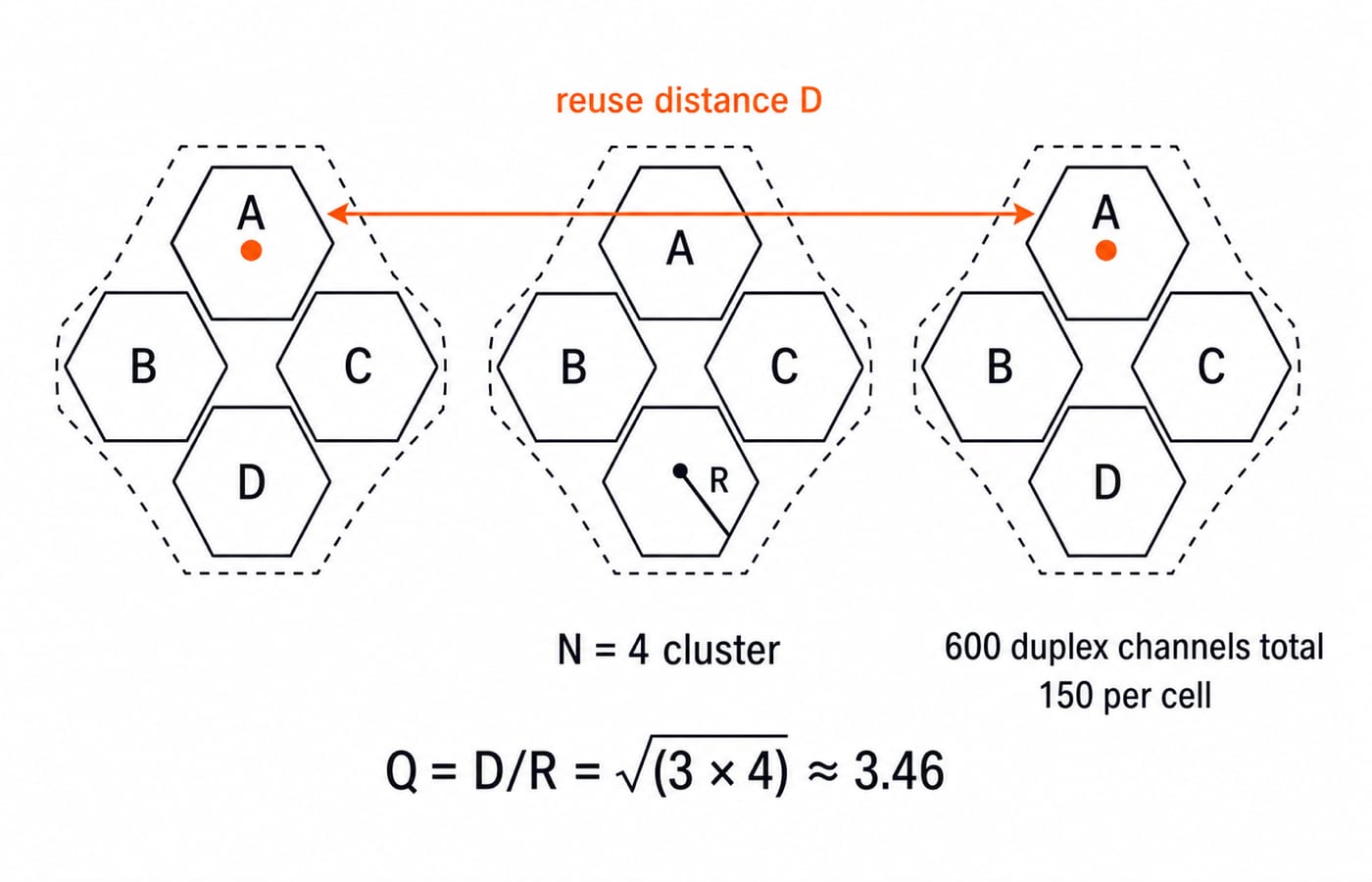
Instead of one high-power tower, a cellular system divides a region into low-power cells, drawn as hexagons, and reuses each frequency group in cells far enough apart.
A cluster is N neighbouring cells that use the full spectrum exactly once. Valid sizes follow N = i² + ij + j², where i and j are non-negative integers. That yields 1, 3, 4, 7, 9, 12 and 13, but never 5.
Worked example A: capacity
An operator has 30 MHz of spectrum. One simplex channel needs 25 kHz, so one duplex voice channel needs two simplex channels:
Duplex channel width =
2 × 25 kHz = 50 kHz.Convert the allocation:
30 MHz = 30,000 kHz.Total duplex channels =
30,000 / 50 = 600.With
N = 4, channels per cell =600 / 4 = 150.For 20 cells, system capacity =
150 × 20 = 3,000 simultaneous calls.
At N = 3, each cell gets 600 / 3 = 200 channels. Capacity rises, but closer co-channel cells increase interference.
The reuse ratio is Q = D/R = √(3N), where D is reuse distance and R is cell radius. For N = 4, Q = √12 ≈ 3.46; for N = 7, Q = √21 ≈ 4.58. Bigger N means cleaner signals but less capacity per cell.
3. FDMA, TDMA and CDMA with a complete decode
FDMA divides frequency, TDMA divides time, and CDMA separates simultaneous users with orthogonal chip sequences. GSM combines FDMA, using 200 kHz carriers, with TDMA, using eight slots per carrier.
Worked example B: CDMA decoding
Station A uses (+1, +1, +1, +1) and B uses (+1, -1, +1, -1). Their inner product is 1 - 1 + 1 - 1 = 0, so they are orthogonal.
A sends bit 1 unchanged. B sends bit 0 as the negated sequence (-1, +1, -1, +1). The channel adds them:
S = (+1, +1, +1, +1) + (-1, +1, -1, +1) = (0, +2, 0, +2)
Correlate S with each code and divide by the chip length, 4:
For A:
S·A / 4 = (0 + 2 + 0 + 2) / 4 = 4/4 = +1, so A sent bit 1.For B:
S·B / 4 = (0 - 2 + 0 - 2) / 4 = -4/4 = -1, so B sent bit 0.
The rule is fixed: +1 means bit 1, -1 means bit 0, and 0 means silent. Non-orthogonal codes leak other stations' signals into the result.
4. GSM architecture and what each box knows
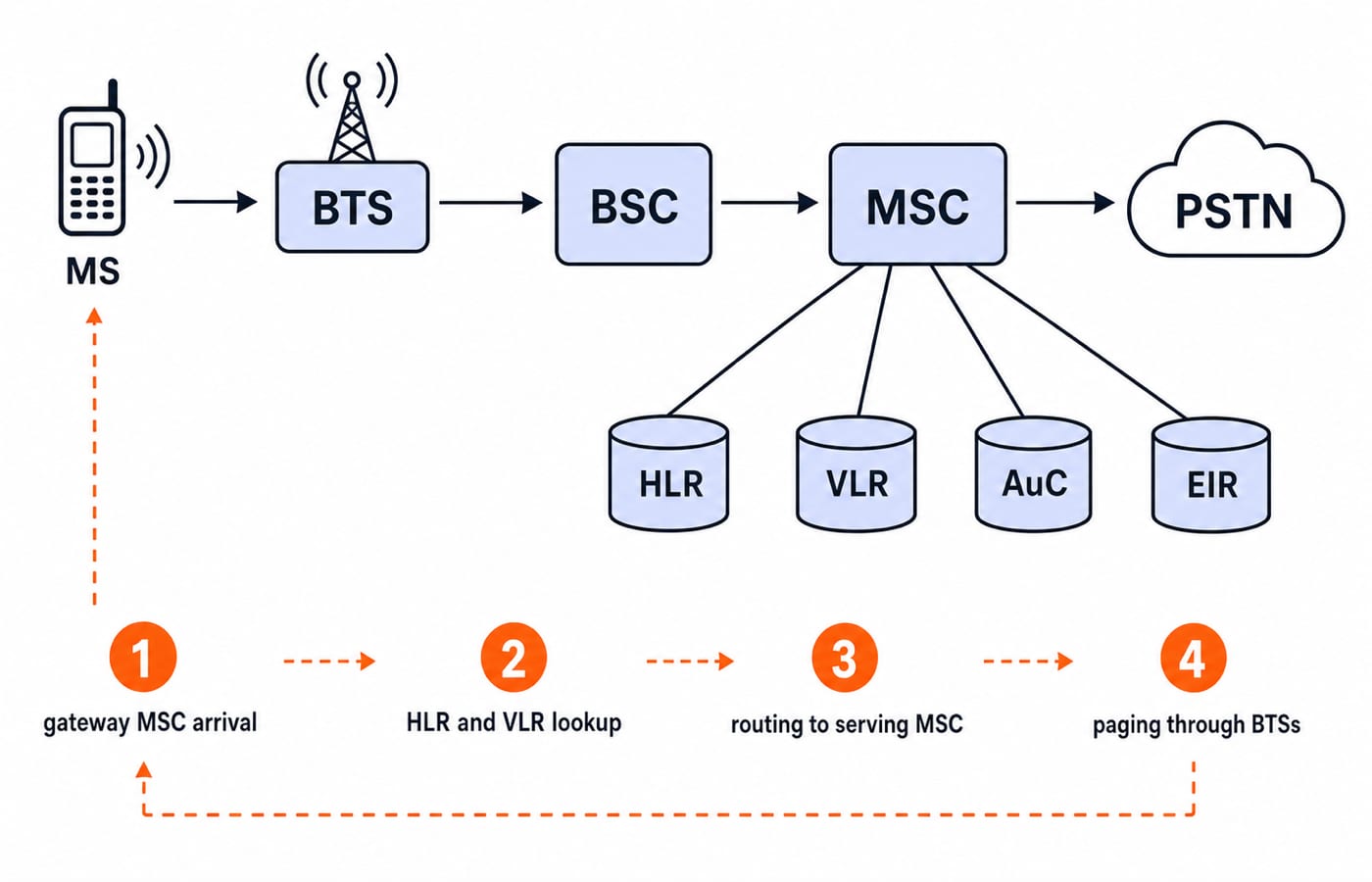
Follow the call path. The Mobile Station is the handset plus SIM. The Base Transceiver Station provides radio. The Base Station Controller manages several BTSs and radio handoffs. The Mobile Switching Centre switches calls and connects through a gateway to the PSTN.
The Home Location Register stores the permanent subscriber record and current VLR. The Visitor Location Register keeps a temporary record for users in its MSC area. The Authentication Centre holds authentication keys; the Equipment Identity Register checks device IMEIs, including stolen equipment.
For an incoming roaming call:
The call reaches the gateway MSC.
The gateway queries the HLR, which asks the current VLR for a roaming number.
The call is routed to the serving MSC.
The serving network pages the mobile through its BTSs.
5. Handoff and Mobile IP when the user moves
A handoff transfers an ongoing call when the serving signal crosses a threshold. Hard handoff is break-before-make: the old link ends before the new one starts. GSM and TDMA use it; one active radio link makes it cheaper. Soft handoff is make-before-break: a mobile briefly talks to two BTSs. It fits CDMA because cells can share a frequency, and it reduces dropped calls.
Mobile IP uses a home agent on the home network, a foreign agent on the visited network and a registered care-of address. The home agent intercepts packets for the home address and tunnels them to the care-of address. Direct replies create triangular routing; route optimisation shortens it.
Keep the distinction sharp: handoff preserves a live radio channel, while Mobile IP preserves a reachable IP identity.
6. Traps that cost marks
In capacity sums, divide by the duplex width. Dividing 30 MHz by 25 kHz wrongly produces 1,200 instead of 600 channels.
Check
N = i² + ij + j². A cluster size of 5 is not legal.More cells per cluster means fewer channels per cell, not more capacity.
In CDMA, divide correlation by the chip-sequence length. Here that divisor is 4.
A decoded value of 0 means silent, not bit 0. Also check orthogonality before decoding.
HLR is the permanent home record; VLR is the temporary visitor record.
BSC, not BTS, manages the radio handoff in the GSM chain.
Soft handoff belongs naturally with CDMA, not GSM.
A care-of address is the current routing location, not the permanent home address.
7. How GATE, UGC NET and interviews test it
In GATE CS, expect occasional CDMA decoding or frequency-reuse numericals, with wireless MAC treated separately. Check scope against the official GATE syllabus on the organising institute's portal for the current cycle. The GATE CS category connects this topic with neighbouring subjects.
UGC NET CS and teaching-recruitment papers favour direct theory MCQs on generations, GSM components, HLR versus VLR and handoff types. Interviews ask what happens at a cell boundary or how packets find a travelling laptop. Practise both explanations aloud in under two minutes.
8. The short version and the next step
Cells reuse spectrum through clusters; capacity is channels per cell multiplied by cell count. FDMA separates frequency, TDMA separates time, and CDMA separates users through codes. GSM divides work across BTS, BSC, MSC, HLR and VLR. Handoff keeps a call alive; Mobile IP keeps an address reachable.
Turn both calculations into 90-second routines with topic-wise and mock practice in the GATE Test Series. For guided subject-wise coverage of Computer Networks and the rest of the syllabus, use GATE Guidance by Sanchit Sir.
Then continue with the Computer Networks MCQs hub and the IP addressing and subnetting guide. Rework the cellular and CDMA examples without looking at the steps. If your numbers still land on 3,000 calls, +1 for A and -1 for B, the chapter has become usable knowledge.
Keep learning
Data Transmission Modes and Connection Types: Simplex, Half-Duplex and Full-Duplex
Learn to classify simplex, half-duplex, full-duplex, point-to-point and multipoint links, then calculate completion time without relying on memorised examples.
Updated 22 Oct 20265 min readComputer Networks
Computer Networks Interview Questions: Trace OSI, TCP/IP and Routing Step by Step
Follow one synthetic web request across DNS, ARP, TCP, NAT and longest-prefix routing, then turn each step into a strong interview answer.
Updated 18 Oct 20266 min readComputer Networks
Basics of Cyber Security: CIA Triad, Risks and a Worked Defence
Learn a consistent security vocabulary, connect common attack paths to suitable controls, and calculate how two defensive layers reduce account takeovers.
Updated 14 Oct 20266 min readComputer Networks
Cyber Threats and Attacks Explained: Types, Worked DDoS Example and Exam Traps
Learn to separate threats, vulnerabilities, vectors and attacks, then apply the distinctions to a calculated DDoS scenario and exam-style questions.
Updated 10 Oct 20266 min readComputer Networks