Manchester Encoding MCQs: 11 Published Questions, Solved and Scope-Checked
Solve 11 published records filed under Manchester encoding, learn the three line-code conventions, and see five outliers identified by their actual topics.
KnowledgeGate Team
Exam prep & CS education
Updated 29 Aug 20267 min read67 views
G.E. Thomas and IEEE assign opposite voltage transitions to bits, while Differential Manchester reads data from the presence or absence of a start-of-bit transition. Questions 1 to 6 cover those Manchester rules, baud rate, pulse width and waveform decoding. Questions 7 to 11 are separated because they test switch capacity, serial framing, Base64 and Wi-Fi certification.
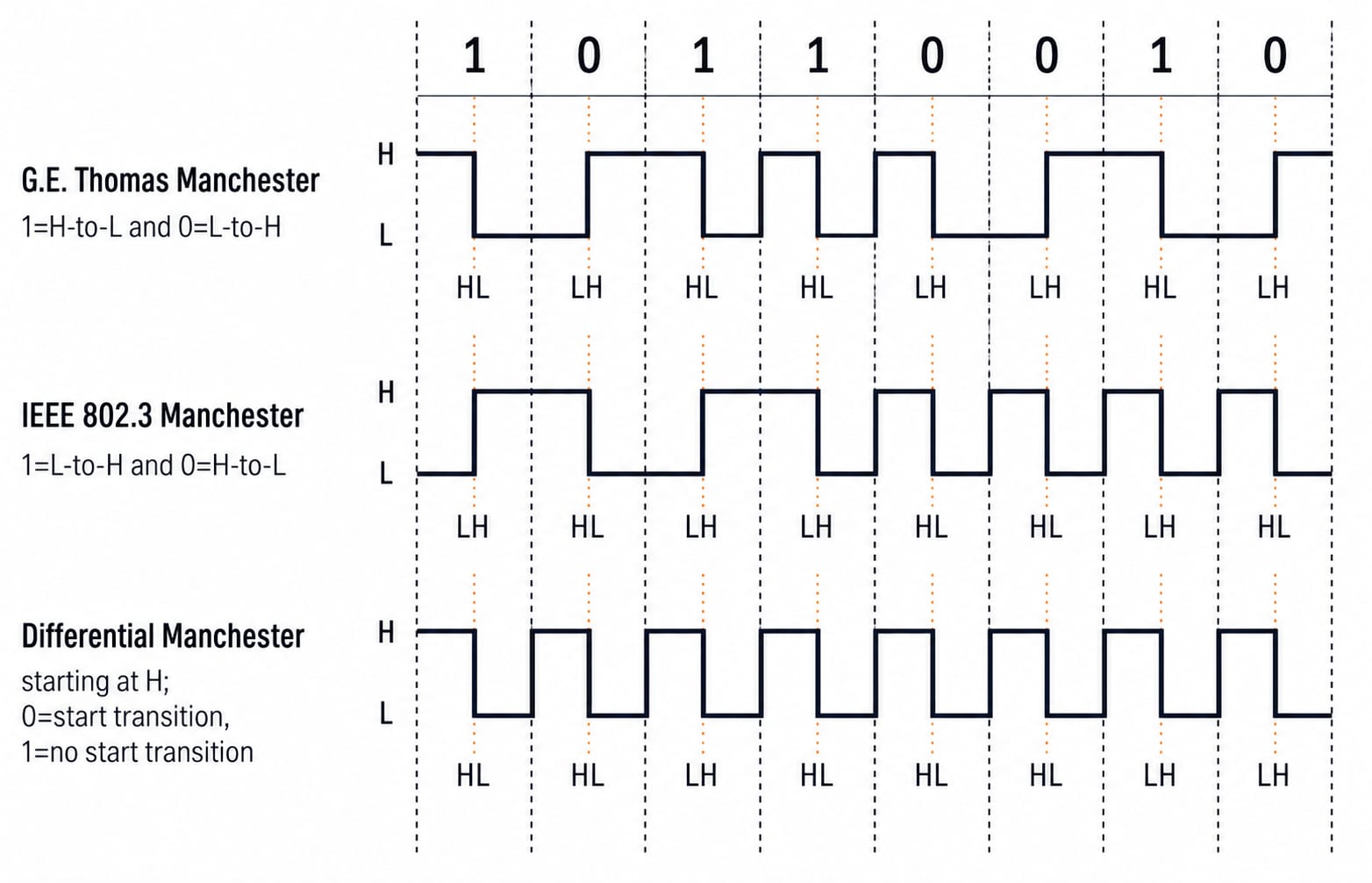
Manchester encoding rules needed before the questions
Use H for high and L for low, and fix the convention before reading a waveform.
Scheme | Bit 0 | Bit 1 | Clock rule |
|---|---|---|---|
G.E. Thomas Manchester |
|
| Mid-bit transition |
IEEE 802.3 Manchester |
|
| Mid-bit transition |
Differential Manchester | Start transition | No start transition | Mid-bit transition always |
Differential Manchester needs a starting level. Inverting the complete waveform does not change the decoded bits.
For 10110010, the G.E. Thomas half-bit pairs are:
HL | LH | HL | HL | LH | LH | HL | LH
The IEEE 802.3 pairs are:
LH | HL | LH | LH | HL | HL | LH | HL
For Differential Manchester starting at H, the pairs are:
HL | HL | LH | HL | HL | HL | LH | LH
Check the first three bits. Bit 1 has no start transition, so it goes H to L at mid-bit. Bit 0 starts by switching L to H, then returns H to L at mid-bit. The next 1 starts at L without a boundary transition, then switches L to H at mid-bit.
Manchester bit rate, baud rate and pulse-width questions
One bit period T_b contains two signal intervals of width T_b/2, so baud rate = 2 x bit rate and bit rate = baud rate/2. Manchester line coding converts each data bit into two signal intervals. Ethernet transmission delay, propagation delay, CSMA/CD cable length and utilisation instead depend on frame size, distance and timing constraints.
Question 1, GATE 2007
In Ethernet when Manchester encoding is used, the bit rate is:
(a)
Half the baud rate.(b)
Twice the baud rate.(c)
Same as the baud rate.(d)
None of the above
Answer: (a). Each bit uses two signal intervals, so baud = 2 x bit rate. Rearranging gives bit rate = baud/2, which is half the baud rate.
Attribution: GATE 2007. GATE Manchester bit-rate solution.
Question 2, UGC NET 2021
In Ethernet, when Manchester coding is used, the bit rate is:
(a)
Half the baud rate(b)
twice the baud rate(c)
Thrice the baud rate(d)
Same as the baud rate
Answer: (a). At 10 Mb/s, Manchester encoding gives 20 Mbaud, so the bit rate is half the baud rate. Option (b) reverses this relationship, while option (d) ignores the two signal intervals per bit.
Attribution: UGC NET 2021. UGC NET Manchester bit-rate solution.
Question 3, DSSSB 2021
In Ethernet, when Manchester encoding is used, the pulse width is ____ that of straight binary encoding.
(a)
Same(b)
Half(c)
Twice(d)
One third
Answer: (b). A straight-binary pulse occupies the full bit interval T_b. Manchester divides that same interval into two pulses of width T_b/2, so each pulse is half as wide.
Attribution: DSSSB 2021. DSSSB Manchester pulse-width solution.
Manchester conventions, transitions and waveform decoding
Question 4, UGC NET December 2023
Which of the following statements are correct?
(A) NRZ is a bipolar scheme in which the positive voltage define bit is 0 (zero).
(B) NRZ-L and NRZ-I both have an average signal rate of N/2.
(C) The idea of RZ and NRZ-L are combined into Manchester scheme.
(D) NRZ-L and NRZ-I both have DC component problems.
(E) The minimum bandwidth of Manchester and differential Manchester is 3 times that of NRZ.
Choose the correct answer from the options given below :
(a)
(A), (B) and (C) Only(b)
(A), (C), (D) and (E) Only(c)
(B), (C) and (D) Only(d)
(A), (B), (C) and (E) Only
Answer: (c). A is false because NRZ is a polar level code, not the bipolar scheme described; B is true under the average random-data convention. C is true because Manchester combines a level-code idea with a return-to-zero-style mid-bit transition, and D is true because both NRZ forms can retain a DC component. E is false because this comparison treats Manchester bandwidth as about twice, not three times, NRZ bandwidth.
Attribution: UGC NET December 2023. UGC NET line-coding solution.
Question 5, GATE 2007
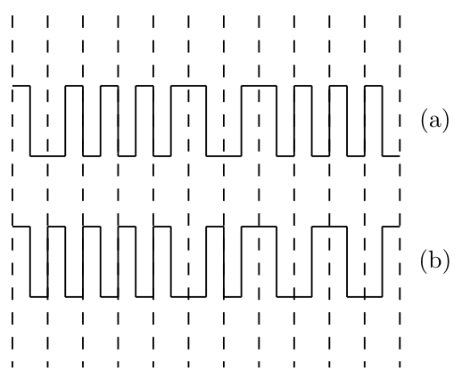
In the waveform (a) given below, a bit stream is encoded by Manchester encoding scheme. The same bit stream is encoded in a different coding scheme in wave form (b). The bit stream and the coding scheme are
(a)
1000010111 and Differential Manchester respectively(b)
0111101000 and Differential Manchester respectively(c)
1000010111 and Integral Manchester respectively(d)
0111101000 and Integral Manchester respectively
Answer: (a). The ten intervals in waveform (a) read 1|0|0|0|0|1|0|1|1|1, hence 1000010111. In waveform (b), every interval has a mid-bit transition; start-boundary transitions occur at the zero positions 2, 3, 4, 5 and 7, but not at 1, 6, 8, 9 and 10. This identifies Differential Manchester; Integral Manchester is a distractor.
Attribution: GATE 2007. GATE Manchester waveform solution.
Question 6, Indian Space Research Organization 2007
Phase transitions for each bit are used in:
(a)
Amplitude modulation(b)
Carrier modulation(c)
Manchester encoding(d)
NRZ encoding
Answer: (c). Manchester guarantees a transition within every bit interval, which supports clock recovery. NRZ can remain at one level across a long run, and the modulation choices do not describe the line-code rule being tested.
Attribution: Indian Space Research Organization 2007. ISRO Manchester transition solution.
Related-topic questions: Ethernet switch-count questions
Questions 7 and 8 move from line coding to LAN switch port accounting.
With n eight-port switches connected as a tree, the n - 1 inter-switch links consume 2(n - 1) ports. The host capacity is therefore 8n - 2(n - 1) = 6n + 2.
Question 7, GATE 2019
Consider that 15 machines need to be connected in a LAN using 8-port Ethernet switches. Assume that these switches do not have any separate uplink ports. The minimum number of switches needed is__________.
Options: none; this is a NAT item.
Answer: 3. Two switches provide 16 ports, but one inter-switch link consumes two, leaving 16 - 2 = 14, short of 15. Three switches use two such links, leaving 24 - 4 = 20. Thus 6(2) + 2 = 14 fails and 6(3) + 2 = 20 succeeds, so 3 is the minimum.
Attribution: GATE 2019. GATE switch-count solution.
Question 8
Consider that 15 machines need to be connected in a LAN using 8-port Ethernet switches. Assume that these switches do not have any separate uplink ports. Determine the minimum number of switches required.
Options: none; this is a subjective item.
Answer: 3. This is the subjective wording variant of Question 7. The same capacity proof gives 6n + 2, so two switches support 14 hosts and three support 20.
Related-topic questions: serial throughput, Base64 and Wi-Fi certification
Questions 9 to 11 cover asynchronous serial framing, Base64 and Wi-Fi certification.
Question 9
In a network, how many 8-bit characters can be transmitted per second over a 9600 baud serial communication link using asynchronous mode of transmission with one start bit, eight data bits, two stop bits, and one parity bit ?
(a)
600(b)
800(c)
876(d)
1200
Answer: (b). Each character frame has 1 + 8 + 2 + 1 = 12 transmitted bits. Therefore, 9600/12 = 800 complete characters can be sent per second.
Question 10, GATE 2007
You are given the following four bytes: 10100011 00110111 11101001 10101011. Which of the following is a substring of the Base64 encoding of these four bytes?
(a)
zdp(b)
fpq(c)
qwA(d)
oze
Answer: (b). Six-bit grouping gives 101000 110011 011111 101001 101010 110000; the last unit has two data bits and four padding zeroes. These indices map to o z f p q w, and two missing input bytes require ==, producing ozfpqw==. The listed substring is fpq.
Attribution: GATE 2007. GATE Base64 solution.
Question 11, UPLT 2026
The term used for certified 802.11b product is:
(a)
WPA(b)
Wi-Fi devices(c)
WEP(d)
WAP
Answer: (b). Wi-Fi is the certification and branding term for interoperable IEEE 802.11 products. WPA and WEP are security mechanisms, while WAP is not the certification label asked for.
Attribution: UPLT 2026. Wi-Fi certification solution.
Manchester encoding topics and related practice
Key topics are rate and pulse width, G.E. Thomas versus IEEE polarity, and Differential Manchester waveform decoding. If Questions 1 to 3 went wrong, revise the two half-bit intervals. If Questions 4 to 6 went wrong, redraw 10110010 under all three conventions.
Questions 7 to 11 cover switch capacity, asynchronous serial framing, Base64 and 802.11 certification rather than Manchester line coding.
For more focused Computer Networks practice, use the Subnetting MCQ set for IP arithmetic and the TCP and UDP MCQ set for transport-layer reasoning.
Manchester encoding MCQs: key takeaways
Every Manchester bit has a mid-bit transition.
G.E. Thomas and IEEE use opposite bit-to-direction mappings.
Differential Manchester reads data from the start-boundary transition while retaining the mid-bit clock transition.
With two signal intervals per bit, baud = 2 x bit rate.
If you want the complete subject sequence, continue with GATE Guidance by Sanchit Sir. If you are organising preparation by exam, use the GATE CS Exam Preparation category.
Keep learning
Authentication and Digital Signature MCQs: 12 Solved Hash and Signing Questions
Work through 12 solved exam questions that connect challenge-response, integrity, hash lengths, X.509 certificates and the exact key order for signing and confidentiality.
Updated 25 Oct 20267 min readComputer Networks MCQs
UDP Protocol and Header MCQs: 12 Solved Questions with Explanations
Solve 12 UDP questions, then check the reasoning behind connectionless service, application choices, the 8-byte header, and packet-length calculations.
24 Oct 20267 min readComputer Networks MCQs
Repeater, Hub, Bridge & Switch MCQs: 12 Solved Questions with Explanations
Solve 12 exam questions on device layers, MAC forwarding, VLANs, collision and broadcast domains, port mirroring, bridges and crosspoint counting.
Updated 20 Oct 20267 min readComputer Networks MCQs
Ethernet IEEE 802.3 MCQs: 12 Solved Questions with Explanations
Solve 12 Ethernet questions on IEEE 802.3, speed generations, hubs, MAC addresses, multicast, CSMA/CD and the first binary backoff race.
Updated 16 Oct 20267 min readComputer Networks MCQs