Logical Operators Explained: Negation, Conjunction and Disjunction with Worked Truth Tables
Learn how negation, conjunction and inclusive disjunction change truth values. Follow complete truth tables, scoped negations, De Morgan checks and a worked compound expression.
KnowledgeGate Team
Exam prep & CS education
Updated 26 Aug 20265 min read
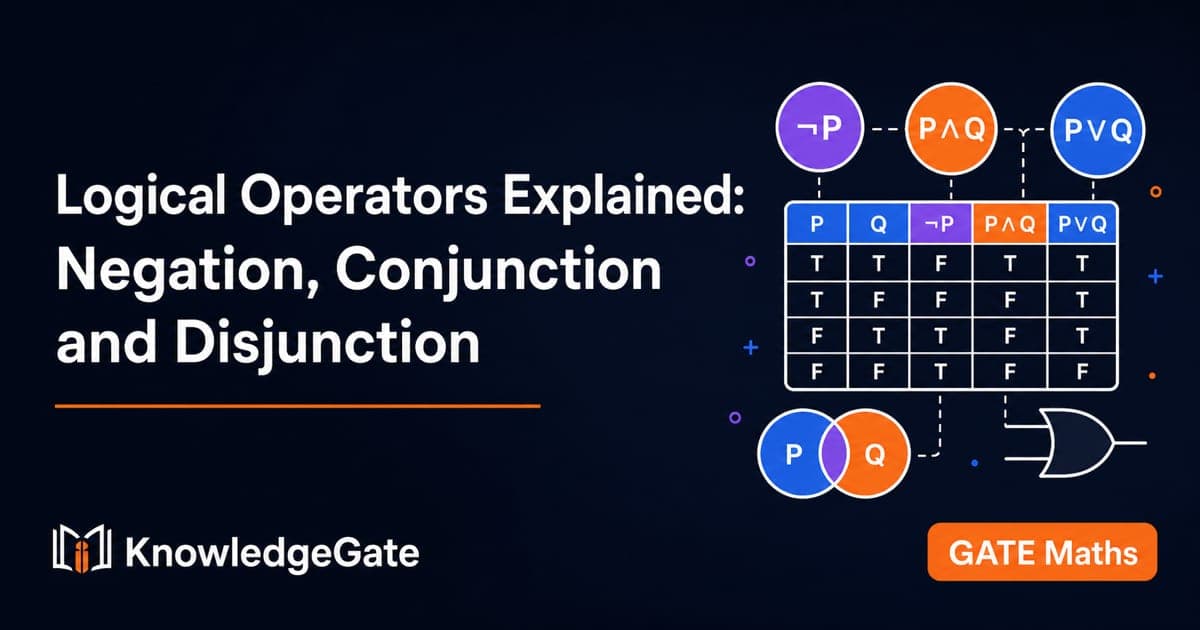
Logical symbols are short, but a missed negation, an unspoken inclusive OR, or one ignored pair of parentheses can reverse an answer. Start with the four-row truth table, then evaluate a compound expression in a fixed order. Evaluate each T/F step explicitly instead of relying on intuition.
What logical operators do to truth values
A proposition is a statement that has exactly one truth value, either true (T) or false (F). We use letters such as p and q as labels for propositions. For the wider concept map, see Propositional and Predicate Logic: Truth Tables to Proofs.
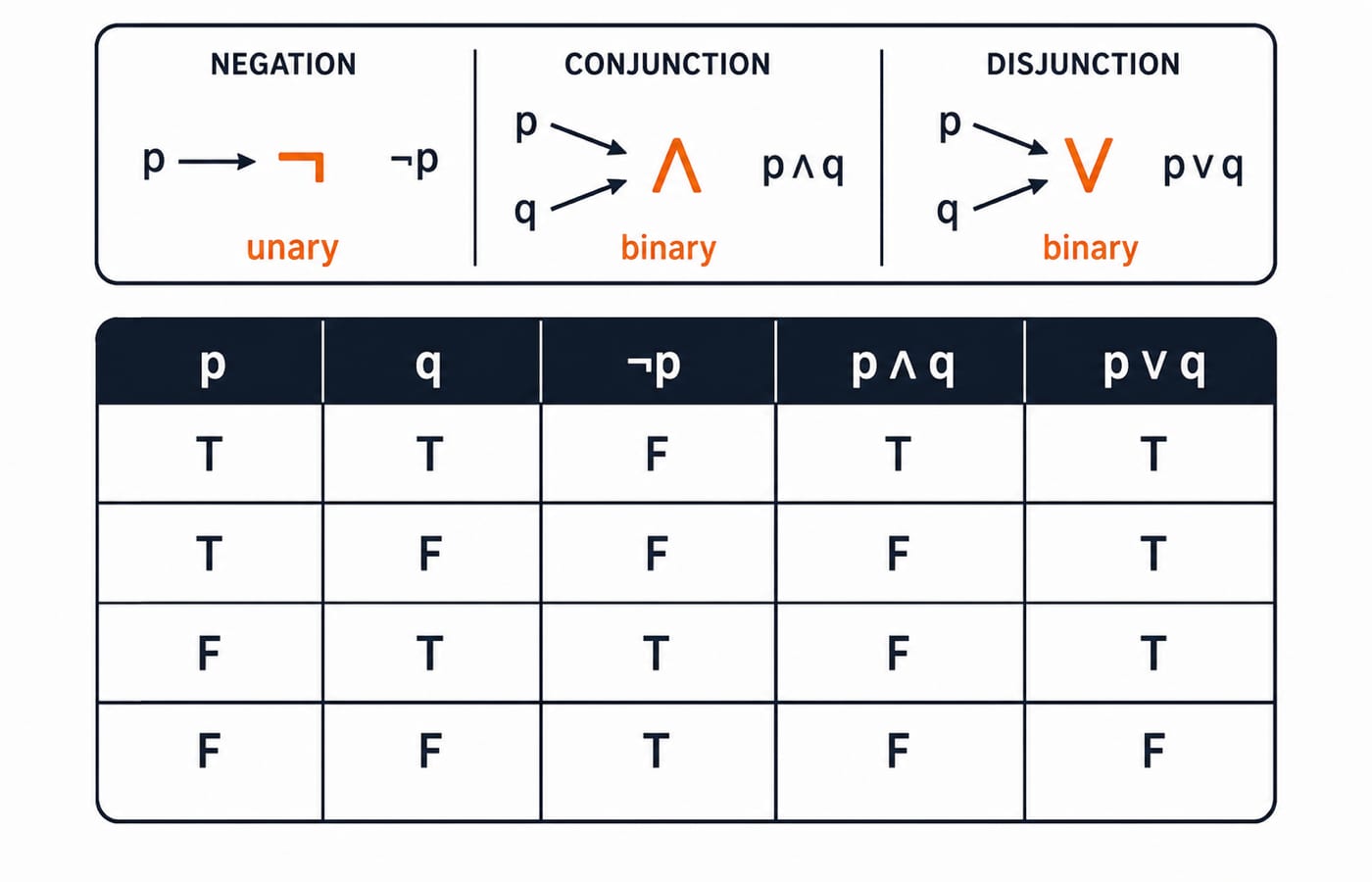
Negation ¬p is unary because it acts on one proposition. Conjunction p ∧ q and disjunction p ∨ q are binary because each joins two propositions.
p | q | ¬p | p ∧ q | p ∨ q |
|---|---|---|---|---|
T | T | F | T | T |
T | F | F | F | T |
F | T | T | F | T |
F | F | T | F | F |
Read the edge cases carefully. AND is true only in the T,T row. Inclusive OR is false only in the F,F row. NOT ignores q and simply flips the value of p.
Negation: flip one proposition, not the whole line blindly
Negation follows two rules:
¬T = F¬F = T
Read ¬p as “not p” or “it is not the case that p”. Suppose p is the proposition “15 is divisible by 4”. This is false, so p = F. Its negation says “15 is not divisible by 4”, which is true. Therefore, ¬p = ¬F = T.
Apply NOT again and the original value returns:
p = F¬p = T¬(¬p) = ¬T = F
Scope matters too. In ¬p ∧ q, NOT acts only on p. In ¬(p ∧ q), it acts on the entire conjunction. Parentheses show what the operator controls.
Conjunction: every joined condition must hold
The conjunction p ∧ q means “p AND q”. It is true only when both propositions are true.
Let n = 12 and define:
p:nis divisible by 3q:nis odd
Since 12 is divisible by 3, p = T. Since 12 is not odd, q = F. Thus:
p ∧ q = T ∧ F = F
Consider the rule “the password has at least 8 characters AND contains a digit”. A password must satisfy both checks. One true component cannot make a conjunction true.
Disjunction: OR is inclusive unless stated otherwise
The disjunction p ∨ q means “p OR q”, with OR understood inclusively. It is true when at least one proposition is true.
Let x = 5, with p meaning “x is less than 0” and q meaning “x is odd”. Then p = F and q = T, so:
p ∨ q = F ∨ T = T
Inclusive OR includes the case in which both propositions are true: T ∨ T = T. Exclusive OR, written p ⊕ q, is false when both are true. Treat “either/or” as exclusive only when a question says “exactly one”.
A useful pair of checks follows directly from the definitions. To make OR false, every alternative must be false. To make AND true, every joined condition must be true.
Worked example: evaluate a compound expression step by step
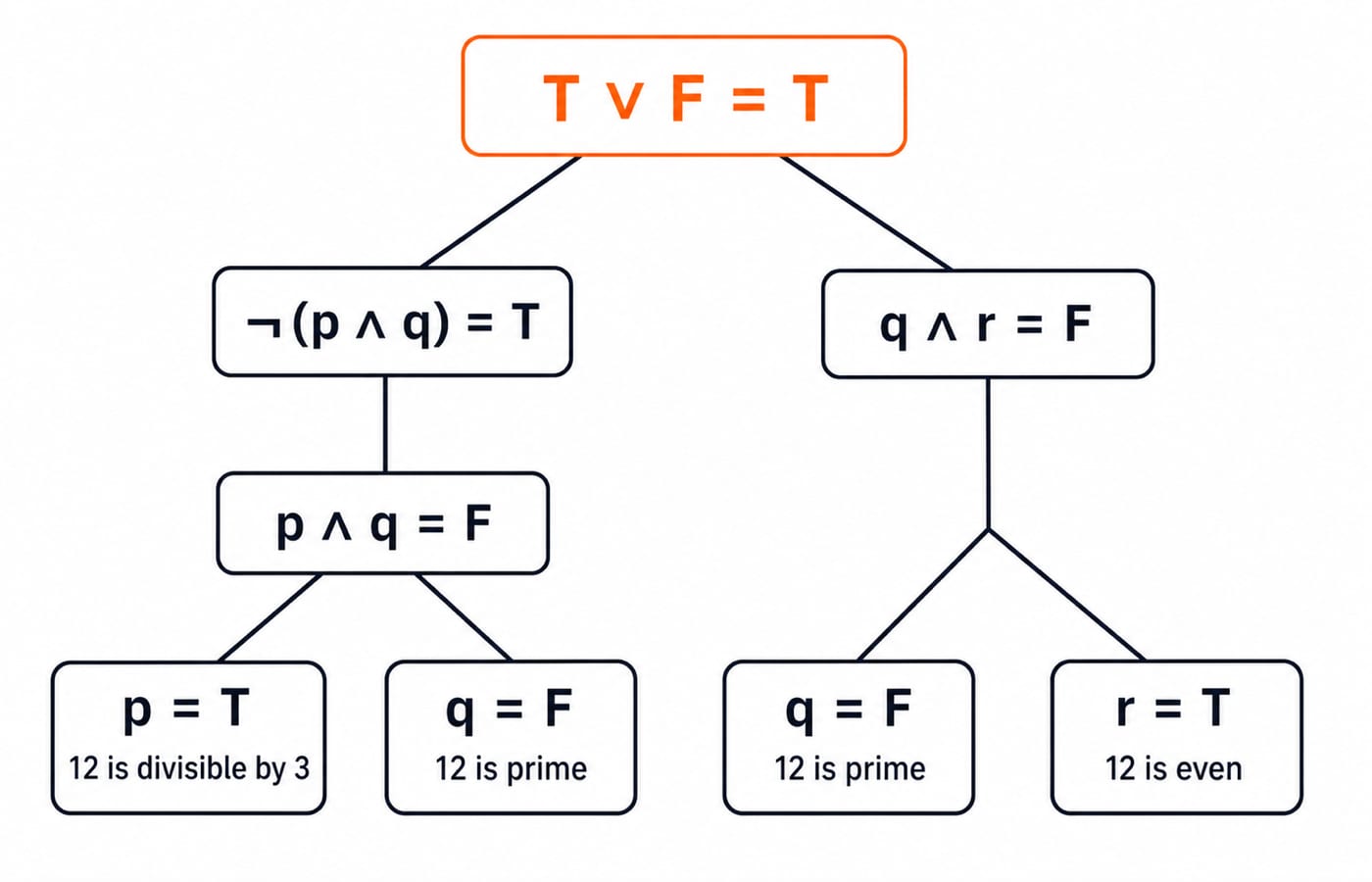
Evaluate ¬(p ∧ q) ∨ (q ∧ r) for these fixed propositions:
p: 12 is divisible by 3, sop = Tq: 12 is prime, soq = Fr: 12 is even, sor = T
Do not jump to the final answer. Work from the inner parentheses outwards:
Left conjunction:
p ∧ q = T ∧ F = FNegate that result:
¬(p ∧ q) = ¬F = TRight conjunction:
q ∧ r = F ∧ T = FJoin the branches:
T ∨ F = T
The final truth value is T. Semantically, both “12 is divisible by 3” and “12 is prime” are not true together, so the left branch is true. That makes the inclusive OR true.
Precedence, De Morgan's laws and traps that reverse answers
Honour parentheses first. Outside parentheses, use the working precedence ¬ first, then ∧, then ∨.
For example, take p = F, q = T, and r = F. Standard precedence gives:
¬p ∨ (q ∧ r) = T ∨ (T ∧ F) = T ∨ F = T
Moving the parentheses creates a different expression and a different answer:
(¬p ∨ q) ∧ r = (T ∨ T) ∧ F = T ∧ F = F
De Morgan's laws provide a controlled way to move a negation through parentheses:
¬(p ∧ q) = ¬p ∨ ¬q¬(p ∨ q) = ¬p ∧ ¬q
Verify both with p = T and q = F. For the first law, ¬(p ∧ q) = ¬F = T, while ¬p ∨ ¬q = F ∨ T = T. For the second, ¬(p ∨ q) = ¬T = F, while ¬p ∧ ¬q = F ∧ T = F. The memory rule is simple: negate each proposition and swap AND with OR.
Three errors recur in logical-operator questions:
Negating only one term inside parentheses. Copy the scope exactly, then apply De Morgan's law if needed.
Reading inclusive OR as exclusive OR. Unless “exactly one” is specified, the
T,Trow remains true.Skipping intermediate values. Evaluate the innermost group and write one operator per line.
How questions test logical operators and how to solve reliably
Logical operators commonly appear in four forms: complete a truth table, translate English into symbols, evaluate a compound expression, or decide whether two expressions are equivalent.
Use this five-step routine:
List the truth value of every atomic proposition.
Mark the exact scope of each negation.
Solve expressions inside parentheses.
Evaluate conjunctions.
Evaluate disjunctions and copy the final T/F result.
For equivalence, compare the final columns across every possible input row. Matching on one convenient row proves nothing about the other rows. Once the method is clear, use Propositional and Predicate Logic MCQs: 12 Solved to practise the same process across varied forms.
The short version and the next useful step
Keep this three-rule memory card: NOT flips one truth value, AND needs every input to be true, and inclusive OR needs at least one input to be true. Parentheses and operator scope always outrank a verbal shortcut.
Now reproduce the four-row reference table from memory. Then evaluate ¬(p ∧ q) ∨ (q ∧ r) without notes for p = T, q = F, and r = T. After a short practice set, log the first incorrect intermediate step, not just the final wrong answer, because that reveals whether the problem was scope, precedence, or an operator rule.
Use the GATE preparation hub to place this topic in your broader plan. For structured mathematics study, continue with Engineering Mathematics. For preparation guidance across subjects, use GATE Guidance by Sanchit Sir.
Keep learning
Graphical Method in Linear Programming: Feasible Region, Corner Points and Optimality with a Worked Example
Learn the two-variable graphical method in the right order, then solve and audit a complete maximisation model without trusting the sketch alone.
Updated 21 Oct 20265 min readEngineering Mathematics
Duality in LP: Construct the Dual, Solve a Worked Example, and Apply Key Properties
Learn a reliable matrix-first method to form an LP dual, solve both programs to value 21, and use duality properties to check optimality and avoid sign errors.
Updated 17 Oct 20266 min readEngineering Mathematics
Commutative Property and Abelian Groups: Tests, Worked Examples and Exam Traps
Learn how to separate commutativity from the other group axioms, test custom operations step by step, and avoid the usual classification traps.
Updated 13 Oct 20266 min readEngineering Mathematics

Closure, Semigroup and Monoid: Worked Algebraic Structure Examples
Learn a reliable order for testing closure, associativity and identity. Worked tables and counterexamples show exactly when a structure becomes a semigroup or monoid.
Updated 9 Oct 20266 min readEngineering Mathematics