Graph Traversal: Walk, Trail, Path, Circuit and Connectivity with Worked Examples
Use one six-vertex graph to distinguish walks, trails, paths, circuits and cycles. Then test reachability, components and a bridge with exact sequences.
KnowledgeGate Team
Exam prep & CS education
Updated 24 Aug 20265 min read
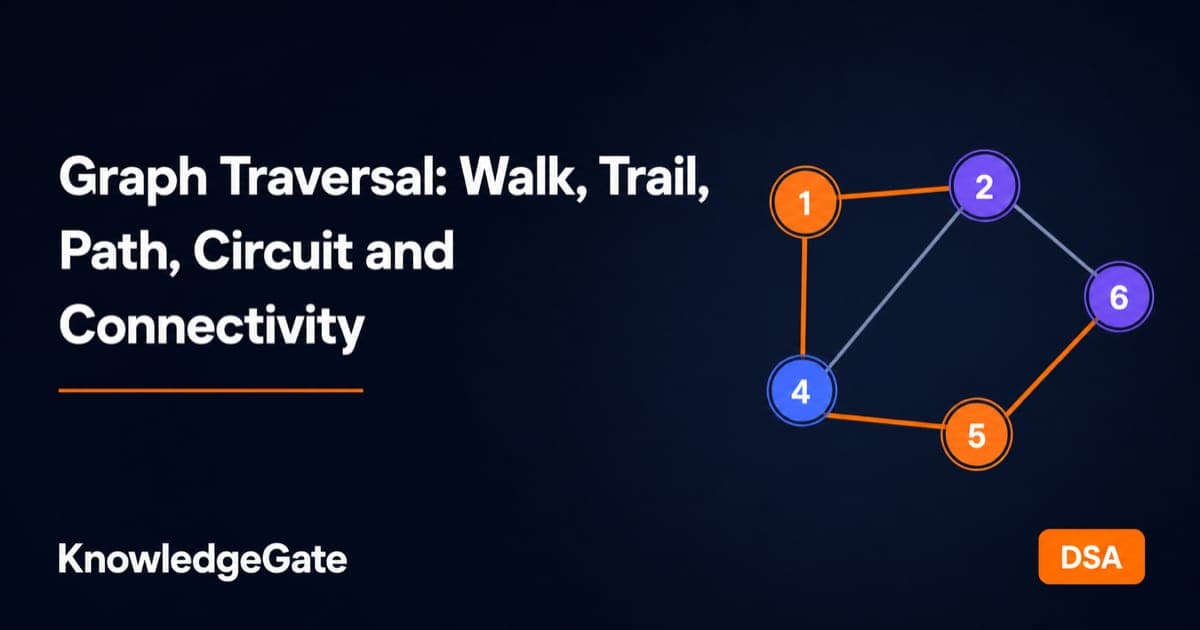
A route through a graph may repeat a vertex, repeat an edge, return to its starting point, or help us reach every vertex. Each change gives the route a different name. Classify routes from definitions, not memory, by checking exact sequences in a fixed undirected graph and testing connectivity. The GATE CS Exam Preparation hub places this topic in the broader study journey.
Related reading: graph theory and graph representation MCQs.
1. Fix the graph and the notation before classifying a route
Use the undirected simple graph , where
and
.
A proposed vertex sequence is a walk only when every consecutive pair is joined by an edge in . Since the graph is undirected, and mean the same edge traversed in opposite directions. The length of a walk is the number of edge traversals, not the number of vertices written. Thus, contains four written vertices but uses the three edges , so its length is 3. By contrast, is not a walk because is absent. This edge-list-first habit also prevents a plausible sketch from hiding an invalid step in the sequence.
The degrees provide a quick check on the drawing: , , , , , and . Their sum is , which agrees with the eight undirected edges.
2. Walk, trail, path, closed walk, circuit and cycle
A walk may repeat vertices and edges. A trail is a walk with no repeated edge. A path is a walk with no repeated vertex. Therefore, every path is a trail and every trail is a walk, but neither converse is guaranteed.
For closed routes, use the following precise hierarchy. A closed walk has the same first and last vertex. A circuit is a closed trail. A cycle is a circuit with no repeated vertex except the first vertex appearing again at the end. If a question supplies a different convention for the words circuit and cycle, follow that stated convention.
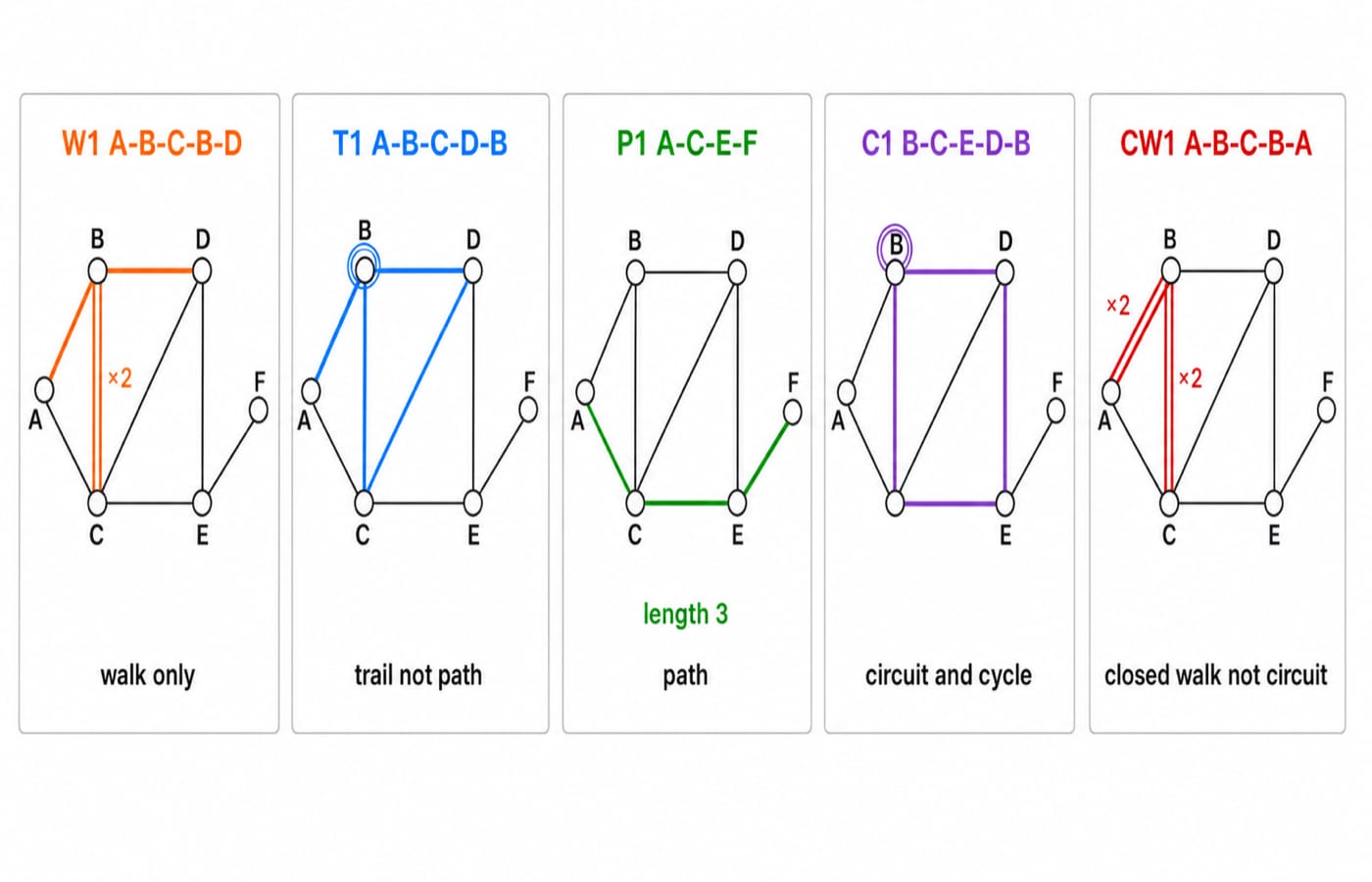
For example, uses four distinct edges and repeats only its endpoint , so it is a length-4 circuit and cycle. The sequence is a length-6 circuit but not a cycle. Its edges are distinct, but appears at the start, in the middle, and at the end. These local definitions lead naturally to graph-wide ideas such as Euler and Hamiltonian circuits, covered in Graph Theory: Euler, Hamiltonian, Coloring for GATE CS.
3. Worked example: classify five sequences step by step
Use the same decision order every time: validate each consecutive pair, write the traversed edges, count those edges, audit repeated edges, audit repeated vertices, compare the endpoints, and only then classify.
Sequence | Edge list | Length | Repeated vertex? | Repeated edge? | Closed? | Most specific classification |
|---|---|---|---|---|---|---|
, all pairs valid | 4 | Yes, | Yes, undirected edge is used twice | No | Walk only | |
, all pairs valid | 4 | Yes, | No | No, | Trail, not path | |
, all pairs valid | 3 | No | No | No | Path, therefore also trail and walk | |
, all pairs valid | 4 | Only endpoint | No | Yes | Circuit and cycle, therefore also closed trail and closed walk | |
, all pairs valid | 4 | Yes, and | Yes, and are each used twice | Yes | Closed walk, not circuit |
The edge audit is decisive. In , writing and then does not create two edges because the graph is undirected. In , vertex repeats, but the edges do not, so the sequence remains a trail. In , the matching endpoints make the trail closed, and no internal vertex repeats, so it satisfies both circuit and cycle.
Keep the containment directions fixed:
The reverse implications do not generally hold.
4. Connected graphs, reachability, components and a bridge
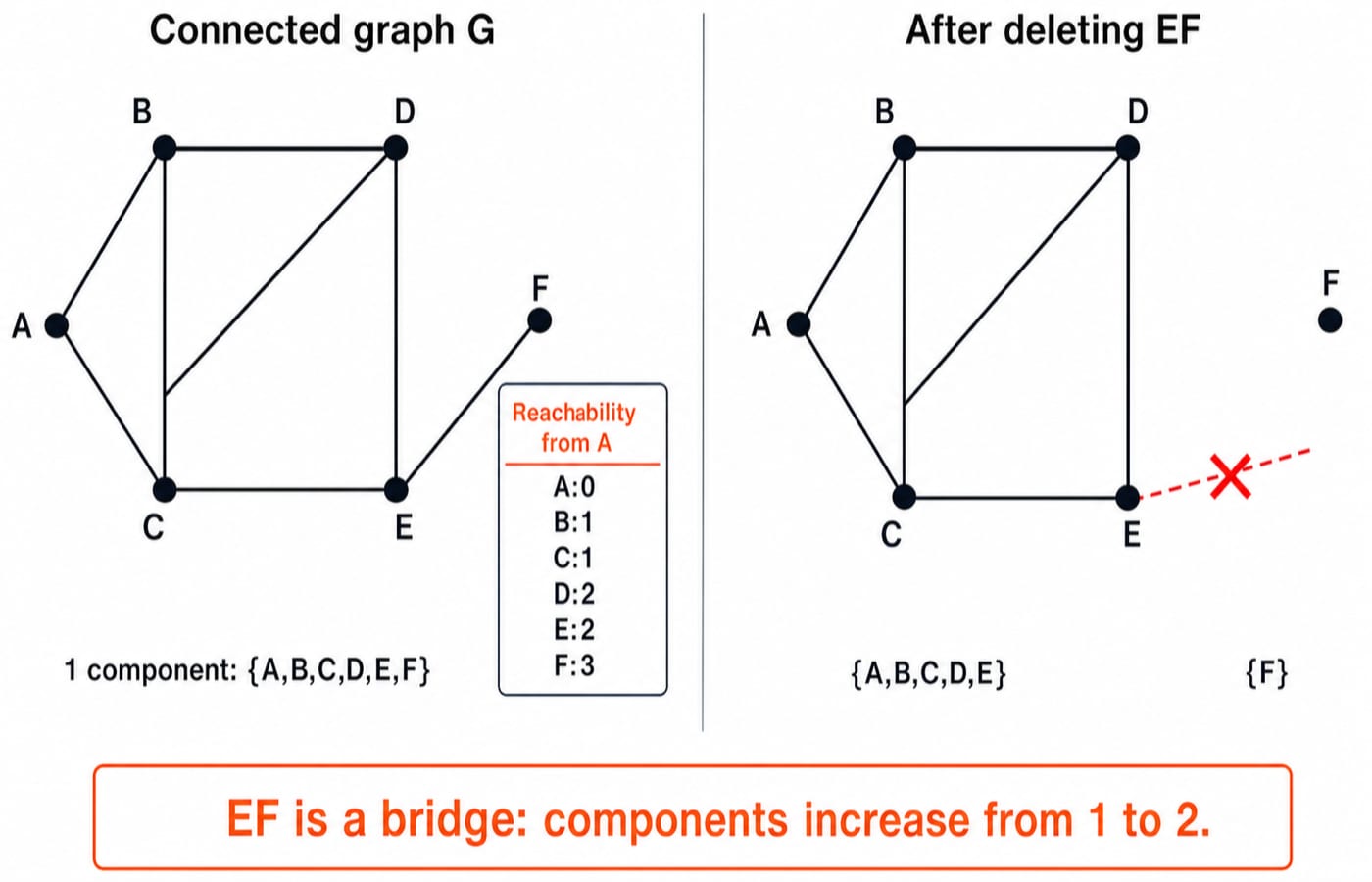
Two vertices and are connected when some path joins them. An undirected graph is connected when every pair of vertices is connected. To test , start at and find one shortest path to every vertex:
Vertex | One shortest path from | Distance |
|---|---|---|
, the length-0 path | 0 | |
1 | ||
1 | ||
2 | ||
2 | ||
3 |
All six vertices are reachable from , so is connected. Connected does not mean complete. There is no edge , yet the path connects those vertices. Connectivity asks whether some path exists between each pair. It does not require every pair to be adjacent, and it does not require one particular route to visit every vertex.
Now delete only . Vertex becomes isolated, while remain mutually reachable. The new graph has exactly two connected components, and . In the original graph, is therefore a bridge because removing it increases the component count from 1 to 2.
5. Common traps and the correction for each
Counting written vertices as the length. List the edges first. has five written vertices but four traversed edges. Likewise, fails before classification because is missing.
Treating a repeated vertex as a repeated edge. Audit vertex identity and edge identity separately. repeats but no edge, so it is still a trail.
Calling every closed walk a circuit. Returning to the start is not sufficient. repeats both and , so it is not a circuit.
Reading connected as complete. Test whether every vertex is reachable by some path. A route does not itself have to visit all vertices for the graph to be connected.
Reversing is valid here because is undirected, but a directed graph requires the arc in the direction you traverse it.
6. How exam-style questions test these ideas
Questions can ask you to classify a supplied sequence, calculate its length, decide whether deleting an edge disconnects a graph, or count connected components. Here are four rapid checks from :
is not a walk because is absent.
is a trail but not a path. Its edges are distinct, while vertex repeats.
is a length-3 circuit and cycle.
Deleting leaves 2 components.
Practise adjacent Graph Theory problems with Graph Theory MCQs: 12 Solved Euler, Coloring, Trees, then attempt a mixed set under a time limit.
A walk or path describes a vertex-edge sequence. For algorithmic traversal using search procedures, study Graph Algorithms: BFS, DFS and Shortest Paths separately. Route classification checks the sequence itself, while BFS and DFS specify procedures for visiting vertices.
7. The short version and the next study step
For any sequence, validate consecutive edges, count edge traversals, check repeated edges, check repeated vertices, and compare the endpoints. For connectivity, test reachability. Remember: paths are trails, trails are walks, cycles are circuits, and circuits are closed walks.
Now classify without looking back. Then remove and list the components. If you want a structured route through the wider subject, continue with GATE Guidance by Sanchit Sir. Your concrete next action is simple: draw the edge list beside every proposed sequence before naming it, then state the reason in one line.
Keep learning
Graphical Method in Linear Programming: Feasible Region, Corner Points and Optimality with a Worked Example
Learn the two-variable graphical method in the right order, then solve and audit a complete maximisation model without trusting the sketch alone.
Updated 21 Oct 20265 min readEngineering Mathematics

Duality in LP: Construct the Dual, Solve a Worked Example, and Apply Key Properties
Learn a reliable matrix-first method to form an LP dual, solve both programs to value 21, and use duality properties to check optimality and avoid sign errors.
Updated 17 Oct 20266 min readEngineering Mathematics

Commutative Property and Abelian Groups: Tests, Worked Examples and Exam Traps
Learn how to separate commutativity from the other group axioms, test custom operations step by step, and avoid the usual classification traps.
Updated 13 Oct 20266 min readEngineering Mathematics

Closure, Semigroup and Monoid: Worked Algebraic Structure Examples
Learn a reliable order for testing closure, associativity and identity. Worked tables and counterexamples show exactly when a structure becomes a semigroup or monoid.
Updated 9 Oct 20266 min readEngineering Mathematics