

Linear Inequalities and Modulus Questions with Solutions: 11 Solved MCQs
Work through 11 linear inequalities and modulus MCQs with complete solutions. Each answer shows the case, graph feature, endpoint or algebraic step that decides it.
KnowledgeGate Team
Exam prep & CS education
Updated 14 Nov 20266 min read
Linear inequalities and modulus questions demand different checks: reverse a sign only after multiplying by a negative, read a modulus graph from its vertex, and test endpoints before comparing algebraic expressions. Work each question first, then use the calculation to identify the sign, case, endpoint or theorem that controls the result. The worked calculations provide focused quantitative aptitude practice.
1. Rules to Recall Before You Start
Keep these three rules beside you:
A negative multiplier reverses the inequality sign. For example, (-2x>6). Dividing both sides by (-2) gives (x<-3), not (x>-3).
A strict modulus bound becomes a double inequality. If (|x-a|<r), then (a-r<x<a+r). Thus (|x-2|<3) becomes (-1<x<5).
A linear expression on independent closed intervals reaches an extreme at endpoints. To minimise it, choose the endpoint that makes each signed term as small as possible.
Modulus and remainder are different ideas. Here, (|x|) means the absolute value of (x). Question 10 asks for a polynomial remainder and uses the Remainder Theorem. Neither idea should be confused with a modulo operation.
After choosing an option, compare it with the controlling calculation and the final value or expression in the solution.
2. Modulus Identity by Case Analysis
Question 1
The expression (((x+y) - |x-y|)/(2)) is equal to :
(a) The maximum of (x) and (y)
(b) The minimum of (x) and (y)
(c) 1
(d) None of the above
Solution: Split the expression into the two possible orderings of (x) and (y).
If (x>= y), then (|x-y|=x-y). Therefore,
(x+y-|x-y|)/(2)=(x+y-x+y)/(2)=y,
which is the smaller value. If (x<y), then (|x-y|=y-x), so
(x+y-y+x)/(2)=x,
again the smaller value.
For a numerical check, ((x,y)=(5,3)) gives 3, while ((2,4)) gives 2. In contrast, replacing the minus sign with a plus makes (((x+y)+|x-y|)/2) equal to the maximum. Answer: (b), the minimum of (x) and (y).
3. Read Absolute-Value Graphs from Their Vertex
Question 2
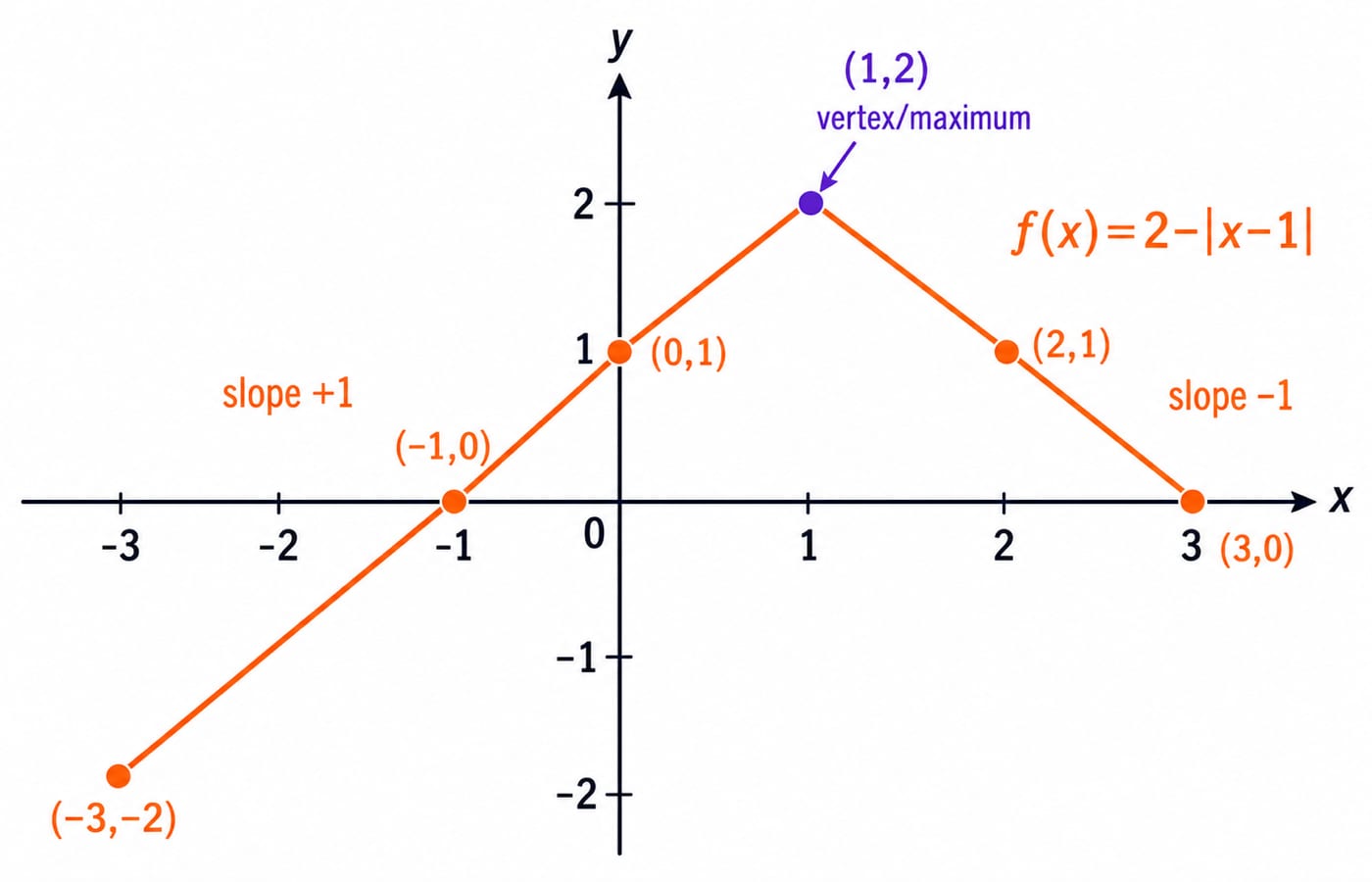
Choose the correct expression for (f(x)) given in the graph.
(a) (f(x) = 1 - |x - 1|)
(b) (f(x) = 1 + |x - 1|)
(c) (f(x) = 2 - |x - 1|)
(d) (f(x) = 2 + |x - 1|)
Solution: The graph has its peak at ((1,2)). The horizontal shift is therefore (x-1), and the vertical shift is 2. Because the V opens downwards, the modulus must be subtracted. This gives (f(x)=2-|x-1|).
Check three points: (f(1)=2), (f(3)=0), and (f(-3)=-2). The left arm has slope (+1), and the right arm has slope (-1). Answer: (c), (f(x)=2-|x-1|).
Question 3
The plot of y=|x-2| is a:
(a) Line
(b) Parabola
(c) V-shaped curve
(d) Sinusoidal curve
Solution: Write (y=x-2) for (x>=2), and (y=2-x) for (x<2). These two straight rays meet at ((2,0)), creating a sharp vertex. The points ((0,2)), ((2,0)), and ((4,2)) also show symmetry about (x=2). Answer: (c), a V-shaped curve.
Question 4
Which of the following functions will generate a V-shaped plot in 2D?
(a) y=|x|
(b) y=x^2
(c) y=sin(x)
(d) y=ex
Solution: For (y=|x|), we have (y=x) when (x>=0) and (y=-x) when (x<0). The two straight rays meet at ((0,0)), forming a sharp corner. By comparison, (x^2) is a smooth parabola, sine is periodic, and the exponential curve is smooth. Answer: (a), (y=|x|).
4. Bound Variables and Minimise a Linear Expression
Question 5
If N is a prime number and 9N is less than 180 and greater than 81 then 13N - 7 is
(a) 107
(b) 162
(c) 123
(d) 156
Solution: Translate the condition as (81<9N<180). Dividing throughout by positive 9 keeps both inequality signs unchanged:
9<N<20.
The prime candidates are (11,13,17,19). Their corresponding values of (13N-7) are (136,162,214,240). Only 162 occurs among the choices, so (N=13).
This candidate-first approach fits the wider idea of learning algebra before advanced CAT quant. Answer: (b), 162.
Question 6
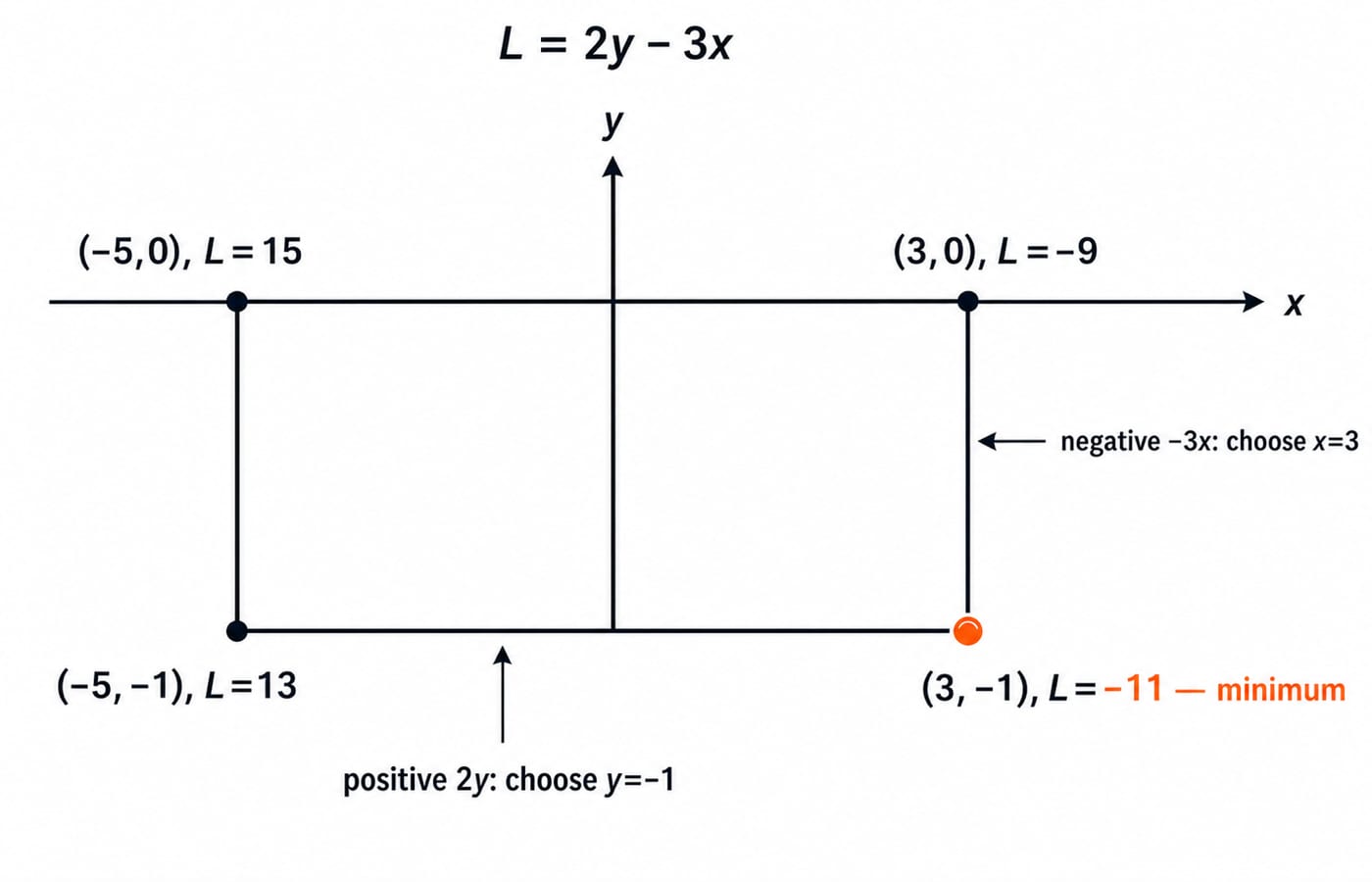
If -5 <= x <= 3 and -1 <= y <= 0, then the minimum value of 2y - 3x is:
(a) -8
(b) -9
(c) -11
(d) -10
Solution: The positive term (2y) is smallest at (y=-1), where it equals (-2). The coefficient of (x) is negative, so (-3x) is smallest at the largest allowed (x), namely (x=3), where it equals (-9). Hence the minimum is
-2-9=-11,
attained at ((3,-1)). A four-corner check gives 13, 15, (-11), and (-9) at ((-5,-1)), ((-5,0)), ((3,-1)), and ((3,0)), respectively. Answer: (c), (-11).
Question 7
If -5 <= x <= 1 and -1 <= y <= 5, then the minimum value of 2y - 3x is:
(a) -5
(b) -9
(c) -8
(d) -10
Solution: Choose (y=-1), which makes (2y=-2). Since the coefficient of (x) is negative, choose the largest allowed value, (x=1), which makes (-3x=-3). The minimum is therefore (-2-3=-5) at ((1,-1)).
Checking all four corners gives 13, 25, (-5), and 7 at ((-5,-1)), ((-5,5)), ((1,-1)), and ((1,5)). Answer: (a), (-5).
5. Solve Exponent and Radical Comparisons Carefully
Question 8
If (3^((x+y)) = 81) and (81^((x-y)) = 3), then what is the value of (x)?
(a) 17/16
(b) 17/8
(c) 17/4
(d) 15/4
Solution: Since (81=3^4), the first equation gives (x+y=4). Rewrite the second equation using the same base:
(3^4)^(x-y)=3^1.
Therefore (4(x-y)=1), so (x-y=1/4). Add the two equations:
2x=4+1/4=(17)/(4).
Dividing by 2 gives (x=17/8). Answer: (b), (17/8).
Question 9
Which of the following is true?
(a) (sqrt(3)+sqrt(7)=sqrt(10))
(b) (sqrt(3)+sqrt(7)<= sqrt(10))
(c) (sqrt(3)+sqrt(7)<sqrt(10))
(d) (sqrt(3)+sqrt(7)>sqrt(10))
Solution: Both sides are positive, so comparing their squares is safe. The left side gives
(sqrt(3)+sqrt(7))^2=3+7+2sqrt(21)=10+2sqrt(21)>10.
The square of the right side is ((sqrt(10))^2=10). Therefore (sqrt(3)+sqrt(7)>sqrt(10)).
The trap is assuming that a square root distributes over addition. It does not. Answer: (d), (sqrt(3)+sqrt(7)>sqrt(10)).
6. Use Substitution for Remainders and One-Sided Limits for Continuity
Question 10
What will be the remainder when we divide ((x^(71) + 71)) by ((x + 1))?
(a) 71
(b) 70
(c) 1
(d) 2
Solution: Let (P(x)=x^(71)+71). When dividing by (x+1), the Remainder Theorem says the remainder is (P(-1)). Since 71 is odd, ((-1)^(71)=-1). Thus (P(-1)=-1+71=70).
Answer: (b), 70.
Question 11
Piecewise function supplied for Question 11
where [x] denotes the greatest integer <= x. If f is to be continuous at x = 0, then a must be
(a) 0
(b) 1
(c) 2
(d) -1
Solution: Here, ([x]) is the floor function, not ordinary brackets. For (0<= x<1), ([x]=0). Therefore the right-hand limit is (cos0=1), and the defined value is also (f(0)=1).
From the left, (|x| -> 0), so (|x|+a -> a). Continuity at zero requires the left-hand limit, right-hand limit and function value to agree. Hence (a=1). Answer: (b), (a=1).
7. Answer Key, Error Check and Next Practice Step
The compact key is 1-b, 2-c, 3-c, 4-a, 5-b, 6-c, 7-a, 8-b, 9-d, 10-b, 11-b. For every miss, tag the cause as a wrong case split, wrong endpoint, lost exponent or misread graph.
Then solve only those questions again without looking at the options. That short second attempt tells you whether the method is now clear, rather than whether you can recognise an answer you just saw.
For the next practice round, use Aptitude for Placement for placement-focused work or Aptitude for GATE for GATE preparation. If you first need to organise the topics around these questions, follow a broader aptitude study plan. Whichever route you choose, redo Questions 1, 2 and 6 from a blank page. They cover the three habits that matter most here: splitting cases, reading the vertex and choosing the controlling endpoint.
Keep learning
Sync Counter Design MCQs: 11 Solved Questions on Modulus, State Sequences and Excitation Logic
Solve 11 synchronous-counter questions covering modulus boundaries, repeated outputs, common-clock tracing, excitation equations, enables and composite states.
Updated 14 Sep 20267 min readDigital Electronics MCQs
Linear Equations Questions with Solutions: 12 Solved MCQs
Practise 12 linear-equation MCQs that move from direct one-variable equations to ratios, systems and integer constraints, with a check after every solution.
Updated 13 Nov 20267 min readAptitude & Reasoning

Basic Terminologies in Linear Programming: Feasible Solutions, BFS and an Optimal Solution Worked Step by Step
Separate feasible, basic feasible and optimal solutions through geometry, slack variables, vertex enumeration and concise counterexamples.
Updated 25 Sep 20265 min read82 viewsEngineering Mathematics
Factors, Multiples and Prime Factorization: 11 Questions with Worked Solutions
Confusing prime factors with total factors? Attempt these 11 questions, then check each calculation to learn divisor counting, odd and even restrictions, sums and multiples.
Updated 5 Nov 20267 min readDiscrete Mathematics MCQs