

Factors, Multiples and Prime Factorization: 11 Questions with Worked Solutions
Confusing prime factors with total factors? Attempt these 11 questions, then check each calculation to learn divisor counting, odd and even restrictions, sums and multiples.
KnowledgeGate Team
Exam prep & CS education
Updated 5 Nov 20267 min read
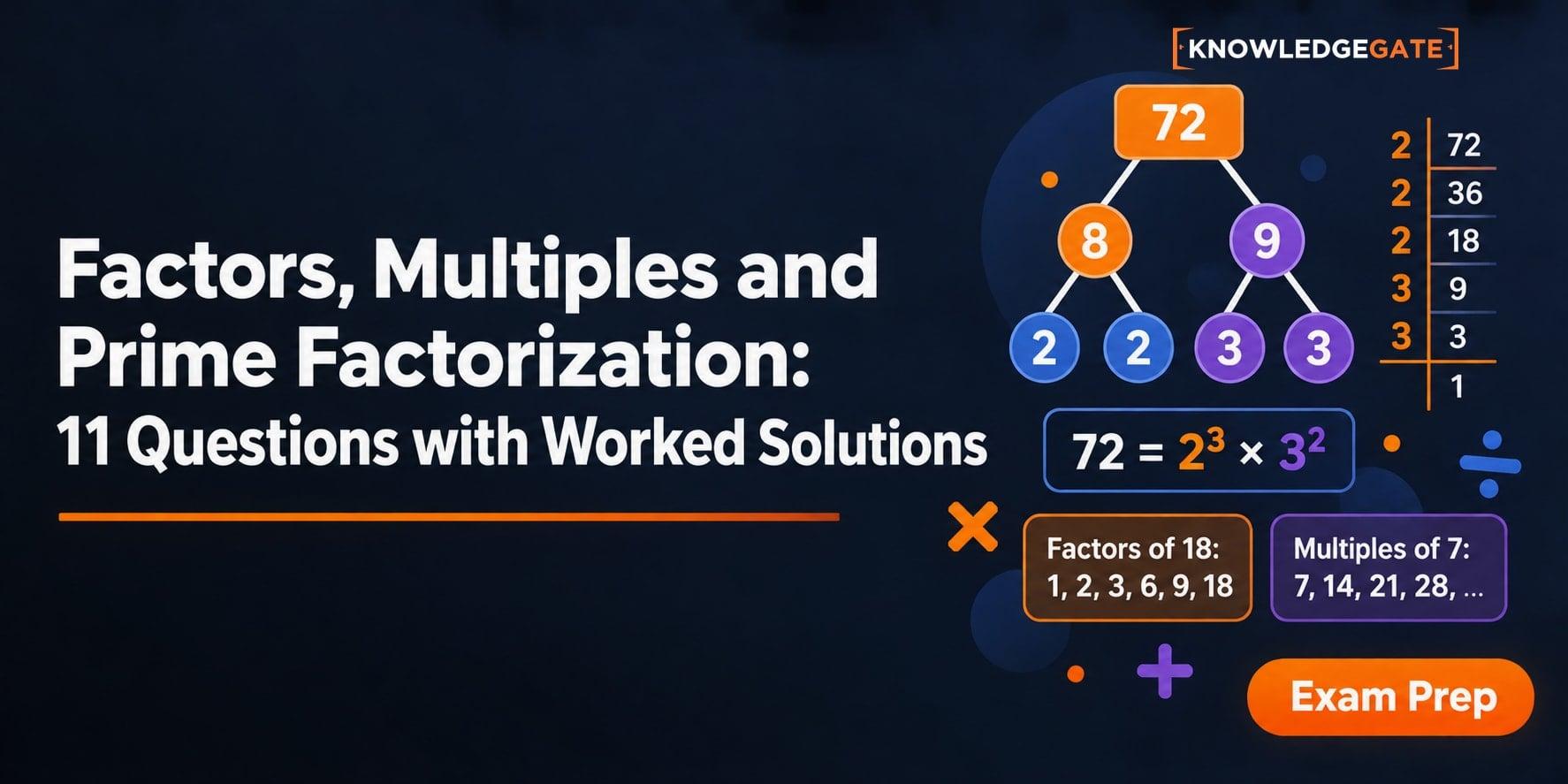
A number's prime factors, its total factors and its multiples answer three different questions, but similar wording can make you choose the wrong method. The calculations move from writing a prime product to adding even divisors and finding shared primes, with a check for each result. Attempt each question before reading the solution, and write one working line rather than guessing from the options. Here, 'factors' means positive divisors, including 1 and the number itself.
1. Prime factorisation and primality: Q1-Q2
Prime factorisation ends only when every factor is prime. Repeated division gives you a reliable route; multiplying the result back checks that no factor has disappeared.
Q1
Express 252 as a product of primes.
(a) 2 * 2 * 3 * 3 * 7
(b) 3 * 3 * 3 * 3 * 7
(c) 2 * 2 * 2 * 3 * 7
(d) 2 * 3 * 3 * 3 * 7
Answer: (a). Divide successively: 252 / 2 = 126, 126 / 2 = 63, 63 / 3 = 21, 21 / 3 = 7, and 7 / 7 = 1.
Thus 252 = 2^2 * 3^2 * 7. Check: 4 * 9 * 7 = 36 * 7 = 252. Writing 4 * 9 * 7 checks the value, but it is not itself a product of primes because 4 and 9 are composite. Revisit the worked prime-factorisation page after your attempt.
Q2
Which of the following are prime numbers?
(a) 241
(b) 303
(c) 111
(d) 121
Answer: (a), 241. Since sqrt 241 < 16, test the primes 2, 3, 5, 7, 11 and 13. None divides 241: the last three give remainders 3, 10 and 7 respectively.
Why stop there? A composite number must have a prime divisor no greater than its square root; otherwise both factors would be too large. The other choices fail immediately: 303 = 3 * 101, 111 = 3 * 37, and 121 = 11^2. Being odd does not make a number prime.
2. Count all positive divisors: Q3-Q5
For a prime power p^k, a divisor can use exponent 0 through k, giving k + 1 choices. Multiply the choices for different primes because each choice is independent. Exponent zero matters: it lets a prime be absent.
Q3
How many factors does 400 have?
(a) 8
(b) 10
(c) 12
(d) 15
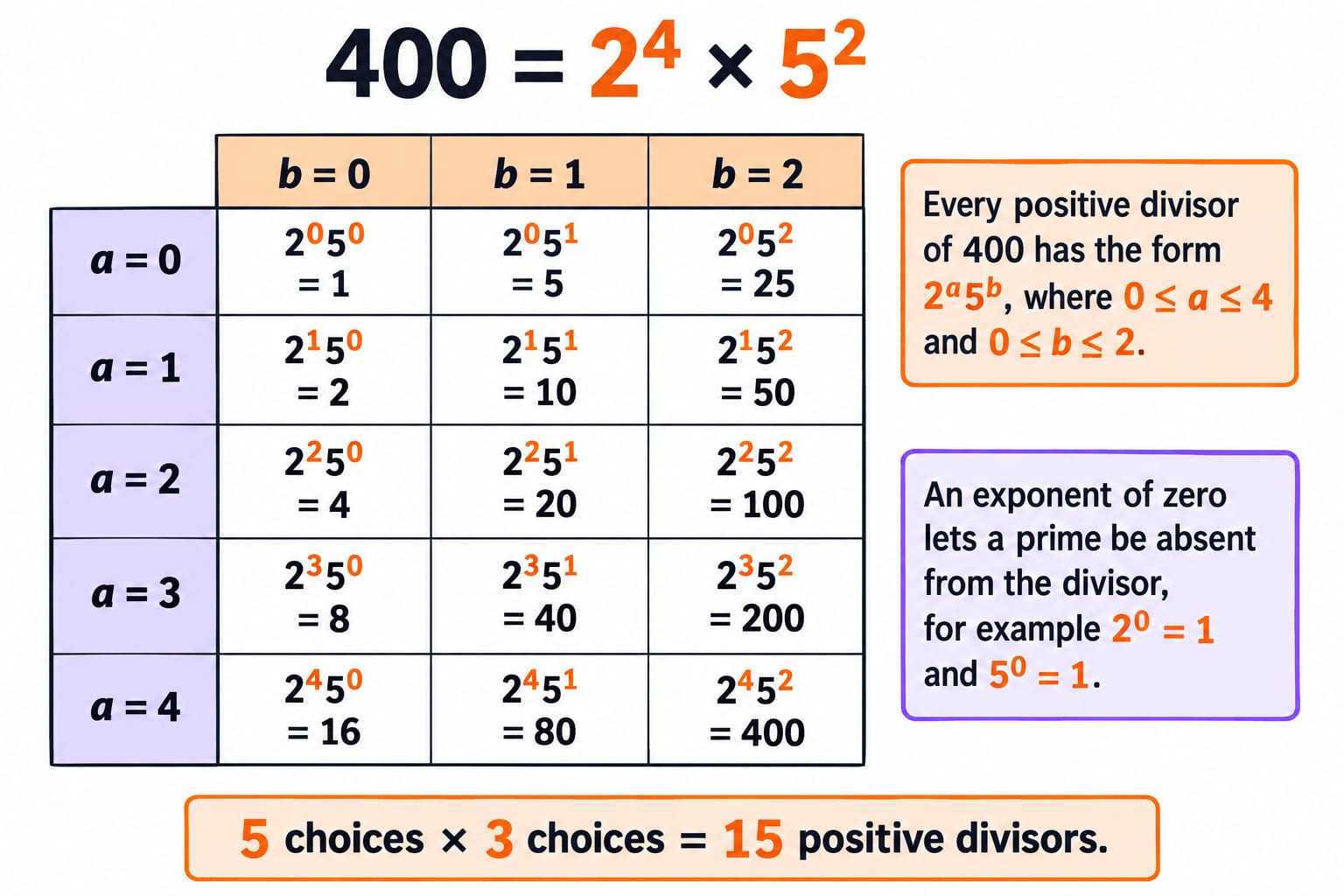
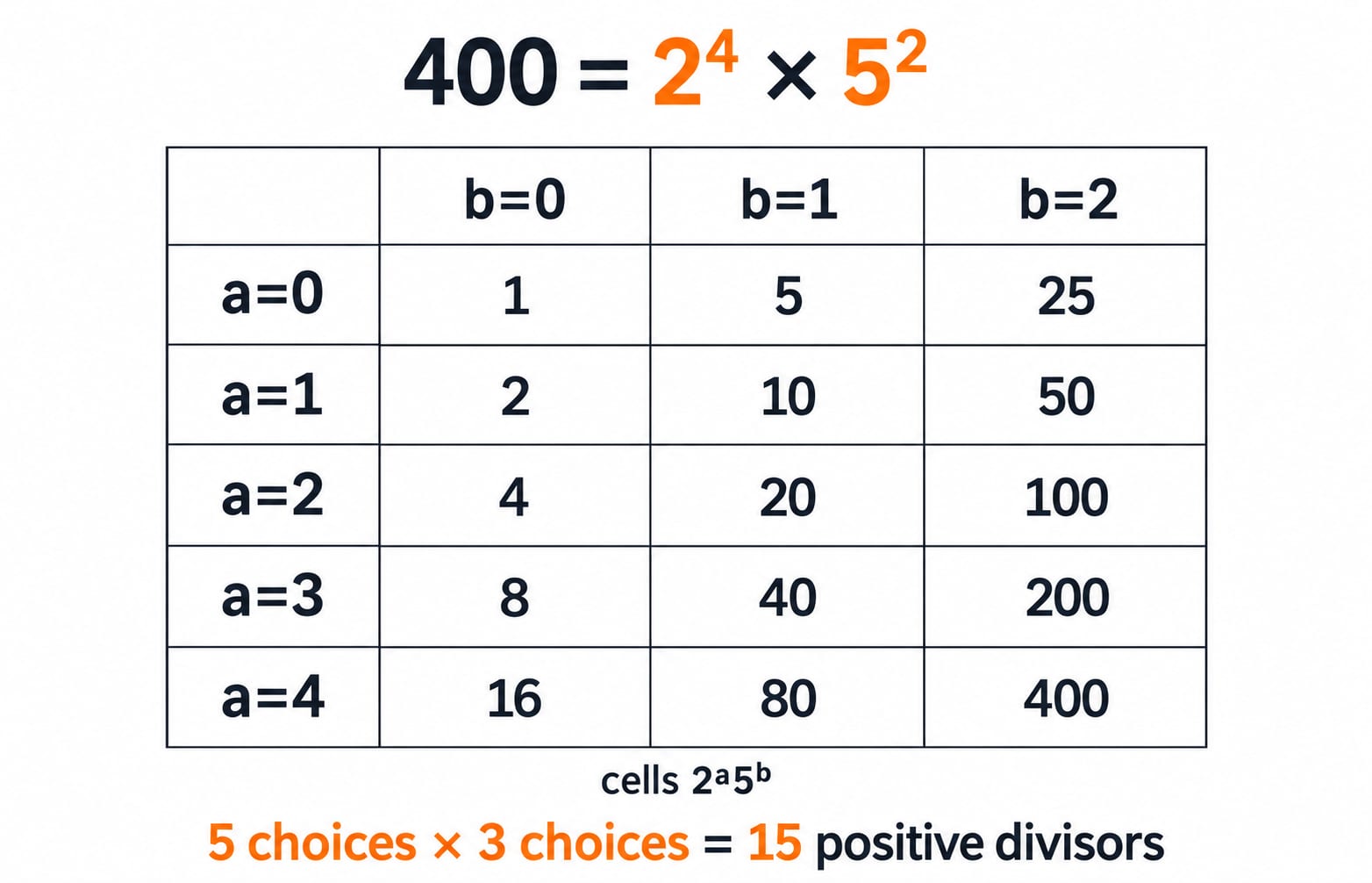
Answer: (d), 15. First, 400 = 16 * 25 = 2^4 * 5^2. Every divisor has the form 2^a5^b, where a = 0, 1, 2, 3, 4 and b = 0, 1, 2. That gives 5 * 3 = 15 distinct divisors, including 1 and 400.
The 400 divisor-count solution accompanies this question. Each cell below represents one choice of the two exponents.
Q4
Find out the number of factors of the number 6222?
(a) 16
(b) 15
(c) 14
(d) 18
Answer: (a), 16. Factorise fully:
6222 = 2 * 3111 = 2 * 3 * 1037 = 2 * 3 * 17 * 61.
All four primes have exponent 1, so the divisor count is (1 + 1)^4 = 16. Four is the number of distinct prime factors, not the total number of divisors. Each prime can be included or omitted.
If finding the initial factors slows you down, practise Divisibility Rules: Digit Sums and Missing-Digit Examples.
Q5
Find the number of divisors of 1728?
(a) 20
(b) 8
(c) 28
(d) 30
Answer: (c), 28. Use 1728 = 12^3 = (2^2 * 3)^3 = 2^6 * 3^3. Therefore the count is (6 + 1)(3 + 1) = 7 * 4 = 28.
Applying "exponent plus one" directly to 12^3 would count only 1, 12, 144 and 1728. It misses divisors such as 2 and 3 because 12 is composite. Split composite bases before counting exponent choices.
3. Restrict the exponents for odd and even factors: Q6-Q7
An odd divisor contains no factor of 2. An even divisor contains at least one. Translate those conditions into allowed exponents before multiplying the choices; do not simply halve the total divisor count.
Q6
How many factors of 2^4* 5^3 * 7^4are odd numbers?
(a) 100
(b) 99
(c) 20
(d) 24
Answer: (c), 20. A divisor is 2^a5^b7^c. To make it odd, set a = 0. The remaining exponents can be b = 0, 1, 2, 3 and c = 0, 1, 2, 3, 4.
Hence there are 1 * 4 * 5 = 20 odd divisors. The total divisor count is 5 * 4 * 5 = 100, which explains option (a). Subtracting gives 80 even divisors, so odd and even divisors are not equally numerous. Compare your exponent choices with the odd-factor solution.
Q7
If N = 4P, where P is a prime number greater than 2, how many different positive even divisors does n have including n?
(a) 0
(b) 8
(c) 5
(d) 4
Answer: (d), 4. Here lowercase n refers to N. Since P is an odd prime, N = 2^2P. An even divisor uses exponent 1 or 2 for the prime 2, and exponent 0 or 1 for P.
That gives 2 * 2 = 4 divisors: 2, 4, 2P and 4P. Check with P = 3: N = 12, whose even divisors are 2, 4, 6 and 12. Including N is essential.
4. A sum of divisors is not a count: Q8
Before selecting a formula, underline the requested operation. Counting divisors tells you how many terms exist; adding divisors tells you their combined value.
Q8
Find the sum of even divisors of 4096 .
(a) 8190
(b) 8760
(c) 8820
(d) 9240
Answer: (a), 8190. Since 4096 = 2^1^2, the even divisors are 2^1, 2^2, ..., 2^1^2. Their sum is a finite geometric series:
S = 2 + 4 + 8 + ... + 4096 = 2(2^1^2 - 1)/(2 - 1) = 2 * 4095 = 8190.
To see the cancellation, double the sum: 2S = 4 + 8 + ... + 8192. Subtract S to obtain S = 8192 - 2 = 8190.
As another check, all positive divisors sum to 2^1^3 - 1 = 8191. Remove the sole odd divisor, 1, leaving 8190. There are 12 even divisors, but 12 answers a count question, not this sum question.
5. Count multiples inside a range: Q9
Factors divide a fixed number. Multiples arise by multiplying a fixed number by successive integers. For a range question, locate the last valid multiple before counting.
Q9
How many numbers between 1 and 400 are divisible by 6?
(a) 70
(b) 66
(c) 68
(d) 72
Answer: (b), 66. The multiples are 6, 12, 18, ..., 396. Since 6 * 66 = 396 and 6 * 67 = 402, the valid multipliers run from 1 through 66.
Equivalently, floor(400/6) = 66. Floor means taking the greatest integer no larger than the quotient, not rounding to the nearest integer. As an arithmetic progression, the count is (396 - 6)/6 + 1 = 65 + 1 = 66. Neither endpoint, 1 nor 400, is divisible by 6, so including or excluding them does not change the answer.
6. Recover shared primes and the HCF: Q10-Q11
When products share some unknown primes, factorise both products and compare. Common prime factors identify the overlap.
Q10
There are four prime numbers written in ascending order. The product of first three is 385 and that of last three is 1001. The last number is:
(a) 9
(b) 13
(c) 15
(d) 12
Answer: (b), 13. Write the four primes as p, q, r, s. The two products pqr and qrs share the middle pair q, r.
Now 385 = 5 * 7 * 11, while 1001 = 7 * 11 * 13. The shared pair is 7, 11, so the ascending sequence is 5, 7, 11, 13. Check both triples: 5 * 77 = 385 and 77 * 13 = 1001. The last prime is therefore 13; the shared-prime worked solution covers this question.
Q11
If a, b are two distinct prime number than highest common factor of a, b is
(a) None of the above
(b) 2
(c) 1
(d) ab
Answer: (c), 1. A prime has only two positive divisors: 1 and itself. Distinct primes share no prime factor, so their only common divisor is 1.
For a = 3 and b = 5, HCF = 1; their product ab = 15 is their LCM. The word "distinct" matters: a prime paired with itself would have that prime as its HCF. Continue with LCM and HCF: Differences with Solved Examples.
7. Factors and multiples: repair the method you missed
Answer key: 1 (a); 2 (a); 3 (d); 4 (a); 5 (c); 6 (c); 7 (d); 8 (a); 9 (b); 10 (b); 11 (c).
Use the missed question to identify the method that failed:
Q1-Q2: finish the prime factorisation and test only prime divisors through the square root.
Q3-Q7: write the allowed exponent range, then count the independent choices for each prime.
Q8-Q9: distinguish a divisor sum from a divisor count and locate the last valid multiple in the range.
For Q10-Q11, factor both products or state why two distinct primes have only 1 as a common divisor. Redo each missed question tomorrow without viewing the key, and write one numerical cross-check.
KnowledgeGate's placement question bank offers further practice on Factors, Multiples & Prime Factorization. For broader practice, explore Placement Preparation & Coding: Exams, Eligibility & Courses. If you want a structured next step, consider the Aptitude Course for Placement.
Go deeper with the full courseDiscrete Mathematics
Keep learning
Introduction and Types of Data MCQs: 11 Questions with Worked Solutions
Separate counts from measurements, read histograms, calculate grouped means and test distribution, trend and price-index rules with worked questions.
Updated 31 Oct 20267 min readDiscrete Mathematics MCQs
Linear Inequalities and Modulus Questions with Solutions: 11 Solved MCQs
Work through 11 linear inequalities and modulus MCQs with complete solutions. Each answer shows the case, graph feature, endpoint or algebraic step that decides it.
Updated 14 Nov 20266 min readAptitude & Reasoning

K-Map Structure and Prime Implicants: A Worked 4-Variable Example for GATE
Learn how a 4-variable K-map is laid out, why Gray-code adjacency matters, and how one eight-minterm example leads to three PIs, two EPIs, and a minimum SOP.
Updated 17 Sep 20265 min read87 viewsDigital Logic
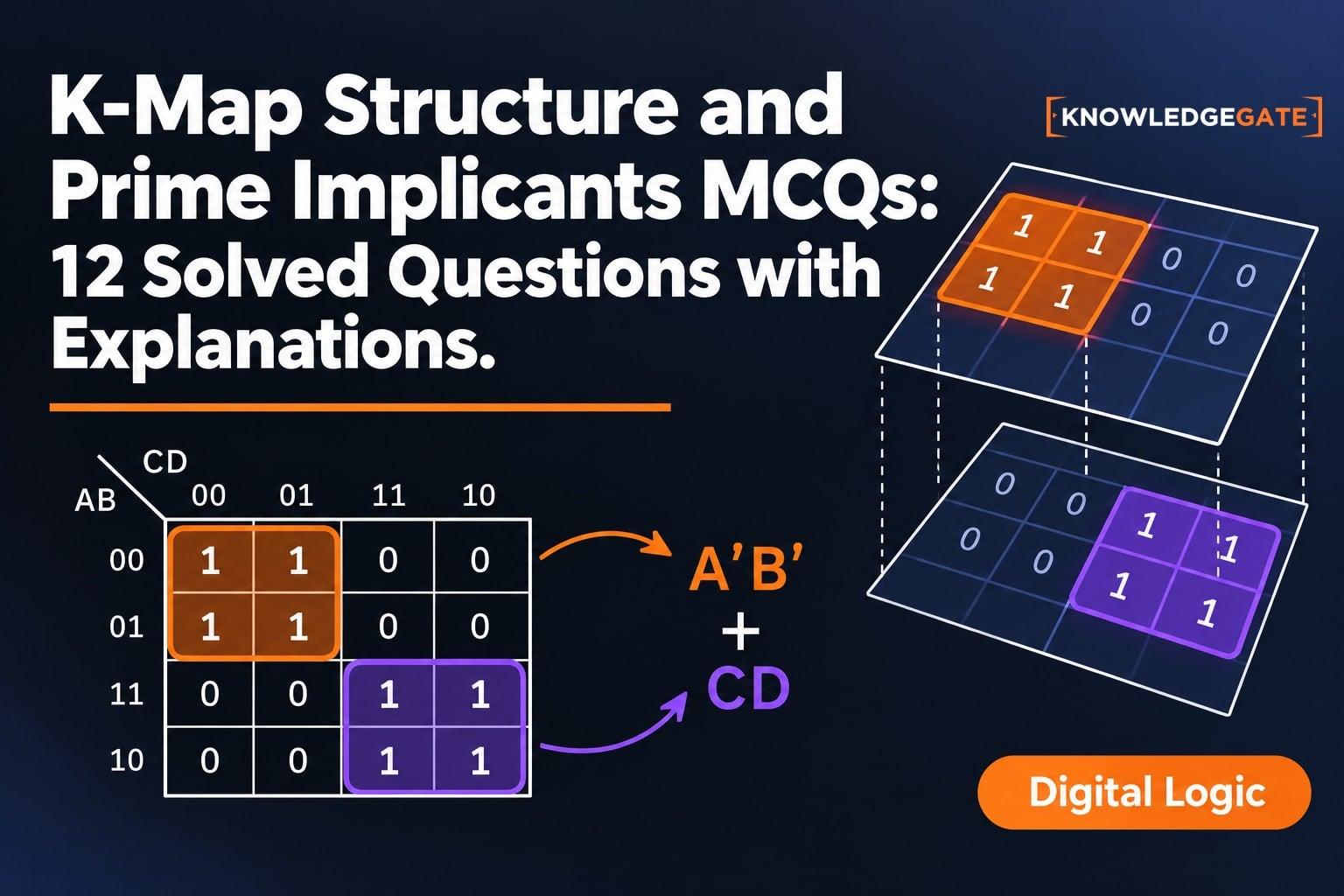
K-Map Structure and Prime Implicants MCQs: 12 Solved Questions with Explanations
Solve 12 K-map questions on cells, adjacency, don't-cares, SOP and POS minimisation, and prime or essential prime implicant counting.
Updated 10 Sep 20268 min read137 viewsDigital Electronics MCQs