Quadratic Equations Questions with Solutions: 12 Solved MCQs
Attempt 12 quadratic-equation MCQs, then check complete solutions covering the formula, discriminants, graphs, Vieta's relations, modelling, and radix notation.
KnowledgeGate Team
Exam prep & CS education
Updated 26 Oct 20268 min read
Remembering the quadratic formula is not enough when a question asks about transformed roots, a parameter range, or an equation hidden inside a word problem. Attempt each MCQ before reading its solution, and keep your own steps visible. These 12 published question-bank questions move from direct root calculation to discriminants, Vieta's relations, graphs, word problems, and an unknown-base problem. They are a focused practice set, not a representation of any official exam pattern.
Quadratic equations: four tools to keep beside the set
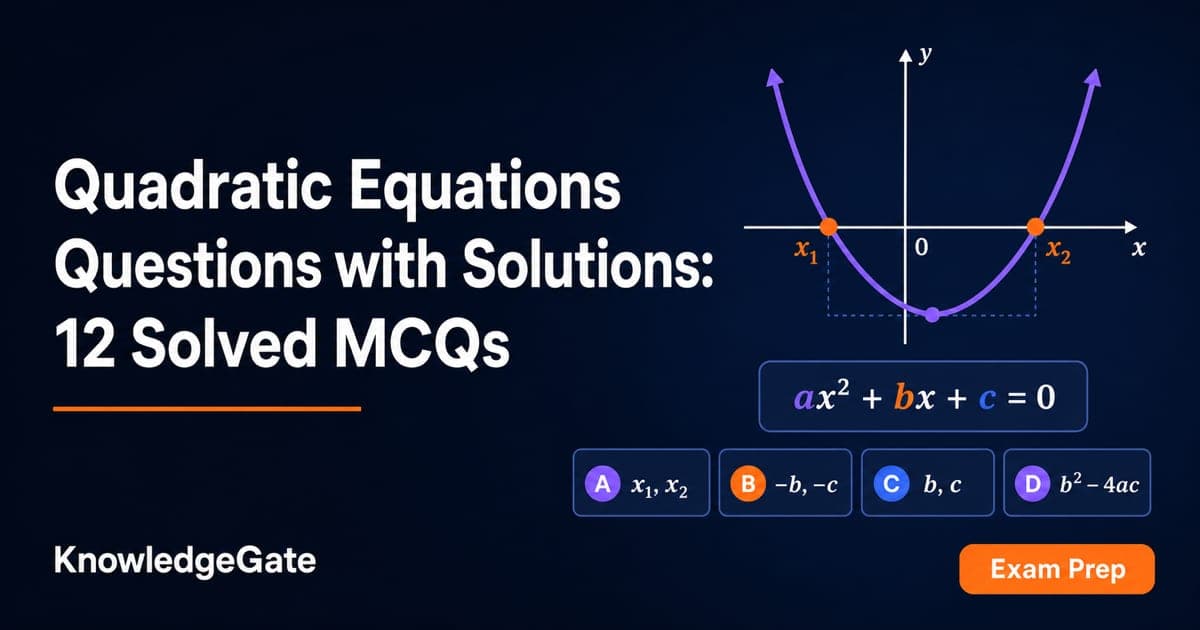
Write a quadratic equation in the standard form ax² + bx + c = 0, where a ≠ 0. Its roots are
x = (-b ± √(b² - 4ac))/(2a).
The discriminant is D = b² - 4ac. If D > 0, there are two distinct real roots. If D = 0, the real roots are equal. If D < 0, there are no real roots.
For roots α and β, Vieta's relations give α + β = -b/a and αβ = c/a. For reciprocal roots 1/α and 1/β, the sum becomes (α + β)/(αβ) and the product becomes 1/(αβ).
Use the Engineering Mathematics course for structured theory and the Aptitude category for broader practice. The CAT Quant: Arithmetic and Algebra First guide shows where algebra fits in a sensible study order.
Questions 1-3: calculate roots and read the discriminant
Question 1: direct quadratic formula
Solve using the quadratic formula: x2 - 2x - 24 = 0
(a) x = -6; x = 4
(b) x = 4; x = 6
(c) x = 6; x = -4
(d) x = -4; x = -6
Solution. Typeset the equation as x² - 2x - 24 = 0, so a = 1, b = -2, and c = -24.
D = (-2)² - 4(1)(-24) = 4 + 96 = 100
Therefore, x = (2 ± 10)/2, which gives x = 6 or x = -4. Answer: (c).
Question 2: irrational coefficients
Find the zeros of the quadratic polynomial √3x² − 8x + 4√3.
(a) −2√3, 2/√3
(b) −2√3, −2/√3
(c) 2√3, 2/√3
(d) 2√3, −2/√3
Solution. Here a = √3, b = -8, and c = 4√3.
D = 64 - 4(√3)(4√3) = 64 - 48 = 16
Thus x = (8 ± 4)/(2√3). The roots are 12/(2√3) = 2√3 and 4/(2√3) = 2/√3. Answer: (c).
Question 3: condition for distinct real roots
The quadratic equation ax^2 + bx + c = 0 has two distinct real roots if:
(a) b^2 - 4ac < 0
(b) b^2 - 4ac > 0
(c) b^2 - 4ac = 0
(d) More than one of the above
(e) None of the above
Solution. Let D = b² - 4ac. A negative D gives no real roots, zero gives equal real roots, and a positive D gives two distinct real roots. Answer: (b).
Questions 4-6: parameter ranges, the vertex, and root spacing
Question 4: count integer parameters that keep roots real
x² - 9x + |k| = 0 has real roots. How many integer values can k take?
(a) 20
(b) 41
(c) 40
(d) 21
Solution. Real roots require
D = 81 - 4|k| ≥ 0, so |k| ≤ 81/4 = 20.25.
For integer k, -20 ≤ k ≤ 20: 20 negative values, zero, and 20 positive values, giving 41. At the boundary, k = 20 gives D = 1, while k = 21 gives D = -3. Answer: (b).
Question 5: vertex of a parabola
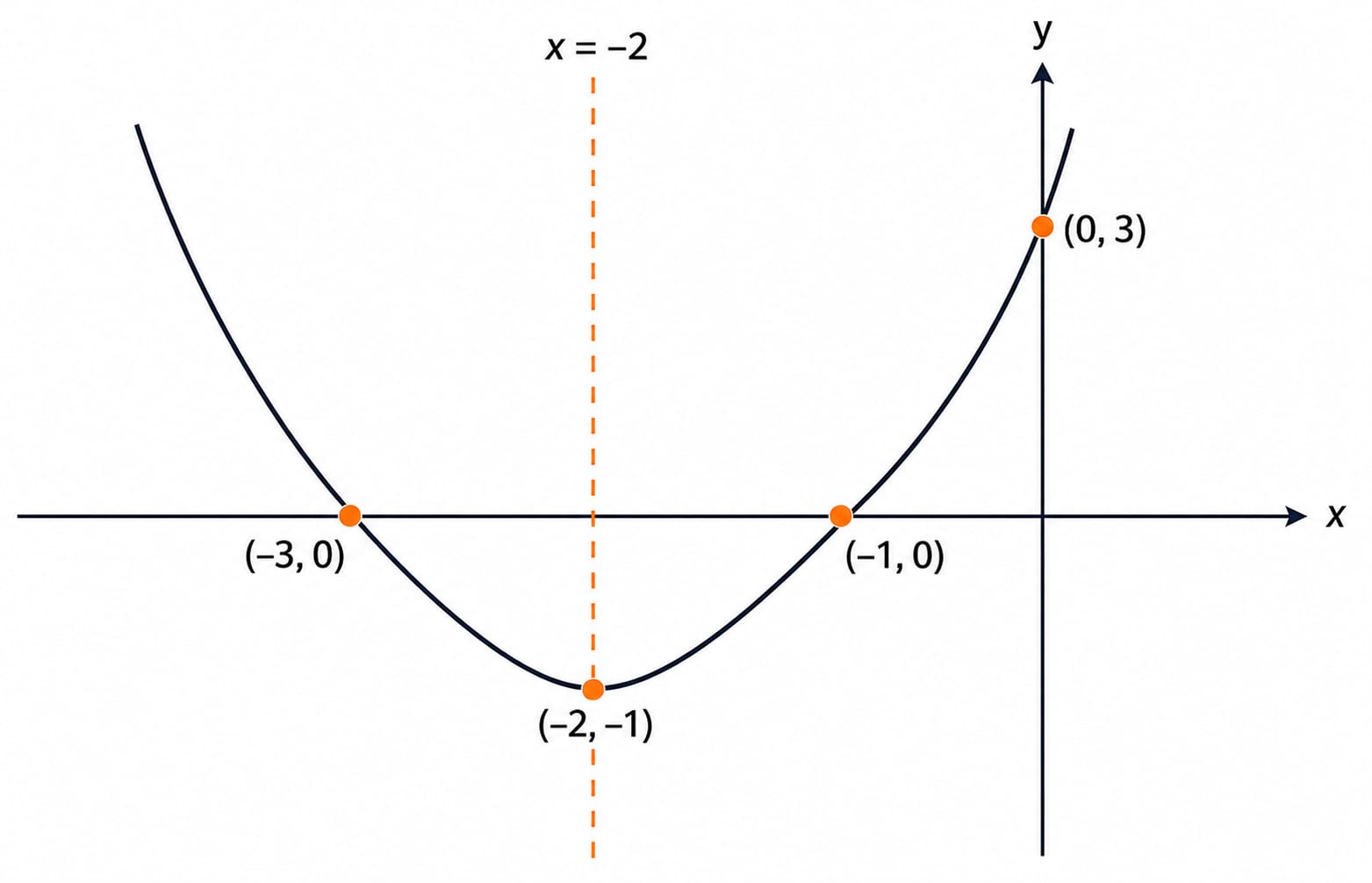
The graph of y = x² + 4x + 3 has its vertex at:
(a) (−2, −1)
(b) (2, 1)
(c) (−1, 3)
(d) (1, 3)
Solution. The vertex has
x_v = -b/(2a) = -4/2 = -2.
Substitution gives y_v = (-2)² + 4(-2) + 3 = -1. Completing the square confirms it: y = (x + 2)² - 1. Answer: (a).
Question 6: consecutive integer roots
If the roots of the equation x² − bx + c = 0 are two consecutive integers, then b² − 4c is
(a) 1
(b) -1
(c) 0
(d) 2
Solution. Let the roots be n and n + 1. Vieta gives b = 2n + 1 and c = n(n + 1). Hence
(2n + 1)² - 4n(n + 1) = 4n² + 4n + 1 - 4n² - 4n = 1.
The faster check is D = (α - β)² = 1² = 1. Answer: (a).
Questions 7-9: Vieta's relations and transformed roots
Question 7: recover a coefficient from a relation between roots
If α, β are zeros of x² − 6x + k, what is the value of k if 3α + 2β = 20?
(a) 8
(b) -8
(c) -2
(d) -16
Solution. Vieta gives α + β = 6 and αβ = k. Put β = 6 - α into the given relation:
3α + 2(6 - α) = 20
3α + 12 - 2α = 20, so α = 8, β = -2, and k = αβ = -16. Answer: (d).
Question 8: equation whose roots are reciprocals
If x₁ and x₂ are the roots of the equation x² + 2x − 15 = 0 then the quadratic equation which has the roots 1/x₁ and 1/x₂ is:
(a) −15x² − 2x − 1 = 0
(b) 15x² − 2x − 1 = 0
(c) 15x² − 2x + 1 = 0
(d) 15x² + 2x − 1 = 0
Solution. Here x₁ + x₂ = -2 and x₁x₂ = -15. The reciprocal roots have sum (-2)/(-15) = 2/15 and product 1/(-15) = -1/15. Their equation is
x² - (2/15)x - 1/15 = 0.
Multiplying by 15 gives 15x² - 2x - 1 = 0. Answer: (b).
Question 9: reduce an expression using the root equation
Let r be a root of the equation x² + 2x + 6 = 0. Then the value of the expression (r + 2)(r + 3)(r + 4)(r + 5) is
(a) 51
(b) -51
(c) 126
(d) -126
Solution. The root equation gives r² = -2r - 6. Pair the factors:
(r + 2)(r + 5) = r² + 7r + 10 = 5r + 4
(r + 3)(r + 4) = r² + 7r + 12 = 5r + 6
Their product is 25r² + 50r + 24. Substitution gives 25(-2r - 6) + 50r + 24 = -126. Answer: (d).
Questions 10-12: build the quadratic hidden in the wording
Question 10: rectangle equation formation
A rectangle has area 154 cm². Its length is 4 times the breadth plus 4 cm. What would be the quadratic equation?
(a) 4b²+4b−154=0.
(b) 4b²+4b−1=0.
(c) 4b²+4b−4=0.
(d) 4b²+4b−14=0.
Solution. Let breadth be b cm, so length is 4b + 4 cm. Area gives b(4b + 4) = 154, hence 4b² + 4b - 154 = 0. The stem asks only for the equation, so stop here. Answer: (a).
Question 11: benches and a fixed total
In a school, 600 students are to be seated on benches, with an equal number of students seated on each bench. If the number of benches available is reduced by 10, each bench would need to seat 2 more students to accommodate all 600 students. Find the original number of benches.
(a) 65
(b) 120
(c) 60
(d) 70
Solution. Let x be the original benches and y the students per bench. Then xy = 600 and (x - 10)(y + 2) = 600. Expanding and using xy = 600 gives
600 + 2x - 10y - 20 = 600, so x - 5y = 10 and x = 5y + 10.
Now xy = 600 becomes y² + 2y - 120 = 0 = (y + 12)(y - 10). Reject y = -12; with y = 10, x = 60. Check: 60 × 10 = 600 and 50 × 12 = 600. Answer: (c).
Question 12: unknown radix
What is the radix of the numbers if the solution to the quadratic equation x² - 10x + 26 = 0 is x = 4 and x = 7?
(a) 8
(b) 9
(c) 10
(d) 11
Solution. Let the unknown base be R. Then 10_R means decimal R, while 26_R means decimal 2R + 6. The equation is x² - Rx + (2R + 6) = 0.
The roots sum to 11, so Vieta gives R = 11. Their product is 4 × 7 = 28 = 2(11) + 6, confirming the constant term. Digits 0, 1, 2, and 6 are valid in base 11. Answer: (d).
Score the set and diagnose the method to revise
Give yourself one point for each correct response. These are editorial practice bands, not official cutoffs:
10-12: ready for a mixed timed set
7-9: revise the one method that caused most errors
4-6: rebuild discriminants and Vieta's relations
0-3: restart with direct factorisation and the quadratic formula
Use question numbers to find the gap. Q1-Q2 test formula use and arithmetic; Q3-Q6 test the discriminant and graph meaning; Q7-Q9 test Vieta and transformed roots; Q10-Q12 test modelling and interpretation. The MCA Entrance Mathematics: Algebra to Calculus Order guide can help you decide what should follow algebra.
Answer key, short revision card, and next practice step
Question | 1 | 2 | 3 | 4 | 5 | 6 | 7 | 8 | 9 | 10 | 11 | 12 |
|---|---|---|---|---|---|---|---|---|---|---|---|---|
Answer | C | C | B | B | A | A | D | B | D | A | C | D |
Keep this four-step revision card beside your next set:
Standardise the equation.
Choose factorisation, the formula, the discriminant, or Vieta.
Keep the required condition visible.
Substitute back or cross-check the roots.
For structured drills, continue with the Aptitude for Placement course. For the wider algebra study order, return to the CAT Quant guide linked above. The useful next step is simple: redo every missed question without looking at its solution, then explain why the other options fail.
Keep learning
Function Basics MCQs: 12 Solved Questions on Domain, Range and Function Counting
Solve 12 function basics MCQs step by step, from identifying domains and ranges to counting total and partial functions and testing image identities.
Updated 25 Oct 20268 min readDiscrete Mathematics MCQs

Bijective Function MCQs: 10 Solved Questions on Definition, Counting and Properties
Solve 10 bijective-function MCQs with collision checks, range analysis, composition logic and permutation counting, each followed by a worked explanation.
Updated 24 Oct 20267 min readDiscrete Mathematics MCQs
Conditional Probability Questions with Solutions: 12-Question Practice Set
Practise 12 conditional probability questions on independence, restricted samples, Bayes' rule, draws and complements, with checked calculations.
20 Oct 20267 min readDiscrete Mathematics MCQs

Order of Elements in Groups MCQs: 10 Solved Objective Questions
Build a reliable method for finding element orders, then apply it to 10 bank questions, including NAT, MSQ and two composition-table problems.
Updated 16 Oct 20267 min readDiscrete Mathematics MCQs