K-Map Structure and Prime Implicants MCQs: 12 Solved Questions with Explanations
Solve 12 K-map questions on cells, adjacency, don't-cares, SOP and POS minimisation, and prime or essential prime implicant counting.
KnowledgeGate Team
Exam prep & CS education
Updated 10 Sep 20268 min read70 views
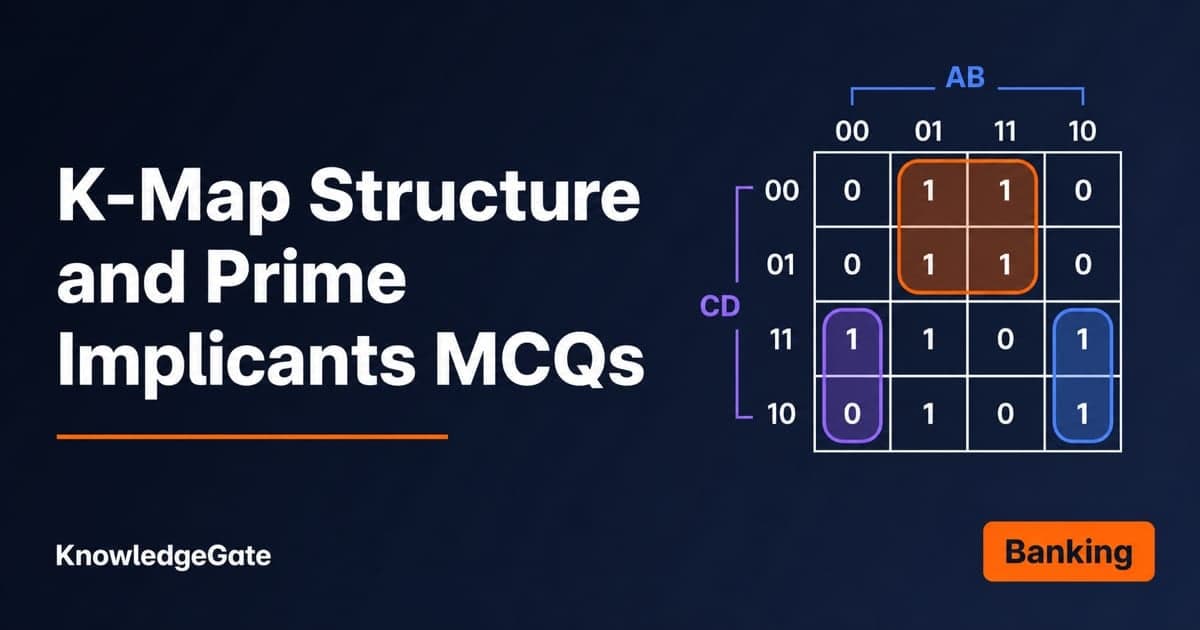
K-maps are easy to recognise but unforgiving when Gray-code adjacency, wrap-around groups, don't-cares, maximal groups, and the difference between a prime implicant and an essential prime implicant appear together. Start by fixing the cell count, then test adjacency and maximal groups before reducing SOP or POS. Treat PI or EPI counting as a coverage problem: enumerate every maximal group, then mark each uniquely covered ON-set minterm. Attempt each item and draw the map before reading its explanation, because seeing a finished loop is not the same as finding it yourself.
Related reading: K-map minimisation and canonical SOP and POS.
1. K-Map rules to keep beside the 12 questions
An n-variable K-map has 2^n cells. Label its rows and columns in Gray order 00, 01, 11, 10, so neighbouring cells differ in one bit. In SOP, each cell represents one minterm, and valid groups contain 1, 2, 4, 8, ... adjacent cells. Edges wrap, diagonal cells are not adjacent, and groups may overlap when that creates a larger cover. Use a don't-care as 0 or 1 only when it improves the result.
An implicant is a product term covering ON-set cells and, if useful, don't-cares, but no zero. A prime implicant cannot expand into a larger valid group. An essential prime implicant covers at least one ON-set minterm that no other PI covers. For POS, group zeros and read sum terms instead of grouping ones and reading product terms. Rebuild these ideas with the Boolean Algebra and K-Map Minimization Guide if needed.
2. Cells, minterms and group sizes: Questions 1-3
Q1. Count the cells in a five-variable K-map
Source: UP Police 2016.
The size (number of cells) of the k-map to simplify a Boolean function f(A, B, C, D, E) of five variables is:
A. 32B. 6C. 16D. 8
Answer: A. 32. An n-variable map contains 2^n cells, so here 2^5 = 32. Each cell represents one of the 32 distinct five-bit input combinations. A four-variable map has 16 cells and a three-variable map has 8, which explains the closest distractors. A five-variable K-map is often drawn as two 16-cell maps, but that split does not change the total.
Q2. What one SOP K-map square represents
Source: UP Police 2017.
In K-map, each square is represented by _________.
A. Min termB. Max termC. Average termD. None of these
Answer: A. Min term. In the usual SOP reading, one cell fixes every input variable and therefore corresponds to one minterm. For example, cell m10 in an A,B,C,D map represents binary input 1010, or AB'CD'. The same truth-table row can be indexed through its maxterm while forming POS, but the one-cell SOP representation asked here is a minterm.
Q3. What a quad removes
Source: UP Police 2018.
What does a Quad in a K-map represent?
A. DifferenceB. SumC. ProductD. Don't care
Answer: C. Product. In SOP minimisation, a quad is a four-cell group of 1s that reads as one product term. Four adjacent cells vary in two bit positions, so two variables disappear. For {m0,m1,m2,m3} in a four-variable map, A=0 and B=0 stay fixed while C,D vary. The resulting product term is A'B'.
3. Adjacency and don't-cares: Questions 4-5
Q4. Choose the valid grouping rule
Source: TPSC 2025.
Which of the following is a valid Karnaugh map grouping rule ?
A. Groups must be in straight line, with no gapsB. Groups must be in circlesC. Groups can only have four termsD. Each Group must contain only adjacent cells
Answer: D. Each Group must contain only adjacent cells. Adjacent cells differ in one input bit, including cells on opposite edges because a K-map wraps. A valid group must also be rectangular and contain a power-of-two number of cells. Option A is too restrictive because a wrap-around group can look split across the left and right edges of a flat drawing. Option C wrongly excludes pairs, octets, and larger valid groups.
Q5. Use a don't-care only when it helps
Source: BPSC 2024.
What is the purpose of the “don’t care” condition in digital logic?
A. To indicate that the value of a variable does not affect the outputB. To prioritize certain inputs over othersC. To ensure that all possible input combinations are covered in truth tablesD. More than one of the aboveE. None of the above
Answer: A. To indicate that the value of a variable does not affect the output. A don't-care marks an input combination whose output is irrelevant for the specified use, so treat that cell as 1 or 0 to improve the grouping. For F(A,B,C)=Σm(1,3)+Σd(5,7), using d5,d7 creates {1,3,5,7} and gives the one-literal result C. Ignoring them leaves {1,3} and the less compact term A'C. This is optimisation freedom, not input priority or a command to include every don't-care.
4. Prime implicants and essential coverage: Questions 6-8
Q6. Recognise an essential prime implicant
Source: RSSB 2022.
In K-Map, a group that covers at least one minterm that no other prime implicant can cover is called an essential prime implicant.
A. Prime ImplicitB. Essential Prime ImplicitC. Redundant Prime ImplicitD. Selective Prime Implicit
Answer: B. Essential Prime Implicit. The options use “Implicit”, while the standard term is essential prime implicant. Apply the unique-cover test: if a PI-chart column has only one mark, the PI in that row is essential. A non-essential PI has no such minterm because every cell it covers can also be covered by other PIs.
Q7. Count all maximal groups, not only the chosen cover
Source: GATE 2015 Set 3, NAT.
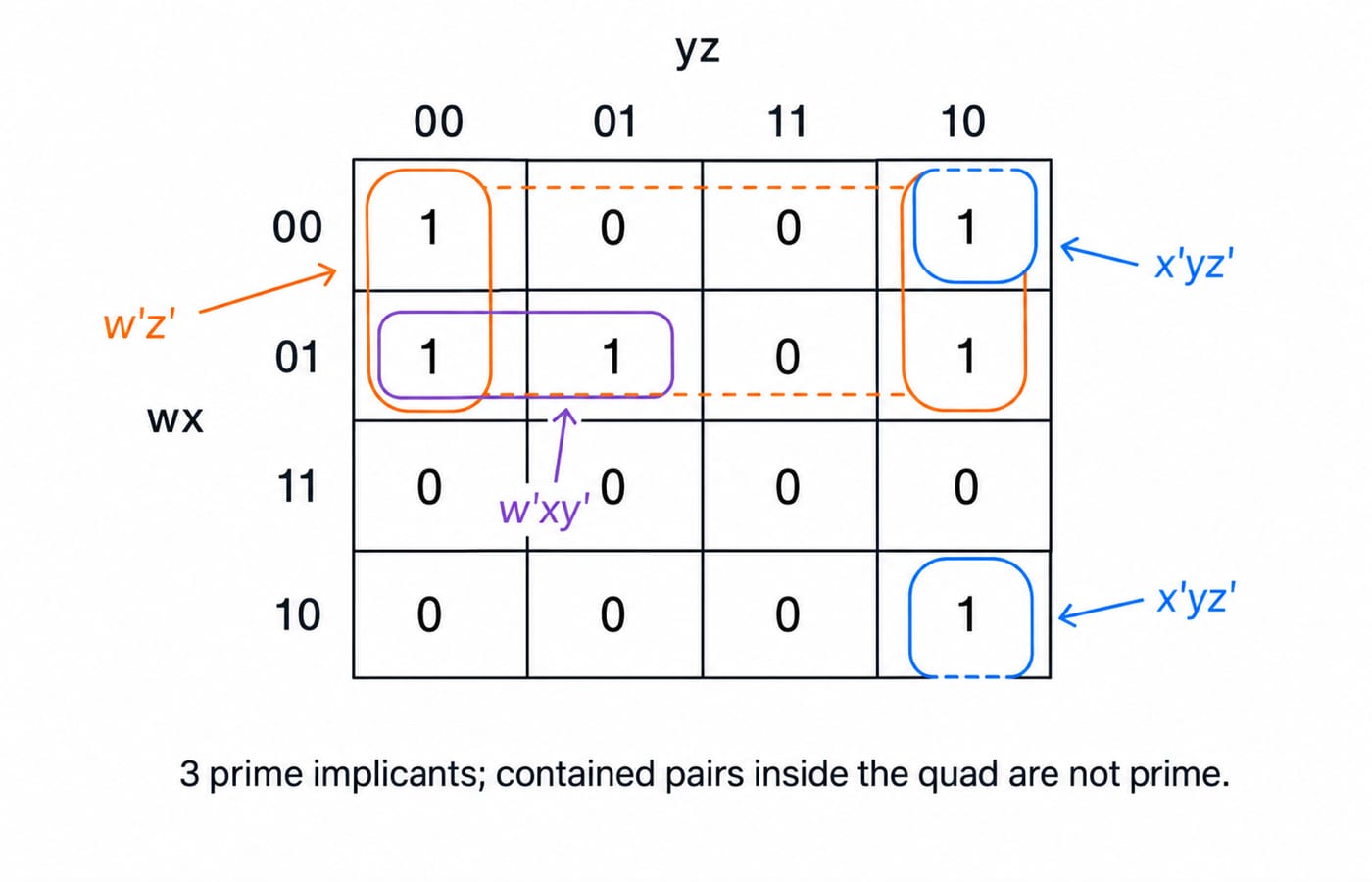
The total number of prime implicants of the function 𝑓(𝑤, 𝑥, 𝑦, 𝑧) = ∑(0, 2, 4, 5, 6, 10) is _______.
Answer: 3. Draw rows wx=00,01,11,10 and columns yz=00,01,11,10. The maximal quad {0,2,4,6} fixes w=0,z=0 and gives w'z'. The other maximal groups are {4,5}, giving w'xy', and the top-to-bottom wrap pair {2,10}, giving x'yz'. Smaller pairs inside {0,2,4,6} are implicants but not prime because each expands into the quad. The question counts every maximal group, not merely the terms selected first for a cover.
Q8. Count prime and essential prime implicants separately
Source: KnowledgeGate Digital Logic practice question.
Let f(A,B,C,D)=Σ(1,5,6,7,12,13,15). The number of prime implicants and essential prime implicants are _____.
A. 4,4B. 4,5C. 5,4D. 5,5
Answer: A. 4,4. The four maximal groups are A'C'D covering {1,5}, A'BC covering {6,7}, ABC' covering {12,13}, and BD covering {5,7,13,15}. Now apply unique coverage: m1 forces A'C'D, m6 forces A'BC, m12 forces ABC', and m15 forces BD. All four PIs are therefore essential, giving (4,4). Also, an EPI count cannot exceed the PI count, so B and D are impossible.
Use Prime Implicants and EPI Counting for GATE when you need the full PI-chart method.
5. Read minimal SOP and POS from actual maps: Questions 9-10
Q9. Form two quads and recognise XNOR
Source: UGC NET 2022.
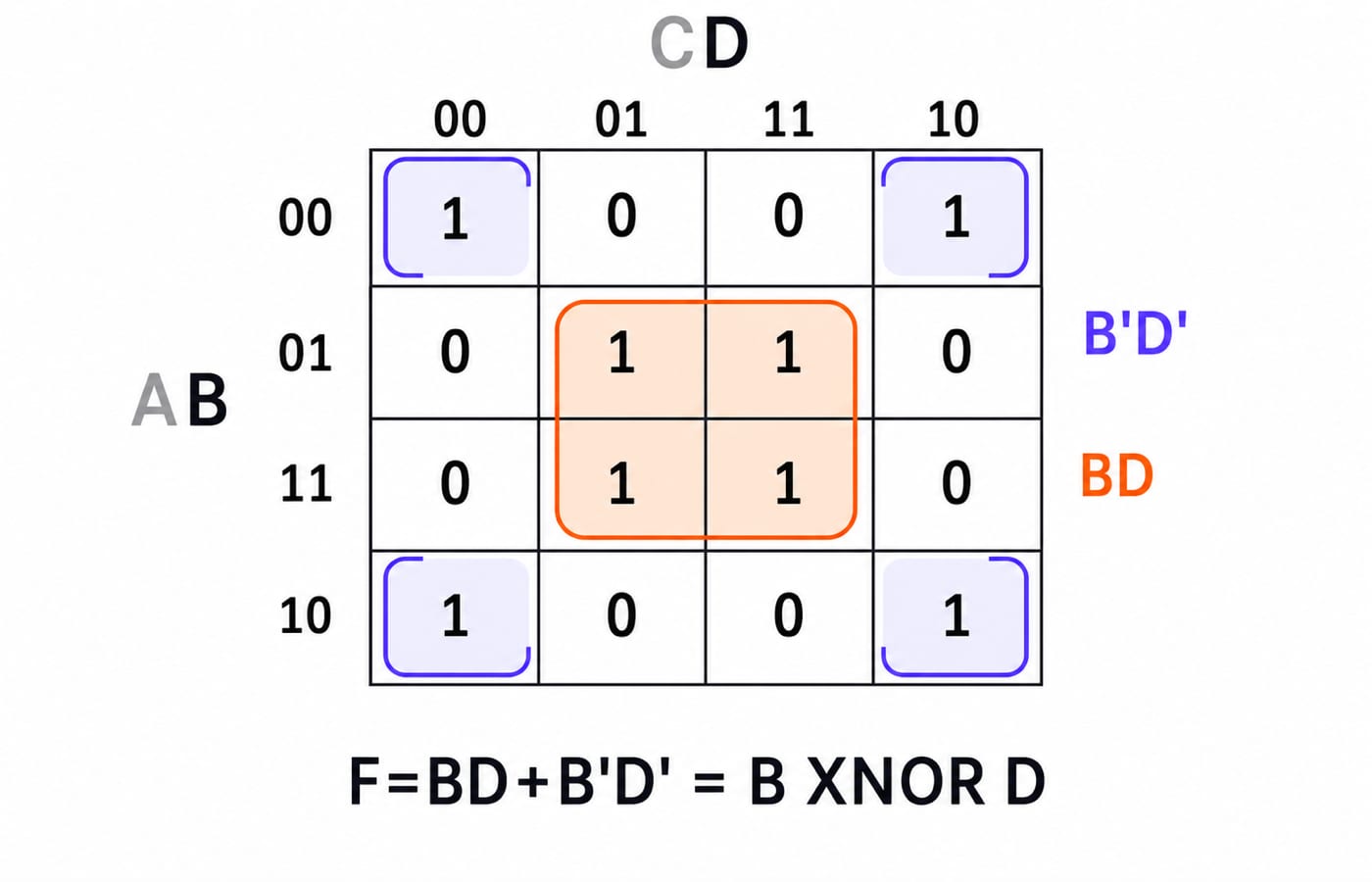
Simplify the following using K-Map
A. \(\mathrm{BD}+\mathrm{B}^{\prime} \mathrm{D}^{\prime}\)B. \(\mathrm{AC}+\mathrm{A}^{\prime} \mathrm{C}^{\prime}\)C. \(\mathrm{BC}+\mathrm{B}^{\prime} \mathrm{C}^{\prime}\)D. \(\mathrm{AD}+\mathrm{A}^{\prime} \mathrm{D}^{\prime}\)
Answer: A. BD+B'D'. The quad {5,7,13,15} fixes B=1,D=1 while A,C vary, so it gives BD. The corner-wrap quad {0,2,8,10} fixes B=0,D=0, so it gives B'D'. Thus F=BD+B'D', which is true exactly when B=D, the XNOR pattern. Variables A and C disappear because both take values 0 and 1 inside each quad.
Q10. Minimise in POS by grouping zeros
Source: KnowledgeGate Digital Logic practice question.
The function f(w,x,y,z)= Σ(0,5,10,15)+Σd(2,7,8,13) . The minimal product of sums expression for f(w,x,y,z) =
A. (x’+z)(x+z’)B. (x’ + z’)( x + z)C. xz’ + x’zD. x’z’ + xz
Answer: A. (x'+z)(x+z'). POS requires grouping zeros, which are {1,3,4,6,9,11,12,14}. The group {1,3,9,11} has x=0,z=1 and produces (x+z'); {4,6,12,14} has x=1,z=0 and produces (x'+z). Multiplying gives (x'+z)(x+z'). Option C is SOP for XOR, while the given ON-set and don't-care freedom support equality, or XNOR, instead.
6. Algebra, literal count and cross-checking the map: Questions 11-12
Q11. Factor before drawing a four-variable map
Source: KnowledgeGate Digital Logic practice question.
The minimal expression for PQ + P'QR + P'QR'S is ____.
A. PQ + QR + QSB. P+R+SC. QD. None
Answer: A. PQ + QR + QS. Factor Q: Q[P+P'R+P'R'S]. Inside the bracket, P'R+P'R'S=P'(R+R'S)=P'(R+S). Now use P+P'X=P+X to obtain Q(P+R+S), then expand to PQ+QR+QS. Option B loses the necessary outer Q, while C would incorrectly make the function true for every input with Q=1.
Q12. Compare minimum literal counts in SOP and POS
Source: KnowledgeGate Digital Logic numerical-answer question.
The literal count of a Boolean expression is the sum of the number of times each literal appears in the expression. For example, the literal count of (x’y+xz’ + y’z) is 6. If the minimum possible literal counts of the sum-of-product and product-of-sum representations of the function f(X1, X2, X3, X4) = Σm (0, 2, 4, 8, 10, 12, 13) + Σd (1, 5, 9,14,15) are given by a and b respectively, the value of a + 2b =
Answer: 11. For SOP, group {0,1d,4,5d,8,9d,12,13} to get X3', then {0,2,8,10} to get X2'X4'. Thus the minimum SOP is X3'+X2'X4', so a=1+2=3. For POS, group zero cells {3,7,11,15d} to get (X3'+X4'), then {6,7,14d,15d} to get (X2'+X3'). The minimum POS is (X3'+X4')(X2'+X3'), so b=2+2=4, and a+2b=3+2(4)=11. Counting terms instead of literal occurrences would give the wrong result.
As a map cross-check, use ON-set value m13=1101. In the SOP, X3'=1; in the POS, both (X3'+X4') and (X2'+X3') equal 1, so both forms return 1. For zero-cell m7=0111, the SOP terms are both 0, while the POS has (X3'+X4')=0, so both forms return 0.
7. Score map and the next practice step
Misses on Q1-Q3 mean you should rebuild cell counts and map structure. Q4-Q5 point to adjacency and don't-care rules; Q6-Q8 to maximal-group and unique-cover checks; Q9-Q10 to separating SOP-one groups from POS-zero groups; and Q11-Q12 to algebraic verification and literal counting. Keep this score map beside your next attempt, and redraw every missed question from a blank grid. Use Boolean Algebra and K-Map MCQs: 12 Solved (GATE) to switch among Boolean laws, expression simplification, canonical forms, K-maps, and NAND or NOR realization. Stay here when the weak point is map structure, grouping, or prime-implicant coverage. Continue at the K-Map Structure and Prime Implicants practice hub to choose another question from the same subtopic. Move to the GATE Test Series once you can solve Q7, Q9, and Q12 without the explanations.
Keep learning
Special Logic Circuits MCQs: 12 Solved Questions on Adders, Encoders, PLA and DAC
Solve 12 special logic circuits MCQs covering recognition, hardware counts, Boolean identities and numerical calculations. Each answer includes the reasoning you should reproduce in an exam.
19 Sep 20268 min readDigital Electronics MCQs
Function Equivalence MCQs: 12 Solved Boolean Algebra Problems
Solve 12 function-equivalence questions step by step, from De Morgan's law and absorption to minterm sets, counterexamples and a four-option MSQ.
Updated 17 Sep 20268 min readDigital Electronics MCQs

CLA & Arithmetic Logic MCQs: 10 Solved Questions with Explanations
Solve ten CLA and arithmetic logic MCQs with compact workings for carry equations, timing paths, hardware sizing and operand-pair counting.
Updated 16 Sep 20267 min readDigital Electronics MCQs

Sync Counter Design MCQs: 11 Solved Questions on Modulus, State Sequences and Excitation Logic
Solve 11 synchronous-counter questions covering modulus boundaries, repeated outputs, common-clock tracing, excitation equations, enables and composite states.
Updated 14 Sep 20267 min readDigital Electronics MCQs