ISRO Scientist/Engineer Selection Explained: Eligibility, Written Test and Interview
Follow the written-test recruitment route from the eligibility check to technical screening, interview and final merit, without relying on stale percentages or ratios.
KnowledgeGate Team
Exam prep & CS education
Updated 26 Aug 20264 min read141 views
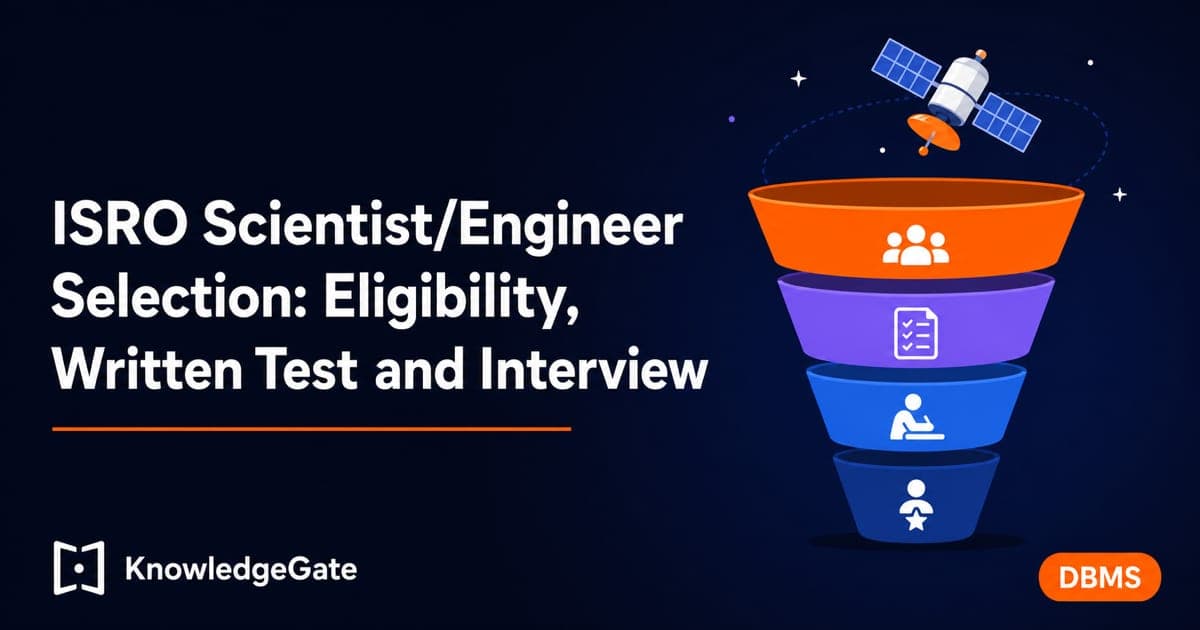
ISRO Scientist/Engineer (SC) selection has used two routes: GATE-score shortlisting followed by interview, and a written test followed by interview. The live 2026 ICRB Computer Science recruitment uses the GATE route; the 2025 recruitment used the written-test route.
Eligibility is the first gate, not final selection. The notice for the cycle decides the accepted degree, score threshold, age cut-off, shortlisting method and final-merit calculation.
Related reading: ISRO degree and equivalence checks and written-test and interview preparation.
ISRO Scientist/Engineer eligibility in 2026
For post code BE003 in the 2026 advertisement, the essential qualification is a BE, BTech or equivalent degree in Computer Science Engineering with at least 65% aggregate marks across all semesters or a CGPA of 6.84 on a 10-point scale. The same notice requires a valid GATE 2025 or GATE 2026 score in Computer Science and Information Technology, paper code CS.
The age limit is 28 years on 17 August 2026. Government employees and candidates in applicable reserved categories receive relaxation under Government of India rules. These cycle-specific values come from the Recruitment to the post of Scientist/Engineers 'SC' page for advertisement ISRO:ICRB:02(EMC-CEPO):2026.
Check these four items against your documents:
The exact degree and branch name must match BE003 or an allied discipline accepted in the official FAQ.
Your aggregate must meet either 65% or CGPA 6.84/10 as recorded on the degree or consolidated marksheet.
Your GATE score must be from 2025 or 2026 and use paper code CS.
Your age and any relaxation must be valid on the notice's cut-off date.
The 2026 notice does not permit converting CGPA into percentage when the degree or consolidated marksheet reports only CGPA. If both CGPA and percentage are reported, meeting either published threshold is sufficient. This document-level rule is easy to miss and can decide eligibility before selection begins.
ISRO Scientist/Engineer selection uses two routes
GATE route, used in the 2026 advertisement. Eligible applicants are shortlisted for interview in a 1:7 ratio using the GATE Score entered in the application, not GATE marks or rank. The final panel gives 50% weight to the GATE Score and 50% to interview marks.
Written-test route, used in the 2025 recruitment. Eligible applicants sit an objective paper, the written result creates the interview shortlist, and the interview follows. The notice for that cycle defines the paper, qualifying criteria, shortlist and final-merit method.
The routes must not be combined. The 2026 advertisement has no written-test stage, while a written-test notice does not automatically inherit the GATE shortlisting formula.
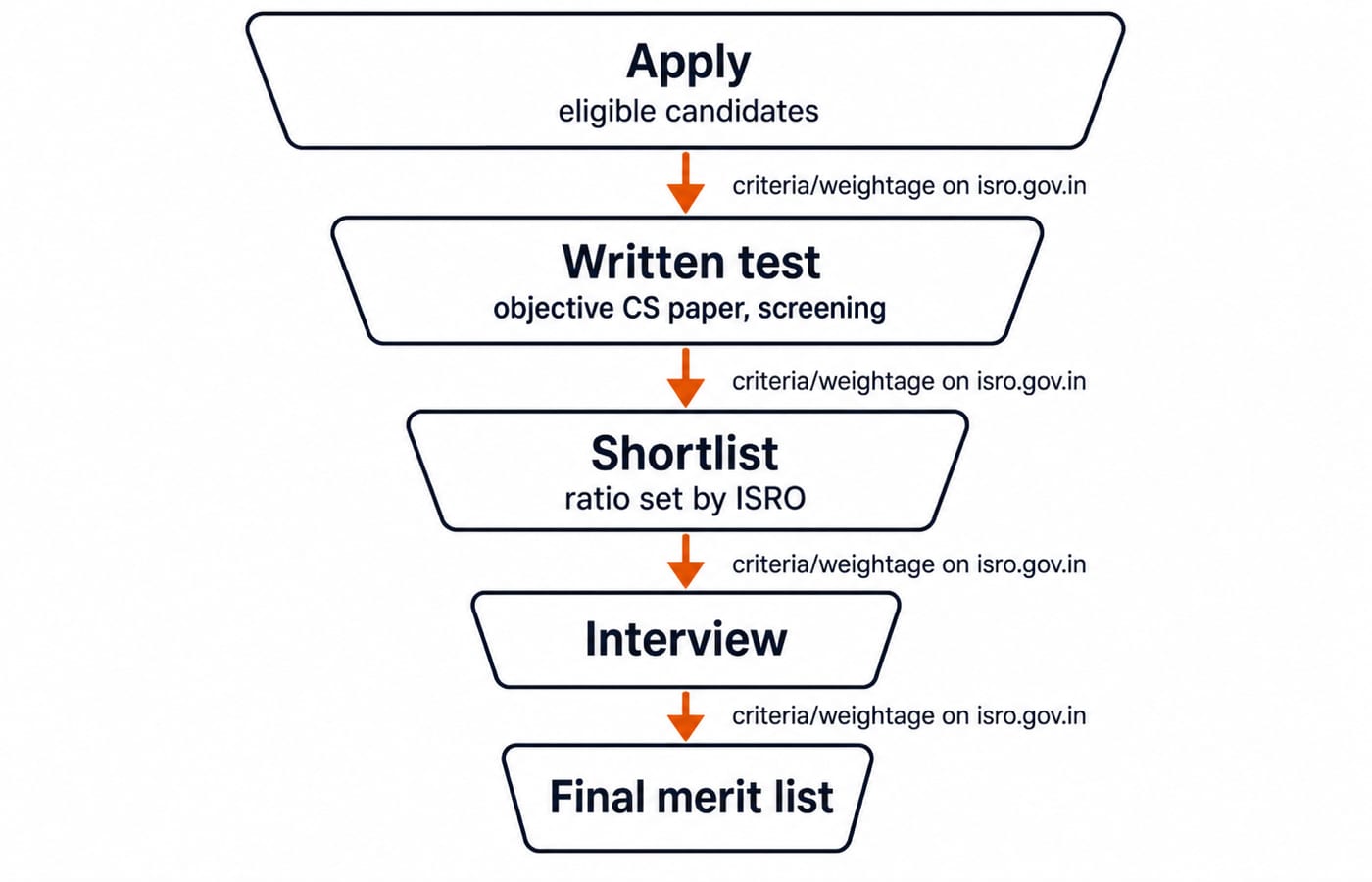
ISRO written-test route: what the screen checks
When a recruitment notice uses a written test, the paper ranks eligible candidates for an interview shortlist. For Computer Science, preparation centres on core areas such as networks, operating systems, DBMS, computer organisation, data structures, algorithms, theory of computation and programming. The cycle notice remains decisive for the paper structure and marking rule.
A reliable preparation loop is:
Revise one concept until you can state its definition and boundary conditions without prompts.
Solve direct questions for retrieval speed, then analytical questions that expose shallow understanding.
Review every wrong option so that elimination is based on knowledge rather than pattern guessing.
Mix subjects so that a chapter heading does not reveal the method.
The GATE CS Subject Weightage: Where Hours Pay Off guide maps the technical landscape. Its GATE weightages are not an ISRO prediction, so use the map for coverage rather than copying its percentages into an ISRO plan.
ISRO interview: what the panel scores
The 2026 interview allocates its 100 marks across five published attributes:
Technical academic knowledge: 40 marks.
General awareness related to the technical specialisation: 20 marks.
Presentation and communication skill: 20 marks.
Comprehension: 10 marks.
Academic achievements: 10 marks.
A DBMS answer may begin with normalisation and move to a functional dependency. An operating-systems answer may begin with deadlock and move to the Coffman condition broken by a proposed rule. A networks answer may test whether you can reason from addressing or protocol behaviour instead of reciting a paragraph.
Prepare by explaining core topics without notes. Give the definition first, state the rule, then work a small example. If you do not know an answer, separate what you can establish from what you cannot. Technical clarity, comprehension and communication are all explicit parts of the 2026 score.
ISRO final selection: how the route changes merit
For the 2026 GATE route, UR and EWS candidates must meet 50% in GATE Score, 50% in interview and 60% in aggregate. Reserved candidates must meet 40%, 40% and 50% respectively wherever the post is reserved. Candidates who qualify are placed on the final panel using equal 50% weights for GATE Score and interview marks.
A written-test recruitment can use different qualifying thresholds and weights. Eligibility cannot compensate for a weak screen, a shortlist does not guarantee final selection, and an interview score cannot be interpreted without that cycle's final-merit rule.
For structured preparation, the ISRO Scientist/Engineer SC (CS) Course follows the recruitment-facing path, while GATE Guidance by Sanchit Sir develops deeper core-CS coverage.
For comparison, the Coal India MT Eligibility and Selection Checklist shows how similar technical preparation can sit inside a different public-sector selection contract.
ISRO Scientist/Engineer: the short version and next step
For 2026 Computer Science, the chain is BE or BTech eligibility at 65% or CGPA 6.84/10, a valid 2025 or 2026 GATE CS score, shortlisting at 1:7, interview, and a final panel weighted 50:50 between GATE Score and interview. The age limit is 28 years on 17 August 2026, subject to the stated relaxations.
For a written-test notice, replace the GATE step with that notice's paper and shortlist rules. Start with PSU Exam Preparation Courses, choose the path that matches your target, and keep the official recruitment page beside your study plan.
Keep learning
Common Editing Ctrl Keys Explained: Copy, Cut, Paste, Undo and Redo with Worked Examples
Learn what each common Ctrl key does, then trace the document, clipboard, cursor and edit history through precise examples without confusing Copy, Cut or Undo.
Updated 11 Oct 20266 min readTeaching Recruitment (Computer Science)
Browsers and Search Engines MCQs: 9 Solved Questions with Explanations
Solve nine published browser and search engine questions, check each answer, and rebuild the browser, cache, crawler and indexing distinctions that exam distractors blur.
Updated 6 Oct 20267 min readTeaching Recruitment (Computer Science)
IT Act, 2000 Explained: Key Sections, Digital Signatures and Worked Exam Examples
Build an exam-ready map of the IT Act, then apply it to an exact digital-signature walkthrough and a section 43, 66, 66C and 66D caselet.
Updated 2 Oct 20266 min readTeaching Recruitment (Computer Science)
Emerging Trends Introduction MCQs: 12 Solved Questions with Explanations
Solve 12 Emerging Trends Introduction questions with clear answer logic, exam-year labels and a compact trap check for focused revision.
Updated 27 Sep 20268 min readTeaching Recruitment (Computer Science)