Browsers and Search Engines MCQs: 9 Solved Questions with Explanations
Solve nine published browser and search engine questions, check each answer, and rebuild the browser, cache, crawler and indexing distinctions that exam distractors blur.
KnowledgeGate Team
Exam prep & CS education
Updated 6 Oct 20267 min read
A browser displays and lets you interact with web resources, while a search engine discovers, indexes and retrieves pages. Cache, private browsing and robots.txt belong to different parts of this system, but exam options often mix them together.
Choose an option before reading each answer. Repeated questions can confirm the same concept against changed distractors. Use the Govt Teaching Jobs category to place the topic in the wider syllabus. Continue with the Browsers & Search Engines PYQ Questions hub for more practice.
1. Browser, search engine, cache and crawler: one model before the MCQs
Part | Main job | Example | Do not confuse it with |
|---|---|---|---|
Browser | Requests and renders a URL | Firefox | A service that discovers pages |
Search engine | Crawls, indexes and ranks pages | DuckDuckGo in Question 1 | The browser displaying a result |
Cache | Stores reusable resource copies locally | A saved stylesheet | History or a bookmark |
| Gives crawler directives |
| Privacy mode or access control |
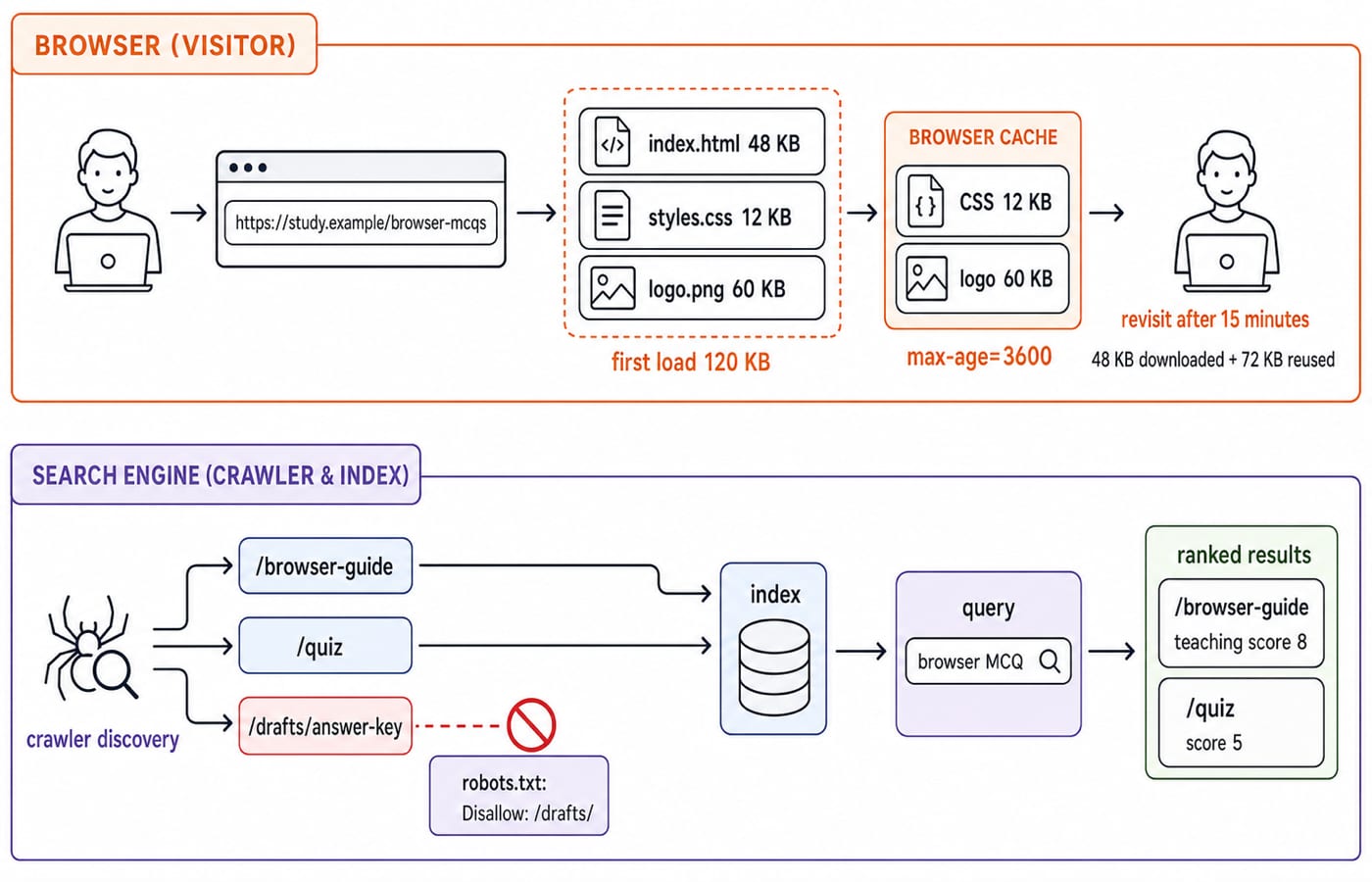
The browser side becomes clearer with a payload example. A learner opens https://study.example/browser-mcqs. The server sends index.html = 48 KB, styles.css = 12 KB and logo.png = 60 KB. The first-load payload is 48 + 12 + 60 = 120 KB. HTML is marked no-store, while CSS and the logo are cacheable for 3600 seconds. After 15 minutes, or 900 seconds, the browser downloads the 48 KB HTML again but reuses 12 + 60 = 72 KB. The simplified second-load payload is 48 KB, and the saved payload is 72 KB. A search engine is not needed to open this known URL. Web Technologies for Teaching Exams: HTML and HTTP develops this browser and client-server path.
Discovery is separate. A crawler starts at https://study.example/, finds /browser-guide, /quiz and /drafts/answer-key, then reads User-agent: * and Disallow: /drafts/. It may crawl the first two paths but is asked not to crawl the draft. Suppose an illustrative teaching score gives /browser-guide relevance 8 for browser MCQ and /quiz relevance 5. The guide ranks first. These scores explain ordering only; they are not a real engine's formula.
2. MCQ 1: classify a browser, a search engine and a communication app
Question 1 (RSSB 2022)
In context of internet consider the following –
Column – I
(P) DUCKDUCKGO
(Q) FIREFOX
(R) SKYPE
Column – II
(1) Browser
(2) Video conferencing
(3) Search engine
Which of the following is correct match of column-I and column-II?
A. P-1, Q-3, R-2
B. P-2, Q-1, R-3
C. P-3, Q-1, R-2
D. P-3, Q-2, R-1
Answer: C. P-3, Q-1, R-2. Column II makes 1 = Browser, 2 = Video conferencing and 3 = Search engine. DuckDuckGo maps to 3, Firefox to 1 and Skype to 2. Firefox retrieves and renders a page, DuckDuckGo helps locate pages, and Skype is the communication application here.
3. MCQs 2-3: recognise a metasearch engine despite changed distractors
Question 2
Which search engine gathers results from several search engines?
कौन-सा सर्च इंजन कई अलग-अलग सर्च इंजनों से परिणाम (results) एकत्र करता है?
A. Web crawler
वेब क्रॉलरB. Meta search engine
मेटा सर्च इंजनC. Index engine
इंडेक्स इंजनD. Spider
स्पाइडर
Answer: B. Meta search engine / मेटा सर्च इंजन. A metasearch engine aggregates results from multiple search services. If Source A returns {A, B, C} and Source B returns {B, D, E}, there are six raw placements but five unique URLs, {A, B, C, D, E}, after duplicate B is removed. A crawler or spider discovers pages instead.
Question 3
Which search engine collects results from multiple search engines?
कौन-सा सर्च इंजन कई सर्च इंजनों से परिणाम एकत्रित करता है?
A. Directory engine
डायरेक्टरी इंजनB. Meta search engine
मेटा सर्च इंजनC. Crawler engine
क्रॉलर इंजनD. Index engine
इंडेक्स इंजन
Answer: B. Meta search engine / मेटा सर्च इंजन. This is Question 2's concept with new distractors. The words “collects results from multiple search engines” identify metasearch. The {A, B, C} and {B, D, E} example again becomes five unique results, while a directory organises resources, a crawler discovers pages and an index stores searchable representations.
4. MCQs 4-5: browser cache versus private browsing
Question 4
Which browser component stores frequently accessed web resources locally?
ब्राउज़र का कौन-सा कंपोनेंट अक्सर उपयोग किए जाने वाले वेब संसाधनों (web resources) को लोकली स्टोर करता है?
A. Cache
कैशB. Cookie
कुकीC. Bookmark
बुकमार्कD. Session
सेशन
Answer: A. Cache / कैश. In the worked example, cache reuses the 12 KB stylesheet and 60 KB logo, saving 72 KB on the revisit. A cookie stores small site-related state, a bookmark stores an address, and a session describes an interaction or related state. Revalidation rules mean a cached item does not always eliminate a request.
Question 5
Which browser mode, used within a user's existing profile, prevents the browser from storing browsing history for that session?
A. Private browsing
B. Guest browsing
C. Safe browsing
D. Hidden browsing
Answer: A. Private browsing. The clues are an existing browser context and reduced local history retention for that session. Guest browsing is a separate temporary-profile idea, Safe Browsing refers to security warnings, and “Hidden browsing” is not the standard mode. Private browsing does not hide activity from websites, network administrators or an internet provider. It mainly limits local persistence after the private session closes.
5. MCQs 6-7: the deep web and what robots.txt actually controls
Browser and crawler requests still use web protocols, but indexing is a separate concern. Application Layer Protocols: DNS and HTTP Guide explains that request path in more depth.
Question 6 (MPPSC 2025)
Which part of the web is not indexed by typical search engines?
A. Surface web
B. Static web
C. Deep web
D. Hyperlinked web
Answer: C. Deep web. Deep-web content is absent from a typical public search index. For example, https://college.example/result?id=1042 is available only after student 1042 signs in. A public crawler cannot retrieve that personalised result for the ordinary index. A static HTML page can still be indexed, while the surface web is the indexed contrast.
Question 7 (UP Police 2023)
What is the purpose of the “robots.txt” file in relation to search engines?
A. It improves website speed.
B. It enhances website security.
C. It instructs search engine crawlers on which pages to index or ignore.
D. It redirects users to different URLs
Answer: C. It instructs search engine crawlers on which pages to index or ignore. That is the basic exam description. More precisely, robots.txt gives cooperative crawlers crawl directives. User-agent: * with Disallow: /drafts/ asks the crawler not to fetch /drafts/answer-key, while the guide and quiz remain allowed. It does not authenticate, encrypt, redirect or improve speed. Crawl blocking neither guarantees de-indexing nor protects sensitive content, which needs access control.
6. MCQs 8-9: handle dated “multilingual search engine” questions carefully
These are separate UP Police 2016 questions from two shifts, with different option sets. Language availability is a changing product capability, so treat each answer as a historical answer key rather than a current product fact.
Question 8 (UP Police 2016, Shift II)
Which of the following search engines is not multilingual?
A. Yahoo!
B. Baidu
C. Bing
D. Google
Answer: B. Baidu, according to the historical answer key. This reflects a 2016 product-classification framing. Interface languages, market coverage and language-processing support can change independently, so remember this as a historical bank key rather than an unqualified present-tense claim.
Question 9 (UP Police 2016, Shift I)
Which of the following search engine is not Multilingual?
A. Yahoo!
B. Yandex
C. Bing
D. Google
Answer: B. Yandex, according to the historical answer key. Keep the option sets separate: Question 8 places Baidu at B, while Question 9 places Yandex at B. This is also a dated key. Read every option set instead of carrying the previous answer forward merely because the stems look alike.
7. Score the set, repair one weak distinction, then continue
The answer strip is 1-C, 2-B, 3-B, 4-A, 5-A, 6-C, 7-C, 8-B, 9-B.
8-9 correct: revise only the missed distinction.
6-7 correct: redraw the browser, search engine, crawler and cache model.
0-5 correct: reread the model and attempt all nine again before adding questions.
These bands are study guidance, not an exam cutoff. Keep five durable distinctions clear: a browser renders while a search engine discovers; a crawler finds pages while metasearch aggregates results; cache stores resources while cookies, bookmarks and sessions serve different jobs; private browsing is not anonymity; and crawl directives are neither authentication nor a guarantee about indexing. Treat Questions 8 and 9 as recall of dated answer keys.
For wider internet and communication vocabulary, continue with ICT for Teaching Exams: Fundamentals Explained. Readers preparing the wider teaching-CS syllabus can use the UP LT Grade Assistant Teacher 2025 Computer Science Course, whose curriculum includes Internet Technology, Web Design and Web Technology. Review the one distinction that caused your first wrong answer, then retry all nine without looking at the key.
Keep learning

IT Act, 2000 Explained: Key Sections, Digital Signatures and Worked Exam Examples
Build an exam-ready map of the IT Act, then apply it to an exact digital-signature walkthrough and a section 43, 66, 66C and 66D caselet.
Updated 2 Oct 20266 min readTeaching Recruitment (Computer Science)
Emerging Trends Introduction MCQs: 12 Solved Questions with Explanations
Solve 12 Emerging Trends Introduction questions with clear answer logic, exam-year labels and a compact trap check for focused revision.
Updated 27 Sep 20268 min readTeaching Recruitment (Computer Science)
MS Word Basics MCQs with Answers: 12 Solved Questions Explained
Work through 12 MS Word questions covering everyday commands, page layout, formatting, links, file features and mail merge. Each answer explains the decisive clue and the closest distractor.
Updated 25 Sep 20267 min readTeaching Recruitment (Computer Science)
Raster vs Random Scan MCQs and Descriptive Problems: Solved Questions with Explanations
Attempt seven option-based questions and four descriptive problems on raster and random scan systems, then check each answer with a compact explanation.
Updated 23 Sep 20267 min readTeaching Recruitment (Computer Science)