ISRO Recruitment
14 articles in this topic

ISRO Scientist CS Cutoff Trends: How to Set Your Target Score
A remembered cutoff is useful only when you know its score scale and recruitment stage. Compare two historical CS notices, calculate an illustrative buffer and use weaker mocks to plan your next repair week.
30 Sep 20264 min read96 viewsISRO Recruitment
ISRO CS Theory of Computation and Compiler Design PYQs: 7 Solved Questions
Seven exact ISRO Theory of Computation and Compiler Design previous-year questions, with options, correct answers and clear explanations.
21 Sep 20266 min read167 viewsISRO Recruitment
ISRO CS Computer Organization and Architecture PYQs: 7 Solved Questions
Seven exact ISRO Computer Organization and Architecture previous-year questions, with options, correct answers and clear explanations covering cache, memory, control units, interrupts and addressing modes.
21 Sep 20266 min read109 viewsISRO Recruitment
ISRO CS Data Structures and Algorithms PYQs: 6 Solved Questions
Six exact ISRO Data Structures and Algorithms previous-year questions, with options, correct answers and explanations covering arrays, trees, searching, BFS and sorting.
21 Sep 20265 min read244 viewsISRO Recruitment
ISRO CS Computer Networks PYQs: Solved OSPF, CSMA and TCP Questions
Six exact ISRO Computer Networks previous-year questions, with options, correct answers and explanations covering NAT, OSPF, CSMA and TCP.
Updated 19 Sep 20265 min read162 viewsISRO Recruitment
ISRO CS Scientist/Engineer Role: Projects, Testing and Career Growth
See how core CS knowledge can support a project lifecycle through a fictional telemetry monitor, from requirement and design to testing, review and maintenance.
Updated 19 Aug 20265 min read81 viewsISRO Recruitment
ISRO CS Operating Systems PYQ Patterns: Scheduling, Memory and Deadlock Worked Step by Step
Learn four scratch-work methods for ISRO-style Operating Systems problems. Follow complete Round Robin, paging, LRU, semaphore and deadlock safety traces.
Updated 17 Aug 20266 min read111 viewsISRO Recruitment
ISRO CS PYQ Analysis: Build a Subject-Wise Speed and Accuracy Profile
Stop treating one raw PYQ score as the diagnosis. Use a subject ledger to find concept gaps, slow methods, and the next ten hours of focused repair.
Updated 8 Aug 20266 min read142 viewsISRO Recruitment
ISRO CS DBMS PYQs: Solved Patterns for Keys, Normalisation, SQL and Transactions
Learn to classify and solve representative ISRO CS DBMS problems through closures, normal forms, SQL row tracing, index I/O and precedence graphs.
Updated 5 Aug 20268 min read239 viewsISRO Recruitment
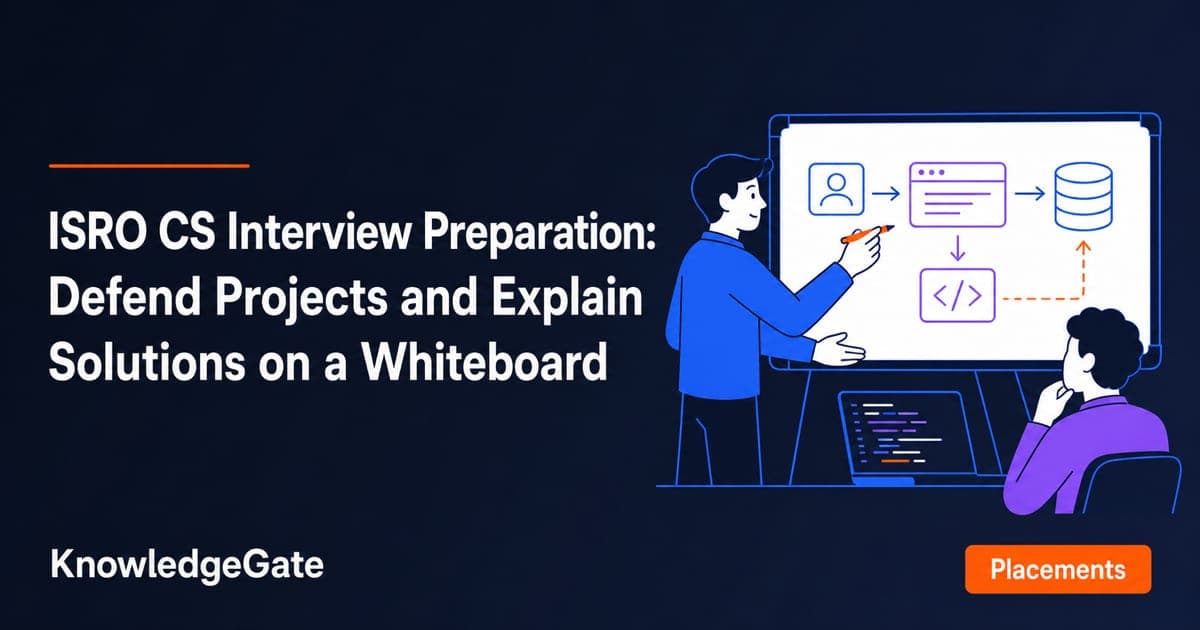
ISRO CS Interview Preparation: Defend Projects and Explain Solutions on a Whiteboard
Build a defensible project story around evidence, invariants and limitations, then rehearse the architecture, race condition and failure cases on a whiteboard.
Updated 2 Aug 20265 min readISRO Recruitment
ISRO CS Written Test vs Interview: Prepare for Speed, Depth and Project Questions
Prepare the same CS concepts in two ways: make quick, checked decisions for the written stage, then defend assumptions, follow-ups and honest project evidence aloud.
Updated 31 Jul 20266 min readISRO Recruitment
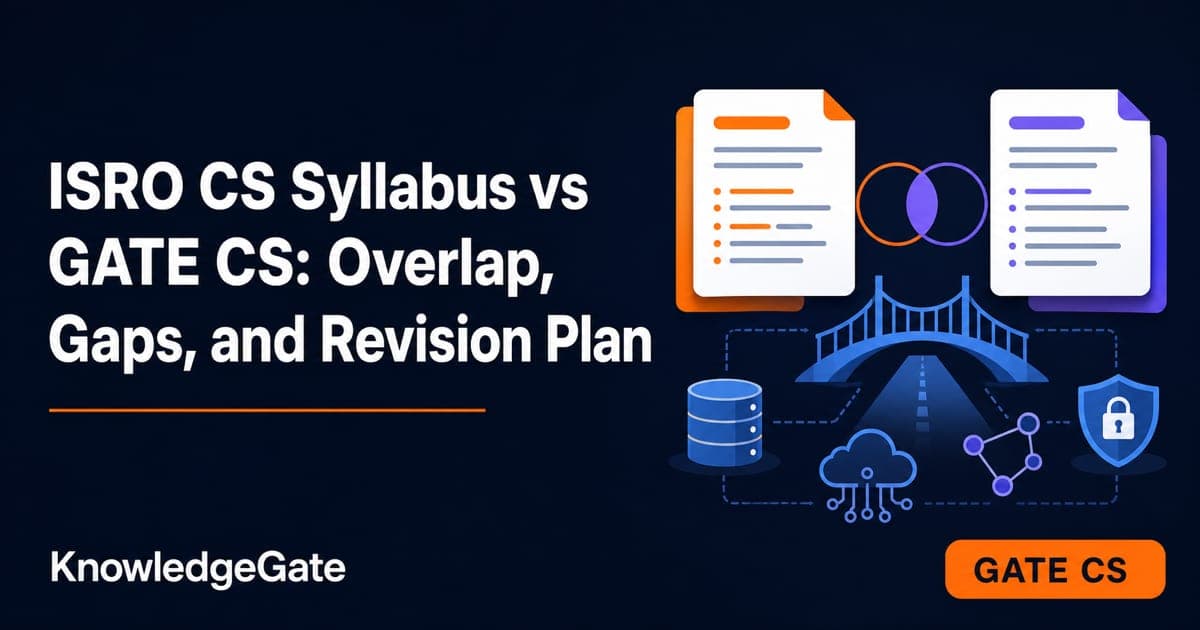
ISRO CS Syllabus vs GATE CS: Overlap, Gaps, and Revision Plan
Most GATE CS notes transfer well to ISRO Scientist/Engineer CS preparation, but not completely. See what carries over, what the official 2023 paper adds, and how to bridge it.
Updated 28 Jul 20265 min read65 viewsISRO Recruitment