ISRO CS Computer Networks PYQs: Solved OSPF, CSMA and TCP Questions
Six exact ISRO Computer Networks previous-year questions, with options, correct answers and explanations covering NAT, OSPF, CSMA and TCP.
KnowledgeGate Team
Exam prep & CS education
Updated 19 Sep 20265 min read96 views
How to identify the Computer Networks concept first?
Match the wording to the layer before reading the options:
An address modified while crossing a router points to network-layer translation.
OSPF and shortest-path computation point to link-state routing.
Collision handling and wireless access point to data-link MAC protocols.
Pseudo-header and one’s-complement arithmetic point to the TCP checksum.
A zero advertised receive window points to the TCP persist timer.
1. Network Address Translation — ISRO CS 2014
Question
The process of modifying IP address information in IP packet headers while in transit across a traffic routing device is called:
(A) Port address translation (PAT)
(B) Network address translation (NAT)
(C) Address mapping
(D) Port mapping
Correct answer: (B) Network address translation (NAT)
Explanation
NAT changes IP address information as a packet crosses a translating router or gateway. PAT is a specific form of translation that also uses transport-layer port numbers so several private hosts can share a public address.
Because the stem speaks generally about modifying IP information, NAT is the correct umbrella term. “Address mapping” and “port mapping” are descriptive phrases, not the protocol name requested by the question.
2. OSPF routing algorithm — ISRO CS 2014
Question
What is routing algorithm used by OSPF routing protocol?
(A) Distance vector
(B) Flooding
(C) Path vector
(D) Link state
Correct answer: (D) Link state
Explanation
OSPF is a link-state interior gateway protocol. Routers flood link-state advertisements so each router can construct a topology database, then run Dijkstra’s shortest-path-first algorithm locally.
Flooding is part of distributing the information, but it is not the routing-algorithm family being asked for. Distance vector describes protocols such as RIP, while path vector describes BGP. Attempt the original item on the ISRO OSPF practice page.
3. Ethernet collision handling — ISRO CS 2016
Question
In Ethernet CSMA/CD, the special bit sequence transmitted by media access management to handle collision is called:
(A) Preamble
(B) Postamble
(C) Jam
(D) None of the above
Correct answer: (C) Jam
Explanation
A station that detects a collision sends a jam signal so every station in the shared collision domain recognises that the current transmission failed. It then stops and waits for a randomly selected backoff interval before trying again.
The preamble belongs to the beginning of an ordinary Ethernet frame and helps synchronisation; it is not a collision notification. Open the ISRO CSMA/CD practice question for another attempt.
4. Wireless LAN access — ISRO CS 2017
Question
Which media access control protocol is used by IEEE 802.11 wireless LAN?
(A) CDMA
(B) CSMA/CA
(C) ALOHA
(D) None of the above
Correct answer: (B) CSMA/CA
Explanation
IEEE 802.11 wireless LANs use carrier-sense multiple access with collision avoidance (CSMA/CA). A wireless station cannot reliably transmit and listen for a collision at the same time, so Wi-Fi attempts to reduce collisions before sending through carrier sensing, interframe spacing and random backoff.
CSMA/CD belongs to traditional shared Ethernet. CDMA is a channelisation method, and ALOHA is an earlier random-access approach. Reattempt the item on the ISRO CSMA/CA practice page.
5. TCP checksum and the pseudo-header — ISRO CS 2020
Question
Checksum field in TCP header is:
(A) ones complement of sum of header and data in bytes
(B) ones complement of sum of header, data and pseudo header in 16 bit words
(C) dropped from IPv6 header format
(D) better than md5 or sh1 methods
Correct answer: (B) ones complement of sum of header, data and pseudo header in 16 bit words
Explanation
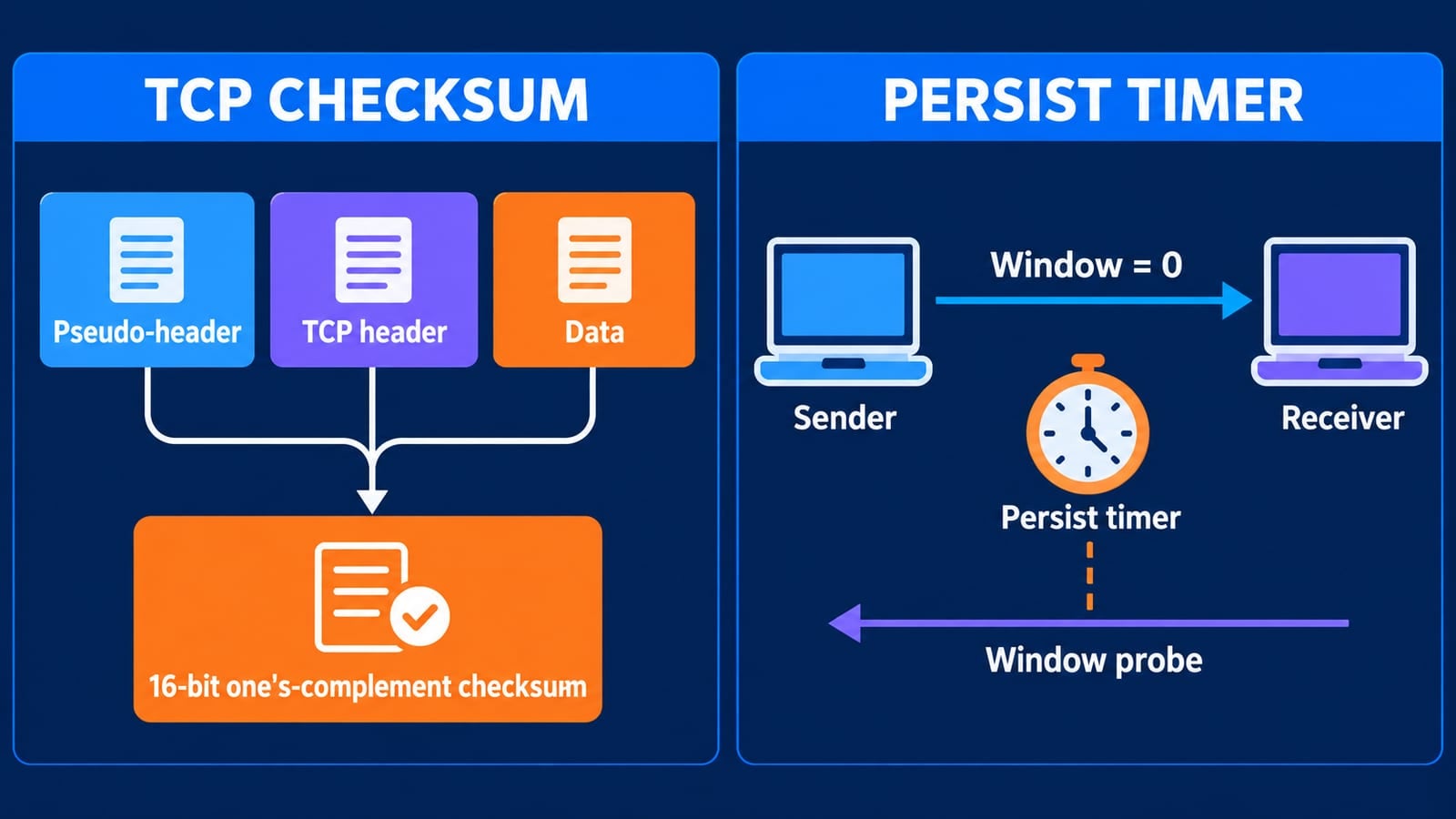
TCP computes its checksum over the TCP header, payload and a pseudo-header derived from the IP layer. The pseudo-header protects important addressing and protocol information without becoming part of the TCP segment transmitted as TCP data.
The addition uses 16-bit words with end-around carry, followed by a one’s complement. Option A omits the pseudo-header and uses the wrong unit. Option C confuses TCP with the removed IPv6 header checksum: TCP’s checksum remains required.
6. TCP flow control and the persist timer — ISRO CS 2020
Question
The persist timer is used in TCP to:
(A) To detect crashes from the other end of the connection
(B) To enable retransmission
(C) To avoid deadlock condition
(D) To timeout FIN_WAIT1 condition
Correct answer: (C) To avoid deadlock condition
Explanation
Suppose a receiver advertises a zero window because its buffer is full. Later it sends a window update, but that update is lost. The sender still believes the window is zero and waits; the receiver believes it announced new space and also waits.
TCP’s persist timer breaks this deadlock by causing the sender to transmit a small window probe. The response carries the receiver’s current window. Retransmission timeout, keepalive and connection-state timers have different jobs.
Common traps in ISRO Computer Networks PYQs
Tempting shortcut | Why it fails | Correct check |
|---|---|---|
Treat PAT and NAT as identical names | PAT is a port-using form of NAT | Use the broad term requested by the stem |
Choose flooding for OSPF | Flooding distributes LSAs; it does not name the routing family | OSPF is link state and runs Dijkstra |
Choose the Ethernet preamble after a collision | The preamble synchronises a normal frame | Collision notification uses the jam signal |
Replace CSMA/CA with CSMA/CD in Wi-Fi | Wireless stations cannot reliably detect while transmitting | IEEE 802.11 uses collision avoidance |
Checksum only the TCP header and data | The pseudo-header is also covered | Add pseudo-header, TCP header and payload |
Treat the persist timer as retransmission timeout | It specifically resolves zero-window deadlock | Look for an advertised window of zero |
For related subject-wise articles, continue with the ISRO CS DBMS PYQ walkthrough and ISRO CS Operating Systems PYQ guide.
A short revision loop
Redo all six questions without looking at the answers. For every miss, write one deciding phrase:
NAT modifies IP information.
OSPF is link state.
Collision means jam.
IEEE 802.11 means CSMA/CA.
The TCP checksum includes the pseudo-header.
The persist timer prevents zero-window deadlock.
Then solve the questions again from the options rather than from memory. That habit turns each fact into an elimination rule you can use under exam pressure.
Keep learning

ISRO Scientist CS Cutoff Trends: How to Set Your Target Score
A remembered cutoff is useful only when you know its score scale and recruitment stage. Compare two historical CS notices, calculate an illustrative buffer and use weaker mocks to plan your next repair week.
30 Sep 20264 min readISRO Recruitment
ISRO CS Theory of Computation and Compiler Design PYQs: 7 Solved Questions
Seven exact ISRO Theory of Computation and Compiler Design previous-year questions, with options, correct answers and clear explanations.
21 Sep 20266 min read138 viewsISRO Recruitment
ISRO CS Computer Organization and Architecture PYQs: 7 Solved Questions
Seven exact ISRO Computer Organization and Architecture previous-year questions, with options, correct answers and clear explanations covering cache, memory, control units, interrupts and addressing modes.
21 Sep 20266 min read70 viewsISRO Recruitment
ISRO CS Data Structures and Algorithms PYQs: 6 Solved Questions
Six exact ISRO Data Structures and Algorithms previous-year questions, with options, correct answers and explanations covering arrays, trees, searching, BFS and sorting.
21 Sep 20265 min read166 viewsISRO Recruitment