ISRO CS Scientist/Engineer Role: Projects, Testing and Career Growth
See how core CS knowledge can support a project lifecycle through a fictional telemetry monitor, from requirement and design to testing, review and maintenance.
KnowledgeGate Team
Exam prep & CS education
Updated 19 Aug 20265 min read70 views
An exam syllabus tells you what to study, but it does not show how Computer Science supports engineering work after selection. This guide connects software development, testing, documentation, reviews and teamwork. A telemetry-monitor example turns one requirement into a design, measurable test evidence and a review-ready package, so you can see how subject knowledge becomes engineering work.
1. ISRO CS Scientist/Engineer work: think project lifecycle, not only coding
ISRO's official procedure page says Department of Space activities are largely project oriented. Its examples of decisions include technology choices, system or subsystem specifications, interfaces, test setups and testing methodology.
Scope: The telemetry monitor and role links are training examples, not a universal job description or posting guarantee. Duties, review ownership and formal progression depend on the centre, unit, project, assignment and current ISRO rules.
The engineering loop is: clarify requirement, define interfaces, design, implement, unit and integration test, document evidence, review, then maintain. Coding is one part of that loop. For example, a sensor team supplies values and timing, a protocol team transports them, a CS engineer validates and stores them, and systems, quality and operations teams review the evidence. Use ISRO Scientist/Engineer CS Preparation for recruitment context and ISRO CS Written vs Interview: What Each Stage Demands for selection-stage context.
2. ISRO CS project example: turn a telemetry need into a testable design
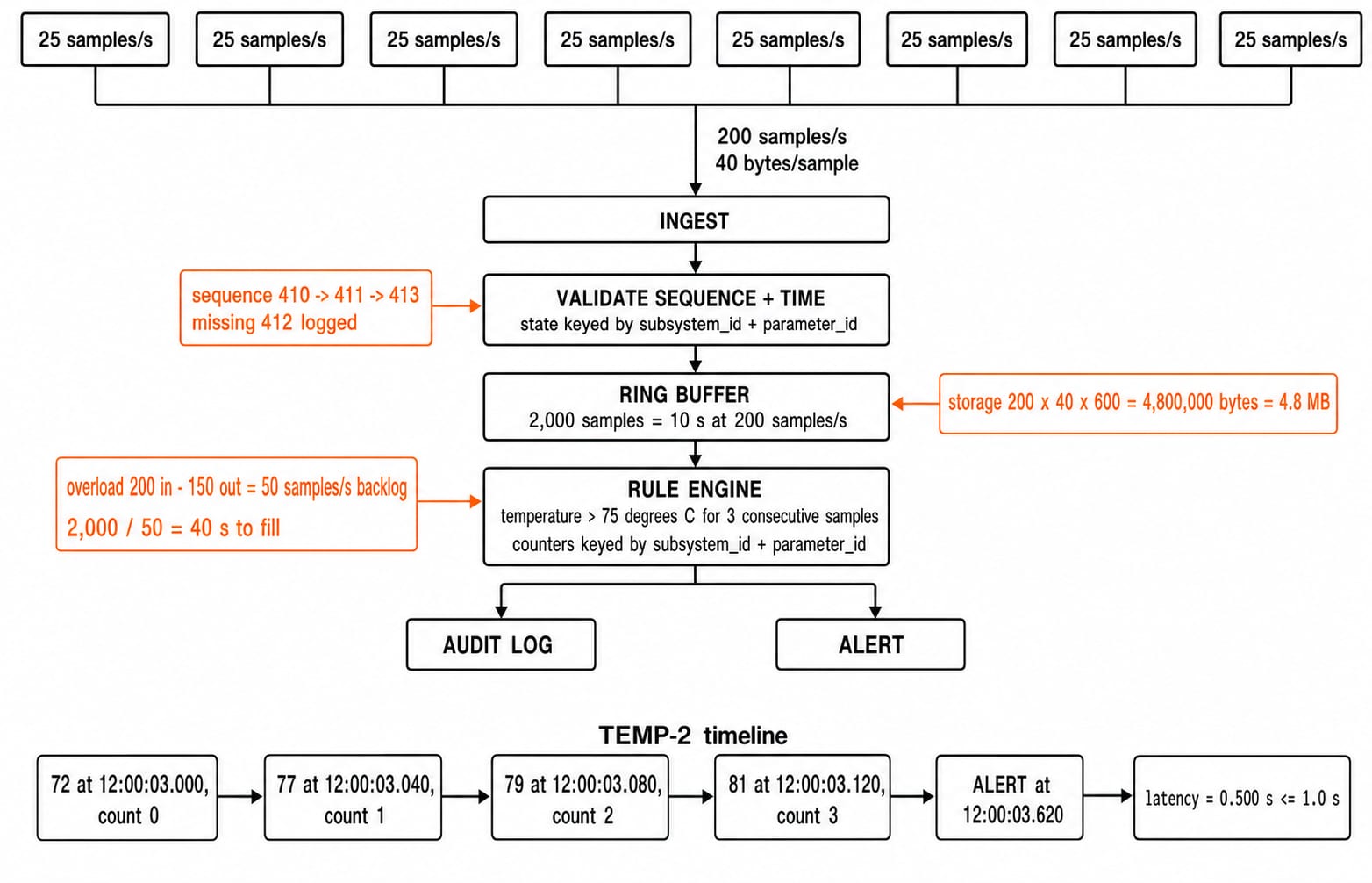
Requirement REQ-TLM-03 says: accept 25 telemetry values per second from each of 8 subsystems, store each in 40 bytes, alert within 1.0 second after the third consecutive temperature sample above 75 degrees C, and log missing sequence numbers and stale timestamps.
The load calculation is direct:
8 x 25 = 200 samples/s200 x 40 = 8,000 bytes/s10 minutes = 600 s200 x 600 = 120,000 samples8,000 x 600 = 4,800,000 bytes = 4.8 MBin decimal units
The eight streams are aggregated only for throughput, storage and buffer calculations. Each record carries subsystem_id and parameter_id; separate last-sequence, last-timestamp and threshold-counter state is kept for every pair. Interleaved records therefore cannot create false loss, stale-time or threshold results.
Build an ingest adapter, sequence and timestamp validator, 2,000-sample ring buffer, threshold rule engine, audit store and alert interface. Together, these components create a pipeline whose behaviour can be checked against the original requirement. The review package should contain a one-page requirement table, interface definition, component diagram, test plan and test report.
3. Software testing in the example: prove load, thresholds and failure paths
Plan expected results before running the software. Do not replace evidence with “tested successfully”.
For each (subsystem_id, parameter_id) stream, source timestamps must be nondecreasing: an incoming timestamp earlier than that stream's last accepted timestamp is stale and must be flagged; an equal timestamp is allowed.
Test | Input | Expected result |
|---|---|---|
Nominal load | 200 samples/s for 600 s | 120,000 accepted records; 4.8 MB raw payload |
Threshold and alert latency | TEMP-2: 72 at 12:00:03.000, 77 at 12:00:03.040, 79 at 12:00:03.080, 81 at 12:00:03.120; alert recorded at 12:00:03.620 | No alert at 72; 81 is the third consecutive value above 75; alert latency must be no more than 1.0 s |
Counter reset | 76, 74, 78 | No alert because 74 resets the counter |
Sequence loss | IDs 410, 411, 413 | Missing ID 412 logged |
Stale time | For one | Stale-record flag because 12:00:04 is earlier than that stream's last accepted timestamp |
The third qualifying sample arrived at 12:00:03.120, and the alert was recorded at 12:00:03.620. The measured delay is 03.620 - 03.120 = 0.500 s; because 0.500 s <= 1.0 s, REQ-TLM-03 passes the alert-latency test.
Use unit tests for rule logic, integration tests across ingest and storage, and a system test for sustained load. A useful report records the build ID, environment, input, expected result and observed result.
4. Technical documentation and design reviews: make every claim traceable
One traceability row can connect REQ-TLM-03 -> DES-RULE-02 -> TC-THR-02. The requirement is three consecutive readings above 75 degrees C. The design uses a counter that resets on any reading at or below 75. The test sends 72, 77, 79, 81 and expects the alert after 81.
The official procedure page says systematic reviews are organised at project milestones, including Preliminary Design Review, Detailed Design Review, Critical Design Review and Pre-Shipment Review. These reviews assess progress, resolve interfaces and check compliance with project objectives.
In a review, an engineer defends the requirement interpretation, interface assumptions, buffer size, overflow policy, test coverage, failures and evidence. ISRO CS Interview: Defend Projects on the Whiteboard shows how to move from building a project to explaining those decisions clearly.
5. ISRO CS syllabus-to-role map: turn core subjects into engineering decisions
The following table applies core areas from the live course page to decisions in the training example.
Course-prepared area | Decision in the example | Exact evidence |
|---|---|---|
Data Structures and Algorithms | Ring buffer sizing |
|
Operating Systems | Producer-consumer backlog |
|
Computer Networks | Ordering and loss | IDs 410, 411, 413 reveal missing 412 |
DBMS | Auditable event record |
|
Software Engineering | Traceability |
|
Basic AI | Possible anomaly scoring | The deterministic threshold remains the approved example requirement |
If you already study GATE topics, ISRO CS vs GATE CS: Overlap, Gaps, 14-Day Revision Plan helps you separate reusable preparation from ISRO-specific revision.
6. Career growth: increase the scope and quality of engineering decisions
Think of growth as a capability ladder. First, deliver a reviewed component. Then own its requirement, interfaces and tests. Next, coordinate subsystem integration and close review actions. Later, mentor others and make broader reliability, risk and maintainability trade-offs.
Visible evidence includes clearer specifications, fewer ambiguous interfaces, reproducible test results, documented defect closure and calm review explanations. It also appears in sound decisions under technical constraints. Build technical depth, verification discipline, communication and systems thinking.
7. The short version: build one role-aware project and prepare the core
The useful role model is requirement, design, code, test, evidence, review and maintenance. This loop prepares you for project work.
Try a seven-day sprint. On day 1, write REQ-TLM-03 and its interface. On days 2 and 3, implement ingest, validation, the 2,000-slot buffer and threshold rule. On day 4, run all five tests. On day 5, inject sequence loss and stale timestamps. On day 6, write the traceability table and report. On day 7, give a 10-minute review explaining the 10-second buffer and 40-second overload result.
For structured core-subject preparation, use the ISRO Scientist/Engineer SC (CS) Course. If you only need role-aware practice, complete the standalone project sprint first.
Keep learning

ISRO Scientist CS Cutoff Trends: How to Set Your Target Score
A remembered cutoff is useful only when you know its score scale and recruitment stage. Compare two historical CS notices, calculate an illustrative buffer and use weaker mocks to plan your next repair week.
30 Sep 20264 min readISRO Recruitment
ISRO CS Theory of Computation and Compiler Design PYQs: 7 Solved Questions
Seven exact ISRO Theory of Computation and Compiler Design previous-year questions, with options, correct answers and clear explanations.
21 Sep 20266 min read135 viewsISRO Recruitment
ISRO CS Computer Organization and Architecture PYQs: 7 Solved Questions
Seven exact ISRO Computer Organization and Architecture previous-year questions, with options, correct answers and clear explanations covering cache, memory, control units, interrupts and addressing modes.
21 Sep 20266 min read68 viewsISRO Recruitment
ISRO CS Data Structures and Algorithms PYQs: 6 Solved Questions
Six exact ISRO Data Structures and Algorithms previous-year questions, with options, correct answers and explanations covering arrays, trees, searching, BFS and sorting.
21 Sep 20265 min read166 viewsISRO Recruitment