Propositions in Logic: Non-Contradiction, Excluded Middle and Worked Truth Tables
Learn what makes a sentence a proposition, how excluded middle differs from non-contradiction, and how both laws simplify a larger truth table.
KnowledgeGate Team
Exam prep & CS education
Updated 12 Sep 20266 min read
Remembering the symbols is not enough if you still mix up a false row, a contradiction, and the law of non-contradiction. It is equally easy to call a command or an open sentence a proposition when neither has a definite truth value. A proposition has a definite truth value; the two classical laws differ in form, and a complete two-variable truth table can be simplified and checked row by row. In classical propositional logic, every proposition has exactly one truth value, T or F, under a fixed interpretation. This distinction makes every later calculation cleaner.
Related reading: Tautology and contradiction and Propositional logic MCQs.
Propositions in logic: the definite-truth-value test
A proposition is a declarative sentence to which exactly one truth value can be assigned under a fixed interpretation. It does not have to be true. 7 is prime is a proposition with value T, while 10 < 4 is a proposition with value F.
Now compare three non-propositions. Close the door is a command, not a claim. Is 7 prime? is a question. x + 2 = 5 is an open sentence because its truth depends on the free variable x. None receives one fixed truth value as written.
Let p mean 7 is prime and let q mean 10 < 4. Each is an atomic proposition. Formulas such as p ∧ q and p ∨ q are compound propositions because logical connectives combine their parts. Their truth values are computed from the atomic values, not guessed from the wording.
Logical connectives: compute before naming the formula
With p = T and q = F, the standard connectives give these results:
Formula | Connective | Value |
|---|---|---|
| Negation | F |
| Conjunction | F |
| Inclusive disjunction | T |
| Implication | F |
| Biconditional | F |
Two rules deserve special care. Inclusive ∨ is true at (T,T) as well as when exactly one input is true. An implication p → q is false only at (T,F). Use this implication and biconditional truth-table refresher if those rows are not yet automatic.
For longer formulas, evaluate brackets first, followed by negations, conjunctions, disjunctions, implications, and biconditionals. Explicit parentheses always control the order.
Excluded middle and non-contradiction: two laws, three formulas
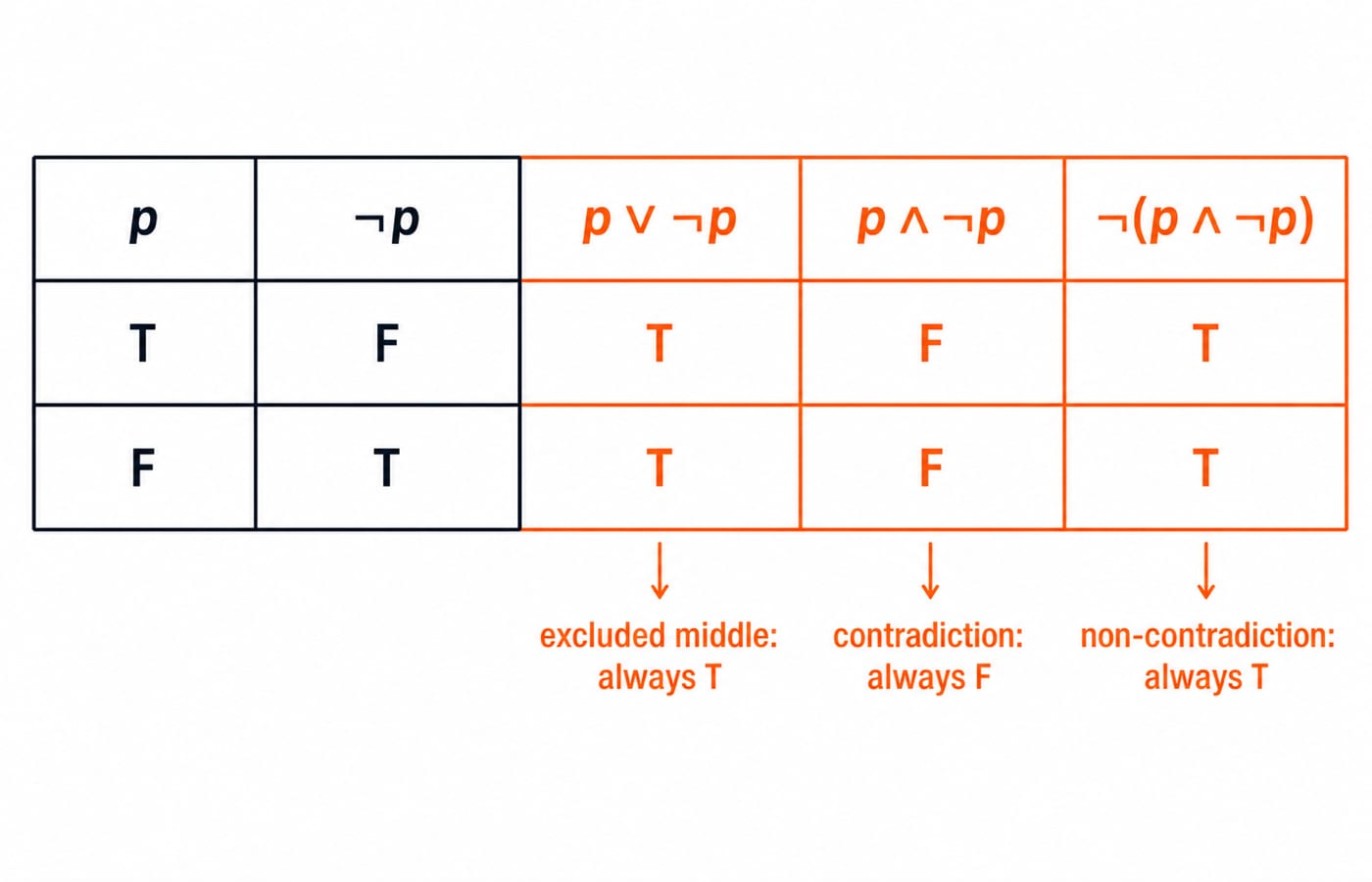
Classical two-valued logic gives three closely related formulas, but their names and final values are not interchangeable:
The law of excluded middle is
p ∨ ¬p ≡ T.The contradictory form is
p ∧ ¬p ≡ F.The law of non-contradiction is
¬(p ∧ ¬p) ≡ T.
The middle formula is a contradiction because it is always false. The final formula negates that impossible combination, so it is always true. That final tautology is the law of non-contradiction.
|
|
|
|
|
|---|---|---|---|---|
T | F | T | F | T |
F | T | T | F | T |
De Morgan's law confirms the final column algebraically:
¬(p ∧ ¬p) ≡ ¬p ∨ ¬¬p ≡ ¬p ∨ p ≡ T
Double negation turns ¬¬p back into p, leaving a proposition disjoined with its complement. Thus excluded middle and non-contradiction both end in T, but they reach it through different connective patterns.
Worked truth table: simplify the laws inside a larger formula
Consider the larger formula
E = [(p ∨ ¬p) ∧ (q → p)] ∨ (q ∧ ¬q)
Simplify the familiar pieces before expanding the table:
p ∨ ¬p ≡ Tby excluded middle.q ∧ ¬q ≡ Fbecause it is a contradiction.Therefore,
E ≡ [T ∧ (q → p)] ∨ F ≡ q → p.
The full table keeps both law-based columns visible:
|
|
|
|
|
|
|
|
|---|---|---|---|---|---|---|---|
T | T | F | T | F | F | T | T |
T | F | F | T | T | F | T | T |
F | T | T | T | F | F | F | F |
F | F | T | T | T | F | T | T |
The final column is T,T,F,T. Since it contains both truth values, E is contingent. It is neither a tautology nor a contradiction.
Check the only false row directly at p = F and q = T:
[(F ∨ T) ∧ (T → F)] ∨ (T ∧ F)
= (T ∧ F) ∨ F
= F
This direct substitution agrees with the simplified formula q → p, which is false precisely when q = T and p = F. Simplification and row-by-row evaluation have therefore produced the same four results.
![Reduction of E = [(p ∨ ¬p) ∧ (q → p)] ∨ (q ∧ ¬q) to q → p, with the final column reading T, T, F, T.](https://cdn.knowledgegate.ai/blog-assets/blog_asset_1784662709748_8utq6c.jpg)
Open sentences become propositions only after binding the variable
Return to x + 2 = 5. Substituting x = 3 produces 3 + 2 = 5, a true proposition. Substituting x = 1 produces 1 + 2 = 5, a false proposition. Before substitution, the free x makes the expression a predicate or open sentence rather than a proposition.
Quantifiers can also bind the variable. Over the integer domain, ∃x(x + 2 = 5) is true because x = 3 is a witness. In the same domain, ∀x(x + 2 = 5) is false because x = 1 is a counterexample. A quantified statement is not complete without its domain because the domain determines which values the quantifier ranges over.
Binding a variable settles whether a statement is true or false. For implication variants, quantifier negation and a worked validity proof, continue with Propositional and Predicate Logic: Truth Tables to Proofs. This post stays with proposition identification, excluded middle, non-contradiction and the reduction of E to q → p.
Proposition-law traps: repair the exact reasoning error
The most common errors come from applying a correct rule in the wrong place:
Deciding from one row.
Eis false at(p,q) = (F,T), but that does not make it a contradiction. Its final column contains bothTandF, so it is contingent. Classify a formula only after checking every valuation.Treating any disjunction as excluded middle.
p ∨ qis false whenp = Fandq = F. Only the complementary formp ∨ ¬pearns the law automatically. Also remember that ordinary∨is inclusive, soT ∨ T = T.Confusing a contradiction with the law named after its impossibility. Keep a three-part card:
p ∧ ¬pis alwaysF;¬(p ∧ ¬p)is alwaysT; andp ∨ ¬pis also alwaysT, but it uses a different pattern.
Proposition questions in exams: five patterns and three rapid checks
Representative question forms ask you to identify whether a sentence is a proposition, fill a missing truth-table column, classify a formula, simplify with complement, identity and De Morgan laws, or translate a verbal statement into symbols. The Propositional and Predicate Logic MCQs: 12 Solved collection gives worked practice across those patterns; the explanations here establish the laws you use to solve them.
Three short reductions make useful self-checks:
(p ∧ ¬p) → q ≡ F → q ≡ T, so the formula is a tautology.(p ∨ ¬p) ∧ q ≡ T ∧ q ≡ q, so the formula is contingent.¬(p ∨ ¬p) ≡ ¬T ≡ F, so the formula is a contradiction.
Each result follows from a law before it needs a full table. If the classification still feels surprising, rebuild the relevant table and inspect its final column. This logic topic fits inside the wider GATE CS Exam Preparation route, where you can connect it with the rest of the subject sequence.
Propositions in logic: the short version and next step
A proposition has one definite truth value under a fixed interpretation. p ∨ ¬p is excluded middle and always T; p ∧ ¬p is a contradiction and always F; ¬(p ∧ ¬p) is non-contradiction and always T. In a larger formula, simplify these pieces first, then check what remains over every valuation.
Rebuild both tables by hand until every column is explainable. If you want the wider GATE CS sequence and guided problem practice, continue with GATE Guidance by Sanchit Sir.
Keep learning

Classification of Finite and Infinite Groups: Orders, Cyclicity and Worked Examples
Learn how group axioms, group order, element order and generators classify finite and infinite groups through complete, checkable examples.
Updated 4 Oct 20266 min readEngineering Mathematics
Bipartite, Cycle, Regular and Complement Graphs: Tests, Formulas and a C6 Worked Example
Learn a dependable order for classifying simple graphs, then apply it to C6 and list, count and test every edge in its complement.
Updated 29 Sep 20266 min readEngineering Mathematics

Basic Terminologies in Linear Programming: Feasible Solutions, BFS and an Optimal Solution Worked Step by Step
Separate feasible, basic feasible and optimal solutions through geometry, slack variables, vertex enumeration and concise counterexamples.
Updated 25 Sep 20265 min readEngineering Mathematics

Assignment Problem and Hungarian Method: Formulation with a Complete Worked Example
Learn why greedy assignment fails, how matrix reductions preserve the optimum, and how the uncovered-value adjustment leads to a minimum cost of 140.
Updated 24 Sep 20266 min readEngineering Mathematics