Implication and Biconditional Operators in Logic: Truth Tables, Equivalences and Exam Traps
Learn why implication fails only at T to F, how biconditional checks matching values, and how to translate if, only if, necessary and sufficient. Includes a full contrapositive proof and fast exam checks.
KnowledgeGate Team
Exam prep & CS education
Updated 10 Sep 20265 min read
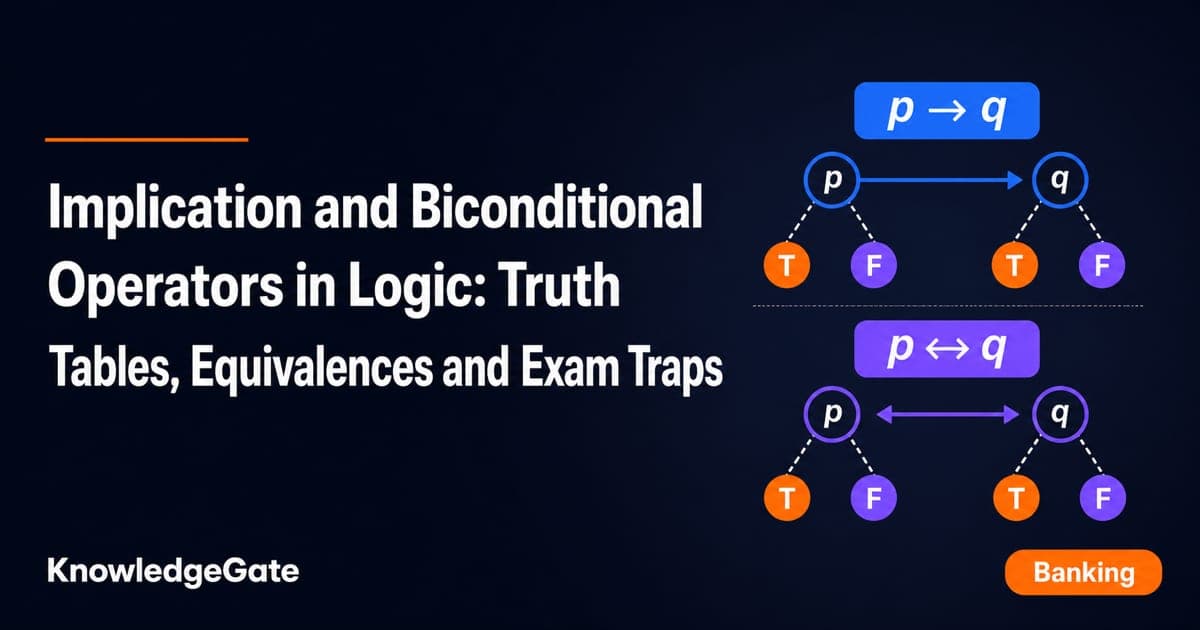
Students often remember that implication is "false once" and biconditional is "true when both match", yet mistakes begin when words enter the question. A false antecedent looks like failure, "only if" gets reversed, and the converse gets confused with the original. Implication fails only at T → F, while biconditional is true only when the inputs match; translations and equivalences follow from those two rules.
Implication and biconditional operators: meanings and four truth-value cases
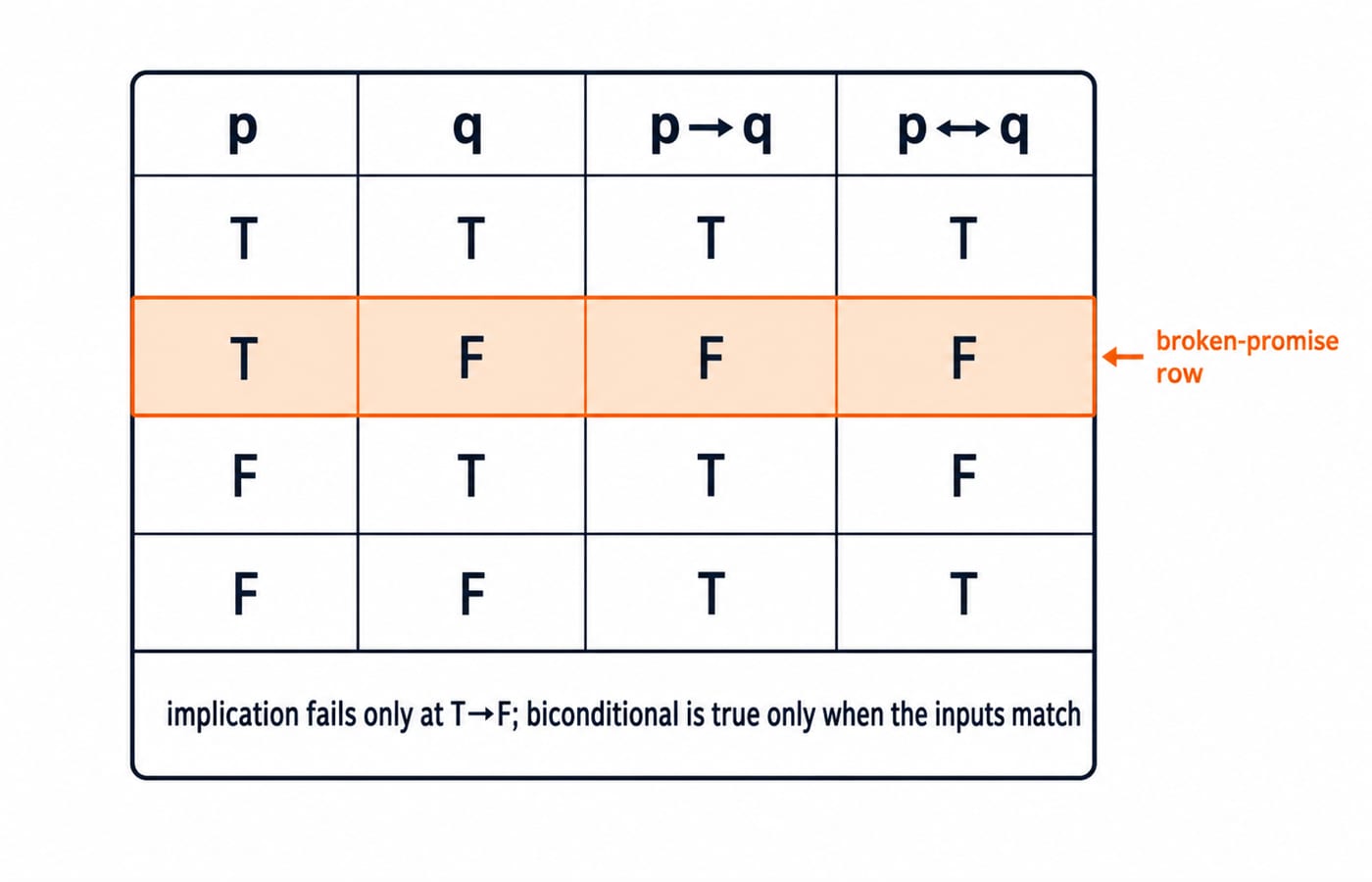
The implication p → q means "if p, then q". Here, p is the antecedent and q the consequent. This promise breaks only when p is true and q is false. In row order TT, TF, FT, FF, its outputs are T, F, T, T.
This gives the material-implication rewrite:
p → q ≡ ¬p ∨ q
The biconditional p ↔ q means "p if and only if q". It checks equality, so its outputs are T, F, F, T. Implication permits F → T, but biconditional rejects every mismatch. For quantifiers and inference, use the broader Propositional and Predicate Logic guide.
“If”, “only if”, necessary and sufficient: translate before calculating
Let p(n) mean "n is divisible by 4" and q(n) mean "n is even". The sentence "n is divisible by 4 only if n is even" is p → q. Here p is sufficient for q, while q is necessary for p.
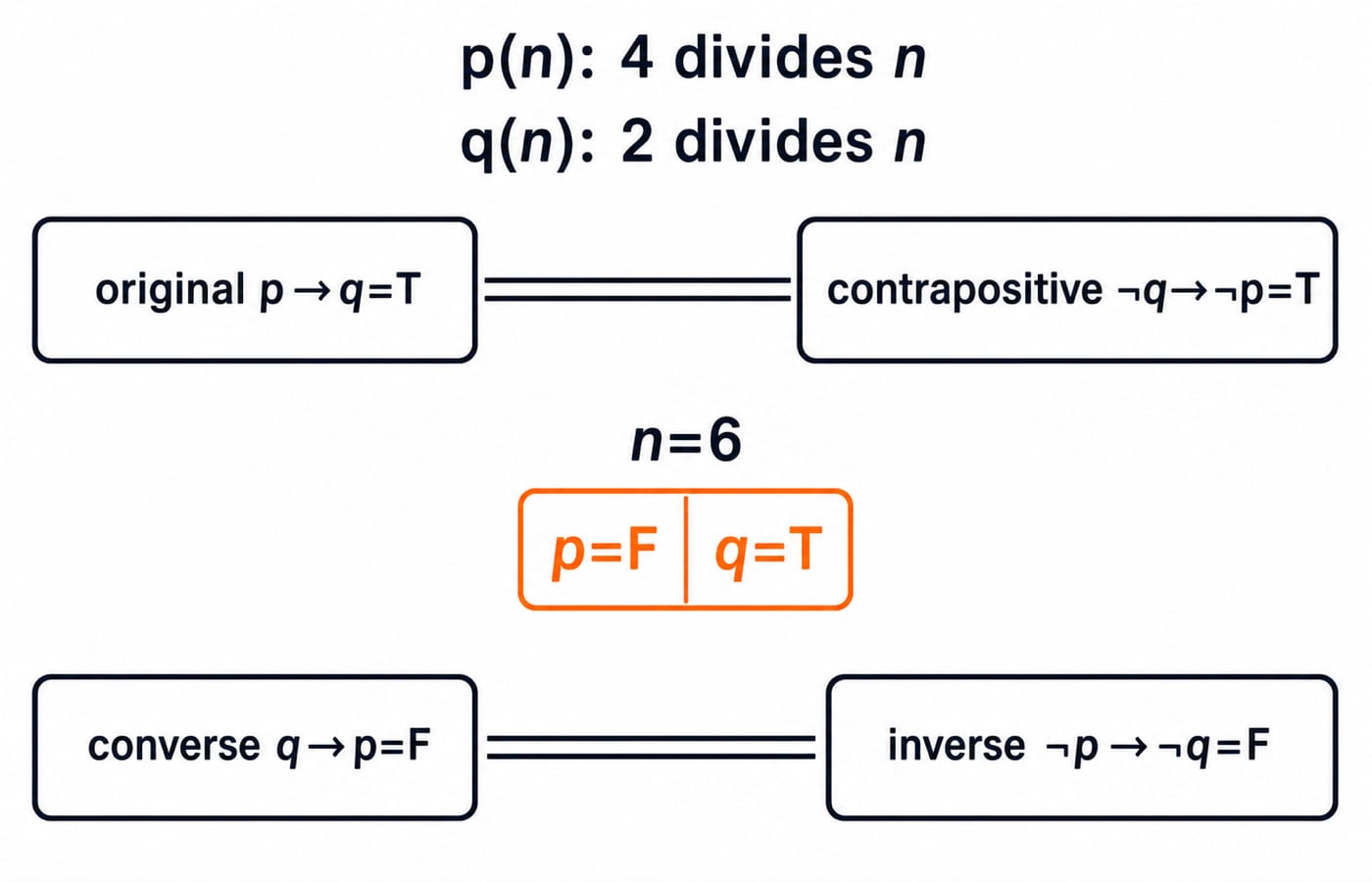
Reverse the wording: "n is divisible by 4 if n is even" means q → p. At n = 6, q(6) = T and p(6) = F, so q → p = T → F = F. "If and only if" needs both directions, so p ↔ q is also false here.
Use this translation rule:
In "A only if B", write
A → B.In "A if B", write
B → A.In "A iff B", require both directions,
A ↔ B.
Converse, inverse and contrapositive: one counterexample separates all four
For p → q, the converse is q → p, inverse ¬p → ¬q, and contrapositive ¬q → ¬p. The exact equivalence pairs are:
Original and contrapositive:
p → q ≡ ¬q → ¬pConverse and inverse:
q → p ≡ ¬p → ¬q
The original does not generally equal the converse. With p(n): 4 divides n, q(n): 2 divides n, and n = 6, we have p = F and q = T. Thus p → q = F → T = T; q → p = T → F = F; ¬p → ¬q = T → F = F; and ¬q → ¬p = F → T = T. The row confirms both pairs and disproves the converse.
Worked truth table: prove an implication equals its contrapositive
Test every assignment with F = (p → q) ↔ (¬q → ¬p).
p | q | p → q | ¬q | ¬p | ¬q → ¬p | F |
|---|---|---|---|---|---|---|
T | T | T | F | F | T | T |
T | F | F | T | F | F | T |
F | T | T | F | T | T | T |
F | F | T | T | T | T | T |
Row 2 carries the trap. With p = T and q = F, p → q = T → F = F. Also, ¬q = T and ¬p = F, so ¬q → ¬p = T → F = F. Finally, F ↔ F = T because both sides match.
The last column is T, T, T, T. The formula is therefore a tautology, proving the components logically equivalent.
Now check the same result algebraically, as a separate proof:
¬q → ¬p ≡ ¬(¬q) ∨ ¬p ≡ q ∨ ¬p ≡ ¬p ∨ q ≡ p → q
Biconditional equivalences and negation
A biconditional can be expanded into two implications:
p ↔ q ≡ (p → q) ∧ (q → p)
Its case form says that both values are true or both are false:
p ↔ q ≡ (p ∧ q) ∨ (¬p ∧ ¬q)
At p = T, q = T, the first conjunction is true. At p = F, q = F, the second is true. Negation selects the mismatched rows:
¬(p ↔ q) ≡ (p ∧ ¬q) ∨ (¬p ∧ q)
At p = T, q = F, p ↔ q = F, so its negation is T. This is the exclusive-or pattern.
Do not confuse biconditional with meta-level equivalence. p ↔ q can change value by row. A ≡ B says two formula columns match on every row, as in p → q ≡ ¬p ∨ q.
Implication and biconditional traps: diagnose the wrong move
Trap 1, false antecedent. Neither F → F nor F → T is false. Both are true because neither contains the only violation, T → F.
Trap 2, converse error. From p → q, you cannot conclude q → p. Recall n = 6: being divisible by 2 does not make the number divisible by 4.
Trap 3, wrong negation. The correct law is ¬(p → q) ≡ p ∧ ¬q, not ¬p → ¬q. At p = T, q = F, ¬(T → F) = ¬F = T, while T ∧ ¬F = T ∧ T = T.
Trap 4, reading biconditional as "both true". Matching false values also work: F ↔ F = T.
Repair these errors in three steps: translate the English direction, eliminate arrows with p → q ≡ ¬p ∨ q when useful, then evaluate only the requested rows.
How exams test implication and biconditional operators
Questions commonly ask for direct truth-value evaluation, tautology or equivalence checks, converse/inverse/contrapositive identification, and English-to-symbol translation using "if", "only if", "necessary", or "sufficient".
Try a short evaluation. For p = T, q = F, r = T, find (p → q) ∨ (q ↔ r):
p → q = T → F = F.q ↔ r = F ↔ T = F.Therefore
F ∨ F = F.
As a count check, p → q is true in 3 of 4 rows, while p ↔ q is true in 2 of 4. Practise Implication and Biconditional Operators in Logic MCQs, then try Propositional and Predicate Logic MCQs: 12 Solved Questions. The first set isolates these two operators, while the second checks how they interact with wider propositional logic.
Implication and biconditional operators: the short version and next step
p → qfails only atp = T, q = F.p ↔ qis true when the two values match."Only if" points from the condition to the requirement.
An implication is equivalent to its contrapositive.
A negated biconditional means the inputs differ.
If you need the full Discrete Mathematics sequence around logic, continue with GATE Guidance by Sanchit Sir. If you are still comparing broader preparation paths, start with the GATE CS exam preparation category.
Keep learning

Classification of Finite and Infinite Groups: Orders, Cyclicity and Worked Examples
Learn how group axioms, group order, element order and generators classify finite and infinite groups through complete, checkable examples.
Updated 4 Oct 20266 min readEngineering Mathematics
Bipartite, Cycle, Regular and Complement Graphs: Tests, Formulas and a C6 Worked Example
Learn a dependable order for classifying simple graphs, then apply it to C6 and list, count and test every edge in its complement.
Updated 29 Sep 20266 min readEngineering Mathematics

Basic Terminologies in Linear Programming: Feasible Solutions, BFS and an Optimal Solution Worked Step by Step
Separate feasible, basic feasible and optimal solutions through geometry, slack variables, vertex enumeration and concise counterexamples.
Updated 25 Sep 20265 min readEngineering Mathematics

Assignment Problem and Hungarian Method: Formulation with a Complete Worked Example
Learn why greedy assignment fails, how matrix reductions preserve the optimum, and how the uncovered-value adjustment leads to a minimum cost of 140.
Updated 24 Sep 20266 min readEngineering Mathematics