Logical Cases MCQs: Tautology, Contradiction, Contingency, Satisfiability and Validity
Solve 12 logic MCQs using truth tables, counterexamples and algebra. Learn one final-column test for separating tautologies, contradictions and contingencies.
KnowledgeGate Team
Exam prep & CS education
Updated 17 Sep 20268 min read
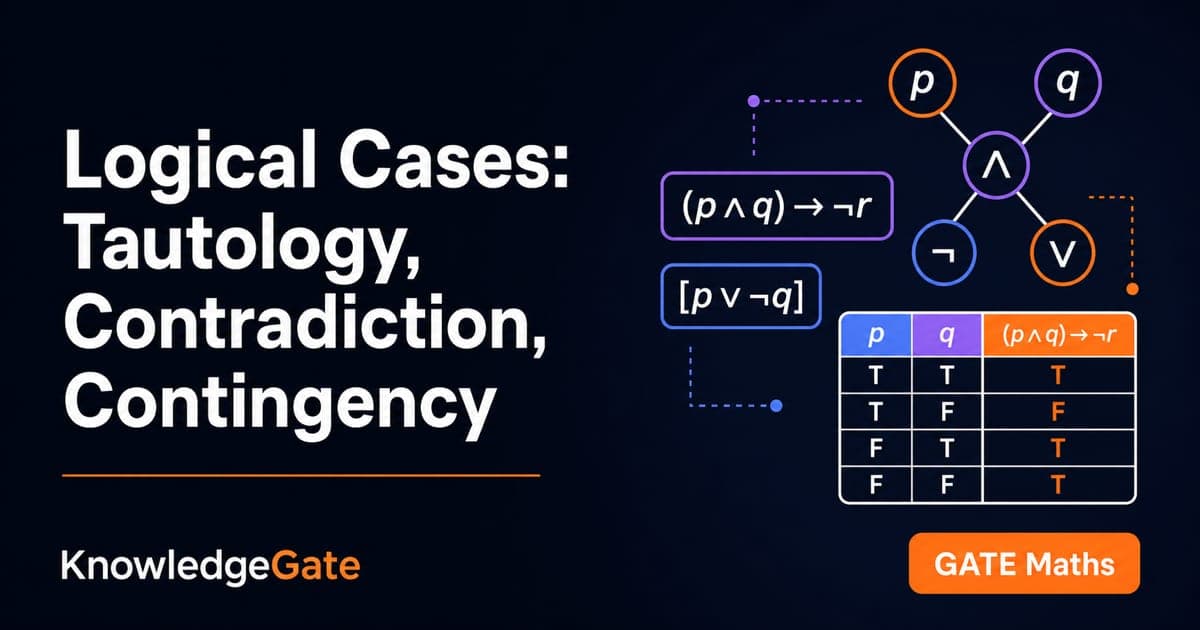
Students often know the definitions of tautology and contradiction but still mix up valid, satisfiable and contingent when a formula appears in an MCQ. The cure is not another list of definitions, but one repeatable test: enumerate every valuation, inspect the final column, and classify the formula from that column.
The same final-column test also separates validity from satisfiability. The Types of Logical Cases practice questions page keeps the topic's exercises together, including items without standalone lesson pages.
Related reading: Propositions and laws and Propositional logic MCQs.
The three-row classification test
Final column | Classification | Satisfiability and validity |
|---|---|---|
| Tautology | Valid and satisfiable |
| Contradiction | Invalid and unsatisfiable |
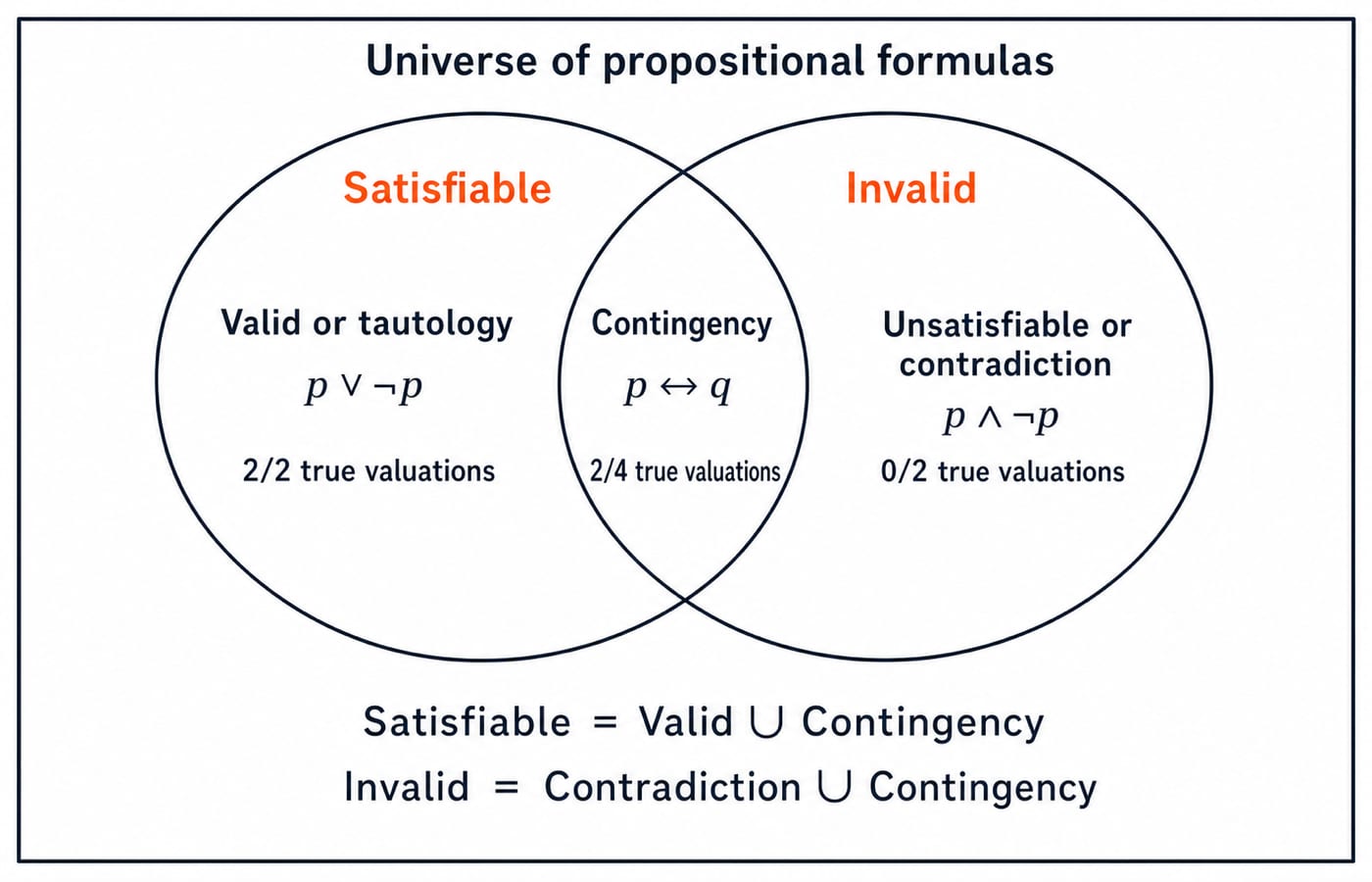
Both | Contingency | Invalid and satisfiable |
The number of rows doubles with each variable. One variable gives 2^1 = 2 rows, two variables give 2^2 = 4 rows, and three variables give 2^3 = 8 rows. Do not classify from one convenient row. Complete the final column first.
Questions 1 to 3: identify the definition before calculating
Question 1
A proposition that is always true is called:
A.
TautologyB.
ContradictionC.
ContingencyD.
None of the above
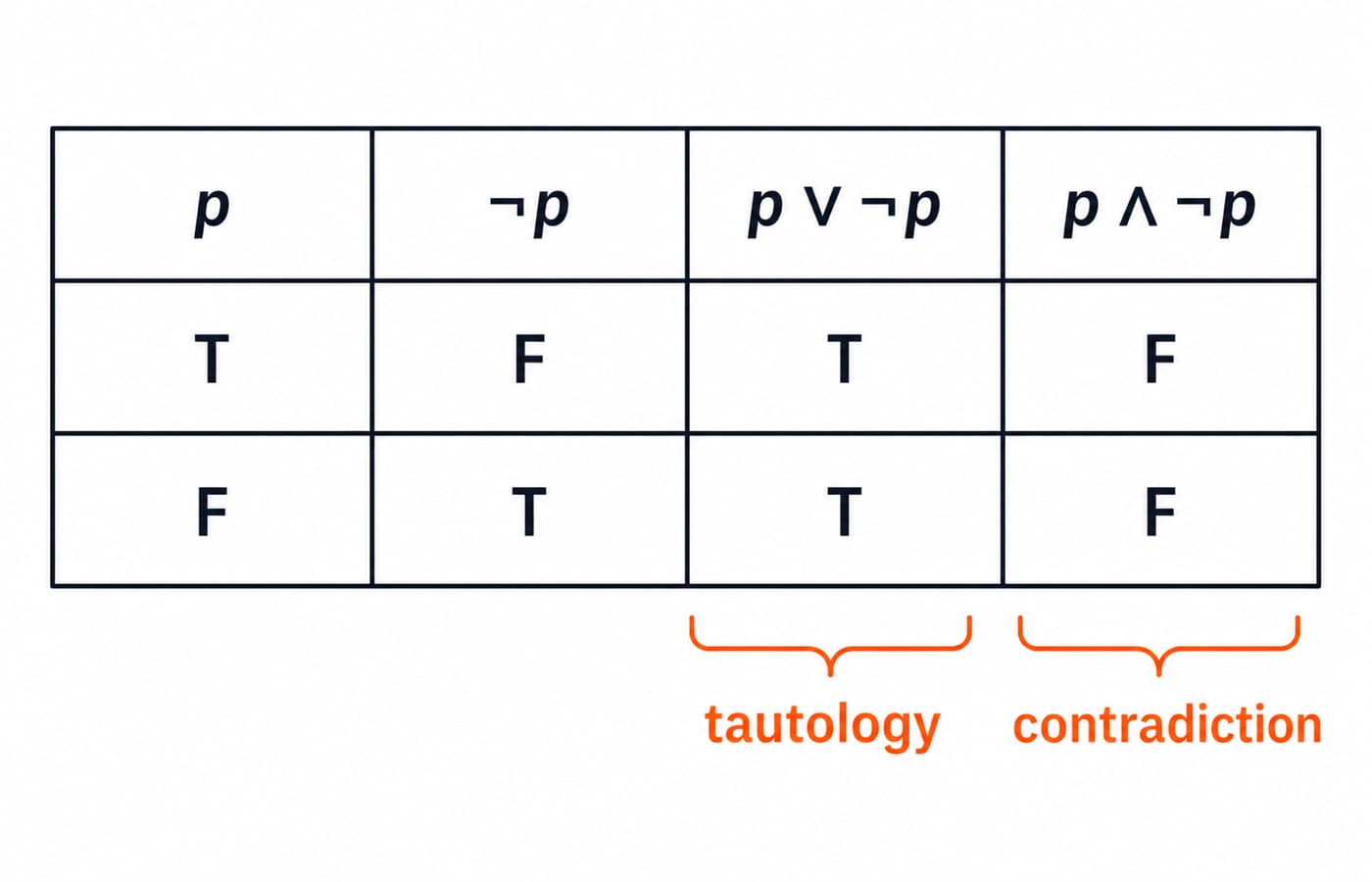
Answer: A, Tautology. "Always true" means that every row in the final column is T. For p ∨ ¬p, the two valuations of p produce T ∨ F = T and F ∨ T = T, so the output sequence is T, T. A contradiction is always false, while a contingency is true on some rows and false on others.
Question 2
A proposition that is always false is called:
A.
TautologyB.
ContradictionC.
ContingencyD.
None of the above
Answer: B, Contradiction. Take p ∧ ¬p. When p = T, its negation is F, giving T ∧ F = F. When p = F, its negation is T, giving F ∧ T = F. The output sequence is F, F, with zero satisfying valuations.
Question 3
A contingent statement is:
A.
Always trueB.
Always falseC.
Sometimes true and sometimes falseD.
None of the above
Answer: C, Sometimes true and sometimes false. For p ↔ q, use the valuations (T,T), (T,F), (F,T), (F,F). A biconditional is true when both sides match, so its final column is T, F, F, T. It is true in 2 of 4 valuations. Therefore it is satisfiable but not valid, which makes it contingent.
The key is to classify the complete final column, not any single row that happens to be true or false.
Questions 4 to 6: classify formulas with a two-row truth table
Question 4
If a statement is a contradiction, then its truth value is:
A.
Always trueB.
Always falseC.
Sometimes trueD.
Sometimes false
Answer: B, Always false. "Sometimes false" is too weak because a contingency is also false sometimes. A contradiction must be false under every valuation, so its final column contains only F.
Question 5
What is the truth value of ?
A.
TautologyB.
ContradictionC.
ContingencyD.
None of the above
Answer: B, Contradiction. Work both valuations instead of relying only on the law name. If p = T, then ¬p = F, so T ∧ F = F. If p = F, then ¬p = T, so F ∧ T = F. Since the result is false in both rows, p ∧ ¬p is a contradiction.
Question 6
Which of the following represents a tautology?
A.
\( p \lor \neg p \)B.
\( p \land \neg p \)C.
\( p \rightarrow \neg p \)D.
\( \neg p \land q \)
Answer: A, p ∨ ¬p. For p = T, it becomes T ∨ F = T. For p = F, it becomes F ∨ T = T. Option B is a contradiction. Option C is false at p = T, because T → F = F. Option D is false at p = T, q = T, because F ∧ T = F. A single false valuation is enough to reject a tautology candidate.
The excluded-middle check in Question 6 is the two-row baseline. For broader argument translation, inference and counterexample drills that also use excluded middle, continue with Questions and Practice Problems on Propositions MCQs. The remaining questions here stay focused on formula classification, satisfiability and semantic entailment.
Questions 7 and 8: separate validity from semantic entailment
Question 7
A valid sentence or tautology is a sentence that is:
A.
True under all interpretations, no matter what the world is actually like or what the semantics isB.
False under all interpretationsC.
Both A and BD.
None of the above
Answer: A. In propositional logic, the operational test is precise: a valid formula is true under every valuation of its variables. If a formula is true under only one valuation, or even under several but not all valuations, it is satisfiable but not valid.
Question 8
The mathematical notation to describe logical entailment of a sentence “α entails another sentence β” is : -
A.
α ⊨ βB.
α ⊆ βC.
β ⊨ αD.
β ⊆ α
Answer: A, α ⊨ β. Entailment means that every valuation satisfying α also satisfies β. Let α = p ∧ q and β = p. For (p,q) = (T,T), (α,β) = (T,T). For (T,F), it is (F,T). For (F,T) and (F,F), it is (F,F). No row has α = T and β = F, so α ⊨ β. The symbol ⊨ expresses semantic entailment; ⊆ is the subset symbol.
Validity classifies one formula. Entailment compares a condition with a conclusion. Rows where α is false do not violate α ⊨ β; only a row with true α and false β would do that.
Questions 9 and 10: biconditional contingency and a valid argument form
Question 9
The proposition (P⇒Q)⋀(Q⇒P) is a
A.
tautologyB.
contradictionC.
contingencyD.
absurdity
Answer: C, contingency. The expression (P⇒Q)⋀(Q⇒P) is equivalent to P ↔ Q. At (T,T), both implications are true. At (T,F), P⇒Q is false, so the conjunction is false. At (F,T), Q⇒P is false, so the conjunction is again false. At (F,F), both implications are true because each has a false antecedent. The final column is therefore T, F, F, T. Both truth values occur, so the formula is contingent. The step-by-step construction is covered in Implication and Biconditional Operators in Logic.
Question 10
Choose the correct statement about “ P ∧ (P-> Q) ->Q “
A.
Not validB.
TautologyC.
Not satisfiableD.
Contradiction
Answer: B, Tautology. The intended grouping is (P ∧ (P→Q))→Q, the propositional form of modus ponens. For (P,Q) = (T,T), the antecedent is T, so the result is T. For (T,F), P→Q = F, making the antecedent F and the whole implication T. For (F,T) and (F,F), the antecedent is F, so each implication is T. The final column is T, T, T, T.
|
|
|
|
|
|---|---|---|---|---|
T | T | T | T | T |
T | F | F | F | T |
F | T | T | F | T |
F | F | T | F | T |
The only row with a true antecedent also has a true conclusion. Every other row makes the outer implication true through a false antecedent, so no counterexample exists.
Questions 11 and 12: simplify a tautology and map the boundary cases
Question 11
The proposition [(p Λ q) -> (p v q) v ∼p v q]
A.
tautologyB.
satisfiable but not tautologyC.
a contradictionD.
none of the above
Answer: A, tautology. Normalise the source symbols as [(p ∧ q) → (p ∨ q)] ∨ ¬p ∨ q, then simplify:
[(p ∧ q) → (p ∨ q)] ∨ ¬p ∨ q
≡ [¬(p ∧ q) ∨ (p ∨ q)] ∨ ¬p ∨ q
≡ [(¬p ∨ ¬q) ∨ (p ∨ q)] ∨ ¬p ∨ q
≡ (¬p ∨ p) ∨ (¬q ∨ q) ∨ ¬p ∨ q
≡ T ∨ T ∨ ¬p ∨ q
≡ T
The first step replaces A → B with ¬A ∨ B; the next uses De Morgan's law. The complementary pairs then make the entire expression true under every valuation.
Question 12
Consider the statements: S1: Every unsatisfiable formula is a contingency. S2: Every valid formula is a contingency. S3: Every invalid formula is a contradiction. Which option identifies the correct statements?
A.
S1 and S3B.
S2 and S3C.
S1 onlyD.
None of these
Answer: D, None of these. All three statements are false:
S1 fails because an unsatisfiable formula has
0satisfying valuations, while a contingency has at least one true valuation and at least one false valuation.S2 fails because a valid formula is true in all valuations, while a contingency is false in some valuations.
S3 fails because invalid formulas include both contradictions and contingencies, not contradictions alone.
The model counts make the boundaries visible. p ∨ ¬p is true in 2/2 valuations, so it is valid and satisfiable. p ↔ q is true in 2/4, so it is invalid but satisfiable. p ∧ ¬p is true in 0/2, so it is invalid and unsatisfiable.
The short version and next practice step
Keep this three-line memory rule beside every truth table:
All
Tmeans valid and satisfiable.All
Fmeans invalid and unsatisfiable.Mixed
TandFmeans invalid but satisfiable.
Write the final-column sequence before looking at the options. With two variables, T, F, F, T proves contingency, T, T, T, T proves tautology, and F, F, F, F proves contradiction. This habit prevents definition words from blurring together under time pressure.
With three variables, apply the same rule across all eight rows.
For a structured course route, continue with GATE Guidance by Sanchit Sir. The GATE CS Exam Preparation Courses & Test Series category helps you choose the next topic.
Keep learning
Graph Traversal MCQs: 12 Solved Questions on Walks, Paths, Trails, Circuits and Connectivity
Attempt 12 graph traversal and connectivity questions, then check each answer through definitions, reachability, degree conditions and edge-count arguments.
Updated 3 Oct 20267 min readDiscrete Mathematics MCQs
Planar Graphs MCQs: 12 Solved Questions on Kuratowski’s Theorem, Homeomorphism and Edge Bounds
Solve 12 planar graph questions, then check each answer through a forbidden-subdivision argument, a crossing-free redraw, or a short calculation.
Updated 28 Sep 20268 min readDiscrete Mathematics MCQs
Power Set and Cardinality MCQs: 12 Solved Questions with Explanations
Solve 12 power set questions, from direct enumeration and nested sets to inclusion chains, ordered pairs and recurrence-based counting.
25 Sep 20267 min readDiscrete Mathematics MCQs
Null Set, Universal Set, Subset and Proper Subset MCQs: 12 Solved Questions
Practise 12 MCQs on null sets, universal sets, subsets, proper subsets, complements and nested inclusion, with clear reasoning for every answer.
Updated 24 Sep 20267 min readDiscrete Mathematics MCQs