Implication and Biconditional Operators in Logic: 11 Solved MCQs and NATs with Step-by-Step Explanations
Eleven solved questions on implication and biconditionals: converse, only if, unless, contraposition, equivalence, truth values and two NAT problems.
KnowledgeGate Team
Exam prep & CS education
Updated 21 Jul 20267 min read
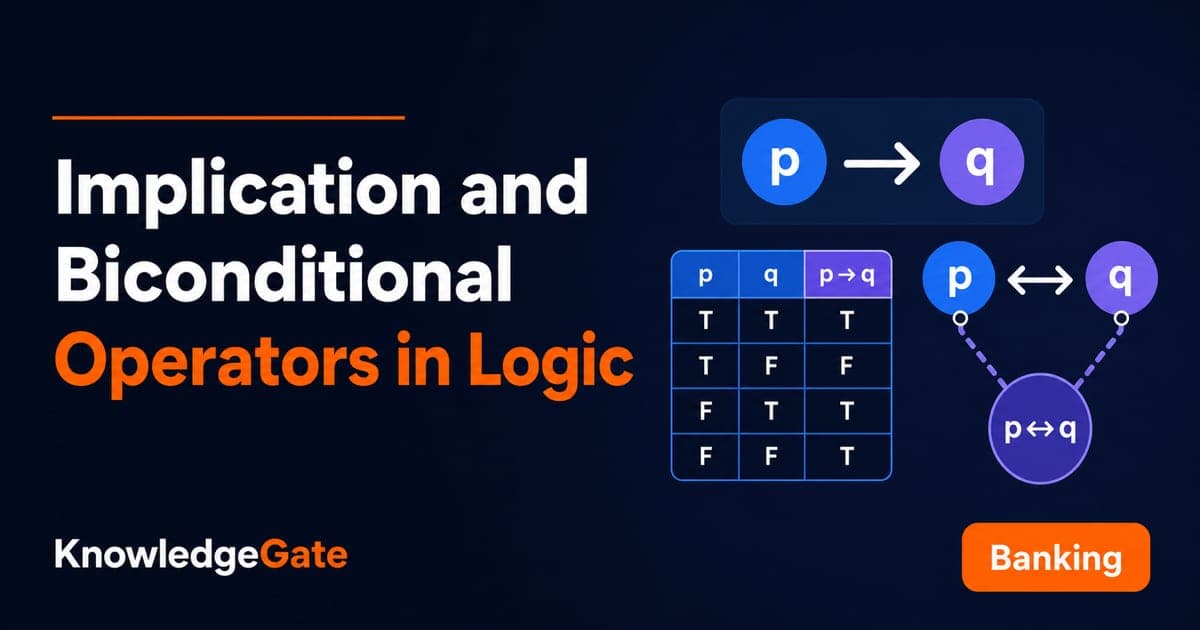
Students know the → and ↔ truth tables but lose marks when English hides them. They confuse converse with contrapositive, mistranslate “only if” and “unless”, or forget p → q ≡ ¬p ∨ q. The eleven questions below turn on exactly those slips, and each one is worked down to the single step that decides the answer.
Lock these five facts before attempting the questions
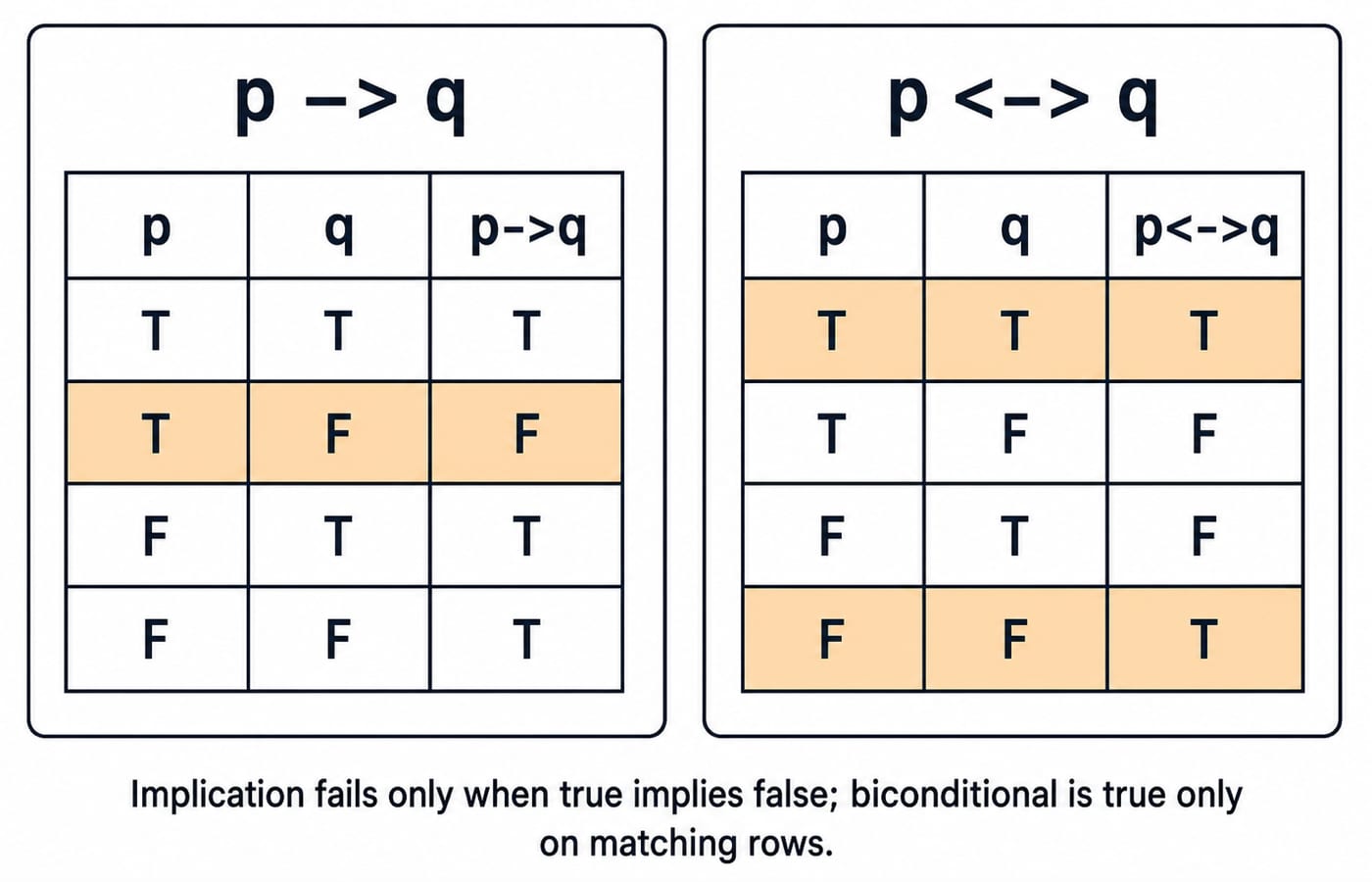
Implication: p → q is false only for p=T, q=F. It is true otherwise, including whenever p is false, called vacuously true.
Core identity: p → q ≡ ¬p ∨ q.
Negation: ¬(p → q) ≡ p ∧ ¬q, a conjunction.
Three relatives: converse q → p, inverse ¬p → ¬q, contrapositive ¬q → ¬p. Only the contrapositive equals p → q. Converse and inverse equal each other.
Biconditional: p ↔ q is true when p and q match. Its forms are (p → q) ∧ (q → p), (¬p ∨ q) ∧ (p ∨ ¬q), and (p ∧ q) ∨ (¬p ∧ ¬q).
For full theory, read Propositional and Predicate Logic.
Translating English into implication: converse, “only if”, “unless”
Q1. Converse of “only if”
Stem: What is the converse of the following assertion? I stay only if you go.
Options: A) I stay if you go B) If I stay then you go C) If you do not go then I do not stay D) If I do not stay then you go
Correct answer: A. With S for “I stay” and G for “you go”, the assertion is S → G. Its converse G → S reads “I stay if you go”. Option B is the original. See this converse question solved.
Q2. Translating “cannot be given when”
Stem: p: Fail grade can be given. q: Student scores more than 50% marks. Statement: “Fail grade cannot be given when student scores more than 50% marks.”
Options: A) q → ¬p B) q → p C) p → q D) ¬p → q
Correct answer: A. The condition is q and the result is ¬p, so the formula is q → ¬p. Reversing the arrow is the trap. See this sentence-translation question solved.
Q3. Translating “unless”
Stem: “If X, then Y unless Z” in propositional logic.
Options: A) (X ∧ ¬Z) → Y B) (X ∧ Y) → ¬Z C) X → (Y ∧ ¬Z) D) (X → Y) ∧ ¬Z
Correct answer: A. “Y unless Z” means ¬Z → Y. X is also required, giving (X ∧ ¬Z) → Y. Attaching ¬Z to the result is the trap. See this unless question solved.
Equivalence and the contrapositive trap
Q4. Inverse, converse, and equivalent form
Stem: The statement (¬p) → (¬q) is logically equivalent to which of the statements below? I. p → q II. q → p III. (¬q) ∨ p IV. (¬p) ∨ q.
Options: A) I only B) I and IV only C) II only D) II and III only
Correct answer: D. The contrapositive of ¬p → ¬q is q → p, statement II. Expanding it gives ¬q ∨ p, statement III. The trap is equating this inverse with p → q. See this logical-equivalence question solved.
Q5. Contrapositive in ordinary language
Stem: P: Good mobile phones are not cheap. Q: Cheap mobile phones are not good. L: P implies Q. M: Q implies P. N: P is equivalent to Q. Which is CORRECT?
Options: A) Only L is TRUE B) Only M is TRUE C) Only N is TRUE D) L, M and N are TRUE
Correct answer: D. With g for good and c for cheap, P is g → ¬c and Q is its contrapositive c → ¬g. They are equivalent, so L, M, and N hold. The trap is missing the contrapositive in words. See this contrapositive question solved. Also revise Set Theory and Relations.
Biconditional equivalence questions
Q6. Spot the XOR
Stem: Which one of the following is NOT equivalent to p ↔ q?
Options: A) (¬p ∨ q) ∧ (p ∨ ¬q) B) (¬p ∨ q) ∧ (q → p) C) (¬p ∧ q) ∨ (p ∧ ¬q) D) (¬p ∧ ¬q) ∨ (p ∧ q)
Correct answer: C. A and B express (p → q) ∧ (q → p), while D covers matching cases. C is XOR, true when p and q differ, so it negates p ↔ q. Missing that reversal is the trap. See this biconditional-equivalence question solved.
Q7. Exactly two variables are true
Stem: Which one of the following propositional logic formulas is TRUE when exactly two of p, q and r are TRUE?
Options: A) ((p ↔ q) ∧ r) ∨ (p ∧ q ∧ ¬r) B) (¬(p ↔ q) ∧ r) ∨ (p ∧ q ∧ ¬r) C) ((p → q) ∧ r) ∨ (p ∧ q ∧ ¬r) D) (¬(p ↔ q) ∧ r) ∧ (p ∧ q ∧ ¬r)
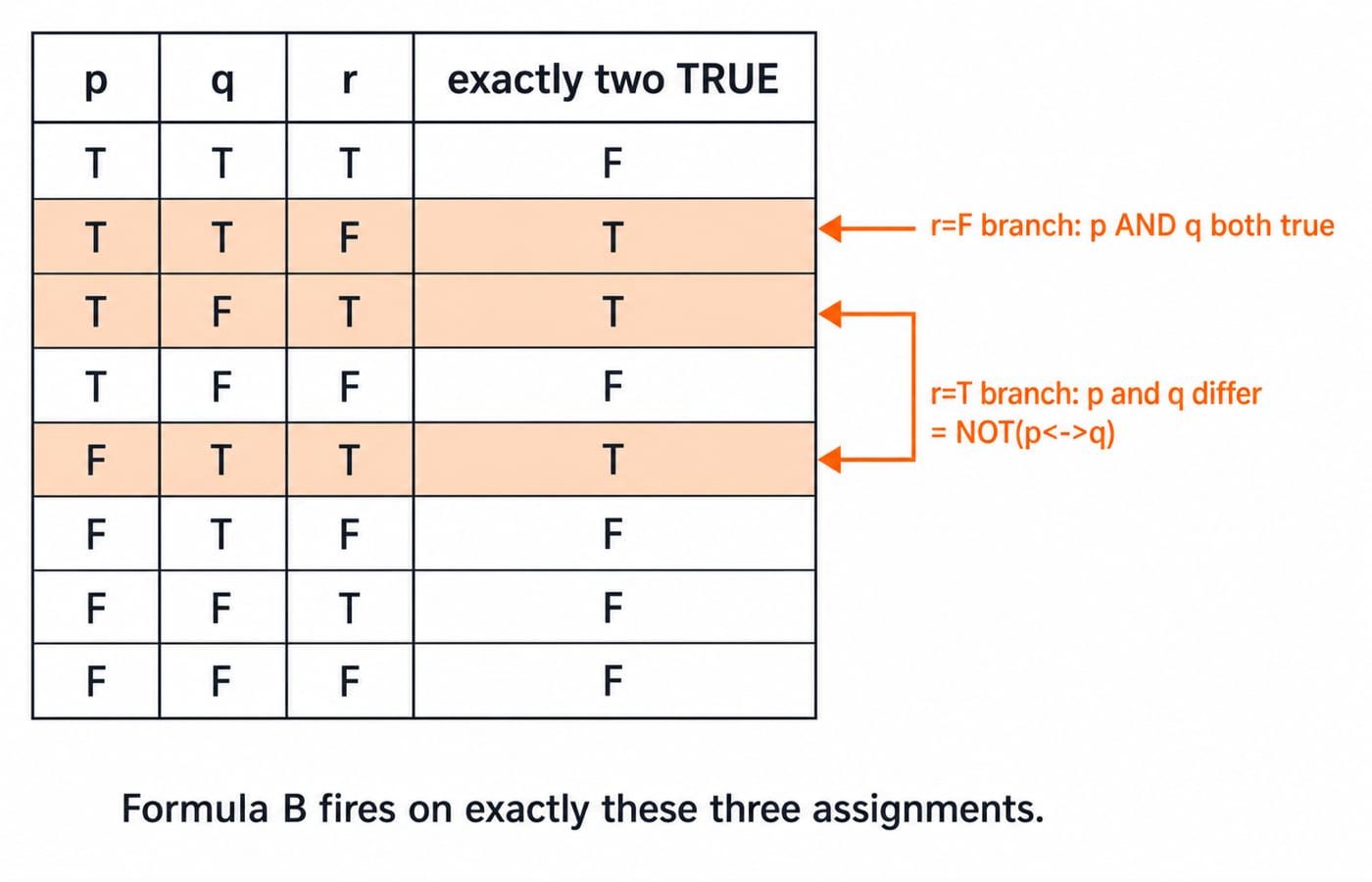
Correct answer: B. If r is true, p and q must differ: ¬(p ↔ q) ∧ r. If r is false, both must be true: p ∧ q ∧ ¬r. OR gives B. A wrongly makes p and q equal, so it fires on p=q=r=T; C fires on p=F, q=F, r=T, where only one variable is true; D joins two incompatible cases with AND, so it is never true. See this exactly-two-true question solved.
Evaluating a formula under a given premise
Q8. Can the target truth value be fixed?
Stem: If the proposition ¬p → q is true, then the truth value of the proposition ¬p ∨ (p → q), where ¬ is negation, ∨ is inclusive OR and → is implication, is
Options: A) True B) Multiple Values C) False D) Cannot be determined
Correct answer: D. The premise is ¬p → q ≡ p ∨ q. For p=T, q=T, the target is F ∨ (T → T) = T. For p=T, q=F, the premise F → F remains true, but the target is F ∨ (T → F) = F. Both satisfy the premise, so the target is undetermined. Testing one case is the trap. See this truth-value question solved.
Full-sentence translation and numerical-answer (NAT) questions
Q9. Translate both clauses before joining them
Stem: p, q, r denote “It is raining”, “It is cold”, “It is pleasant”. Statement: “It is not raining and it is pleasant, and it is not pleasant only if it is raining and it is cold.”
Options: A) (¬p ∧ r) ∧ (¬r → (p ∧ q)) B) (¬p ∧ r) ∧ ((p ∧ q) → ¬r) C) (¬p ∧ r) ∨ ((p ∧ q) → ¬r) D) (¬p ∧ r) ∨ (r → (p ∧ q))
Correct answer: A. The first clause is ¬p ∧ r. “A only if B” means A → B, so the second is ¬r → (p ∧ q). AND gives option A. Reversing “only if” or using OR is the trap. See this full-sentence translation solved.
Q10. Count the implied expressions
Stem: Consider the following expressions: (i) false (ii) Q (iii) true (iv) P ∨ Q (v) ¬Q ∨ P. The number of expressions given above that are logically implied by P ∧ (P → Q) is ____.
Correct answer: 4. The premise makes P true, then modus ponens makes Q true. Now (i) false is not implied; (ii) Q is; (iii) true always is; (iv) P ∨ Q = T; and (v) ¬Q ∨ P = F ∨ T = T. Items (ii) to (v) give 4. Forgetting that true is implied is the trap. See this implication-count NAT solved.
Q11. Simplify the negation before testing values
Stem: p: x ∈ {8, 9, 10, 11, 12}; q: x is a composite number; r: x is a perfect square; s: x is a prime number. Find the integer x ≥ 2 satisfying ¬((p → q) ∧ (¬r ∨ ¬s)) ____.
Correct answer: 11. Apply De Morgan's law and negate the implication:
¬((p → q) ∧ (¬r ∨ ¬s)) ≡ ¬(p → q) ∨ ¬(¬r ∨ ¬s) ≡ (p ∧ ¬q) ∨ (r ∧ s).
No x ≥ 2 is both prime and a perfect square, so r ∧ s is false. In the set, 8, 9, 10, and 12 are composite; only 11 satisfies p ∧ ¬q. Mishandling the two negations is the trap. See this predicate-logic NAT solved. Continue with Group Theory: Groups, Rings and Fields for more practice.
The traps that cost the most marks
Converse q → p and inverse ¬p → ¬q do not equal p → q. Only contrapositive ¬q → ¬p does.
“A only if B” means A → B. “A unless B” means ¬B → A. “A if B” means B → A.
Negating p → q gives p ∧ ¬q, never another implication.
p ↔ q is true on matching rows. Its negation, p XOR q, is true on differing rows.
For “cannot be determined”, test two premise-satisfying assignments.
The short version and where to practise next
Master p → q ≡ ¬p ∨ q and the direction of “only if” and “unless”. Most questions then need one short transformation.
Study with Engineering Mathematics for GATE, then use the GATE Test Series for timed practice. The GATE CS Exam preparation hub connects it to the wider syllabus. KnowledgeGate carries nearly 60 solved questions on implication and biconditionals, enough repetition to make these translations automatic.
Keep learning
Conditional Probability Questions with Solutions: 12-Question Practice Set
Practise 12 conditional probability questions on independence, restricted samples, Bayes' rule, draws and complements, with checked calculations.
20 Oct 20267 min readDiscrete Mathematics MCQs
Order of Elements in Groups MCQs: 10 Solved Objective Questions
Build a reliable method for finding element orders, then apply it to 10 bank questions, including NAT, MSQ and two composition-table problems.
Updated 16 Oct 20267 min readDiscrete Mathematics MCQs
Partial Order Relation MCQs: 12 Solved Poset and Total Order Questions
Solve 12 published partial order questions with fresh explanations covering posets, total orders, lattices, recursive comparisons, linear extensions and counterexamples.
12 Oct 20267 min readDiscrete Mathematics MCQs
Set Operations MCQs: 11 Solved Questions with Step-by-Step Explanations
Solve 11 set operations MCQs, then compare your decisive step with a fresh explanation covering counts, identities, complements and constructions.
Updated 8 Oct 20267 min readDiscrete Mathematics MCQs