

Internet and Web Services: Security, Cyber Law and Worked Examples
Separate the Internet from the Web, map common services to ports and controls, then trace a secure order request and calculate a file transfer.
KnowledgeGate Team
Exam prep & CS education
Updated 9 Nov 20265 min read
The Internet, Web, DNS, e-mail, file transfer and e-commerce perform different jobs and create different security risks. Network architecture, access methods and cache timing are developed in Internet Fundamentals: Architecture, Connections, DNS, URLs and Worked Examples; browser-side URL, DNS, TCP and HTTP tracing is developed in Internet Fundamentals for GATE: DNS, HTTP and a Worked Web Request Trace. The security lens starts where those traces end: select a service, protect the channel, authorise the object and preserve the electronic record.
Internet and Web are related, not interchangeable
The Internet is the interconnected network that moves packets between hosts. The Web is one client-server service that uses URLs, HTTP or HTTPS, and browsers over that network. https://portal.example/orders/42 identifies a Web resource. E-mail and SFTP also use the Internet, but they are not Web browsing.
Separate four identifiers in that URL journey:
The domain name
portal.examplenames the host.The documentation IP address
203.0.113.10identifies its network destination.Port
443selects the HTTPS service on that host.The path
/orders/42selects a resource inside that service.
DNS resolves the name, IP routing moves packets towards the host, the port selects the service, and HTTP carries the path. A request involving DNS and HTTP follows this sequence.
The core Internet services map
These ports are conventional exam associations, not guarantees for every deployment.
Need | Service or protocol | Conventional port | What crosses the network | Security caution |
|---|---|---|---|---|
Name resolution | DNS | 53 | Names and resource records | A forged answer can redirect a client |
Network configuration | DHCP | 67/68 | Address and configuration messages | Reject untrusted configuration sources |
Web access | HTTP / HTTPS | 80 / 443 | Requests and responses | HTTP alone does not provide a protected channel |
File transfer | FTP / SFTP over SSH | 20/21 / 22 | Files and commands | FTP and SFTP have different security properties |
Send mail | SMTP | 25/587 | Mail submission and transfer | Sender identity and channel protection need checks |
Retrieve mail | IMAP / POP3 | 143 / 110 | Mailbox messages | Credentials and messages need protection |
Remote administration | SSH | 22 | Commands and terminal data | Strong authentication and restricted access matter |
These services support configuration, discovery, communication, information access, file transfer and remote management. E-commerce combines several. A Web API commonly exchanges structured data over HTTP(S), while a website commonly returns HTML, CSS and JavaScript.
Worked example: follow one secure order request end to end
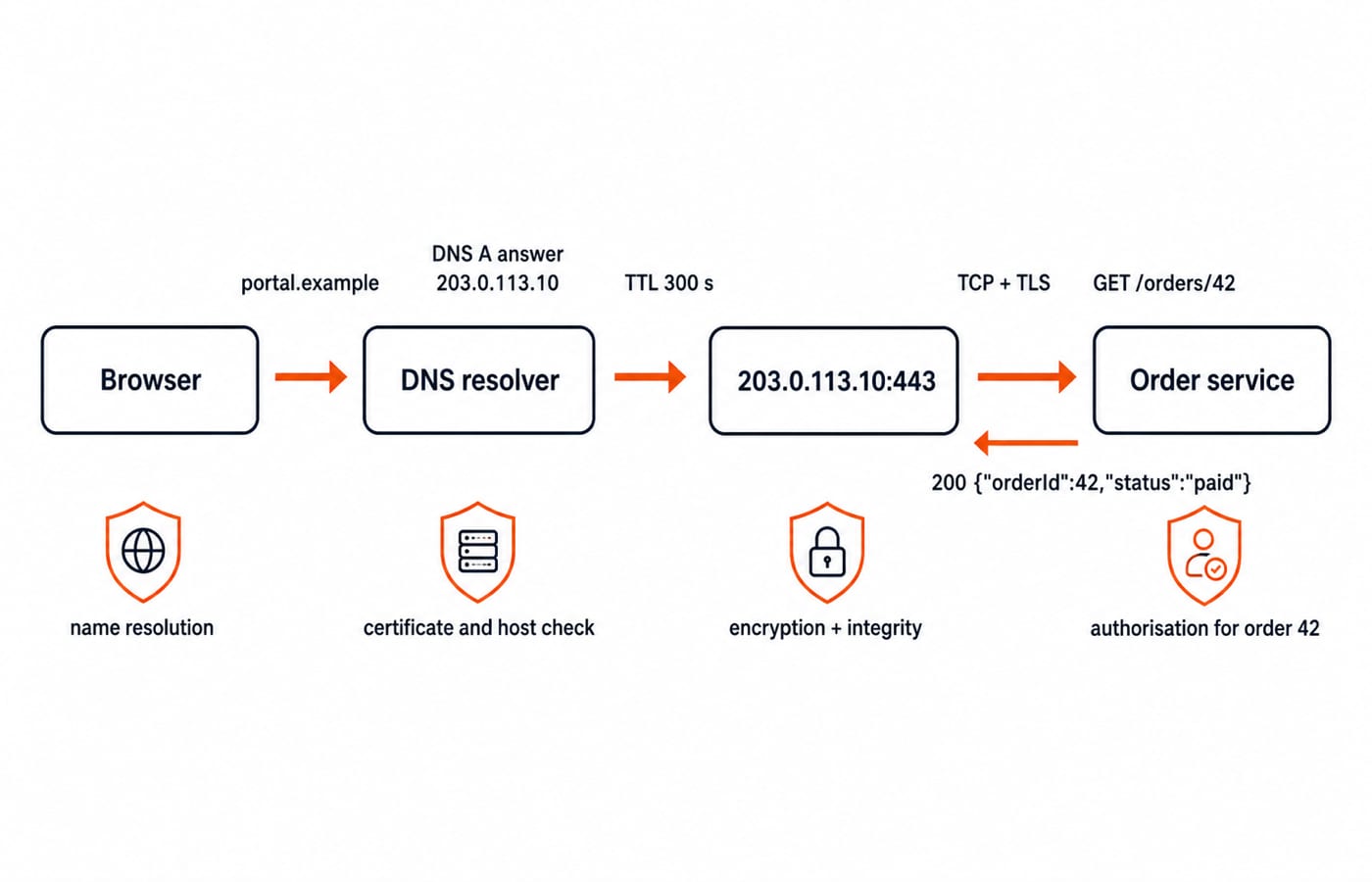
A learner enters https://portal.example/orders/42. DNS returns 203.0.113.10 with a 300-second TTL. The browser opens a TCP connection to destination port 443, establishes TLS after checking that the certificate matches portal.example, and sends GET /orders/42 HTTP/1.1 with Host: portal.example. The server returns status 200 and {"orderId":42,"status":"paid"}.
The URL scheme selects HTTPS. DNS supplies the IP, routing delivers packets, and TCP provides ordered delivery. Port 443 selects the HTTPS endpoint. TLS protects transport confidentiality and integrity. HTTP names the operation and resource. Application authorisation decides whether the signed-in user may view order 42.
A forged name-to-IP answer may redirect the client, while certificate and hostname validation help detect the wrong endpoint. Encryption addresses passive interception, and transport integrity addresses response tampering. TLS does not make a malicious server trustworthy or replace access control. An authenticated user requesting another customer's /orders/43 must still be denied by server-side authorisation.
File transfer calculation and protocol choice
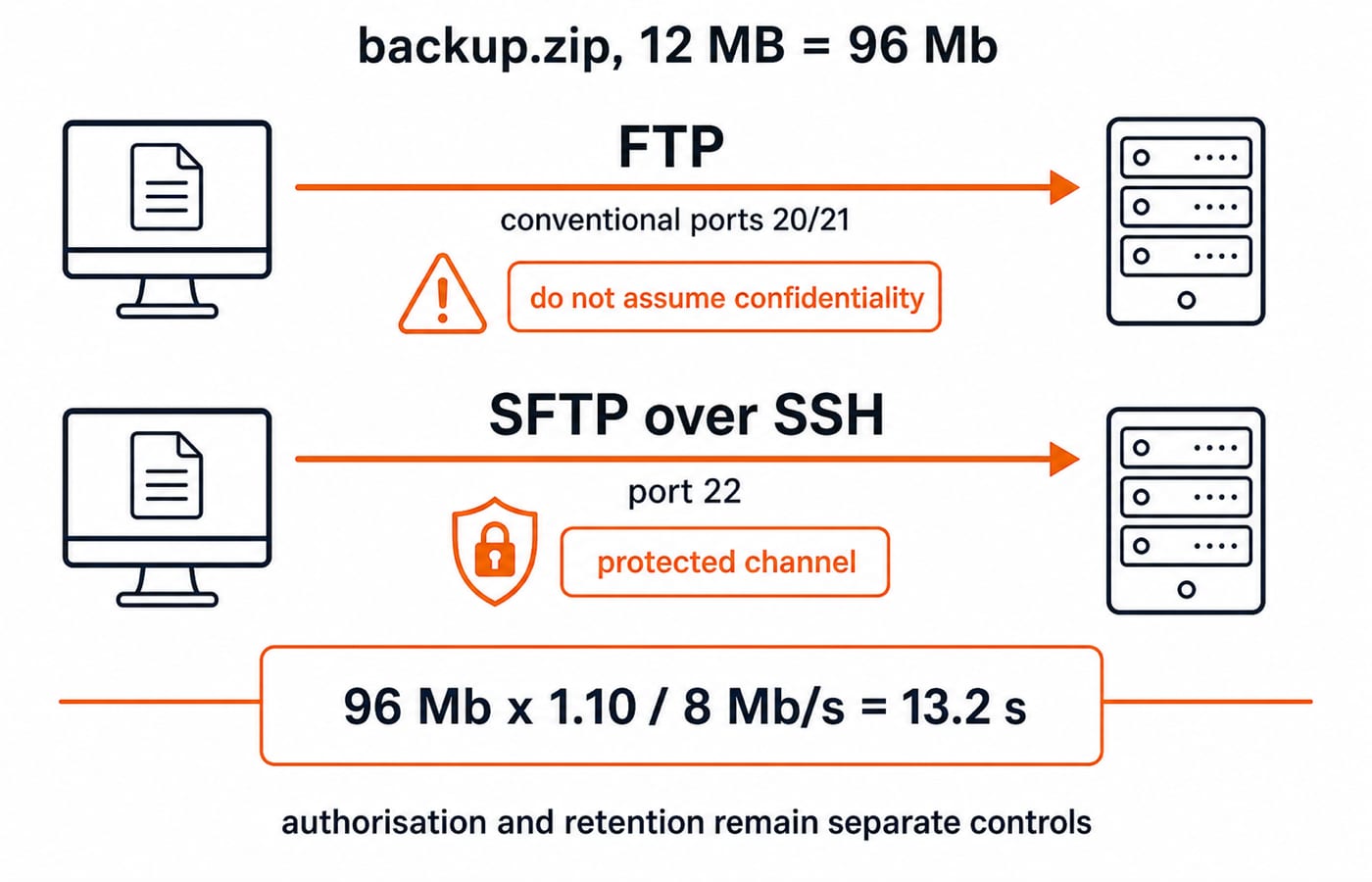
Suppose backup.zip is 12 MB. Using 8 bits per byte, its payload is:
12 MB x 8 = 96 MbIdeal time on an 8 Mb/s link:
96 / 8 = 12 secondsAmount after 10% protocol and retransmission overhead:
96 x 1.10 = 105.6 MbEstimated time:
105.6 / 8 = 13.2 seconds
As a cross-check, the 10% increase applies to the ideal 12 seconds too: 12 x 1.10 = 13.2 seconds. Real time can be higher because this model excludes latency, congestion and server limits.
FTP is a separate file-transfer protocol commonly associated with ports 20/21. SFTP carries file transfer through SSH on port 22. For customer records, choose SFTP because credentials and content need protection in transit. Authorisation, logging and a retention rule are still separate application or organisational controls.
E-commerce: security controls and cyber-law duties
An order can pass from the customer browser to the merchant application, payment provider and bank. At each hand-off, identify which field is collected, its purpose, who may access it, how it is protected in transit and at rest, and which retention rule applies.
For order 42, confidentiality blocks unauthorised readers, integrity prevents an unnoticed change from paid to refunded, and availability keeps the service reachable. Authentication establishes the user's claimed identity. Authorisation decides whether that identity may view /orders/42. Cryptography, malware, firewalls and the wider statutory frame are developed in Cyber Safety and Security: Information Security and Cyber Law with Worked Examples; this transaction raises the narrower record-lifecycle questions of attribution, acknowledgement, dispatch, receipt and retention.
India's Information Technology Act, 2000 gives legal recognition to electronic records and electronic signatures. Where a law requires an electronic record to be retained, section 7 requires it to remain accessible for later reference, preserve the original information accurately, and carry details identifying origin, destination, dispatch time and receipt time. For order 42, an audit record might contain timestamp 2026-07-16T10:32:14+05:30, actor ops17, action READ, resource /orders/42, and result DENIED. The current India Code text of the Information Technology Act, 2000 is the authority for operative wording. A complete, access-controlled log supports investigation, but one entry alone does not settle admissibility, compliance or a dispute.
Traps that turn easy questions wrong
Internet equals Web: The Web is one service that runs over the Internet.
DNS assigns every host its address: DNS resolves names, while DHCP can supply host configuration.
HTTP means secure: HTTPS adds a TLS-protected channel.
SFTP is secure FTP: SFTP runs over SSH and is distinct from FTP.
Authentication grants every action: Authorisation still checks the requested resource.
Encryption proves data was never modified: Integrity checking is a separate property, even when a secure protocol provides both.
12 / 8 = 1.5 seconds: This forgets bytes-to-bits conversion. First compute12 MB x 8 = 96 Mb.Subtract 10% from the link speed: That changes the stated model. Use
96 x 1.10 / 8 = 13.2 seconds.
How exams and interviews test the topic
Typical questions match a service to a purpose or conventional port, order DNS, TCP, TLS and HTTP, select a safe protocol, classify a control, or calculate transfer time.
Try this checkpoint:
DNS can map
portal.exampleto203.0.113.10.Destination port 443 conventionally indicates HTTPS.
TLS alone authorises access to order 42.
A 12 MB payload is 96 Mb.
Statements 1, 2 and 4 are correct. Statement 3 is false because application authorisation is separate. Before choosing an option, label each claim as name resolution, service selection, transport protection or application authorisation.
Short version and the next step
Keep this five-line recall chain:
name -> DNShost -> IPservice -> portsecure Web channel -> HTTPS/TLSallowed action -> authorisation
Redraw the order-42 journey and recompute the 13.2-second transfer without looking. For GATE-focused sequencing, continue with GATE Guidance by Sanchit Sir. For course and test-series options across the subject, use the GATE CS Exam Preparation category.
Go deeper with the full courseGATE Guidance by Sanchit Sir
Keep learning

Cyber Safety and Security: Information Security and Cyber Law with Worked Examples
Learn information security as an applied subject. Classify security failures, work Caesar and RSA examples, separate common attacks, and revise India's cyber-law framework.
Updated 22 Oct 20266 min readGATE Strategy & Roadmap
Information Security and Cyber Laws for GATE: Scope, Question Patterns and Preparation Order
Study this cluster without guessing its official weightage. Build the concepts, trace a tampered request, diagnose weak lanes and follow a realistic revision order.
Updated 30 Oct 20265 min readGATE Strategy & Roadmap
Information Security & Cyber Laws for GATE: Syllabus Scope, Weightage Reality and Prep Order
Check where security concepts overlap with GATE CS, where Cyber Laws sits outside the cited syllabus, and how to protect core preparation while serving a second target.
Updated 30 Oct 20265 min readGATE Strategy & Roadmap

Electronic Data Interchange and E-Commerce: Secure Workflows, Cyber Law and Worked Examples
Follow purchase order PO7421 through mapping, secure transport, acknowledgements, validation, replay protection, invoicing, and audit evidence.
Updated 1 Aug 20266 min readGATE Strategy & Roadmap