

Information Security & Cyber Laws for GATE: A 6-Week Topic Plan
Build an adaptable six-week plan for security and cyber law topics, with a diagnostic hour budget, worked exercises, timed practice and a missed-day rule.
KnowledgeGate Team
Exam prep & CS education
Updated 20 Nov 20265 min read
Information Security and Cyber Laws mixes vocabulary, attack classification, cryptographic reasoning, network controls, response workflows and law. Before assigning GATE study time, verify the syllabus boundary in Information Security & Cyber Laws for GATE: Syllabus Scope, Weightage Reality and Prep Order. That boundary guide separates GATE-only from dual-target study. If the broader cluster survives the check, give it six seven-hour weeks.
Confirm the scope before you spend the first hour
Begin with a 30-minute scope audit. Spend 10 minutes copying headings from the official syllabus or approved course plan, 10 tagging each as in scope, related background or out of scope, and 10 removing anything supported only by coaching hearsay.
Build six blocks: foundations and risk; threats and attacks; cryptography and authentication; network, web and mobile controls; detection and response; cyber law and ethics. For a six-lane concept map and a 14-day HMAC-focused sprint, use Information Security and Cyber Laws for GATE: Scope, Question Patterns and Preparation Order. For the longer timetable, keep the final block only when verified scope includes it and use the GATE CS Exam category to place the block beside official subjects.
Turn one diagnostic into a topic-by-topic hour budget
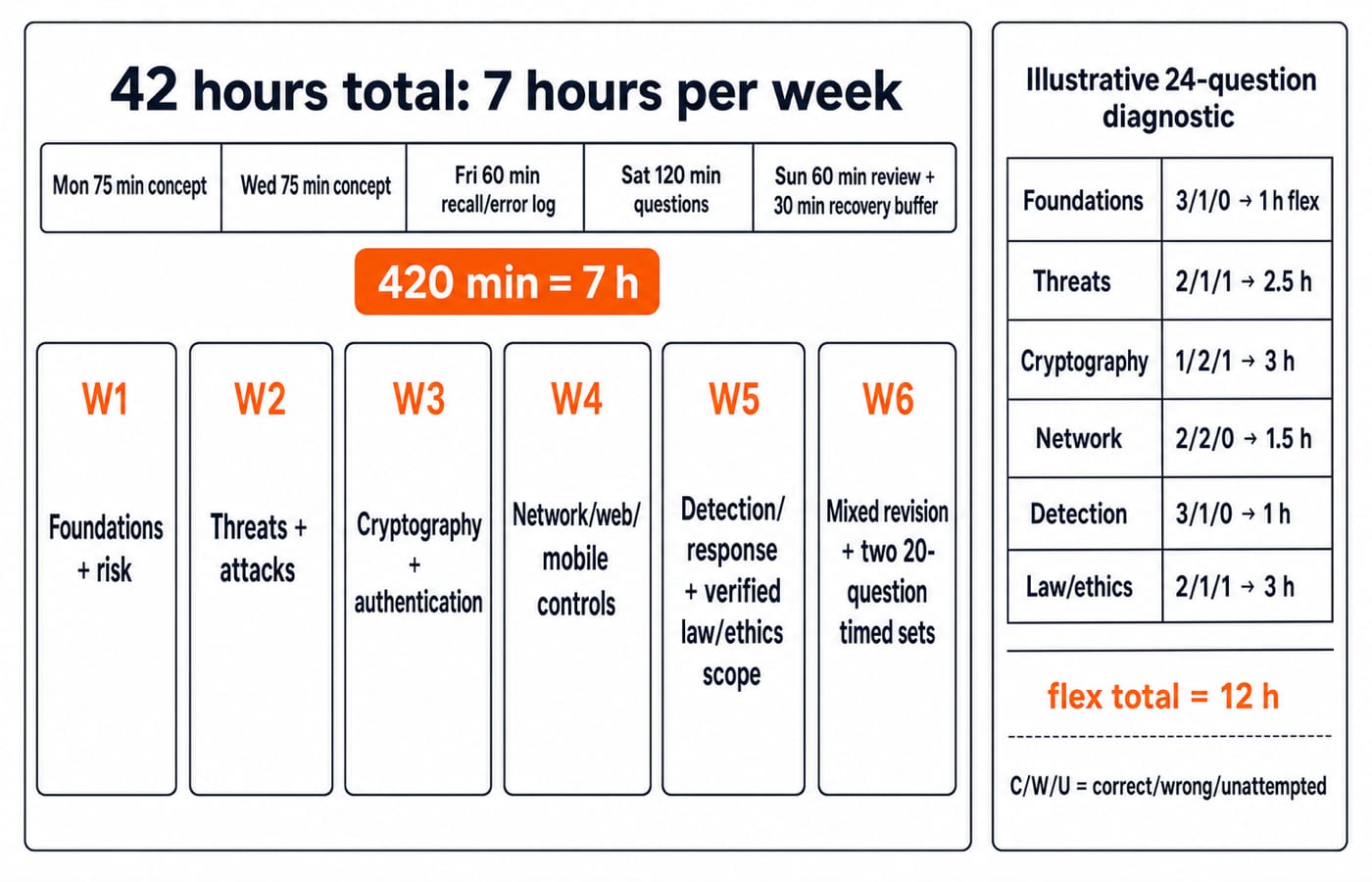
Take 24 questions without notes, four per block, each traceable to a real paper or clearly aligned with the syllabus. These sample counts show the method; yours will differ: foundations 3/1/0, threats 2/1/1, cryptography 1/2/1, network controls 2/2/0, detection and response 3/1/0, law and ethics 2/1/1.
Totals are 13 correct, 8 wrong and 3 unattempted. Attempted accuracy is 13 / (13 + 8) = 13 / 21 = 61.9%; completion is (13 + 8) / 24 = 21 / 24 = 87.5%. Use gap units = wrong + 2 x unattempted, giving 1, 3, 4, 2, 1, 3. Doubling an unattempted question separates “I could not start” from an ordinary error, and a block you could not start needs teaching time, not more practice.
The six Saturdays provide 12 flexible hours. Rank by gap units, cap a block at 3 hours, then use half-hours: 1, 2.5, 3, 1.5, 1, 3. Law and ethics gets the final half-hour for primary-source checks. Total: 12 hours.
Weeks 1 and 2: foundations first, then attack classification
Week 1 links controls to security goals. Review confidentiality, integrity, availability, asset, threat, vulnerability, risk, authentication, authorisation and least privilege. Use likelihood x impact as a planning model: a credential database at 4 x 5 scores 20, a backup archive at 2 x 4 scores 8, and a public brochure page at 2 x 2 scores 4. Study them in the order 20 > 8 > 4.
In Week 2, classify malware, phishing, social engineering, denial-of-service ideas, spoofing and insider threats. Distinguish vulnerability, exploit and impact. For each attack, make a three-column card: entry path, security property harmed, best first control. That builds recall instead of name lists.
Weeks 3 and 4: practise crypto decisions and place network controls
Week 3 separates encryption, hashing, MACs and digital signatures by purpose, key material and receiver verification. Work this repeating-key shift cipher over the 26 letters, with A = 0, plaintext CIPHER and key KEY:
Position | 1 | 2 | 3 | 4 | 5 | 6 |
|---|---|---|---|---|---|---|
Plaintext | C | I | P | H | E | R |
Letter value | 2 | 8 | 15 | 7 | 4 | 17 |
Repeated key | K | E | Y | K | E | Y |
Key value | 10 | 4 | 24 | 10 | 4 | 24 |
(P + K) mod 26 | 12 | 12 | 13 | 17 | 8 | 15 |
Ciphertext | M | M | N | R | I | P |
(C - K) mod 26 | 2 | 8 | 15 | 7 | 4 | 17 |
Encrypt with (P + K) mod 26. The two wraps are 15 + 24 = 39, giving 13 (N), and 17 + 24 = 41, giving 15 (P). The ciphertext is MMNRIP.
Decrypt with (C - K) mod 26: 13 - 24 = -11 becomes 15 (P), while 15 - 24 = -9 becomes 17 (R). All six positions restore CIPHER. Reversing the key operation distinguishes this cipher from a one-way hash.
Different plaintext letters C and I both yield M under different key letters, so M alone does not identify the plaintext. Repeating-key ciphers are insecure because repeated patterns can expose the key period and shifts when enough ciphertext is available.
Then classify four cases: stored-password comparison uses a one-way hash; shared-secret confidentiality uses symmetric encryption; shared-secret integrity plus origin authentication uses a MAC; public origin verification uses a digital signature.
Week 4 maps endpoint protection to a host, a firewall to a traffic boundary, IDS to detection, IPS to inline prevention, and secure protocols to the application or transport layer. Finish a one-page asset -> threat -> control -> residual risk flow, then solve six classification items and four short numerical or bit-level exercises.
Week 5: study response and cyber law without stale memorisation
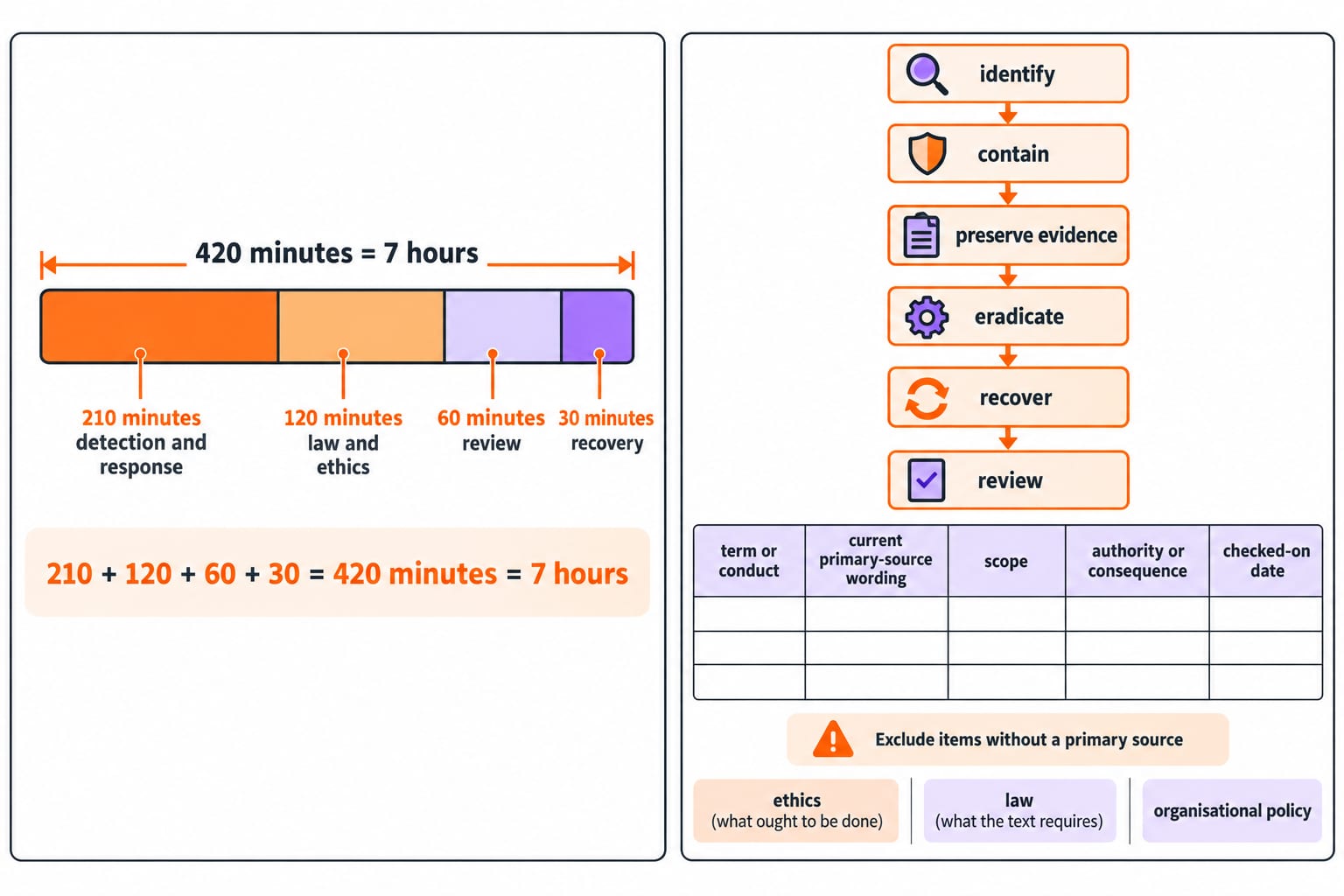
Split the week into 210 minutes detection and response + 120 minutes law and ethics + 60 minutes review + 30 minutes recovery = 420 minutes = 7 hours.
For response, use the stable sequence identify -> contain -> preserve evidence -> eradicate -> recover -> review. Textbooks and standards label these phases differently, so learn the order of actions and take exact names from the primary document your syllabus points to.
Give each legal item a five-column card: term or conduct, current primary-source wording, scope, authority or consequence, and checked-on date. Exclude items without a primary source. Copy section numbers, penalties and amendments only from current legal text. Keep ethics (what ought to be done), law (what the text requires) and organisational policy separate.
Week 6: convert PYQs and timed sets into an error-repair loop
Run two 20-question mixed sets, one on Wednesday and one on Saturday, under the same time limit. In Set A, suppose you record 12 correct, 5 wrong and 3 unattempted. Attempted accuracy is 12 / (12 + 5) = 12 / 17 = 70.6%. Repair exactly 2 concept gaps, 2 confused-pair errors and 1 haste error.
For the worked target, Set B has 15 correct, 3 wrong and 2 unattempted. Its attempted accuracy is 15 / (15 + 3) = 15 / 18 = 83.3%.
Keep a question ledger with source, year or paper, block, type, result, time and repair. Wait for at least five traceable questions in a block before calling a trend. Why PYQs Beat Buying Another Question Bank explains the repair loop. Use the GATE Test Series for pacing, question selection and recovery after a hard item.
Recover missed days, then choose the next structured step
Miss one 75-minute session? Use Sunday's 30-minute buffer and add 15 minutes to each of the next three sessions. That recovers 30 + 15 + 15 + 15 = 75 minutes without doubling a day. After two or more missed sessions in one week, move the lowest-priority new block forward and keep question review. Never delete error review to protect a timetable.
The short version: verify scope, diagnose, assign flexible hours, study one block at a time and retest. Repeat only the weakest block's Saturday flex work before expanding the plan.
Go deeper with the full courseGATE Guidance by Sanchit Sir
Keep learning
Information Security and Cyber Laws for GATE: Scope, Question Patterns and Preparation Order
Study this cluster without guessing its official weightage. Build the concepts, trace a tampered request, diagnose weak lanes and follow a realistic revision order.
Updated 30 Oct 20265 min readGATE Strategy & Roadmap
Information Security & Cyber Laws for GATE: Syllabus Scope, Weightage Reality and Prep Order
Check where security concepts overlap with GATE CS, where Cyber Laws sits outside the cited syllabus, and how to protect core preparation while serving a second target.
Updated 30 Oct 20265 min readGATE Strategy & Roadmap
Internet and Web Services: Security, Cyber Law and Worked Examples
Separate the Internet from the Web, map common services to ports and controls, then trace a secure order request and calculate a file transfer.
Updated 9 Nov 20265 min readGATE Strategy & Roadmap

Cyber Safety and Security: Information Security and Cyber Law with Worked Examples
Learn information security as an applied subject. Classify security failures, work Caesar and RSA examples, separate common attacks, and revise India's cyber-law framework.
Updated 22 Oct 20266 min readGATE Strategy & Roadmap