Reflexive and Irreflexive Relation MCQs: 10 Solved Questions on Counts and Properties
Solve 10 practice questions on reflexive and irreflexive relations. Learn diagonal tests, counting, probability, closure, and property proofs.
KnowledgeGate Team
Exam prep & CS education
Updated 26 Jul 20268 min read

Remembering that reflexive means self-related is not enough when a question asks for a count, probability, union or intersection result, or the difference between not reflexive and irreflexive. One check settles all of them. For a relation R on a set A, write the diagonal Δ_A = {(a,a) : a ∈ A} first: reflexivity forces all of Δ_A into R, irreflexivity forces all of it out, and a partial diagonal makes R neither. Every question below is decided by where Δ_A sits, so the work is locating the diagonal rather than memorising separate cases.
Reflexive relation MCQs: read the quantifier and check the diagonal
Reflexive means ∀ a ∈ A, (a,a) ∈ R. For A = {1,2,3}, the required diagonal is {(1,1), (2,2), (3,3)}; off-diagonal pairs are optional. Set Theory and Relations Explained gives the wider context.
Q1. Identity relation
Which type of relation is R = {(a, a) | a ∈ A} on set A?
(A) Reflexive
(B) Symmetric
(C) Transitive
(D) Asymmetric
Answer: (A) Reflexive.
For every a ∈ A, the identity relation contains (a,a), so it satisfies the reflexive condition directly on every element. It is also symmetric and transitive, so more than one option here is technically true. Reflexive is the intended answer because it is the property the stem's own definition R = {(a,a)} asserts outright, while symmetry and transitivity are consequences you have to derive. In a single-choice paper, take the property the definition states. Review the diagonal idea in the reflexive relation concept lesson.
Q2. Complete the symbolic definition
____ for every a ∈ A is said to be a reflexive relation R on set A.
(A) (a, a) ∈ A
(B) (a) ∈ R
(C) (a, a) ∉ R
(D) (a, a) ∈ R
Answer: (D) (a, a) ∈ R.
The set A contains elements, while the relation R contains ordered pairs. Therefore (a,a) must belong to R, not to A, for every a. The universal quantifier makes this compulsory. Option (C) reverses the membership condition; if that exclusion holds for every element, the relation is irreflexive. If the membership test still feels slippery, write R out by hand for A = {1,2}: reflexivity demands (1,1) and (2,2) inside R, and says nothing at all about (1,2).
Q3. Translate reflexivity into words
What is a reflexive relation?
(A) A relation where every element is related to itself
(B) A relation where some elements are related to themselves
(C) A relation where no element is related to itself
(D) A relation where every element is related to every other element
Answer: (A).
The deciding word is "every". Some self-pairs, as in option (B), can make a relation neither reflexive nor irreflexive. Option (C) defines an irreflexive relation. Option (D) describes the universal relation A × A, which is reflexive but demands far more than reflexivity alone. The habit worth building is to read the quantifier before the wording: "every" gives reflexive, "some" gives neither, "no" gives irreflexive.
Irreflexive relations: stronger than merely not reflexive
Irreflexive means ∀ a ∈ A, (a,a) ∉ R, or R ∩ Δ_A = ∅. On A = {1,2,3}, {(1,2), (2,3)} is irreflexive. However, {(1,1), (1,2)} is neither: two diagonal pairs are missing, but one is present. Counting is symmetric too: irreflexivity forces all n diagonal pairs out and leaves the other n² − n pairs free, so an n-element set carries 2^(n²−n) irreflexive relations, exactly as many as it has reflexive ones. On A = {1,2,3} that is 2⁶ = 64 of each.
Q4. Definition of an irreflexive relation
What is an irreflexive relation on set A?
(A) No (a, a) ∈ R for any a ∈ A
(B) Some (a, a) ∈ R for some a ∈ A
(C) All (a, a) ∈ R for all a ∈ A
(D) Some (a, a) ∈ R for all a ∈ A
Answer: (A).
Cleanly stated, for every a ∈ A, (a,a) ∉ R. Even one self-pair rules out irreflexivity, while missing only one self-pair rules out reflexivity. This is why "not reflexive" does not automatically mean "irreflexive". Check all elements before choosing either label. Option (C) gives the reflexive condition instead. The irreflexive relation concept lesson focuses on the all-out diagonal test.
Counting reflexive relations and finding the probability
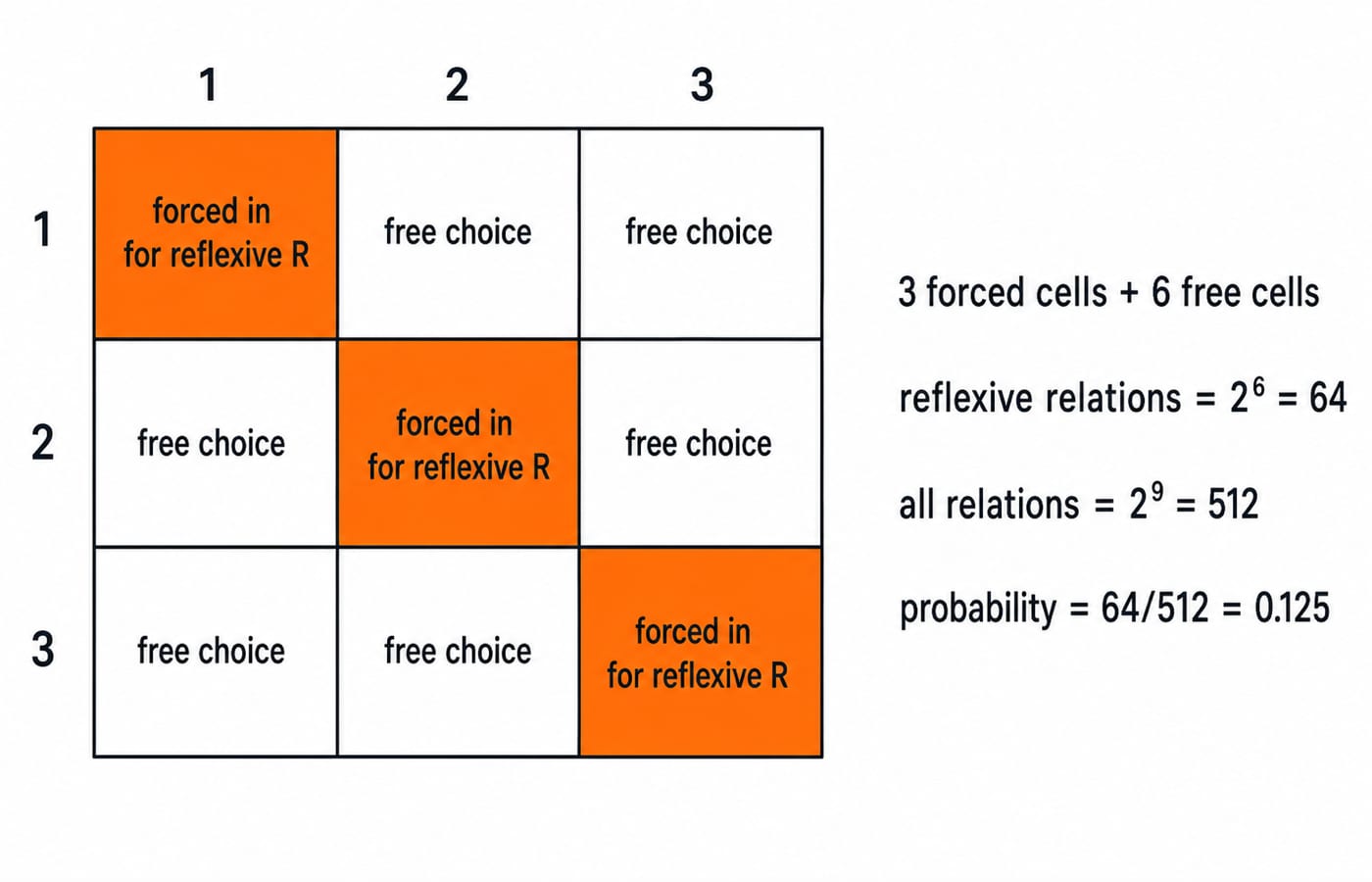
An n-element set gives n² ordered pairs. Reflexivity fixes n diagonal pairs, leaving n² − n independent choices. Thus the count is 2^(n²−n).
Q5. Count on a 5-element set
GATE 2010
What is the possible number of reflexive relations on a set of 5 elements?
(A) 2¹⁰
(B) 2¹⁵
(C) 2²⁰
(D) 2²⁵
Answer: (C) 2²⁰.
Five elements create 5² = 25 possible ordered pairs. Reflexivity makes the five diagonal pairs compulsory, so 25 − 5 = 20 off-diagonal pairs remain free. Each has two independent choices, present or absent, giving 2²⁰ = 1,048,576 reflexive relations. This subtraction matters. Option (D), 2²⁵, counts every possible relation without imposing reflexivity. See the step-by-step solve for this GATE 2010 count.
Q6. Count on a 4-element set
UGC NET 2019, Paper 2 (December)
How many reflexive relations are there on a set with 4 elements?
(A) 2^4
(B) 2^12
(C) 4^2
(D) 2
Answer: (B) 2^12.
The relation matrix has 4² = 16 positions. Four diagonal positions are fixed as present, leaving 16 − 4 = 12 optional positions. Independent inclusion or exclusion gives 2¹² = 4,096 reflexive relations. Option (C), 4² = 16, is only the number of possible ordered pairs, not the number of relations that can be formed. See the step-by-step solve for the four-element count.
Q7. Probability that a random relation is reflexive
GATE 2020, numerical answer type: you type the value, no options are given.
Let ℛ be the set of all binary relations on the set {1,2,3}. Suppose a relation is chosen from ℛ at random. The probability that the chosen relation is reflexive (round off to 3 decimal places) is ________.
Answer: 0.125.
The nine possible ordered pairs give 2⁹ = 512 total relations. A reflexive relation has three forced diagonal pairs and six free off-diagonal pairs, giving 2⁶ = 64 favourable relations. Therefore the probability is 64/512 = 1/8 = 0.125, already at three decimal places. The full probability solve confirms that forced pairs are conditions, not free choices.
Reflexive relations under union, intersection, and closure
Since Δ_A ⊆ R₁ and Δ_A ⊆ R₂, it remains in the intersection and union. For A = {1,2}, R₁ = {(1,1), (2,2), (1,2)} and R₂ = {(1,1), (2,2), (2,1)} give R₁ ∩ R₂ = Δ_A and R₁ ∪ R₂ = A × A; both are reflexive. The same fact defines the reflexive closure of an arbitrary relation R: the smallest reflexive relation containing R is R ∪ Δ_A, so you build it by adding only the missing self-pairs and changing nothing else.
Q8. Closure under intersection and union
UGC NET 2016, Paper 2 (June)
Suppose that R1 and R2 are reflexive relations on a set A.
Which of the following statements is correct ?
(A) R1 ∩ R2 is reflexive and R1 ∪ R2 is irreflexive.
(B) R1 ∩ R2 is irreflexive and R1 ∪ R2 is reflexive.
(C) Both R1 ∩ R2 and R1 ∪ R2 are reflexive.
(D) Both R1 ∩ R2 and R1 ∪ R2 are irreflexive.
Answer: (C).
For every a ∈ A, (a,a) belongs to both original relations. It therefore survives in R₁ ∩ R₂, and it is certainly present in R₁ ∪ R₂. Thus both results contain the full diagonal and are reflexive. No fact about any off-diagonal pair is required. The worked solution for this closure question shows the same invariant.
Scan an explicit relation using only the diagonal
For A = {1,2,3,4}, first check (1,1), (2,2), (3,3), (4,4). Ignore every off-diagonal pair until this checklist is complete.
Q9. Which listed relations are reflexive?
UGC NET 2024, Paper 2 (August)
Consider the following relations on {1,2,3,4}. Which of the following relations are reflexive?
(A) R1={(1,1),(1,2),(2,1),(2,2),(3,4),(4,1),(4,4)}
(B) R2={(1,1),(1,2),(2,1)}
(C) R3={(1,1),(1,2),(1,4),(2,1),(2,2),(3,3),(4,1),(4,4)}
(D)R4={(2,1),(3,1),(3,2),(4,1),(4,2),(4,3)}
(E) R5={(1,1),(1,2),(1,3),(1,4),(2,2),(2,3),(2,4),(3,3),(3,4),(4,4)}
Choose the correct answer from the options given below:
(A) (A), (B) and (C) Only
(B) (A), (D) and (E) Only
(C) (D) and (E) Only
(D) (C) and (E) Only.
Answer: (D) (C) and (E) Only.
R1 misses (3,3). R2 misses (2,2), (3,3), (4,4). R3 has all four diagonal pairs, R4 has none, and R5 has all four. So the reflexive ones are the relations labelled (C) and (E) inside the stem. Watch the label collision here: the relations are lettered (A) to (E) and the answer options are lettered (A) to (D), so the option you actually mark is (D). Symmetry and transitivity are irrelevant. The relation-by-relation scan confirms it.
Perfect-square relation: test four properties with one invariant
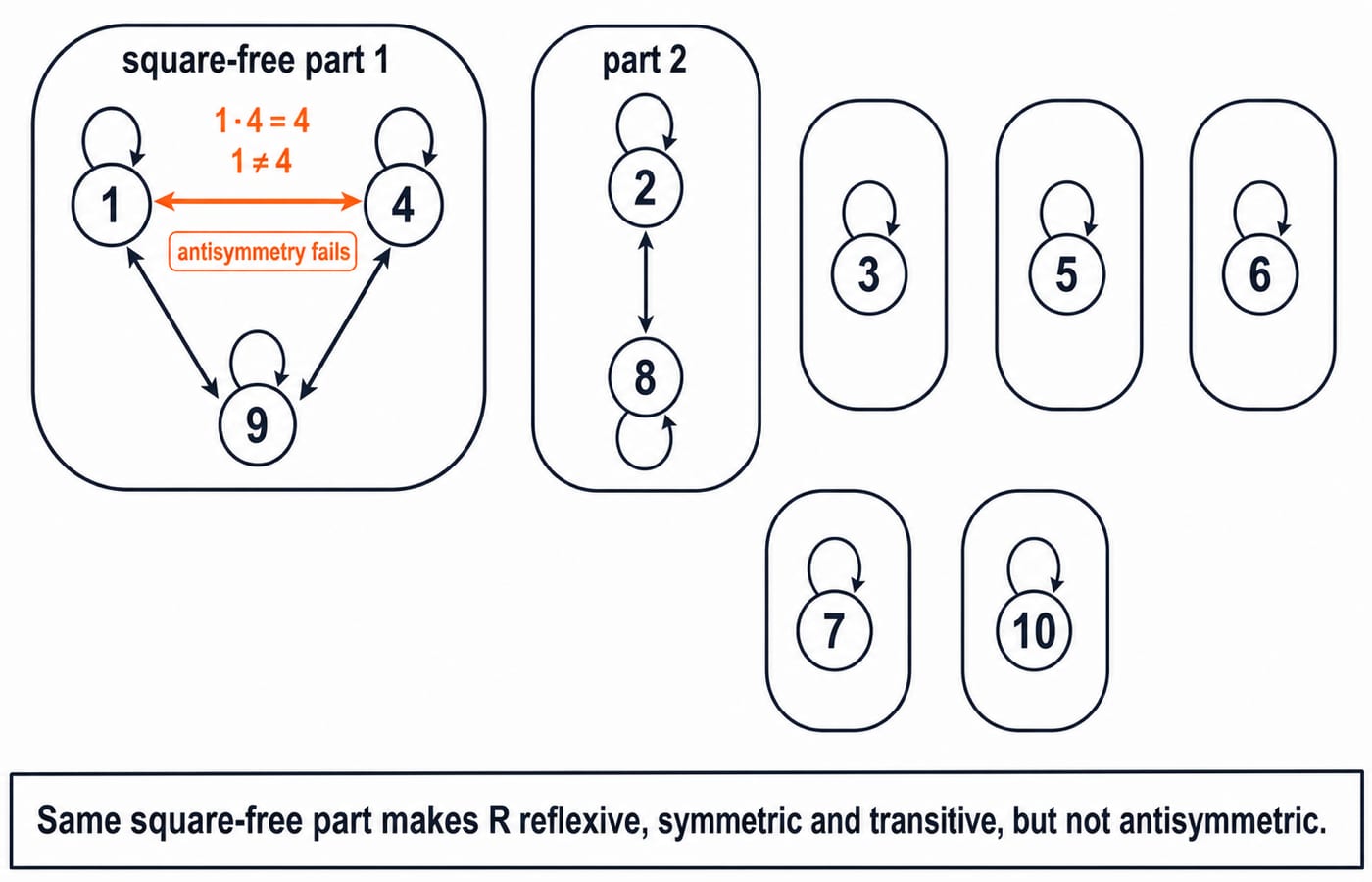
The product xy is square exactly when x and y share a square-free part. On {1,…,10}, the classes are {1,4,9}, {2,8}, {3}, {5}, {6}, {7}, {10}.
Q10. Product is a perfect square
GATE 2026, Set 2, multiple-select: more than one option can be correct.
Let R be a binary relation on the set {1,2,…,10}, where (x,y)∈R if the product of x and y is a perfect square.
Which of the following properties are satisfied by R?
(A) Reflexive
(B) Symmetric
(C) Transitive
(D) Antisymmetric
Answer: (A), (B) and (C).
Reflexivity holds because x·x = x², and symmetry follows from xy = yx. If xRy and yRz, then x,y,z share the same square-free part, so xz is square and transitivity holds. Antisymmetry fails: 1R4 and 4R1 because 1·4 = 4, yet 1 ≠ 4. Choosing only (A) is incomplete. See the property-by-property solve.
Reflexive and irreflexive relations: the short revision card
Reflexive: every pair in Δ_A is present.
Irreflexive: every pair in Δ_A is absent.
Partial diagonal: the relation is neither.
Reflexive relations on n elements: 2^(n²−n).
Irreflexive relations on n elements: also 2^(n²−n).
Reflexive closure of R: R ∪ Δ_A.
When a question stalls you, go back to the diagonal and ask whether Δ_A is fully in, fully out, or only partly in. That one question decides the definition items, the scans, the counts, the probability and the closure results alike. For the quantifier traps behind Q2 and Q3, revise Propositional and Predicate Logic Explained. To keep working through relations at exam pace, continue with GATE Guidance by Sanchit Sir or NTA-UGC-NET Paper 2.
Keep learning

Graph Traversal MCQs: 12 Solved Questions on Walks, Paths, Trails, Circuits and Connectivity
Attempt 12 graph traversal and connectivity questions, then check each answer through definitions, reachability, degree conditions and edge-count arguments.
Updated 3 Oct 20267 min readDiscrete Mathematics MCQs
Planar Graphs MCQs: 12 Solved Questions on Kuratowski’s Theorem, Homeomorphism and Edge Bounds
Solve 12 planar graph questions, then check each answer through a forbidden-subdivision argument, a crossing-free redraw, or a short calculation.
Updated 28 Sep 20268 min readDiscrete Mathematics MCQs

Power Set and Cardinality MCQs: 12 Solved Questions with Explanations
Solve 12 power set questions, from direct enumeration and nested sets to inclusion chains, ordered pairs and recurrence-based counting.
25 Sep 20267 min readDiscrete Mathematics MCQs

Null Set, Universal Set, Subset and Proper Subset MCQs: 12 Solved Questions
Practise 12 MCQs on null sets, universal sets, subsets, proper subsets, complements and nested inclusion, with clear reasoning for every answer.
Updated 24 Sep 20267 min readDiscrete Mathematics MCQs