

Imperative Programming Structure and Flow Control: Concepts, Trace Table and Exam Traps
Learn how commands change state, how branches and loops choose the next command, and how to trace continue and break without losing track of values.
KnowledgeGate Team
Exam prep & CS education
Updated 11 Nov 20265 min read
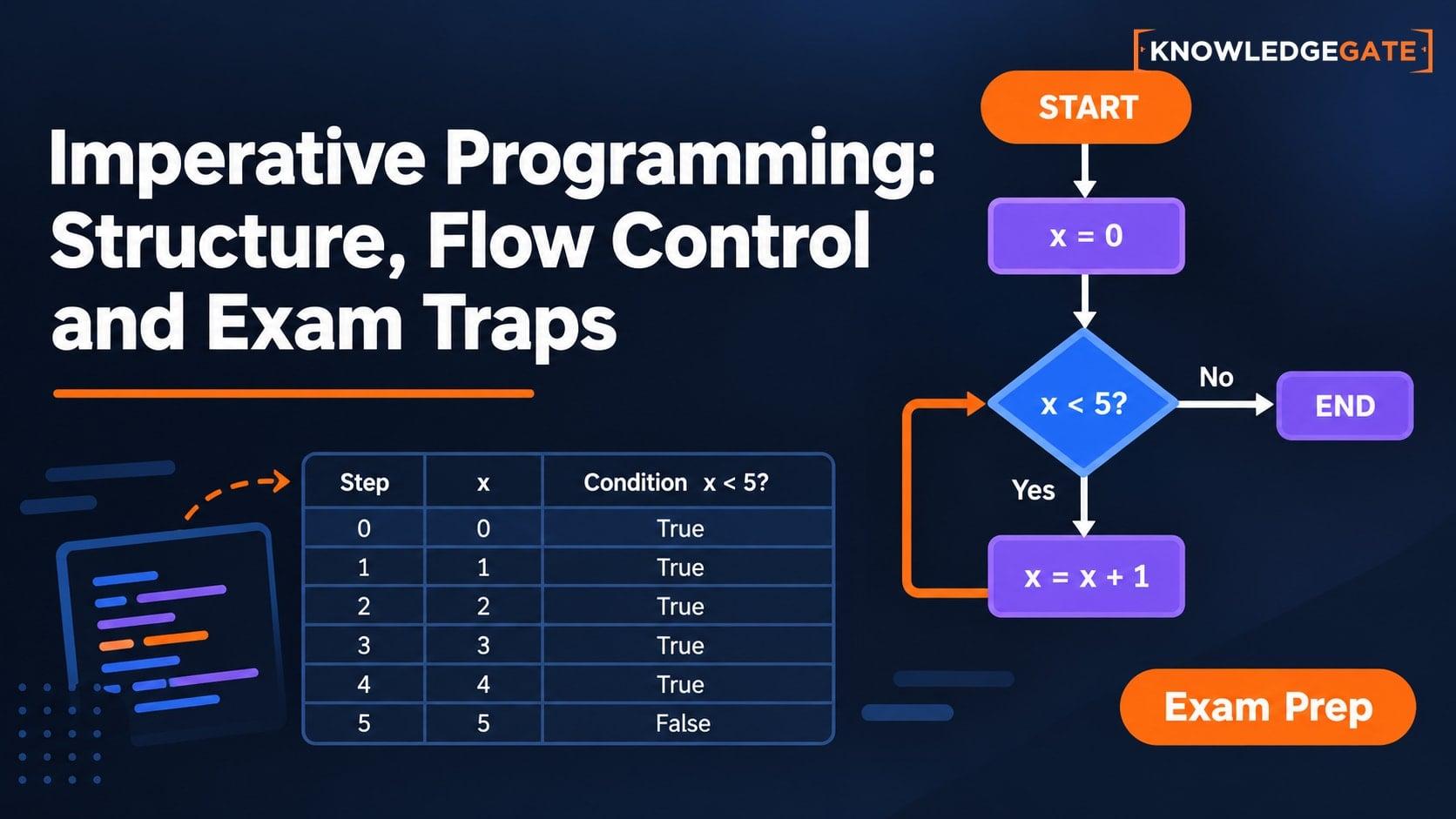
Imperative programs can look like ordinary lines of syntax until a question asks what state exists after one particular execution path. Then every assignment, branch and loop matters. Program structure fixes statement nesting, mutable state records each update, and control flow determines which statement executes next.
What Makes a Program Imperative?
Imperative programming describes a computation as a sequence of commands that changes program state. If the store begins as state = {total: 0, positiveCount: 0}, executing total = total + 4 causes this transition:
{total: 0, positiveCount: 0} -> {total: 4, positiveCount: 0}
The central question is, "What command should happen next?" That differs from the object-based organisation in Object Oriented Technology Explained, where data and associated operations are grouped into objects. Neither organisation is universally better.
Keep syntax separate from execution. Source code has a fixed, nested structure, but control flow decides the dynamic order in which its statements run.
Program Structure from Procedure to Statement
The structural hierarchy is:
program or module
procedure or function
block
declaration
statement
expression
A block groups declarations and statements. Scope determines which declaration a name can refer to. An expression computes a value, while an assignment changes a stored value.
Consider this miniature block:
total = 0;
if (x > 0) {
    total = total + x;
}
Here, total = 0 is initialisation, x > 0 is a Boolean expression, the braces form a nested block, and total = total + x is an assignment statement. If you need language syntax and practice beyond this language-independent model, the Coding and Skills category is the broader route.
The Four Flow-Control Families
Sequence:
a = 2; b = a + 3runs in order and leavesb = 5.Selection:
if (b > 4)chooses the true branch whenbis 5.Iteration:
while (a < 5)repeats its body until updates makea = 5.Explicit transfer:
break,continueandreturnredirect control when their defined conditions are met.
Pre-test and post-test loops differ at the first check. With n = 0, while (n > 0) executes zero times. In contrast, do { n = n + 1; } while (n > 1) executes once and leaves n = 1. Exact syntax, including switch fall-through, depends on the language definition.
A control-flow graph represents basic blocks as nodes and possible next blocks as directed edges. An if creates two outgoing edges. A loop adds a back edge to an earlier test.
Fully Worked Trace: Sequence, Selection, Continue and Break
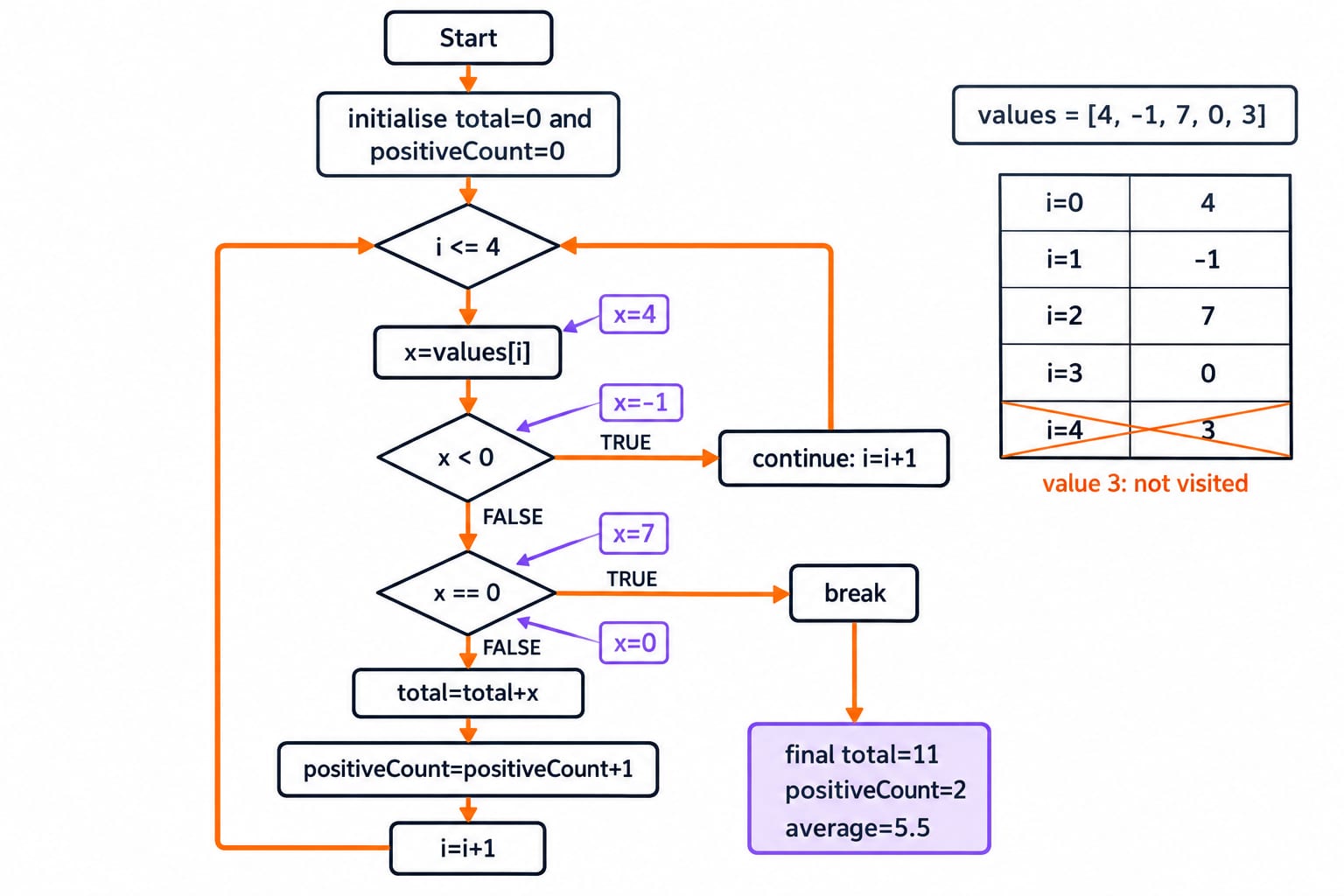
Trace this language-neutral pseudocode:
values = [4, -1, 7, 0, 3]
total = 0
positiveCount = 0

for i = 0 to 4:
    x = values[i]
    if x < 0:
        continue
    if x == 0:
        break
    total = total + x
    positiveCount = positiveCount + 1

average = real(total) / positiveCount
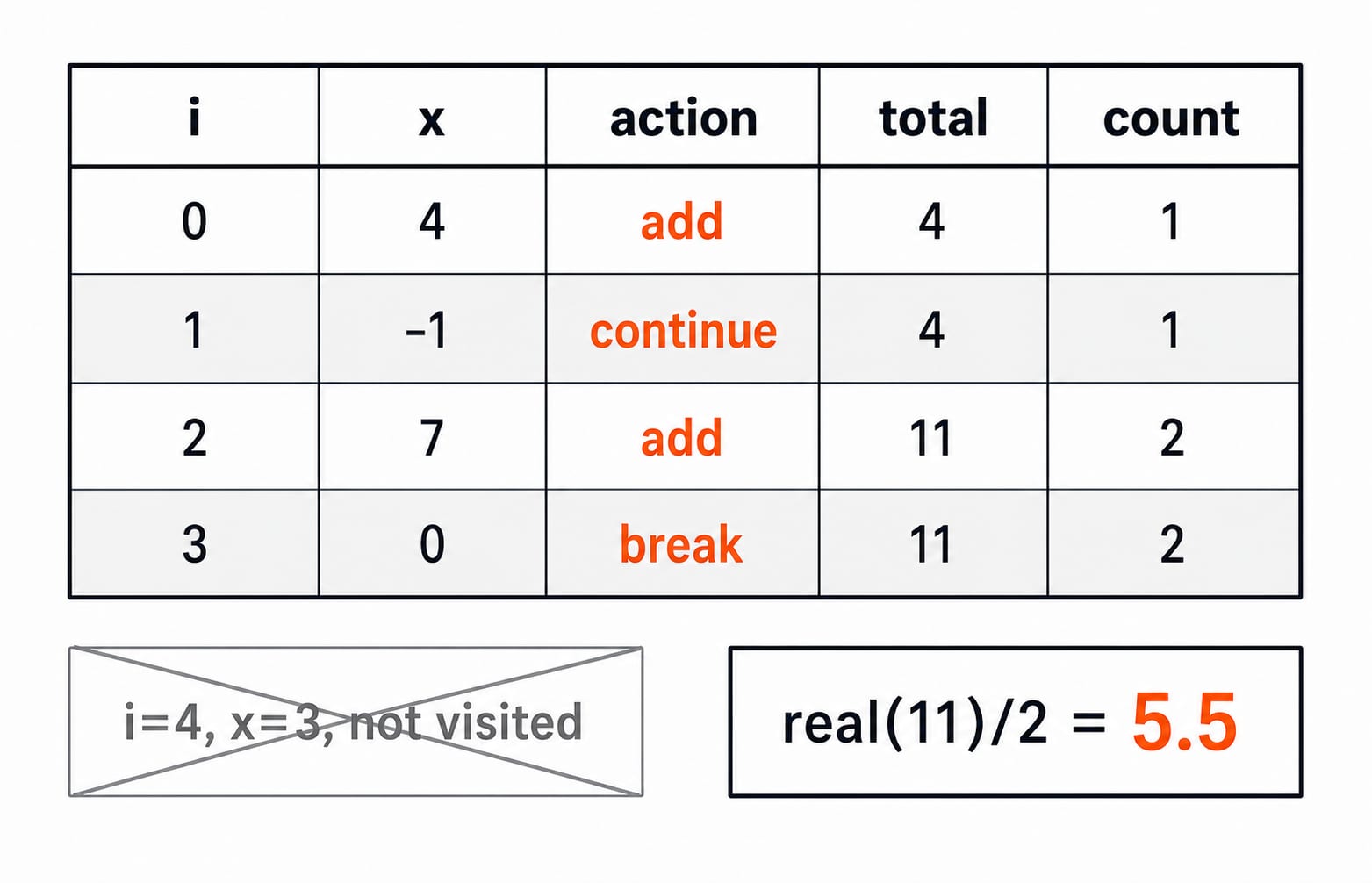
Write the state after each visited iteration:
i | x | x < 0 | x == 0 | action | total | positiveCount |
|---|---|---|---|---|---|---|
0 | 4 | false | false | add | 4 | 1 |
1 | -1 | true | not evaluated | continue | 4 | 1 |
2 | 7 | false | false | add | 11 | 2 |
3 | 0 | false | true | break | 11 | 2 |
At i = 1, continue skips the second test and both updates, then resumes with the loop update and check. At i = 3, break exits the nearest loop. Index 4, containing 3, is not visited.
The final calculation is average = 11 / 2 = 5.5. The conversion real(total) requests real-number division. For more output-tracing practice, use Infosys Pseudocode Questions; that post presents company-style drills, while the trace here develops the state-and-control model step by step.
How to Reason About Correctness and Termination
A loop invariant is: before each iteration, total is the sum and positiveCount is the count of all positive values already processed before the first zero. Initially both are zero. After adding 4, they are 4 and 1. Skipping -1 preserves them. After adding 7, they are 11 and 2.
For termination, i advances on normal iterations and after continue toward the finite bound i <= 4. A break can finish earlier. Division requires at least one positive value before a zero or loop completion. Otherwise, add a positiveCount == 0 guard.
Correctness is more than obtaining some output. If the first item changes to 0, the loop terminates immediately with positiveCount = 0, exposing the missing division guard.
Common Flow-Control Traps and How to Diagnose Them
Write the valid index set {0,1,2,3,4} before tracing. A loop from i = 0 to 5 attempts to access a sixth element in a five-element list. A loop from i = 1 to 4 skips the first value, 4.
continue does not exit a loop. break exits only the nearest enclosing loop or selection construct, as defined by the language. Code after an unconditional return on the same path is unreachable. In nested control flow, mark every transfer's precise target.
Do not assume both operands execute under short-circuit evaluation. Distinguish assignment = from the language's equality operator. Track shadowed variables by scope. Do not infer 5.5 from integer division; here, real(total) converts the numerator.
How Exams and Interviews Turn the Concept into Questions
Common task shapes ask you to trace final values, count executions of a statement, choose the taken path, or predict the effect of changing a boundary or transfer statement.
For example, change 0 to 2 in the worked list. The loop no longer breaks at index 3, so it adds 2, then visits index 4 and adds 3. The positive values processed are 4, 7, 2, 3, giving total = 4 + 7 + 2 + 3 = 16, positiveCount = 4, and average = 16 / 4 = 4.0.
For a second check, replace the continue for a negative value with break. The loop stops at -1, so only 4 has been added. It leaves total = 4, positiveCount = 1, and average = 4 / 1 = 4.0. The explanation matters because it identifies exactly which values become unreachable.
Interviewers often vary one boundary or transfer statement because the resulting trace reveals whether you followed execution or guessed from syntax.
Short Version and Next Step
Structure tells us which statements belong together, state records what has changed, and control flow determines which state transition occurs next. Start with a trace table. Draw a control-flow graph when nested branches or loops make the path hard to follow.
As optional next steps, use the C Language course to practise imperative syntax in C, or the Java course to compare sequence, selection and iteration in Java. Then justify every trace row from the command that executed.
Keep learning
Data Abstraction Explained: Hide Implementation Details with a Worked Java Example
See how a stable Account contract protects its invariant while the Java implementation changes from a running balance to a transaction ledger.
Updated 16 Nov 20265 min readProgramming Languages Survey
Programming Paradigms Explained: Concepts, Classifications and Worked Examples
Learn how imperative, procedural, object-oriented, functional and declarative styles organise the same computation, and how to classify code from visible evidence.
Updated 15 Nov 20265 min readProgramming Languages Survey
Introduction to Visual Basic (VB): Concepts, Worked Code and Exam Patterns
Learn how a VB.NET form turns text-box input and a button click into a traced result. Then practise operators, loops, procedures, scope and debugging.
Updated 14 Nov 20266 min readProgramming Languages Survey
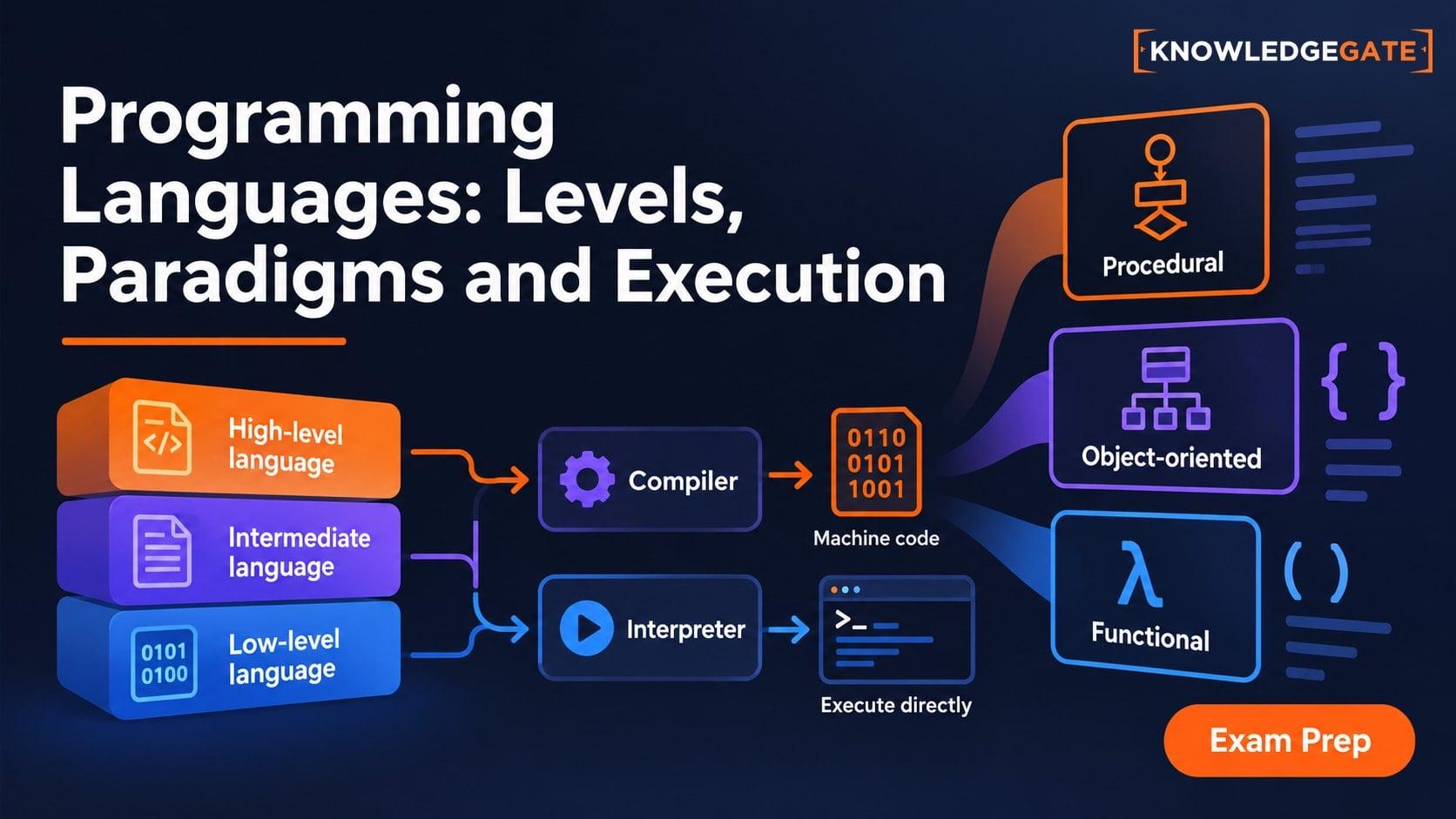
Types of Programming Languages: Levels, Paradigms and Execution Models
Learn why low-level, object-oriented, compiled and dynamically typed describe different axes. Build a clear classification map through one result expressed three ways.
Updated 13 Nov 20266 min readProgramming Languages Survey