IISc Administrative Assistant Syllabus: A Learn, Practise and Revise Map
Turn the official five-section syllabus into a practical study map. Learn the concepts, practise under time and revise from a focused error ledger.
KnowledgeGate Team
Exam prep & CS education
Updated 4 Aug 20266 min read
A copied syllabus says what exists, not what to learn first, practise under time or save for rapid revision. IISc's English syllabus for Administrative Assistant names five sections; every topic inside them is a rule to learn, a skill to practise against the clock, or a fact to revise in scannable form. The official syllabus PDF for your recruitment stays the authority on marks and duration. Start section-wise practice from the IISc Administrative Assistant category.
1. Start with IISc's five-section test map, then add a study layer
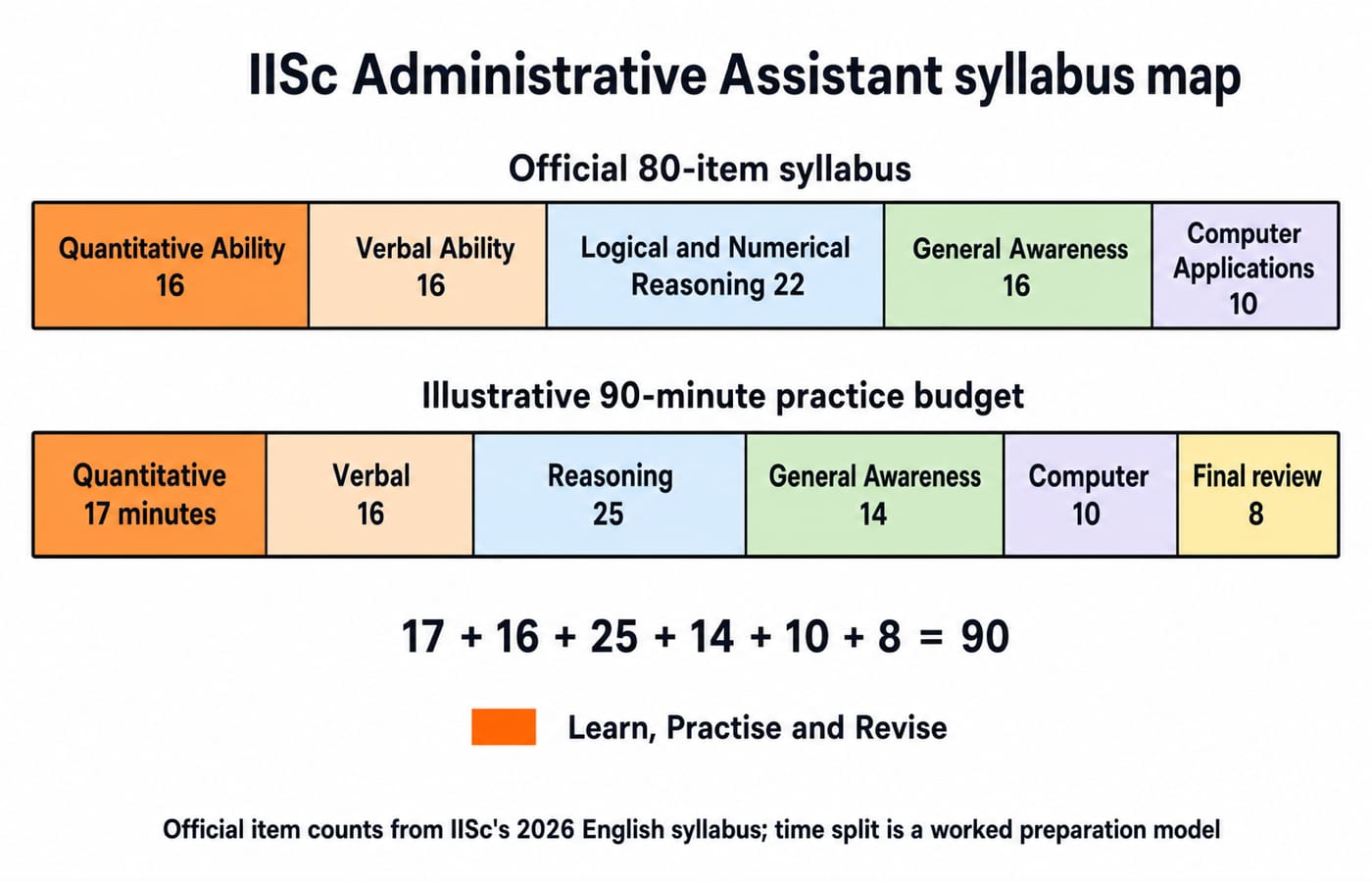
IISc's English syllabus for Administrative Assistant states 80 items at 1 mark each and a duration written as 1.30 hours, which is 90 minutes. The split is Quantitative Ability 16, Verbal Ability 16, Logical and Numerical Reasoning 22, General Awareness 16, and Knowledge in Computer Applications 10. Check: 16 + 16 + 22 + 16 + 10 = 80.
Item counts are the wrong guide to dividing those 90 minutes in the hall. Budget 17 minutes for Quantitative Ability, 16 for Verbal, 25 for Reasoning, 14 for General Awareness, 10 for Computer Applications and 8 for a final sweep: 17 + 16 + 25 + 14 + 10 + 8 = 90. Reasoning draws more than its item share because folding, series and syllogism items are slow, and General Awareness less because a recall item is known in ten seconds or left blank.
Sort every topic into three columns: learn the rule or concept, practise solving or applying it, and revise formulas, vocabulary, compact facts and error patterns. The columns are a study device, not a sixth part of the paper. IISc scores those five sections, and administrative work shows up as the flavour of the questions rather than as a section of its own.
2. Quantitative Ability: learn the method, then calculate cleanly
IISc's list covers arithmetic and commercial maths, algebra, geometry and mensuration, trigonometry, and data interpretation. Representative topics include percentages, ratio and proportion, averages, interest, profit and loss, discount, time and work, time and distance, linear equations, triangles, circles, standard trigonometric identities, histograms, bar diagrams and pie charts.
Work one percentage chain. A base value of 800 rises by 25%, so 800 x 1.25 = 1,000. A 10% reduction then gives 1,000 x 0.90 = 900. Against the original 800 the increase is 100, or 100/800 x 100 = 12.5%. The base is the whole difficulty: the 10% came off 1,000, not 800, so a 25% rise and a 10% fall do not net to 15%. For more of the same method, the SSC CGL quantitative aptitude strategy works through high-yield topics with a weekly plan.
3. Verbal Ability: convert the topic list into editing tasks
IISc lists error spotting, blanks, synonyms and antonyms, spelling, idioms and phrases, one-word substitution, sentence improvement, active and passive voice, direct and indirect narration, sentence ordering and comprehension, all at school level.
Turn that list into edits. Change Neither the files nor the register are missing. to Neither the files nor the register is missing. The verb follows the nearer singular subject, register. Change The assistant prepared the statement to The statement was prepared by the assistant for passive voice.
Learn agreement and transformation rules, practise 12 mixed items in 10 minutes, then revise only the rule behind each error. A result of 8/12 leaves four misses for the next day's drill, not another full grammar chapter.
4. Logical and Numerical Reasoning: give the largest section the widest practice mix
IISc gives this 22-item section verbal and non-verbal scope. Cluster its list into analogy and classification; number, semantic and figural series; coding and decoding; syllogism and statement conclusion; spatial orientation and pattern folding; and matching addresses, dates, cities, centre codes or roll numbers.
For 3, 8, 15, 24, 35, ?, the successive differences are 5, 7, 9, 11. The next odd-number difference is 13, so the missing term is 35 + 13 = 48. Learn the difference pattern, practise a timed series set, and revise the mistaken pattern rather than the answer alone.
Compare HR-2026-0417, HR-2026-0471, HR-2026-0417 and HR-2025-0417. Read left to right and stop at the first character that differs. The first and third match exactly. The second transposes the sequence digits, and the fourth changes the year. These items are scored on speed, so make one pass per pair and never re-read.
5. General Awareness: separate stable coverage from current events
IISc's scope includes current events and everyday scientific awareness, plus India and neighbouring countries, emphasising history, culture, geography, the economic scene, general policy, the Indian Constitution and scientific research.
Build a 12-card weekly check: two Constitution, two history or culture, two geography, two economy or policy, two science and two current-event cards. Give each current-event card a source and verification date, replacing stale cards.
If you get 8 correct, 3 wrong and 1 blank, you attempted 8 + 3 = 11. Attempted accuracy is 8/11 x 100 = 72.7%. Watch that figure week on week: on a fixed card count, rising accuracy means the stable half is settling, and a rising blank count means the cards have gone stale.
6. Computer Applications: practise office operations with administrative context
IISc lists computer characteristics; organisation including RAM and ROM; file systems and input devices; hardware and software; operating systems; Word, Excel or spreadsheets and PowerPoint; the Indian IT Act and digital signatures; e-governance and information kiosks.
IISc's job description mentions letters, files, registers, statements, reports and use of MS Office, so office-flavoured practice is well aimed, but keep it inside the listed scope. Word, Excel and PowerPoint operations are examinable, and the IISc Administrative Assistant MS Office workflows guide takes those three applications task by task. File noting, procurement rules, ERP screens and MS Access form design are not on this section's list.
For a spreadsheet task, let B2:B4 contain 48, 57, 39. Then =SUM(B2:B4) returns 144, =AVERAGE(B2:B4) returns 48, and =IF(B2>=50,"Review","Pending") returns Pending because B2 is 48. For file control, save Meeting-Minutes-v1.docx as Meeting-Minutes-v2.docx, preserving v1 instead of overwriting it.
7. Turn the map into one repeatable learn, practise and revise cycle
Use a six-day cycle. Each study day is also 90 minutes, split 30 to learn, 40 to practise and 20 to revise, so you study on the clock you will sit. Rotate one section per day across Days 1 to 5, then on Day 6 run an 80-item mixed simulation and sort the errors by section. Stacked across ten weeks, that cycle becomes the balanced 10-week IISc Administrative Assistant study plan.
Ledger: Quant 11/16, Verbal 13/16, Reasoning 14/22, GA 10/16 and Computer 8/10, totalling 56/80. Reasoning has the most misses at 22 - 14 = 8, and General Awareness the lowest percentage at 10/16 x 100 = 62.5%, with Reasoning just above it at 14/22 x 100 = 63.6%. Those two take the repair blocks. Quant is next in line at 11/16 x 100 = 68.75%, while Verbal and Computer need maintenance only.
Check documents and corrigenda on the IISc regular positions page, then hold the IISc Administrative Assistant 2026 course against the five sections to see which columns are already built for you. Start the next cycle on your weakest column, not your most comfortable one.
Keep learning
IISc Administrative Assistant Arithmetic: Master Percentages, Ratios and Data Interpretation
Learn to choose the right base, connect fractions with ratios, and solve percentage and data interpretation questions through fully worked examples.
Updated 14 Aug 20265 min readIISC Administrative Assistant
IISc Administrative Assistant Mock Analysis: Balance Every Section
A total score cannot tell you whether concepts, question selection, speed or guessing caused the loss. Use this worked five-section review to diagnose one mock and plan a balanced repair week.
Updated 11 Aug 20266 min readIISC Administrative Assistant
IISc Administrative Assistant Job Profile: Pay Structure and Office Reality
Understand the IISc Administrative Assistant role through its official job description, an honest pay-matrix reading, and a realistic office-file workflow.
Updated 9 Aug 20265 min readIISC Administrative Assistant
IISc Administrative Assistant English: Build Accuracy for Office Work
Train English accuracy through office-style grammar checks, precise sentence correction, fact retrieval, proofreading and a repeatable practice loop.
Updated 7 Aug 20265 min readIISC Administrative Assistant