IISc Administrative Assistant Mock Analysis: Balance Every Section
A total score cannot tell you whether concepts, question selection, speed or guessing caused the loss. Use this worked five-section review to diagnose one mock and plan a balanced repair week.
KnowledgeGate Team
Exam prep & CS education
Updated 11 Aug 20266 min read
A candidate sees one low total and overstudies the lowest-scoring section. That loss may come from weak concepts, poor question selection, slow execution or guessing, while a strong section quietly decays without maintenance. IISc's 2026 Administrative Assistant syllabus scores one aptitude test of 80 items in 90 minutes: 16 Quantitative Ability, 16 Verbal Ability, 22 Logical and Numerical Reasoning, 16 General Awareness and 10 Knowledge in Computer Applications. A reconciled five-section dashboard, one root-cause pass and a balanced 14-hour repair cycle send the week to the section that is actually leaking.
1. Freeze the official paper card before reading the score
Keep this six-field card above the mock sheet, filled from the notice, not from memory:
Field | IISc 2026 Administrative Assistant entry |
|---|---|
Recruitment cycle and post | Administrative Assistant, IISc 2026 recruitment |
Notice | IISc Positions Open page; reissued each cycle |
Sections | Quantitative Ability, Verbal Ability, Logical and Numerical Reasoning, General Awareness, Knowledge in Computer Applications |
Structure | 80 items, one mark each: 16, 16, 22, 16, 10 |
Operation | One aptitude test, 90 minutes, the whole selection score |
Marking | No penalty for a wrong answer stated in that syllabus |
Check the split: 16 + 16 + 22 + 16 + 10 = 80. Those entries come from IISc's 2026 syllabus and advertisement, reachable from the IISc Positions Open page; a later cycle can change any row, so refill the card from your own notice. Nothing in that syllabus states a penalty for a wrong answer, so never import a net-score rule from an SSC or banking paper. Stage map, normalization and tie-break order sit in the IISc Administrative Assistant exam pattern guide.
Write those five names across the mock sheet in the notice's wording, so no section is reviewed under a label the scorer does not use. Reasoning is the biggest block and Knowledge in Computer Applications the smallest, so an equal-time week is already an unbalanced week. Section-wise practice sets sit in the IISc Administrative Assistant category.
2. Reconcile one five-section mock before interpreting it
The review below works a practice set of 15 questions per section, so every section carries the same denominator. These are practice numbers, not an IISc answer key; on a full paper, read the same rows against 16, 16, 22, 16 and 10.
Section | Attempted | Correct | Wrong | Skipped | Min | Accuracy |
|---|---|---|---|---|---|---|
Verbal Ability | 15 | 12 | 3 | 0 | 18 | 12/15 = 80.00% |
Quantitative Ability | 12 | 8 | 4 | 3 | 28 | 8/12 = 66.67% |
Logical and Numerical Reasoning | 14 | 11 | 3 | 1 | 21 | 11/14 = 78.57% |
General Awareness | 13 | 7 | 6 | 2 | 10 | 7/13 = 53.85% |
Computer Applications | 15 | 13 | 2 | 0 | 13 | 13/15 = 86.67% |
Total | 69 | 51 | 18 | 6 | 90 | 51/69 = 73.91% |
Reconciliation: 69 attempted + 6 skipped = 75; 51 correct + 18 wrong = 69; coverage = 69/75 = 92.00%. With no penalty stated, accuracy and coverage are the two numbers that carry the whole diagnosis.
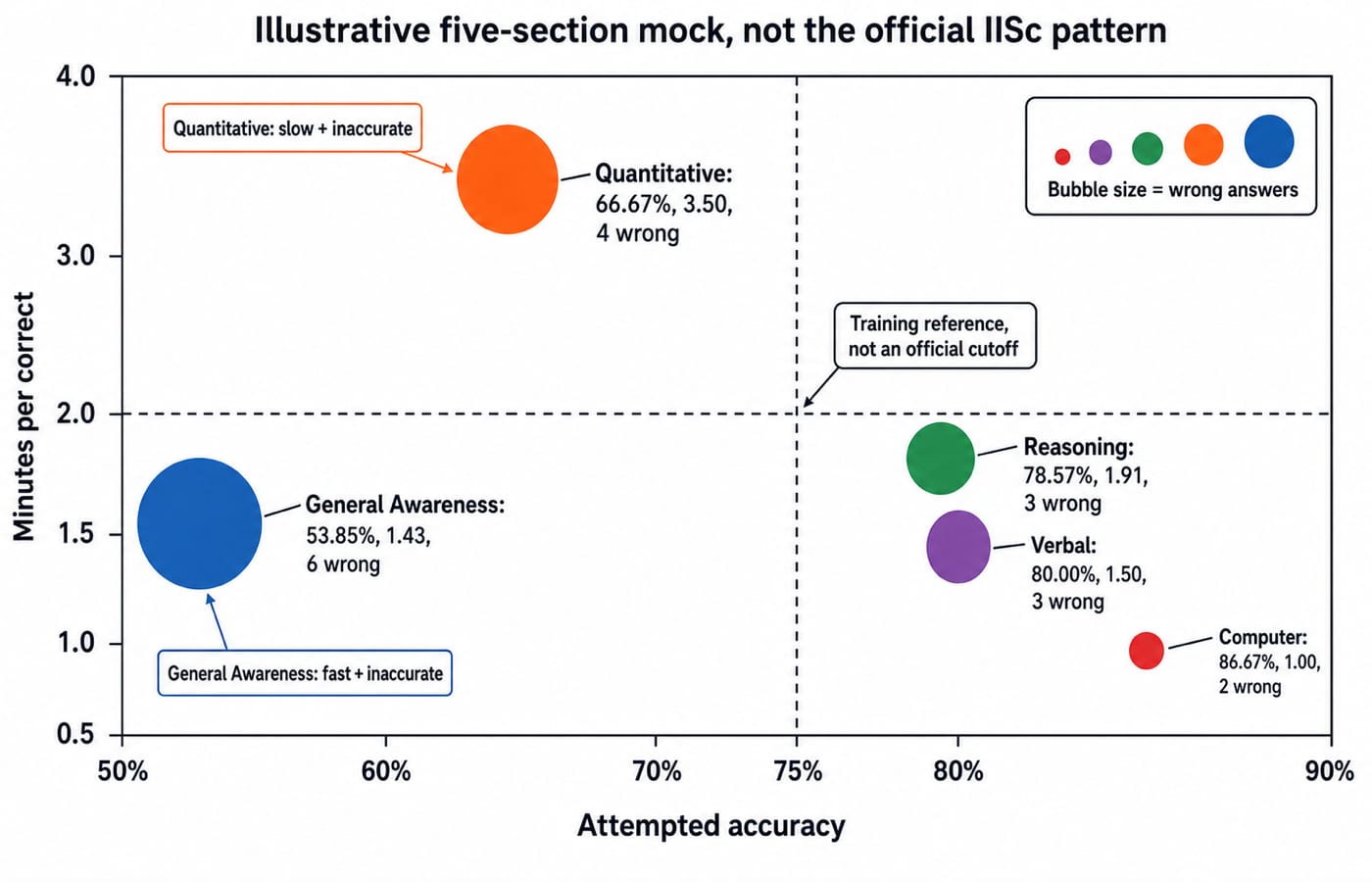
Quantitative is the time leak: 28/90 = 31.11% of time produced 8/51 = 15.69% of correct answers. GA is the accuracy leak, with 6/13 attempts wrong. Computer is efficient but needs maintenance. The SSC CGL mock-test strategy runs the same attempt-versus-accuracy split across a longer two-tier calendar.
3. Separate concept, selection and execution problems
Audit 18 wrong items plus four of six skips solvable untimed; keep two justified skips. The actionable queue is 18 + 4 = 22: concept gap 6, calculation/procedure error 4, slow selection 5, instruction/reading error 3, unsupported recall 4. Check: 6 + 4 + 5 + 3 + 4 = 22. Assign one primary cause and ban “silly mistake”.
Item | Evidence | Cause; correction |
|---|---|---|
Quant Q23 |
| Wrong base; |
Reasoning Q37 |
| Slow selection; 90-sec exit frees 70 sec |
Verbal Q5 |
| Reading error; circle qualifier |
GA Q52 | Low confidence; no named source | Unsupported recall; verify, make sourced card |
Computer Q68 | Chose | Concept gap; |
4. Rank repairs by recurrence, not by section panic
Rank revision by actionable items this mock x mocks affected among last three. Section size does not set the order: Reasoning carries 22 of the 80 items, but a recurring family costs more than a large section already under control.
Repair family | Priority | Time lost |
|---|---|---|
Percentage and ratio bases | 3 x 3 = 9 | 250 sec |
Unsupported GA recall | 4 x 2 = 8 | 100 sec |
Long reasoning sets | 2 x 3 = 6 | 290 sec |
Verbal qualifiers | 3 x 2 = 6 | 75 sec |
Spreadsheet references | 2 x 2 = 4 | 90 sec |
They cover 3 + 4 + 2 + 3 + 2 = 14 of 22 items; log the other eight as lower-frequency repairs. Break ties by time lost, then shorter repair. Order: percentage/ratio, GA recall, long reasoning, verbal qualifiers, spreadsheet references. Quantitative needs method plus selection control; GA needs sourced recall plus a confidence rule.
5. Build repair cards with delayed exit gates
Card format: observed failure | corrected rule/source | worked examples | fresh set | delayed gate.
Percentage card: 240 to 300 = 60/240 x 100 = 25% increase; 500 to 425 = 75/500 x 100 = 15% decrease; 360 to 450 = 90/360 x 100 = 25% increase. Gate: at least 5/6 fresh now and after 48 hours.
GA: Make 12 prompts from named, current primary sources; retain each URL/access date; require 10/12 now and after 72 hours.
Reasoning: Try four fresh sets; use the personal 90-second no-stable-diagram exit; allow at most one above 150 seconds; require 3/4 correct.
Verbal: Mark
not,except,incorrector equivalent in 10 items; require 9/10 now and after 48 hours.Computer: Solve six spreadsheet-reference items including
=B4*$D$1; require 5/6 now and after 48 hours.
Immediate work tests recognition; delay tests recall without the solution.
6. Protect every section in a 14-hour repair cycle
Day | Work | Minutes |
|---|---|---|
1 | Quantitative 60 + Verbal 50 | 110 |
2 | GA 60 + Computer 50 | 110 |
3 | Quantitative 60 + Reasoning 50 | 110 |
4 | GA 60 + Verbal 50 | 110 |
5 | Quantitative 60 + Computer 50 | 110 |
6 | Quantitative 20 + GA 30 + Reasoning 60 | 110 |
7 | Mixed 90-minute mock + 90-minute review | 180 |
Total: 6 x 110 + 180 = 840 minutes = 14 hours. Pre-mock section time is Quantitative 200, GA 150, Reasoning 110, Verbal 100 and Computer 100 minutes: 200 + 150 + 110 + 100 + 100 = 660, matching the six 110-minute days. It favours both leaks while protecting every section. Day 7 is whole-paper work, not counted again.
If a 110-minute day is lost, preserve Day 7 and do 35 minutes before the next day: 10 corrected rules + 20 fresh questions + 5 log update. Move only the unfinished delayed gate, never a double session. The CTET mock-test strategy applies the same retesting and selection discipline to two papers in one sitting.
7. Compare the next mock with process gates, then repeat
On Day 7, compare like with like. Sit the real shape this time: 80 items in 90 minutes, 16 Quantitative, 16 Verbal, 22 Reasoning, 16 General Awareness and 10 Computer Applications, on the same accuracy and coverage denominators.
Personal one-cycle gates on those counts: Quantitative, at least 10 correct from 13 or more attempts inside 20 minutes, against 8 from 12 in 28 this time; General Awareness, at least 11 from 14 or more; Reasoning, at most one of the 22 items above 150 seconds; Verbal, zero missed-qualifier errors; Computer Applications, at least 8 from the 10. These are training targets you set yourself, not qualifying standards, and no mock score predicts a result.
The short version: fill the card from the notice, reconcile the mock, assign one root cause per item, rank recurring families, protect every section and retest after the delay. Fresh sets for each repair card come from a practice bank of more than 51,000 questions across exams. For a built route through all five sections, use the IISc Administrative Assistant 2026 course.
Keep learning

IISc Administrative Assistant Arithmetic: Master Percentages, Ratios and Data Interpretation
Learn to choose the right base, connect fractions with ratios, and solve percentage and data interpretation questions through fully worked examples.
Updated 14 Aug 20265 min readIISC Administrative Assistant

IISc Administrative Assistant Job Profile: Pay Structure and Office Reality
Understand the IISc Administrative Assistant role through its official job description, an honest pay-matrix reading, and a realistic office-file workflow.
Updated 9 Aug 20265 min readIISC Administrative Assistant

IISc Administrative Assistant English: Build Accuracy for Office Work
Train English accuracy through office-style grammar checks, precise sentence correction, fact retrieval, proofreading and a repeatable practice loop.
Updated 7 Aug 20265 min readIISC Administrative Assistant

IISc Administrative Assistant Syllabus: A Learn, Practise and Revise Map
Turn the official five-section syllabus into a practical study map. Learn the concepts, practise under time and revise from a focused error ledger.
Updated 4 Aug 20266 min readIISC Administrative Assistant