IISc Administrative Assistant Preparation: A Balanced 10-Week Study Plan for Working Candidates
A practical ten-week system for working candidates, with diagnostic tests, balanced weekly blocks, error-led revision, mixed sets and mock analysis.
KnowledgeGate Team
Exam prep & CS education
Updated 25 Jul 20266 min read
A working candidate may find 75 weekday minutes yet lose balance by studying only a comfortable section or trying to repay every missed session. Ten weeks is enough to take quantitative ability, reasoning, English, general awareness, MS Office and computer knowledge from separate drills into timed mixed practice, provided the weekly hours are honest and every wrong answer changes the following week.
1. IISc Administrative Assistant preparation begins with a five-lane diagnostic
Five lanes carry this exam: Quantitative Ability, Verbal Ability, Logical and Numerical Reasoning, General Awareness, and Knowledge in Computer Applications including MS Office. Treat computer and MS Office as a first-class lane, not a last-week add-on: it rewards short, frequent recall more than long blocks. Start from the IISc Administrative Assistant exam preparation route and work the lanes in order of weakness, not in the order they are listed.
Take a 40-item diagnostic: 8 quantitative, 8 reasoning, 8 English, 8 computer and MS Office, and 8 general-awareness items. Suppose 32 are attempted: 24 correct, 8 wrong and 8 unanswered:
Attempt coverage =
32 / 40 x 100 = 80%.Attempted-question accuracy =
24 / 32 x 100 = 75%.
Coverage measures reach; accuracy measures attempted work. Classify the errors: 3 quantitative-method, 2 English-rule, 2 computer or MS Office recall, and 1 reasoning. The largest bucket gets next week's flexible block. Keep a small daily general-awareness slot even when its sample goes well.
2. A 12-hour weekly timetable that fits around a full-time job
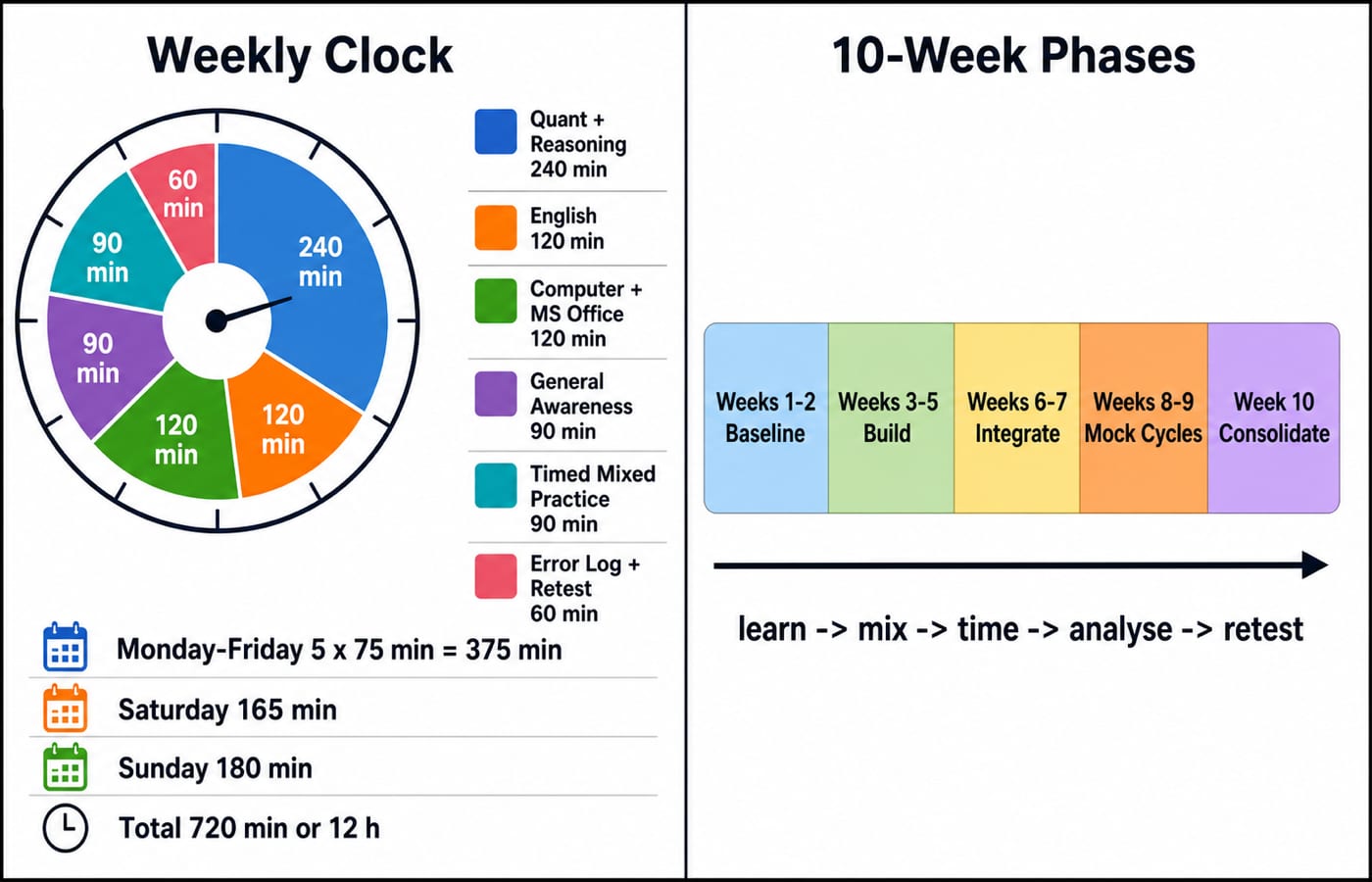
Use this fixed frame: five 75-minute weekdays give 5 x 75 = 375 minutes; Saturday adds 165 and Sunday 180. Total: 375 + 165 + 180 = 720 minutes = 12 hours. If necessary, scale these proportions to fewer hours.
Study lane | Minutes per week |
|---|---|
Quantitative ability plus reasoning | 240 |
English | 120 |
Computer and MS Office | 120 |
General awareness | 90 |
Timed mixed practice | 90 |
Error-log review and retesting | 60 |
Check the allocation: 240 + 120 + 120 + 90 + 90 + 60 = 720 minutes. A weekday uses 35 minutes for concepts or rules, 30 for questions and 10 for the error log: 35 + 30 + 10 = 75 minutes. Saturday has two focused blocks plus review; Sunday has a mixed test, analysis and adjustment. Review is a booked block, not what happens if time is left over.
3. Weeks 1 and 2: establish the baseline and the study mechanics
In Week 1, take Sunday's diagnostic and create an error log: topic | my answer and reason | correct method or fact | error type | retest date. Other blocks cover arithmetic basics, common reasoning forms, grammar rules, computer terms, file handling and brief general-awareness review.
In Week 2, repeat error-producing foundations with three examples:
Quantitative: a record count rises from 240 to 300. Increase
= 300 - 240 = 60; percentage increase= 60 / 240 x 100 = 25%.English: correct “Neither of the reports were complete” to “Neither of the reports was complete”.
MS Office: if B2:B6 contains
18, 22, 15, 20, 25, then=SUM(B2:B6)returns100.
Retest after 48 hours without notes. An answer leaves the log once you can explain its method, rule or function.
4. Weeks 3 to 5: build coverage without giving every topic equal time
Each week adds a layer on top of the previous week's retested items instead of restarting the syllabus.
Week | Main coverage |
|---|---|
3 | Percentages, ratios, averages, series, coding-decoding, subject-verb agreement, computer basics and file formats |
4 | Profit-and-loss style arithmetic without currency values, data interpretation, syllogisms, reading comprehension, operating-system basics, word processing and spreadsheets |
5 | Combined arithmetic and reasoning sets, cloze and error spotting, Internet and security basics, presentation tools and spaced general-awareness revision |
Let the audit change the timetable. If Week 3's 12 errors comprise 5 quantitative, 3 reasoning, 2 English, 1 computer and Office, and 1 general awareness, quantitative plus reasoning contribute 8. Their share is 8 / 12 x 100 = 66.7%. Move one 30-minute flexible block to that pair in Week 4 without deleting another lane.
Aptitude for Placements: A 30-Day Practice Routine sets out the daily-habit machinery this stage needs: a fixed slot, a fixed set size and same-day review, so the build does not drift to whichever lane feels easiest that evening.
5. Weeks 6 and 7: mix all five lanes instead of drilling them apart
Replace isolated drills with three mixed 30-minute sets weekly. One training set contains 5 quantitative, 5 reasoning, 5 English, 5 computer or MS Office, and 5 general-awareness items, totalling 25. Review it for another 30 minutes, labelling every miss as knowledge, method, reading or hurry.
With 19 correct and 6 wrong from 25 attempts, accuracy is 19 / 25 x 100 = 76%. If the errors are 3 knowledge, 2 method and 1 hurry, use the next two sessions for 30 minutes of knowledge repair, 20 minutes of method drills and a 10-minute controlled-speed retest: 30 + 20 + 10 = 60 minutes.
SSC CGL English: A Section Strategy That Works shows the review discipline this needs: every English answer justified by a named grammar rule or a quoted line from the passage, never by what sounded right.
6. IISc Administrative Assistant weeks 8 and 9: turn timed mocks into diagnosis
Build your own mixed mocks to one fixed blueprint, so scores from different weeks are comparable. Take two 60-minute, 50-item practice mocks in Week 8 and three in Week 9. Review each for 75 minutes: 20 re-solving without the key, 25 studying the method or fact, 20 updating the log, and 10 scheduling retests. Thus 20 + 25 + 20 + 10 = 75 minutes.
In Week 8, 31 correct from 42 attempts gives 31 / 42 x 100 = 73.8%. On the same custom blueprint in Week 9, 35 from 42 gives 35 / 42 x 100 = 83.3%. The gain is 83.3 - 73.8 = 9.5 percentage points, not a 9.5 per cent increase. Split the seven remaining errors into 3 knowledge, 3 method and 1 hurry to set Week 10's blocks.
SSC CGL Mock Test Strategy: Turn Mocks Into Marks carries the analyse-and-retest loop in full: score, classify each miss, repair the method, then retest those exact items on a set date. The loop transfers to any mixed paper.
7. Week 10: consolidate, and the missed-session rule that saves the plan
Take two 60-minute custom mixed mocks early, complete four 30-minute error-log retests, and run three 20-minute recall rounds for computer, MS Office and general awareness. Add nothing new during the final two study days; keep other work light to protect sleep and routine.
After one missed 75-minute weekday, label 30 minutes essential and 45 deferrable. Add 15 minutes to each of two following sessions and postpone the rest. After three misses, do not repay 3 x 75 = 225 minutes. Use a 90-minute Sunday reset: 30 mixed practice, 30 review and 30 weakest-area repair, so 30 + 30 + 30 = 90 minutes. Resume the current week.
Keep a weak area below 80% comparable-set accuracy. After two consecutive sets at 80% or higher, move one block to the next error bucket. The 80% is a training threshold you set yourself, so a lane has to prove itself twice before it loses time.
8. The short version: protect the weekly system, then use structured support
Diagnose, protect 12 realistic hours, hold the baseline for two weeks, widen coverage for three, integrate for two, run analysed mocks for two and consolidate in Week 10. Success means each wrong answer changes the next week, not that the timetable looks full.
For organised coverage, practice and progress tracking in one place, use the IISc Administrative Assistant 2026 Course. For the official pattern, marks split and cycle dates, read the current IISc recruitment notification at iisc.ac.in.
Keep learning

IISc Administrative Assistant Arithmetic: Master Percentages, Ratios and Data Interpretation
Learn to choose the right base, connect fractions with ratios, and solve percentage and data interpretation questions through fully worked examples.
Updated 14 Aug 20265 min readIISC Administrative Assistant
IISc Administrative Assistant Mock Analysis: Balance Every Section
A total score cannot tell you whether concepts, question selection, speed or guessing caused the loss. Use this worked five-section review to diagnose one mock and plan a balanced repair week.
Updated 11 Aug 20266 min readIISC Administrative Assistant

IISc Administrative Assistant Job Profile: Pay Structure and Office Reality
Understand the IISc Administrative Assistant role through its official job description, an honest pay-matrix reading, and a realistic office-file workflow.
Updated 9 Aug 20265 min readIISC Administrative Assistant
IISc Administrative Assistant English: Build Accuracy for Office Work
Train English accuracy through office-style grammar checks, precise sentence correction, fact retrieval, proofreading and a repeatable practice loop.
Updated 7 Aug 20265 min readIISC Administrative Assistant