IISc Administrative Assistant Exam Pattern: Stage Map and Merit Flow
See which parts of the IISc Administrative Assistant process carry marks, how multi-session scores and ties are handled, and where eligibility checks apply.
KnowledgeGate Team
Exam prep & CS education
Updated 2 Aug 20264 min read111 views
Candidates may call screening, the aptitude test, normalization, tie-breaking, and document verification five exam stages, although not all carry marks. Only the Job-Oriented Aptitude Test is scored: it carries 100% of the selection weight, and every other step either gates access or reorders candidates who tie. Exact figures come from IISc's 2026 materials, so recheck the official careers page for a later cycle.
IISc Administrative Assistant selection scheme: one scored test
The 2026 advertisement gives the Job-Oriented Aptitude Test 100% selection weight. Screening controls test access; later checks add no scored paper or interview.
In the 2026 scheme, the aptitude test is the selection stage; normalization and tie-breaking are score-processing steps; screening, document verification, and medical fitness are eligibility or appointment gates. Do not carry that classification over to another IISc vacancy or a later notice. Other recruitments are shaped differently, so their stages do not transfer. The SSC CGL tier structure runs in two stages, where Tier 1 only decides who reaches Tier 2. DSSSB TGT Computer Science settles selection in one computer-based test, split into Section A and Section B, with negative marking applied. The IISc 2026 scheme matches neither.
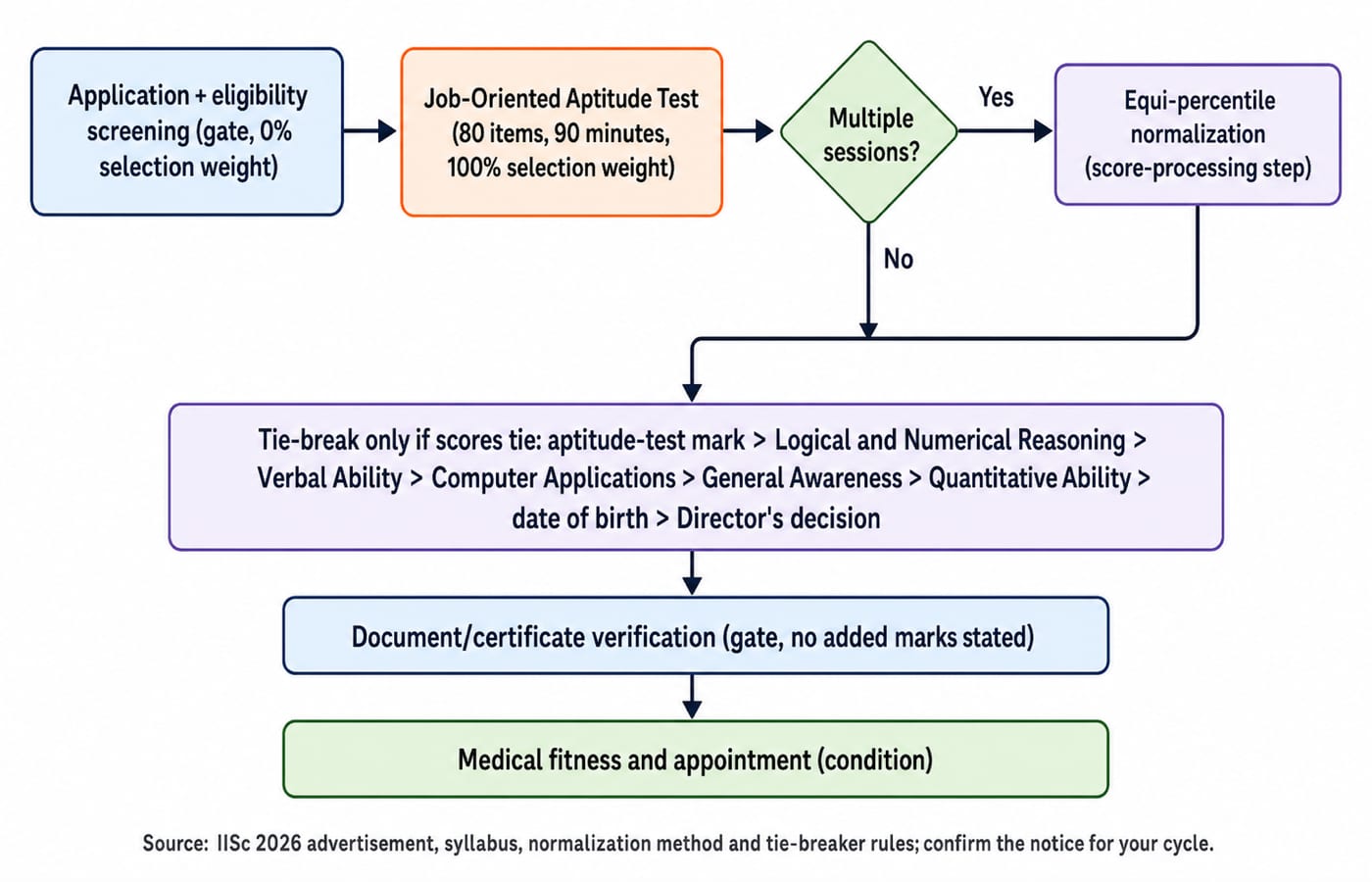
Stage map from application to appointment
Each step does one job, in this order:
Application screening can stop an ineligible application.
The Job-Oriented Aptitude Test supplies the full selection score.
If multiple sessions are used, normalization makes session scores comparable.
Published tie-break rules order candidates whose scores remain equal.
Document verification can cancel unsupported qualification or category claims.
Medical fitness remains a condition before appointment.
What the aptitude test contains
The official 2026 syllabus gives this structure. The shares are calculations, not separate official figures.
Section | Items | Calculated share |
|---|---|---|
Quantitative Ability | 16 | 20% |
Verbal Ability | 16 | 20% |
Logical and Numerical Reasoning | 22 | 27.5% |
General Awareness | 16 | 20% |
Knowledge in Computer Applications | 10 | 12.5% |
Total | 80 | 100% |
Each item carries one mark, with 90 minutes overall. Reasoning has six more items than each 16-item block, but the other four sections contribute 58 of 80 items. A reasoning-only plan is unbalanced.
The syllabus covers school-level arithmetic and data interpretation, English usage and comprehension, verbal and non-verbal reasoning, current and static awareness, and computer basics including organisation, operating systems, MS Office, the IT Act, digital signatures, and e-governance.
A worked 90-minute attempt map
This is a planning example, not IISc-prescribed sectional timing:
Section or task | Minutes |
|---|---|
Quantitative Ability | 18 |
Verbal Ability | 16 |
Reasoning | 25 |
General Awareness | 14 |
Computer Applications | 10 |
Review | 7 |
The total is 18 + 16 + 25 + 14 + 10 + 7 = 90 minutes. The first five blocks use 18 + 16 + 25 + 14 + 10 = 83 minutes. In the seven-minute review, return to six flagged items, allow at most 60 seconds each, and keep the final minute for navigation and submission checks.
Do not assume negative marking because the cited syllabus does not state it. Run an 80-item, 90-minute simulation with the same section counts. Record attempted, correct, incorrect, and unattempted items by section. Move time only after two or three simulations. The balanced 10-week study plan for this recruitment places those timed mocks in weeks 8 and 9, once coverage is already built.
How multi-session normalization affects scores
The 2026 advertisement allowed multi-session normalization. IISc later published an equi-percentile method for the two-shift test, so raw marks and normalized scores are not automatically interchangeable.
Consider only Step 1. In a hypothetical shift with N = 1,000, suppose m = 800 candidates scored at or below K's raw score T = 62. K's percentile is:
100 × m / N = 100 × 800 / 1,000 = 80.00
That 80.00 is K's percentile, not the normalized mark. IISc's method then pulls percentiles back to the marks scale across sessions to obtain the normalized score. Optimise coverage and accuracy instead of chasing rumours about an easy shift.
Worked tie-break cascade
The 2026 order is: aptitude-test mark, Logical and Numerical Reasoning, Verbal Ability, Knowledge in Computer Applications, General Awareness, Quantitative Ability, date of birth, then the Director as competent authority if the tie persists.
Suppose A and B sat different shifts and both came out of normalization with a ranking score of 72.50, which is how equal ranking scores can sit on unequal raw marks. A has an aptitude-test mark of 64, while B has 63, so A ranks higher at the first check. If both have 64, but A has Reasoning 18/22 and B has 17/22, A ranks higher next. If the mark and Reasoning both tie, Verbal Ability decides third, then Knowledge in Computer Applications, then General Awareness, and only then Quantitative Ability.
Reasoning is the first named section used in a tie, but this does not change the test's 100% weighting or justify neglecting the remaining 58 items.
Verification gates still need preparation
Where applicable, keep Class 10 onward marks cards and certificates, essential-qualification evidence, category or relaxation certificates, and CGPA-to-percentage conversion evidence. Government, PSU, or autonomous-body employees should check the notice for the required NOC or undertaking.
A high score cannot repair an unsupported eligibility or reservation claim, and appointment is subject to medical fitness. These gates add no selection marks, so settle the aggregate calculation and the age reference date against the notice before the test, not after the result.
The short version and next action
The 2026 map has one scored aptitude test: 80 one-mark items in 90 minutes. Normalization and tie-breaking can change ranking logic. Verification and medical fitness remain non-scored gates.
For a later cycle, use the IISc careers page as the authority. Save the advertisement, syllabus, normalization-method, and tie-breaker PDFs. Then run the 80-item, 90-minute baseline and log section-wise outcomes.
After that official-first check, inspect the IISc Administrative Assistant course for structured coverage of all five sections. For adjacent recruitment preparation, browse the Govt Jobs category.
Keep learning
IISc Administrative Assistant Arithmetic: Master Percentages, Ratios and Data Interpretation
Learn to choose the right base, connect fractions with ratios, and solve percentage and data interpretation questions through fully worked examples.
Updated 14 Aug 20265 min readIISC Administrative Assistant
IISc Administrative Assistant Mock Analysis: Balance Every Section
A total score cannot tell you whether concepts, question selection, speed or guessing caused the loss. Use this worked five-section review to diagnose one mock and plan a balanced repair week.
Updated 11 Aug 20266 min readIISC Administrative Assistant
IISc Administrative Assistant Job Profile: Pay Structure and Office Reality
Understand the IISc Administrative Assistant role through its official job description, an honest pay-matrix reading, and a realistic office-file workflow.
Updated 9 Aug 20265 min readIISC Administrative Assistant
IISc Administrative Assistant English: Build Accuracy for Office Work
Train English accuracy through office-style grammar checks, precise sentence correction, fact retrieval, proofreading and a repeatable practice loop.
Updated 7 Aug 20265 min readIISC Administrative Assistant