IISc Administrative Assistant Arithmetic: Master Percentages, Ratios and Data Interpretation
Learn to choose the right base, connect fractions with ratios, and solve percentage and data interpretation questions through fully worked examples.
KnowledgeGate Team
Exam prep & CS education
Updated 14 Aug 20265 min read

Percentage, ratio and data interpretation questions can look unrelated. Most become manageable once you identify the correct base, express the quantities in the same form, and calculate without losing the units. Records, files and processed applications are what an IISc Administrative Assistant counts all day, so those are the quantities in the worked examples. The IISc Administrative Assistant preparation category maps the rest of the syllabus.
Build one language for fractions, percentages and ratios
To convert a fraction to a percentage, multiply it by 100. To convert a percentage to a fraction, divide by 100 and simplify. A ratio compares parts, but does not reveal the total unless the question supplies more information.
Useful anchors include 3/8 = 37.5%, 5/8 = 62.5%, 1/6 = 16 2/3%, and 12.5% = 1/8. These are calculation tools, not facts to memorise without meaning.
Suppose two trays contain records in the ratio 3:5, with 320 records altogether.
Total parts
= 3 + 5 = 8.One part
= 320/8 = 40records.The trays hold
3 × 40 = 120and5 × 40 = 200records.The first tray's share
= 120/320 × 100 = 37.5%.
Percentages: find the base before the change
Three common forms need three clear bases. For a percentage of a quantity, multiply the quantity by the stated rate. For percentage change, divide the change by the original quantity. For reverse percentage, divide the final quantity by the percentage it represents.
Start with 500 files. A 20% rise gives 500 × 1.20 = 600. A later 20% fall gives 600 × 0.80 = 480. The final count is 20 below the original, so the net change is 20/500 × 100 = 4% decrease, not zero.
For a reverse check, suppose a quantity is 680 after a 15% reduction. The 680 represents 85%, so the original is 680/0.85 = 800. Substitute it back: 15% of 800 = 120, and 800 - 120 = 680.
Ratios and proportions: expand, divide and rebalance
Multiplying or dividing both ratio terms by the same non-zero number keeps the ratio unchanged. Simplify early, but retain units when the terms describe different quantities.
Two sections hold 1,440 files in the ratio 5:7. The 12 parts make each part 1,440/12 = 120, so the sections hold 600 and 840 files. Moving 120 files from the second section to the first produces 720:720 = 1:1. The total remains 1,440; only its distribution changes.
Combine ratios and percentages without switching the base
Take a group of 360 people split into categories A and B in the ratio 7:5. Category A has 7/12 × 360 = 210 people, while B has 5/12 × 360 = 150.
If B increases by 20% while A stays unchanged, B becomes 150 × 1.20 = 180. The new ratio is 210:180 = 7:6, and the new total is 210 + 180 = 390. B's new share is therefore 180/390 × 100 = 46.15% approximately. Using 180/360 = 50% is a wrong-base error because 360 is the old total.
Read a DI table in a fixed order
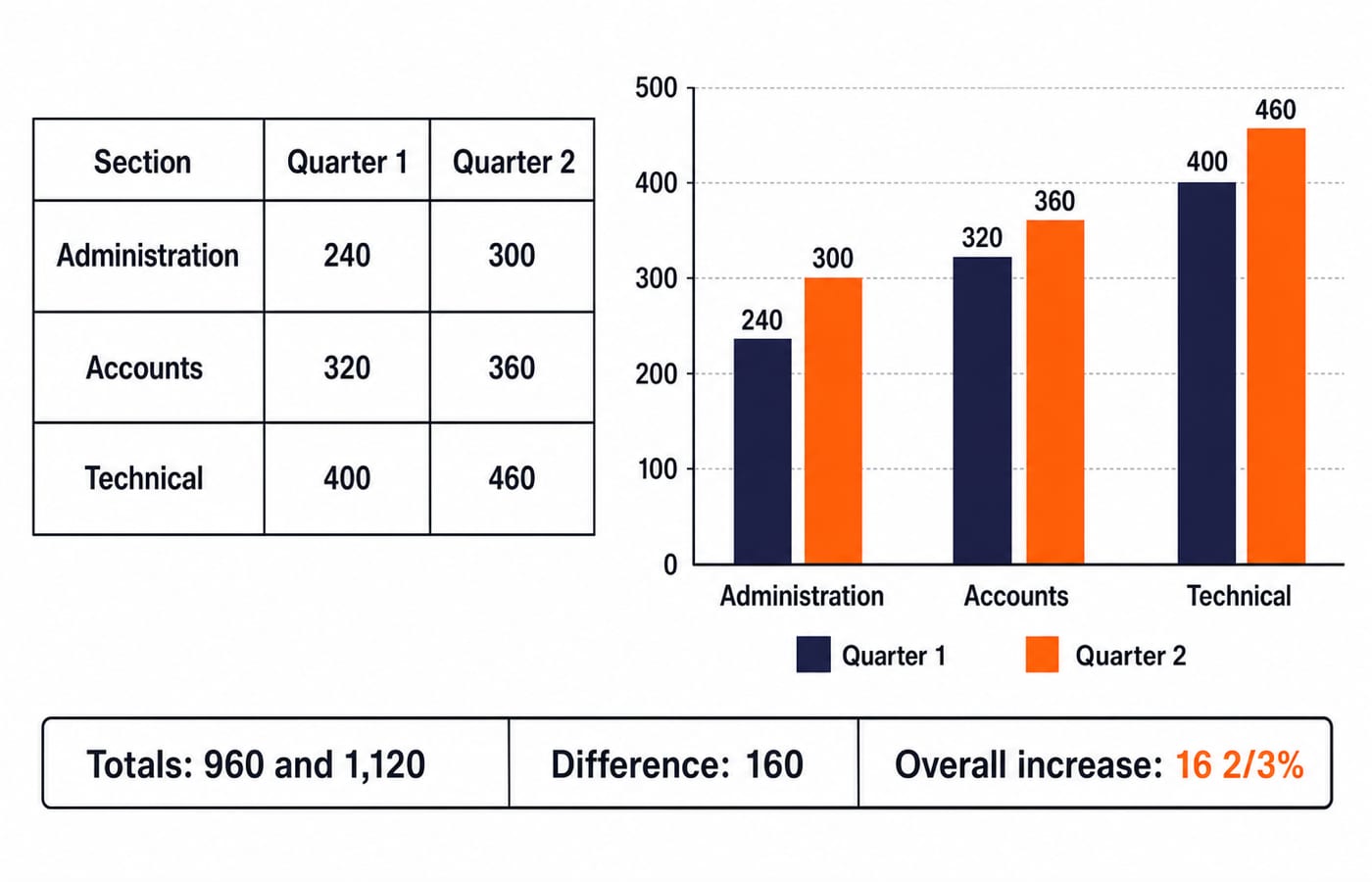
Read labels first, calculate totals, identify the requested comparison, and only then form the percentage. Take this sample table of processed applications:
Section | Quarter 1 | Quarter 2 |
|---|---|---|
Administration | 240 | 300 |
Accounts | 320 | 360 |
Technical | 400 | 460 |
Quarter 1 total = 240 + 320 + 400 = 960. Quarter 2 total = 300 + 360 + 460 = 1,120. The overall increase is 1,120 - 960 = 160, or 160/960 × 100 = 16 2/3%.
Administration rises by 60, so its increase is 60/240 × 100 = 25%. In Quarter 2, the Administration:Accounts ratio is 300:360 = 5:6. Technical's Quarter 2 share is exactly 460/1,120, which is 41.07% approximately. Keep that distinction between an exact fraction and a rounded percentage.
Use fast arithmetic only when accuracy survives
Build a small mental-maths bank: 10% = 1/10, 20% = 1/5, 25% = 1/4, 12.5% = 1/8, 16 2/3% = 1/6, 33 1/3% = 1/3, 50% = 1/2, and 75% = 3/4.
For example, 37.5% of 640 = 3/8 × 640 = 240. Cross-check it by splitting the rate: 25% of 640 + 12.5% of 640 = 160 + 80 = 240.
Estimation is safe when a question asks for the nearest value. Here, 24.8% of 398 = 98.704, approximately 99. The quick estimate 25% of 400 = 100 confirms the scale, but does not replace exact work when options are close.
Catch the traps that cost easy marks
A rate moving from 40% to 50% rises by 10 percentage points. Relative to the old rate, however, the rise is 10/40 × 100 = 25%.
In the ratio 2:3, the first quantity is 2/5 = 40% of the total, not 2/3. It is 2/3 only when compared directly with the second quantity.
For every DI calculation, run four checks: read the unit, confirm the row and column, write the denominator before dividing, and test whether the answer is plausible. An alleged Quarter 2 total of 1,020 fails immediately because 300 + 360 + 460 = 1,120.
Turn the concepts into a practical practice loop
Use a 30-minute session: 8 minutes on fraction-percentage conversions, 8 minutes on ratio distributions, 10 minutes on one DI set, and 4 minutes logging the precise error type. Secure the method first, then add time pressure. Slot those sessions into the balanced 10-week IISc Administrative Assistant study plan so the arithmetic block does not crowd out the other papers. For the same topics under a different exam, the SSC CGL quant strategy picks out the high-yield ones.
Marks, question counts, timing, eligibility and selection details for the current cycle live in the official IISc recruitment notice at iisc.ac.in. Confirm them there before you build a timetable around them.
The short version is simple: identify the base, convert to one representation, compute, retain units, and verify against the original data. For a structured route through the whole paper, continue with the IISc Administrative Assistant course. If you want more arithmetic than one exam needs, the aptitude course catalogue lists the aptitude courses built for other exams.
Keep learning

IISc Administrative Assistant Mock Analysis: Balance Every Section
A total score cannot tell you whether concepts, question selection, speed or guessing caused the loss. Use this worked five-section review to diagnose one mock and plan a balanced repair week.
Updated 11 Aug 20266 min readIISC Administrative Assistant

IISc Administrative Assistant Job Profile: Pay Structure and Office Reality
Understand the IISc Administrative Assistant role through its official job description, an honest pay-matrix reading, and a realistic office-file workflow.
Updated 9 Aug 20265 min readIISC Administrative Assistant

IISc Administrative Assistant English: Build Accuracy for Office Work
Train English accuracy through office-style grammar checks, precise sentence correction, fact retrieval, proofreading and a repeatable practice loop.
Updated 7 Aug 20265 min readIISC Administrative Assistant

IISc Administrative Assistant Syllabus: A Learn, Practise and Revise Map
Turn the official five-section syllabus into a practical study map. Learn the concepts, practise under time and revise from a focused error ledger.
Updated 4 Aug 20266 min readIISC Administrative Assistant