IEEE 754 MCQs: 12 Solved Questions with Step-by-Step Explanations
Solve 12 IEEE 754 questions covering binary32 and binary64 fields, exact conversion, special values, rounding traps and arithmetic on encoded operands.
KnowledgeGate Team
Exam prep & CS education
Updated 17 Sep 20267 min read
IEEE 754 questions demand two decisions before any arithmetic: identify the format, then classify the exponent field. A field-width item can sit beside a bit-pattern decode or a rounding trap, so write s | E | fraction before calculating. General floating-point practice also includes normalisation conventions, custom formats and precision loss; Floating Point Basics MCQs: 12 Solved Questions with Explanations is the earlier question set for those skills. IEEE 754 adds fixed binary32 and binary64 layouts, reserved encodings, exact conversions and arithmetic on encoded operands. Attempt each item before reading its answer. Q4 and Q8 link to the IEEE 754 Standards learn hub rather than a per-question page. The GATE CS Exam Preparation Courses & Test Series page provides broader practice.
1. Keep the IEEE 754 field rules beside the question set
IEEE 754 binary32 uses 1 sign bit, 8 biased-exponent bits and 23 stored fraction bits, with bias 127. Binary64 uses 1 + 11 + 52 = 64 bits, with bias 1023.
For a normalized value, use value = (-1)^s x (1.fraction) x 2^(E-bias). Check exceptions first: an all-zero exponent means zero or a subnormal, while an all-one exponent means infinity or NaN. Rebuild the concept with Floating Point Representation: Encode and Add in IEEE 754 if that distinction is unclear.
2. Field sizes and direct decoding
Use the same five steps: expand hexadecimal to 32 bits, split s | E | fraction, subtract the bias only for a normalized value, restore the hidden leading 1, and apply the sign.
Q1. Double-precision length, UGC NET 2016
The IEEE-754 double-precision format to represent floating point numbers, has a length of _____ bits.
A. 16
B. 32
C. 48
D. 64
Binary64 has 1 sign + 11 exponent + 52 fraction = 64 bits. Binary32 instead has 1 + 8 + 23 = 32, which explains the 32-bit distractor.
Q2. Decode a complete binary32 pattern, ISRO 2015
Which of the given number has its IEEE-754 32 bit floating point representation as 0 10000000 110 0000 0000 0000 0000 0000
A. 2.5
B. 3.0
C. 3.5
D. 4.5
Here s = 0, so the number is positive. The exponent is 10000000₂ = 128, giving 128 - 127 = 1; the significand is 1 + 1/2 + 1/4 = 1.75, so 1.75 x 2^1 = 3.5.
Q3. Decode hexadecimal 0xC0000000, ISRO 2017
In IEEE floating point representation, the hexadecimal number 0xC0000000 corresponds to
A. -3.0
B. -1.0
C. -4.0
D. -2.0
Expand it as 1100 0000 0000 0000 0000 0000 0000 0000, then split 1 | 10000000 | 000...0. The sign is negative, 128 - 127 = 1, and the significand is 1.0, so the value is -1.0 x 2^1 = -2.0.
Q4. Represent exact decimal 0.125
The decimal value 0.125 in IEEE single precision floating point representation has
A. fraction bits of 000…1000 and exponent value of 0
B. fraction bits of 000…000 and exponent value of −2
C. fraction bits of 0010…00 and exponent value of 0
D. fraction bits of 000…000 and exponent value of −3
Convert 0.125 = 1/8 = 2^-3 = 1.0₂ x 2^-3. The normalized significand has no nonzero fraction bits, and the true exponent is -3; as a check, the stored exponent is -3 + 127 = 124 = 01111100₂.
3. Encode decimal values into binary32 and hexadecimal
Determine the sign, convert the magnitude to binary, normalize it, store e + 127, keep or round 23 fraction bits, then regroup into nibbles. Convert the magnitude explicitly before normalizing so decimal and binary place values do not get mixed.
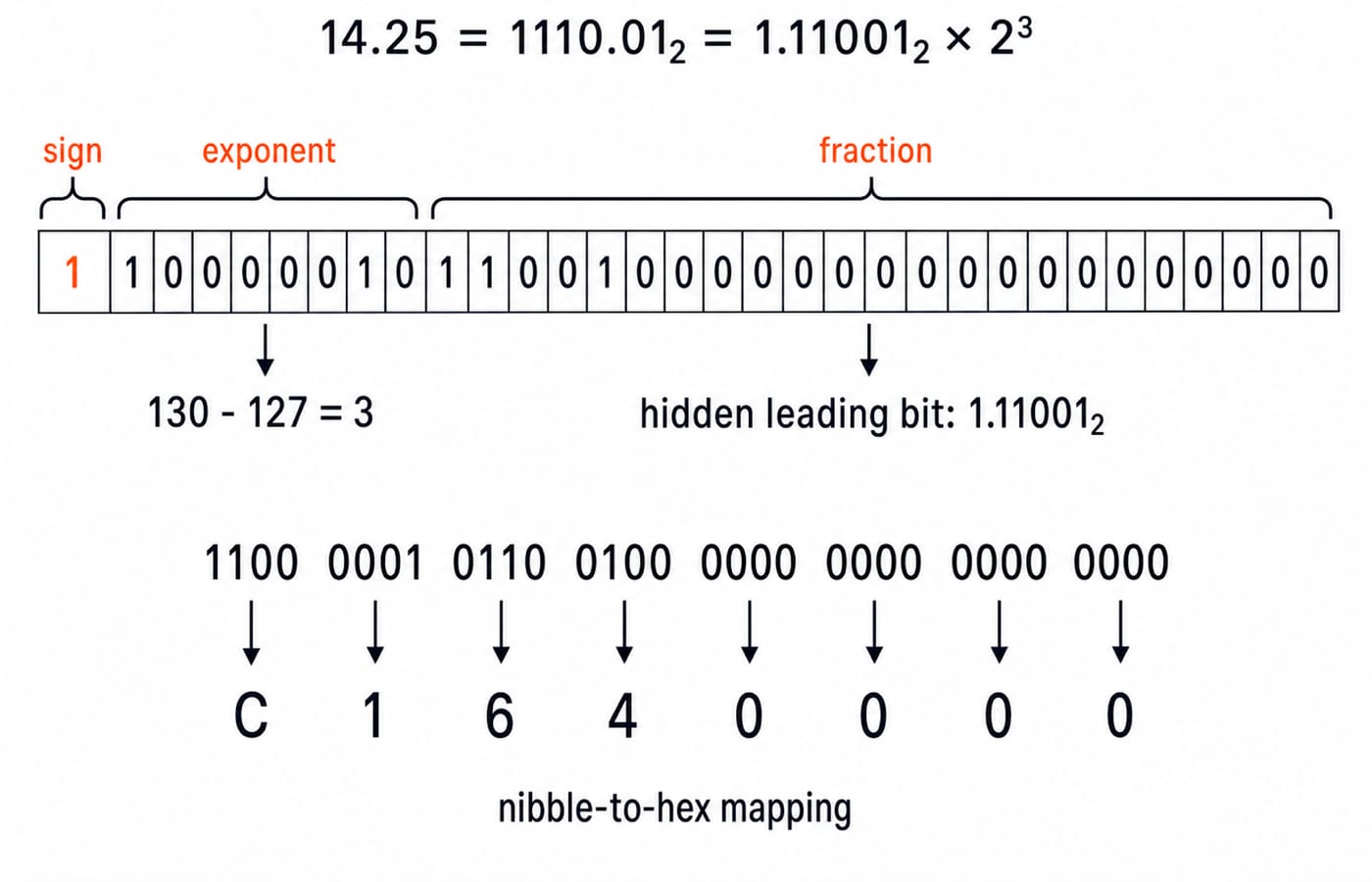
Q5. Encode -14.25, GATE 2014
The value of a float type variable is represented using the single-precision 32-bit floating point format of IEEE-754 standard that uses 1 bit for sign, 8 bits for biased exponent and 23 bits for mantissa. A float type variable X is assigned the decimal value of −14.25. The representation of X in hexadecimal notation is
A. C1640000H
B. 416C0000H
C. 41640000H
D. C16C0000H
14.25 = 1110.01₂ = 1.11001₂ x 2^3, so s = 1 and the stored exponent is 3 + 127 = 130 = 10000010₂. The fraction is 11001000000000000000000; hence 1 | 10000010 | 11001000000000000000000 = 1100 0001 0110 0100 0000 0000 0000 0000₂ = C1640000H.
Q6. Encode a repeating binary fraction, UGC NET 2018
The decimal floating point number −40.1 represented using IEEE-754 32-bit representation and written in hexadecimal form is
A. 0xC2206666
B. 0xC2206000
C. 0xC2006666
D. 0xC2006000
40.1₁₀ = 101000.0001100110011...₂ = 1.010000001100110011...₂ x 2^5. Use sign 1, exponent 5 + 127 = 132 = 10000100₂, and rounded fraction 01000000110011001100110; the result is 11000010001000000110011001100110₂ = 0xC2206666. Unlike Q5's terminating .25, this .1 repeats in binary and must be rounded.
4. Zero, subnormal numbers, and the largest finite value
Classify the exponent before calculating. With E = 00000000, a zero fraction gives signed zero and a nonzero fraction gives a subnormal. Fields 00000001 through 11111110 are normalized. With E = 11111111, a zero fraction gives infinity and a nonzero fraction gives NaN.
Q7. Identify positive zero, GATE 2008
In IEEE 754 floating-point representation, the hexadecimal value 0x00000000 corresponds to
A. the normalized value 2⁻¹²⁷
B. the normalized value 2⁻¹²⁶
C. the normalized value +0
D. the special value +0
The pattern is all zeros: sign 0, exponent 0, fraction 0. This is the special value +0, not a normalized number; 2^-126 needs exponent 00000001 and a zero fraction.
Q8. Find the smallest positive subnormal
Consider IEEE 754 single precision format. Which of the following is the smallest positive denormalized number?
A. 2⁻¹⁴⁶
B. 2⁻¹⁴⁸
C. 2⁰
D. 2⁻¹⁴⁹
Use sign 0, an all-zero exponent and only the least significant fraction bit set. The subnormal scale is 2^-126, and that fraction place is 2^-23, so the value is 2^-126 x 2^-23 = 2^-149.
Q9. Exclude infinity and NaN before comparing, GATE 2024
IEEE 754 single precision uses a 1-bit sign, 8-bit exponent and 23-bit fraction. Choose the largest floating-point value among the following bit patterns.
A. Sign Exponent Mantissa 0 0111 1111 1111 1111 1111 1111 1111 111
B. Sign Exponent Mantissa 0 1111 1110 1111 1111 1111 1111 1111 111
C. Sign Exponent Mantissa 0 1111 1111 1111 1111 1111 1111 1111 111
D. Sign Exponent Mantissa 0 0111 1111 0000 0000 0000 0000 0000 000
Option C has an all-one exponent and nonzero fraction, so it is NaN, not a finite contender. The largest positive finite pattern uses sign 0, exponent 11111110 and an all-one fraction, exactly option B.
5. Rounding makes floating-point addition non-associative
Three-significant-digit decimal arithmetic rounds after each operation. Binary32 uses a binary significand instead, so apply the model named in the stem.
Q10. Evaluate both parenthesizations, GATE 2004
What is the result of evaluating the following two expressions using three-digit floating point arithmetic with rounding?
(113. + -111.) + 7.51
113. + (-111. + 7.51)
A. 9.51 and 10.0 respectively
B. 10.0 and 9.51 respectively
C. 9.51 and 9.51 respectively
D. 10.0 and 10.0 respectively
First, 113 + (-111) = 2.00, then 2.00 + 7.51 = 9.51. With the other grouping, -111 + 7.51 = -103.49, which rounds to -103; then 113 + (-103) = 10.0. The rounded intermediate changes with the parentheses.
6. Arithmetic on encoded values
Decode before operating. As a bit-level check, division by a power of two lowers the exponent, while multiplication by -2^4 flips the sign and raises the unbiased exponent by 4 when the result stays normal.
Q11. Divide two encoded numbers, GATE 2020
Registers R1, R2 and R3 store IEEE 754 single-precision values. R1 = 0x42200000 and R2 = 0xC1200000. If R3 = R1 / R2, which hexadecimal value is stored in R3?
A. 0x40800000
B. 0xC0800000
C. 0x83400000
D. 0xC8500000
Decode 0x42200000 = 40.0 and 0xC1200000 = -10.0, so R3 = 40/(-10) = -4.0. For -4.0 = -1.0 x 2^2, use sign 1, exponent 2 + 127 = 129 = 10000001₂ and a zero fraction, giving 0xC0800000.
Q12. Multiply by an exact power of two, GATE 2023
Consider the IEEE-754 single precision floating point numbers P=0xC1800000 and Q=0x3F5C2EF4. Which one of the following corresponds to the product of these numbers (i.e., P × Q), represented in the IEEE-754 single precision format?
A. 0x404C2EF4
B. 0x405C2EF4
C. 0xC15C2EF4
D. 0xC14C2EF4
P = 0xC1800000 decodes to -16 = -2^4. Multiplication flips Q's sign and raises its exponent field from 01111110₂ = 126 to 130 = 10000010₂, while retaining fraction 10111000010111011110100. Thus the result is 1 | 10000010 | 10111000010111011110100 = 0xC15C2EF4; no overflow, underflow or special operand blocks the shortcut here.
7. IEEE 754 trap checklist and the next practice step
Split fields before calculating.
Use the hidden
1only for normalized numbers.Keep the true exponent separate from the stored biased exponent.
Test all-zero and all-one exponent fields before using the normal formula.
Preserve the sign separately from the magnitude.
Round only when the representation or question model requires it.
One final self-check: changing Q5 from -14.25 to +14.25 changes only the sign bit, so C1640000H becomes 41640000H. IEEE 754 does not use two's-complement negation of the complete 32-bit word.
KnowledgeGate has more than 80 live practice questions on IEEE 754 Standards. Continue through the complete COA sequence with GATE Guidance by Sanchit Sir, use the GATE Test Series for timed mixed practice, or move to Cache Memory: Mapping and Hit Ratio for another worked COA numerical topic.
Keep learning
Instruction Formats and Addressing Modes MCQs: 12 Solved Cross-Concept Questions
Solve 12 cross-concept COA questions that connect addressing-mode choices with PC rules, memory references, opcode fields, and byte-aligned instructions.
3 Oct 20267 min readComputer Organization MCQs
Interrupt-Driven I/O MCQs: 12 Solved Questions with Explanations
Attempt 12 previous-year interrupt-driven I/O questions, then check each answer with a concise explanation. The set covers ISR order, vectoring, priority, and CPU-time numericals.
28 Sep 20268 min readComputer Organization MCQs
Bitmap and Pixmap MCQs: 12 Solved Pixel Depth and Memory Questions
Build a reliable pixel-memory method through 12 live MCQs covering bitmaps, pixmaps, lookup tables, uncompressed storage, refresh rates, masks, and dithering.
Updated 25 Sep 20267 min readComputer Organization MCQs
Assembly & Assembler Design MCQs: 11 Solved PYQs Explained
Attempt 11 published PYQs on assembler directives, language levels, tables, register-pair instructions, debugging and fixed-width arithmetic, then check each worked explanation.
Updated 24 Sep 20267 min readComputer Organization MCQs