

IBPS SO IT Officer Previous Year Analysis: Find Repeating Topics and Set Prep Priorities
Use an evidence-led IBPS SO IT Officer previous year analysis to rank repeating topics, combine them with your errors, and plan a 14-hour study week.
KnowledgeGate Team
Exam prep & CS education
Updated 30 Oct 20264 min read57 views
Many previous year analyses turn a few recalled questions into precise-looking weightage tables. A safer method is to tag recurring concepts, add your own errors, and use the result to plan study time. IBPS remains the authority for the pattern, while old or memory-based papers are preparation evidence, not an official forecast.
Set the evidence rule before counting repeats
Count a repeat only when the same concept appears in at least two distinct papers. Two differently worded questions copied from one paper still count as one paper-level occurrence.
Track paper/year, stage, subject, micro-topic, question form, correct/incorrect, and source quality separately. This keeps prelims aptitude out of a mains Professional Knowledge table.
Use the IBPS Specialist Officers page for the applicable notification and current structure. Recalled papers and coaching reconstructions can suggest topic trends, but cannot establish official frequency, pattern, marks, question count, timing, negative marking, dates, vacancies, fees, or cut-offs.
The earlier IBPS SO Professional Knowledge Study Plan: An 8-Week Role-Specific Method owns role-specific syllabus sequencing and the eight-week routine; this post owns recurrence evidence, the four-paper matrix and the error-weighted priority index.
A broad IBPS question bank can supply practice, but its coverage is not an SO IT or Professional Knowledge frequency.
Start with six Professional Knowledge tagging buckets
Use six buckets, then add micro-topic tags:
DBMS: keys, normalization, SQL, transactions and ACID.
Computer Networks: OSI and TCP/IP, IPv4 and subnetting, protocols, network security.
Operating Systems: processes and scheduling, synchronization and deadlocks, paging and virtual memory, file systems.
Data Structures and Algorithms: linear structures, trees, hashing, searching and sorting, time complexity.
Computer Organization: number representation, CPU and instruction cycle, cache and main memory, pipelining.
Software Engineering and Programming: SDLC, testing, OOP, language fundamentals, exception handling.
These are tagging buckets, not guaranteed weightage bands. The IBPS SO IT Professional Knowledge topic map breaks them into finer prerequisites. Call a bucket high priority only when your tracker supports it.
Turn four papers into a repeat matrix
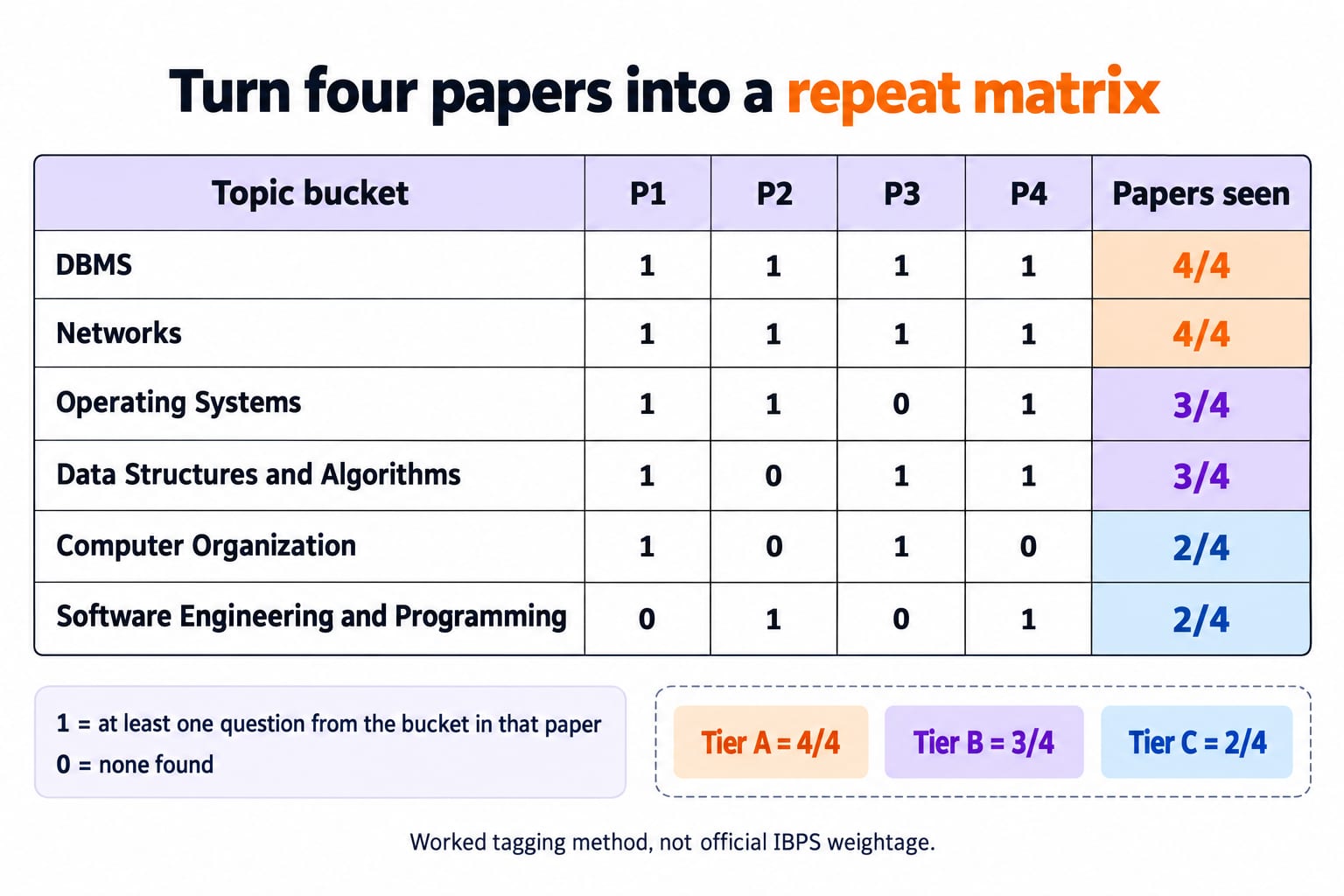
This invented teaching dataset is not historical IBPS frequency data. A 1 means the paper contains at least one question from that bucket, not exactly one.
Topic bucket | P1 | P2 | P3 | P4 | Papers seen |
|---|---|---|---|---|---|
DBMS | 1 | 1 | 1 | 1 | 4/4 |
Networks | 1 | 1 | 1 | 1 | 4/4 |
Operating Systems | 1 | 1 | 0 | 1 | 3/4 |
Data Structures and Algorithms | 1 | 0 | 1 | 1 | 3/4 |
Computer Organization | 1 | 0 | 1 | 0 | 2/4 |
Software Engineering and Programming | 0 | 1 | 0 | 1 | 2/4 |
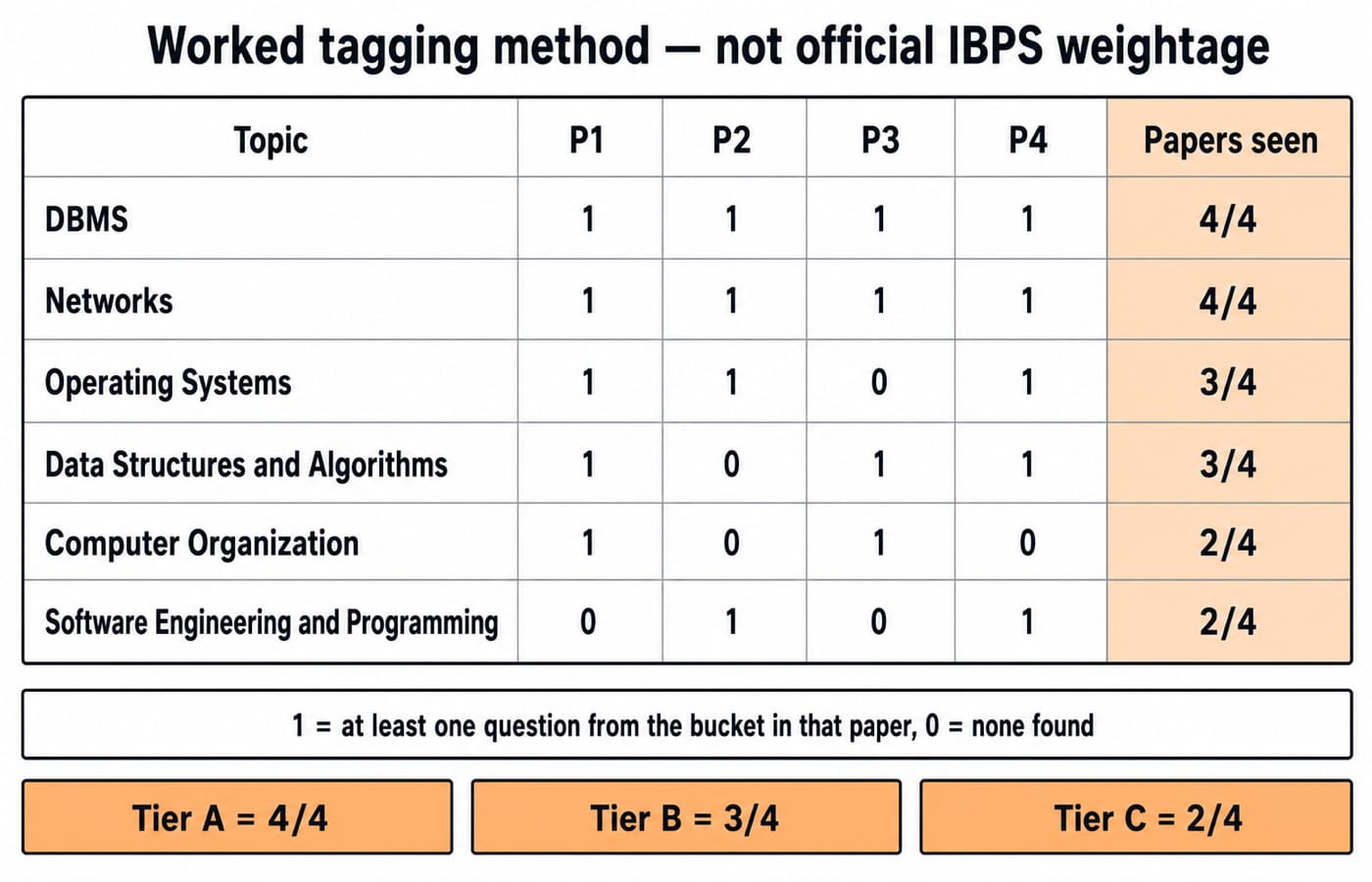
DBMS and Networks are Tier A at 4/4, OS and DSA are Tier B at 3/4, and the remaining buckets are Tier C at 2/4. Save the matrix because another paper can change every tier.
Add your error rate before assigning study hours
Frequency can overvalue topics you already answer well. Add a ten-question diagnostic:
priority index = 2 x papers seen + diagnostic errors
Bucket | Papers seen | Errors | Calculation | Priority index |
|---|---|---|---|---|
DBMS | 4 | 6/10 | 2 x 4 + 6 | 14 |
Operating Systems | 3 | 7/10 | 2 x 3 + 7 | 13 |
Networks | 4 | 3/10 | 2 x 4 + 3 | 11 |
Data Structures and Algorithms | 3 | 4/10 | 2 x 3 + 4 | 10 |
Computer Organization | 2 | 5/10 | 2 x 2 + 5 | 9 |
Software Engineering and Programming | 2 | 2/10 | 2 x 2 + 2 | 6 |
The order is DBMS 14, OS 13, Networks 11, DSA 10, COA 9, then Software Engineering and Programming 6. Seven OS errors outweigh its lower recurrence.
Track repeated question forms, not repeated wording
Practise each concept with changed values:
Subnetting: a
/27block leaves 5 host bits, so it has2^5 = 32total addresses and32 - 2 = 30conventionally usable host addresses. A/26leaves 6 host bits, giving2^6 = 64total and64 - 2 = 62usable.Normalization: for
R(A,B,C)withA -> BandB -> C,Ais the key. The chainA -> B -> Ccreates a transitive dependency, and the 3NF split isR1(A,B)plusR2(B,C).Paging:
4 KB = 2^12bytes, so the page offset needs 12 bits. In a 32-bit virtual address, the virtual page number therefore needs32 - 12 = 20bits.
Use prerequisite-first Computer Science foundations when these transformations expose weak spots.
Convert the priority index into a 14-hour weekly loop
Allocate DBMS 3 hours, OS 3, Networks 2.5, DSA 2, COA 2, and Software Engineering and Programming 1.5. The total is 3 + 3 + 2.5 + 2 + 2 + 1.5 = 14 hours.
Spend 40% on concept repair, 40% on timed questions, and 20% on error-log review. A three-hour DBMS block is 180 minutes: 0.4 x 180 = 72, 0.4 x 180 = 72, and 0.2 x 180 = 36. The parts total 72 + 72 + 36 = 180 minutes.
After each mixed mock, retag errors and recompute. With P5, replace each denominator of 4 with 5. If a weekday is lost, preserve timed practice and error review, then move concept reading instead of doubling a late-night session.
The short version
Tag by micro-topic, count distinct papers, combine recurrence with a personal diagnostic, and refresh the order after every mock. Do not infer the current pattern from an old paper, count multiple questions in one paper as multiple repeats, or attach exact percentages to incomplete recalled sets.
Use the IBPS SO IT Mains course for structured concept coverage and the IBPS SO IT Officer test series for timed retesting. The Banking and Insurance category is the broader navigation step.
Go deeper with the full courseIBPS PO Prelims
Keep learning
IBPS PO Previous Year Analysis: Recurring Question Formats and Attempt Priorities
See what genuinely recurs across IBPS PO papers, solve representative format drills, and turn your own accuracy and speed into a practical attempt priority.
Updated 30 Oct 20265 min readIBPS Exams

RBI Grade B Previous Year Analysis: Recurring Topics and Study Priorities
Use recurring topic families to choose what to revise, then let your errors decide the time allocation. Work through DI, reasoning and reading examples before building a practical weekly plan.
Updated 30 Oct 20265 min readBanking Exams
SSC GD Constable: How to Analyse Your PYQs and Plan Practice
Old papers become useful when you record the method behind each question. Build a syllabus-backed topic map, separate repeated concepts from repeated wording, and turn mistakes into specific practice tasks.
Updated 6 Nov 20265 min readSSC GD Constable

SSC MTS Previous Year Analysis: Spot Topic Patterns and Plan Revision
Solved several MTS papers but unsure what to revise? Tag the operation behind each mistake, compare your practice fairly and turn the results into a manageable weekly plan.
Updated 29 Oct 20265 min readSSC MTS