NIACL AO Eligibility and Exam Pattern: Prelims, Mains and the Descriptive Paper Explained
Understand the NIACL AO selection stages, the specialist professional-knowledge layer and the eligibility checks to complete before planning your preparation.
KnowledgeGate Team
Exam prep & CS education
11 Aug 20265 min read
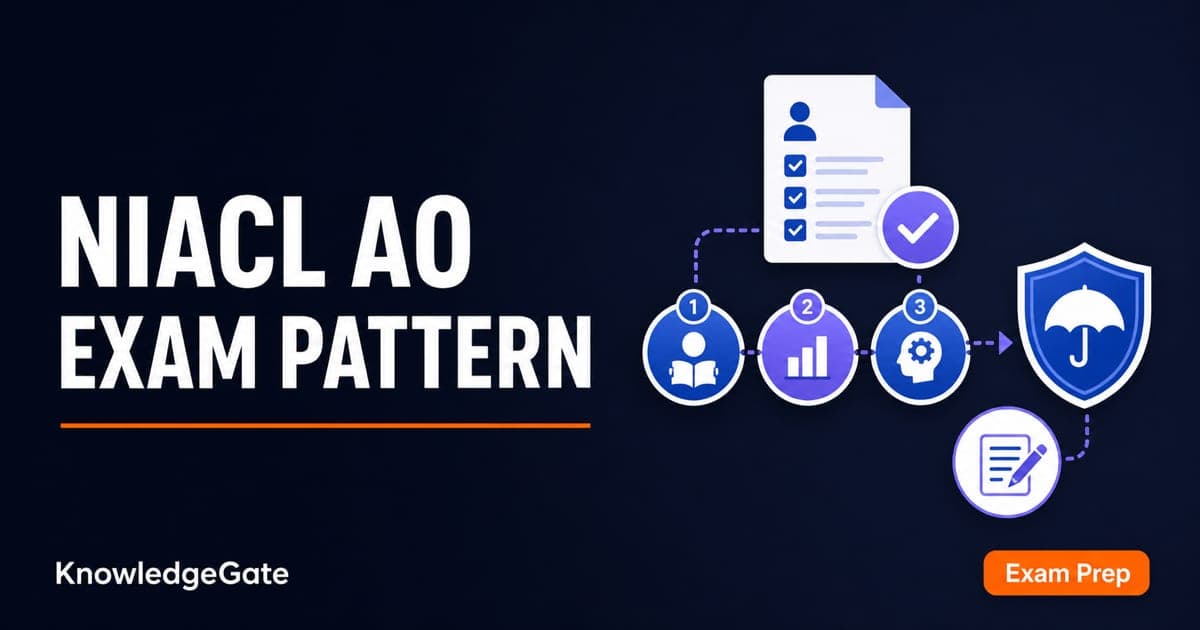
NIACL AO trips up first-time applicants for two reasons. It is an insurance recruitment rather than a bank recruitment, and its Main examination carries a descriptive English component that many banking aspirants have never practised. Get the stages and eligibility checks straight before planning subjects; the current notification owns every number attached to your application.
What NIACL AO is
NIACL AO is the Administrative Officer recruitment run by New India Assurance, a public-sector general-insurance company. Recruitment can include generalist and specialist streams, and a specialist stream such as IT adds both a qualification requirement and a professional-knowledge layer.
The employer's domain changes the context. A general insurer underwrites fire, marine, motor, health and miscellaneous risk rather than taking deposits and lending, and IRDAI rather than the RBI is the regulator behind the sector news you will be asked about. General awareness therefore needs an insurance lens, and an IT specialist also needs the CS core. This is not a renamed bank PO exam, even though the aptitude skills overlap.
The Banking and Insurance category is the useful starting point for that common aptitude base and the separate insurance layer.
The three-stage selection structure
The selection route is Preliminary examination, Main examination and Interview for candidates who clear the required stages:
Prelims screens the applicant pool through an objective paper.
Mains tests a broader objective syllabus, adds the notified descriptive component, and adds professional knowledge for specialist candidates.
The interview is a personality and domain conversation for shortlisted candidates, not a further written test.
A familiar bank-exam formula may not govern how those stages are scored. Copy the selection clause from the live notification and mark three things: which scores only qualify you for the next stage, which carry into the final merit, and whether any component has a separate qualifying requirement.
Preliminary exam as the qualifier
Prelims is objective and typically tests English, Reasoning and Quantitative Aptitude. Recent NIACL AO notifications have used it as the screen into Mains, but the exact section counts, marks, time windows, negative-marking rule and cutoffs belong to the current notification.
Prepare the three skills in bank-exam style, but build your mock conditions from the NIACL table you apply under. A familiar-looking section can still carry a different time constraint or its own qualifying rule.
The IBPS PO eligibility and exam pattern guide shows that shared base, provided you compare structures rather than copy IBPS numbers into NIACL notes.
Main exam and professional knowledge
Mains broadens the objective test and adds General Awareness with an insurance and financial focus. Specialist streams also carry a professional-knowledge section, and an IT applicant should read the notified CS areas as the guide, with DBMS, computer networks, operating systems and data structures as the natural technical base.
Keep two notebooks. The common one covers reasoning, quantitative aptitude, English and awareness. The specialist one maps each professional-knowledge topic to a revision sheet and practice questions, keeping visible what transfers from other exams and what decides the specialist paper.
Do not infer the professional-knowledge mark split from an old cycle or from another insurer. The current table on the official New India Assurance portal is the only version that governs your application.
The descriptive paper explained
The descriptive component tests whether you can organise formal English under time pressure. Prepare for an essay and for the second formal-writing task named by the current notice, which may be a letter or a precis.
A dependable practice method has four steps:
Read the prompt and define the task, audience and position before writing.
Spend a short planning phase on an introduction, two or three body points and a conclusion.
Write direct sentences and keep each paragraph responsible for one point.
Reserve a final review for grammar, repetition, spelling and the notified format.
For an essay, state the position early and support it in sequence. For a letter, match salutation, tone and request to the audience. For a precis, preserve the argument while compressing it in your own words, to the official limit rather than a comfortable one.
The plan, write and clean split in the SBI PO descriptive paper guide transfers here unchanged. What should change is the reading behind it: stock up on insurance and financial-services examples, so an essay on digital claims or financial inclusion carries something concrete.
Descriptive practice is not an extra to add once objective mocks are done. One timed task a week builds a bank of reviewed answers to rewrite in the final phase.
The interview stage: what it actually tests
Assume the panel has read your application form and will start there. Three lines of preparation carry this stage, and none of them is the objective syllabus.
Your own file: the stream you applied under, your degree and discipline, any gap or job change, each accounted for plainly.
Why insurance, and why this insurer. Knowing what a general insurance company actually sells beats an answer about a stable government job.
Sector vocabulary at conversation depth. Premium, underwriting, claim ratio, reinsurance and the general-versus-life split should be words you use, not words you define.
A specialist adds technical ground: the projects on your CV, the systems you have genuinely used, and one design decision you would now make differently. Rehearse aloud against a clock, because the descriptive paper and the interview both reward an organised answer with nothing padded into it.
Eligibility checks before you apply
Eligibility centres on the qualification notified for your chosen stream and an age band with specified category relaxations. A generalist and an IT specialist should not assume the same degree clause: the specialist must match the exact discipline, institution-recognition and result-date wording in the notice.
Check these items against the live notification:
nationality or citizenship conditions
minimum and maximum age on the specified cutoff date
category relaxation and the documents needed to claim it
degree, discipline and result-status requirements for the chosen stream
any experience, attempt or service conditions stated for that cycle
fee, payment window, application dates and document format
The cutoff date matters as much as the age band. You can meet the age today and still fail on the notification's measurement date, and the same trap catches a degree result declared after the required date. An eligibility calculator does not decide acceptance; the official wording does.
The IBPS SO IT Officer vs IBPS PO comparison shows why a specialist qualification clause must be checked separately for each recruiter.
Short version and next step
Prelims supplies the objective screen. Mains adds the broader objective paper, the descriptive English component and professional knowledge for a specialist stream. The interview rewards a candidate who can talk about the insurance business, not only the syllabus. Eligibility turns on the notified stream, age rule, cutoff date and documents.
Confirm every eligibility band, mark, time limit, vacancy, fee and date against the current New India Assurance notification before building a plan on any of them. Then cover the technical syllabus through the NIACL AO IT Specialist course, with descriptive practice running alongside objective preparation rather than after it.
Keep learning

NABARD Grade A Finance Preparation: Resources and an 8-Week Plan
Build a Finance specialist study plan around accounting, calculations and management applications. Use a 12-hour weekly schedule, a worked project appraisal and an error-based review routine.
5 Oct 20265 min readBanking Exams
LIC AAO Preparation for Repeat Attempts: A Six-Week Reset Plan
Familiar chapters need a sharper review method. Use your previous attempt and recent errors to plan six weeks of focused repair, protected mains work and manageable retests.
30 Sep 20265 min readBanking Exams
RBI Grade B Preparation Strategy: A 16-Week Phase-by-Phase Plan
A working aspirant must build early-stage speed without leaving economics, finance, management and writing cold. This plan turns 15 hours a week into foundations, timed practice, mock repair and a post-Phase-I bridge.
Updated 27 Aug 20265 min readBanking Exams
RBI Grade B Syllabus 2026: Phase 1 and Phase 2 Decoded
Separate RBI's official General Cadre syllabus from practical study buckets, then use diagnostics and worked examples to build a balanced weekly plan.
Updated 26 Aug 20265 min read56 viewsBanking Exams