

IBPS RRB PO Preparation Strategy: A 16-Week Phase-by-Phase Plan
Turn 16 weekly hours into a practical IBPS RRB PO study system, from the first diagnostic to controlled speed, mock repair and a calm final week.
KnowledgeGate Team
Exam prep & CS education
Updated 1 Nov 20265 min read

Daily quant, reasoning, deferred awareness study and occasional mocks still need a decision rule for Week 7 and a recovery rule after a missed day. Use the 16-week schedule to assign hours, practise by phase, review mocks and protect buffer time. IBPS uses Officer Scale I in recent CRP-RRBs notices, so map the plan to the current notice on the official IBPS website. Banking & Insurance Exam Preparation covers broader bank-exam study.
Check the current CRP-RRBs notice for the post name, stages, subjects, timing, marking, eligibility and selection. The hours, mock results and speed checkpoints here are planning examples, not official figures or score promises.
1. Convert 16 weeks into a capacity plan
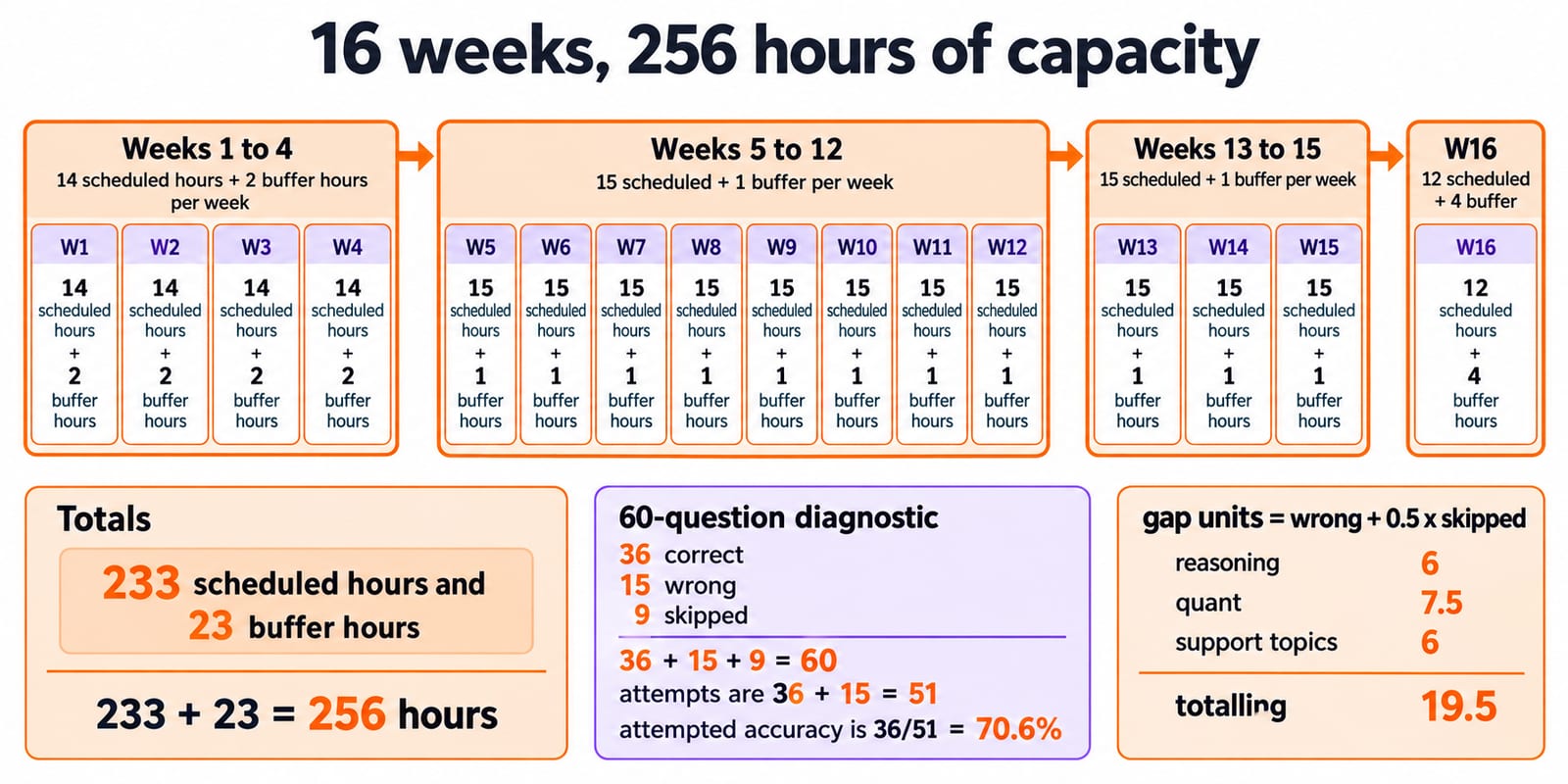
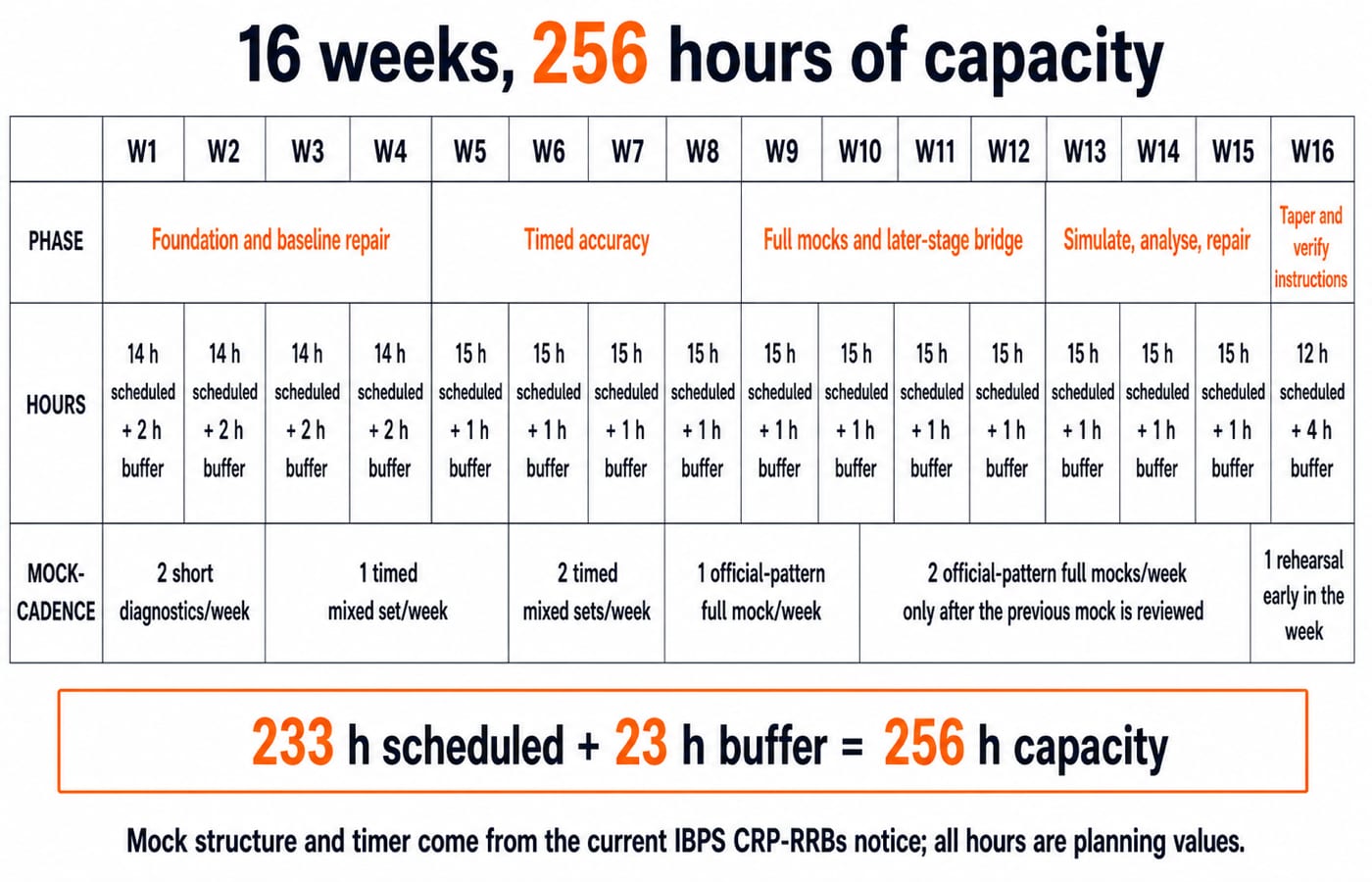
Start with capacity: 16 weeks x 16 hours = 256 hours. Weeks 1 to 4 each have 14 scheduled hours plus 2 buffer hours. Weeks 5 to 12 and 13 to 15 each have 15 scheduled plus 1 buffer. Week 16 has 12 scheduled plus 4 buffer. Therefore, 56 + 120 + 45 + 12 = 233 scheduled hours and 8 + 8 + 3 + 4 = 23 buffer hours. The complete check is 233 + 23 = 256 hours.
Run a private 60-question diagnostic. A worked result is 36 correct, 15 wrong and 9 skipped: reasoning-style 13/5/2, quant-style 11/6/3, and current-notice support topics 12/4/4. Thus 36 + 15 + 9 = 60, attempts are 36 + 15 = 51, and attempted accuracy is 36/51 = 70.6%.
With gap units = wrong + 0.5 x skipped, reasoning gives 6, quant 7.5, and support topics 6, totalling 19.5.
2. Phase 1, Weeks 1 to 4: repair foundations in parallel
Allocate 14 scheduled hours as 4.5 quant, 3.5 reasoning, 4 support topics, and 2 diagnostic review plus re-solves. Reserve the two-hour buffer for missed sessions. If the current notice excludes an assumed support area, move its time to a listed area.
A 90-minute block contains 15 minutes closed-book recall + 45 minutes concept and guided practice + 30 minutes correction. If a 20-question quant set produces 12 correct, 5 wrong and 3 skipped, 12 + 5 = 17 attempts and accuracy is 12/17 = 70.6%. Begin the next block by re-solving all eight non-correct items.
Use two short diagnostics in Weeks 1 and 2, then one timed mixed set in Weeks 3 and 4. The IBPS PO Prelims Preparation Course offers optional practice for shared foundations. Select only RRB-notice topics; this course does not establish the RRB pattern.
3. Phase 2, Weeks 5 to 8: turn accuracy into controlled speed
Split 15 scheduled hours + 1 buffer hour into 3.5 quant, 3.5 reasoning, 3 support topics, 2 timed mixed sets, 2 set analysis and 1 weakest-area repair. The scheduled check is 3.5 + 3.5 + 3 + 2 + 2 + 1 = 15 hours.
For a 30-question drill, 36 minutes in Week 5 means 36 x 60/30 = 72 seconds per question. The same calculation gives 66 seconds at 33 minutes in Week 7 and 60 seconds at 30 minutes in Week 8.
Take one timed mixed set in Weeks 5 and 6, then two in Weeks 7 and 8: 1 + 1 + 2 + 2 = 6 sets. Tag misses as concept, calculation or logic execution, misread, time abandonment, or unsupported guess. For detailed progressions, use the IBPS PO Reasoning: 8-Week Puzzle-to-Mock Ladder and IBPS PO Quant Preparation: Build Arithmetic and DI Accuracy.
4. Phase 3, Weeks 9 to 12: add full mocks and retain later-stage study
Take one full mock in Weeks 9 and 10, then two in Weeks 11 and 12: 1 + 1 + 2 + 2 = 6 mocks. Match the current notice's structure and timer, and review each mock before another.
In Weeks 9 and 10, reserve 2.5 hours for the mock, 3 for review, 5 for later-stage study, 3.5 for early-stage repair and 1 for recall. This is 2.5 + 3 + 5 + 3.5 + 1 = 15 hours. Use unused slot time for error tagging.
In Weeks 11 and 12, use two 2.5-hour mock slots, 4 hours review, 3 repair, 2 later-stage recall and 1 planning: 5 + 4 + 3 + 2 + 1 = 15 hours. Keep the buffer untouched.
The IBPS PO Mains Preparation Course offers optional overlapping-skills practice, but does not establish RRB topics, marking or stages. Reassign unsupported later-stage blocks.
5. Phase 4, Weeks 13 to 15: review before the next mock
Use 15 scheduled hours plus one buffer: two 2.5-hour mock slots = 5 hours, review = 4 hours, repair = 6 hours. Freeze sources in Week 13. If the second Sunday mock remains unreviewed, cancel the next and analyse it.
A custom 50-item audit has 44 attempted, 35 correct, 9 wrong and 6 skipped. Attempt rate is 44/50 = 88%, attempted accuracy 35/44 = 79.5%, and raw correct rate 35/50 = 70%. Its 15 non-correct items are 5 concept gaps + 4 execution slips + 3 misreads + 2 time abandonments + 1 unsupported guess = 15.
Turn that diagnosis into exactly six repair hours:
2 hours for concept reteaching
1.5 hours for slow re-solves of four execution slips
1 hour for a read-check-answer routine on three misreads
1 hour for two 30-minute pacing sets on time abandonments
0.5 hour for a written no-blind-guess rule and recall-sheet update
The check is 2 + 1.5 + 1 + 1 + 0.5 = 6 hours, leaving the buffer available.
6. Week 16: taper and verify instructions
Schedule only 12 hours: 3 error-ledger revision + 2 formulas and decision triggers + 2.5 early-week rehearsal + 2 review + 1.5 official-instruction check + 1 light recall = 12 hours. Leave four hours unfilled for delay, rest or an emergency.
Add no new source, untouched chapter or back-to-back mock. Use the current official structure and timer, then review the rehearsal.
A sample snapshot is 12 hours scheduled, 11 completed, 1-hour backlog, 1 of 1 rehearsals analysed, and 5 priority errors reduced to 2 unresolved. Make the 2 unresolved errors light recall prompts, not reasons for an all-night restart.
7. Recover missed days, then take the first action
Miss one 90-minute block: use this week's one-hour buffer and move 30 minutes to the next buffer. Miss two blocks, or 3 hours: use the buffer and drop up to two hours of new coverage. Protect mock review; never double tomorrow's load.
After two consecutive weeks at 11 completed hours or fewer, reset to 12 scheduled + 2 buffer hours and remove one timed set.
An eight-week alternative has 8 x 18 = 144 hours, split into 128 scheduled + 16 buffer: 2 foundation weeks, 2 timed-accuracy weeks, 3 mock-and-repair weeks and 1 taper week. It has 233 - 128 = 105 fewer scheduled hours, so reduce time on diagnosed strengths without expecting equal depth.
Open the current CRP-RRBs notice, list confirmed areas, run the 60-question diagnostic, then write Week 1 as hours and blocks. A workable plan designs in missed days, mock reviews and official checks.
Go deeper with the full courseIBPS PO Prelims
Keep learning

IBPS PO Preparation Strategy: A 16-Week Plan for Prelims and Mains
Turn 16 weeks into a workable IBPS PO routine. This plan shows how to divide study time, analyse drills, repair errors and retain Mains continuity.
Updated 30 Oct 20265 min readIBPS Exams
SBI PO Preparation Strategy: A 16-Week Build-to-Mocks Plan
Build your SBI PO preparation around a diagnostic, phased practice and complete mock review. The plan includes a 16-hour model and a working-candidate alternative.
Updated 30 Oct 20265 min readSBI Exams

IBPS SO IT Officer Preparation Strategy: A 16-Week Phase-by-Phase Plan
Turn 18 weekly hours into a realistic IBPS SO IT Officer plan, from the first diagnostic to mock repair, tapering and a conditional next-stage bridge.
Updated 30 Oct 20265 min readIBPS Exams
IBPS RRB PO Preparation Mistakes: 6 Costly Errors and Their Fixes
Hard work helps only when each mock changes the next week's plan. Use six measurable corrections to control weak areas, accuracy, revision and resources.
Updated 10 Nov 20265 min readIBPS Exams