

IBPS RRB PO Preparation Mistakes: 6 Costly Errors and Their Fixes
Hard work helps only when each mock changes the next week's plan. Use six measurable corrections to control weak areas, accuracy, revision and resources.
KnowledgeGate Team
Exam prep & CS education
Updated 10 Nov 20265 min read
IBPS RRB PO preparation fails in predictable ways: a borrowed pattern, unmeasured accuracy, unreviewed mocks, comfort-zone practice, and constant resource switching. Each error below gets a measurable correction for the next study week, while the current CRP RRB notification on the official IBPS website remains the authority for stages, syllabus, marking rules, dates and eligibility.
The IBPS PO preparation mistakes guide covers generic PO selection errors. The RRB PO focus here is the current CRP RRB notice, error-share allocation, and mock-decision repair.
The IBPS PO preparation mistakes guide covers generic PO selection errors. The RRB PO focus here is the current CRP RRB notice, error-share allocation, and mock-decision repair.
1. IBPS RRB PO mistake 1: building the plan before reading the current notice
Why it happens. The labels “bank PO” and “RRB PO” look similar, while familiar coaching material feels easier to open than an official notice.
What goes wrong. You may spend weeks following a borrowed pattern, miss a stage or skill named in the applicable notice, or treat another IBPS exam as interchangeable with Officer Scale I.
What to do instead. Build a one-page notice-to-plan map with four columns: official item, where it is tested, current preparation source, and evidence completed. Populate it from the current CRP RRB notice. Write verify wherever a field is not confirmed, never a guessed number. Use the IBPS PO stage-by-stage preparation priority map as a template, then fill each exam-specific entry from the current CRP RRB notice.
2. IBPS RRB PO mistake 2: counting study hours instead of finding the bottleneck
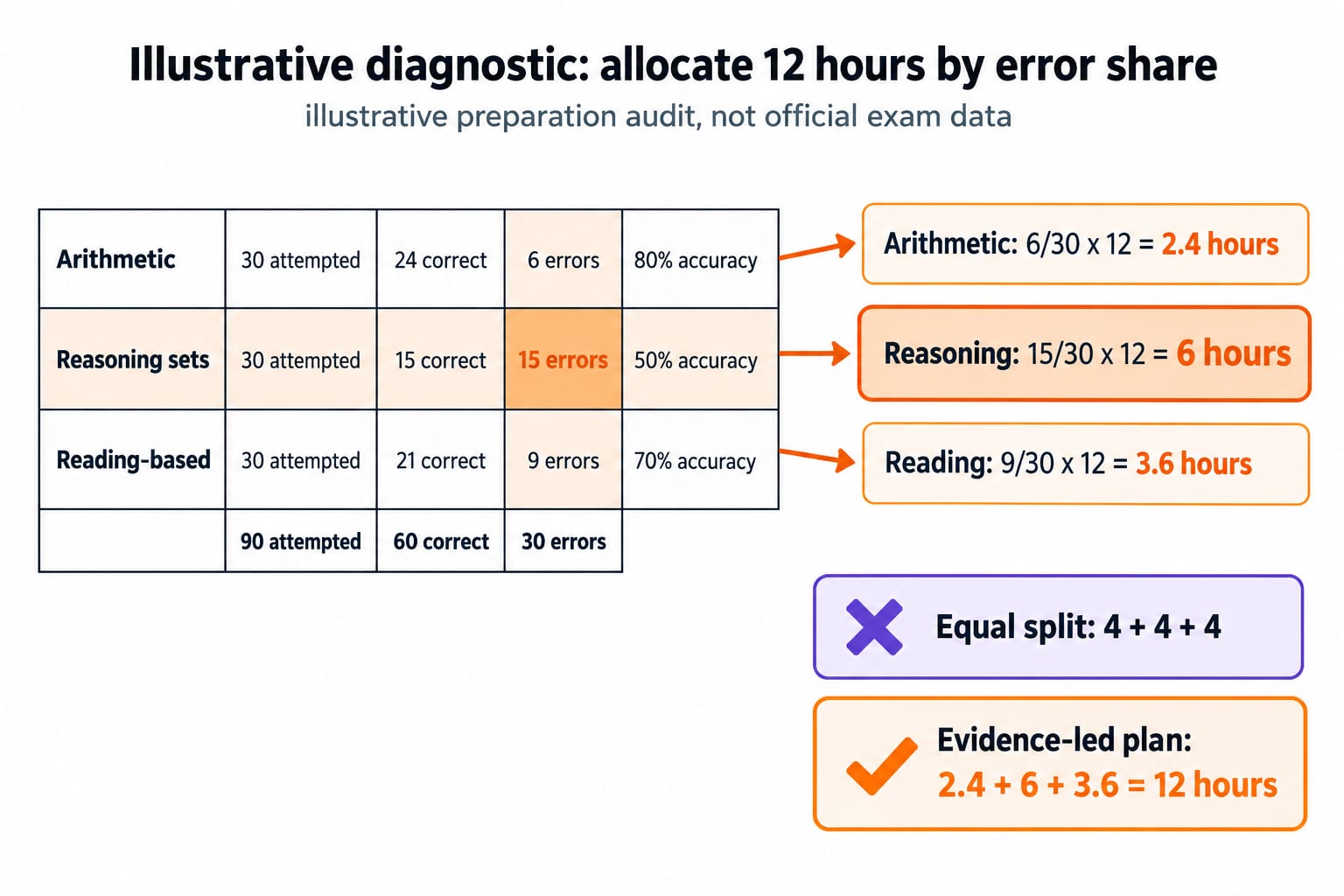
Why it happens. Equal splits look disciplined, and hours are easy to count.
What goes wrong. Strong and weak areas receive equal time, leaving the bottleneck unchanged.
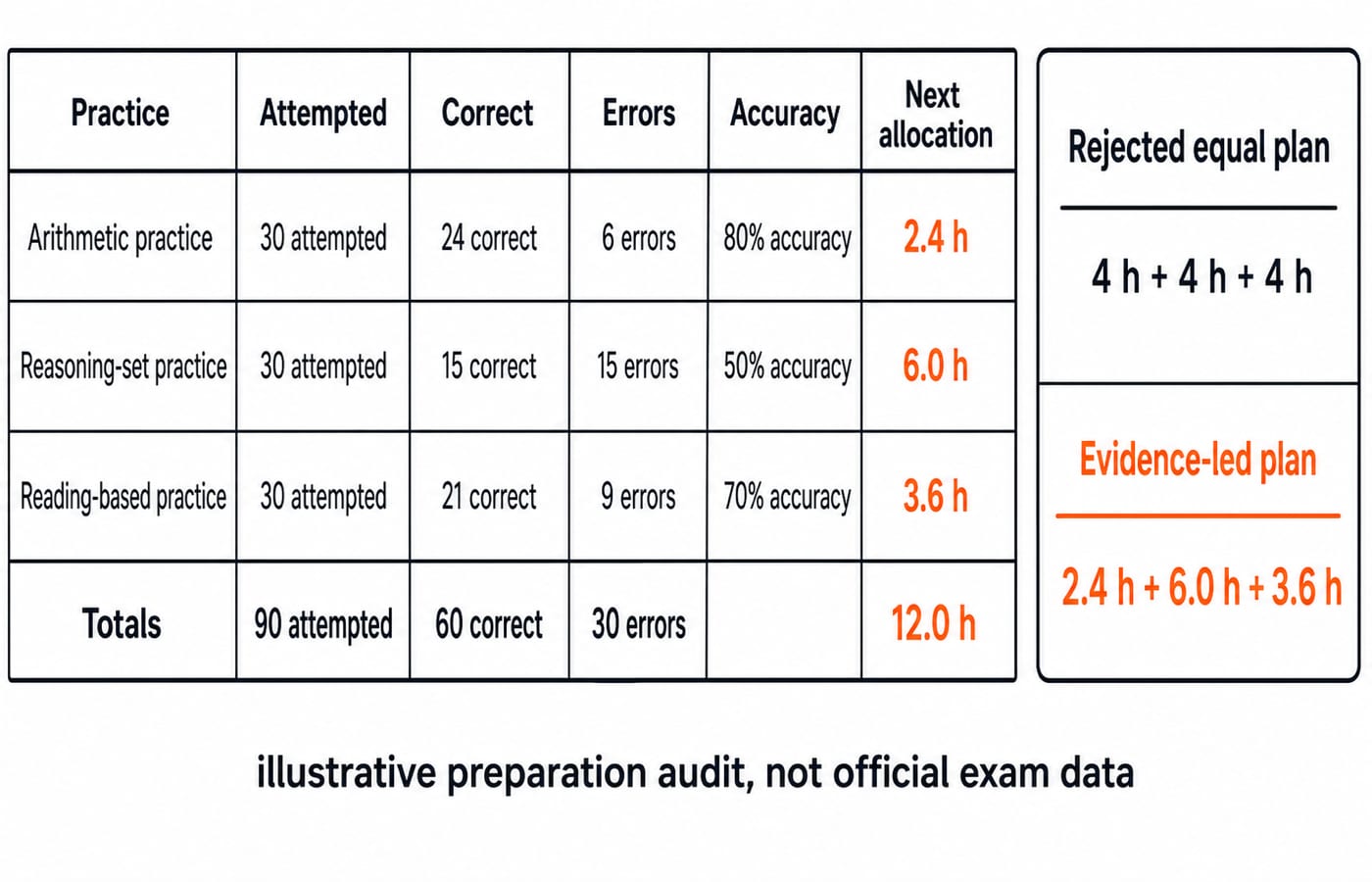
Run this illustrative diagnostic on three notice-checked practice buckets:
Bucket | Result |
|---|---|
Arithmetic |
|
Reasoning sets |
|
Reading based |
|
Totals are 24 + 15 + 21 = 60 correct and 6 + 15 + 9 = 30 errors.
What to do instead. Allocate 12 hours by error share: arithmetic 6/30 x 12 = 2.4, reasoning 15/30 x 12 = 6, and reading 9/30 x 12 = 3.6 hours. Check: 2.4 + 6 + 3.6 = 12. Replace the equal 4 + 4 + 4 split and recalculate next week.
3. IBPS RRB PO mistake 3: chasing attempts while accuracy collapses
Why it happens. Attempt count is visible, so speed feels like progress.
What goes wrong. Forced attempts create errors and hide poor selection. Mock A has 80 attempts, 58 correct and 22 wrong, so accuracy is 58/80 x 100 = 72.5%. Mock B has 70 attempts, 60 correct and 10 wrong, so accuracy is 60/70 x 100 = 85.7% to one decimal place. With 10 fewer attempts, Mock B has 2 more correct and 12 fewer wrong, showing better decision quality. Compare scores using the marking rule in the current official CRP RRB notification.
What to do instead. Use two passes. In Pass 1, take only questions whose method is clear. In Pass 2, revisit marked questions. Classify every wrong answer as a concept, calculation, reading, or forced-attempt error.
4. IBPS RRB PO mistake 4: treating mocks as scorecards instead of feedback
Why it happens. Taking another mock feels more productive than reopening an uncomfortable error.
What goes wrong. The same weakness survives across tests, while a rising or falling total gives no instruction for the next session. Suppose five matched practice mocks produce 50 errors: 18 concept gaps, 14 poor question-selection decisions, 10 calculation or transcription errors, and 8 time-pressure guesses. The ledger balances because 18 + 14 + 10 + 8 = 50.
What to do instead. Rank repair by error count. Schedule six 45-minute sessions: three for concept gaps, two for selection decisions, and one for calculation discipline. That is 6 x 45 = 270 minutes, and 270/60 = 4.5 hours. Ban forced guesses throughout. Compare the next five matched mocks by error category. Apply the IBPS PO paper-analysis method to build a topic and error profile for your RRB PO practice.
5. IBPS RRB PO mistake 5: protecting comfortable practice and sacrificing revision
Why it happens. Familiar chapters produce quick correct answers, while error review and spaced revision feel slow.
What goes wrong. Weak skills remain weak, and previously learned methods decay between mocks.
What to do instead. Plan an honest 10-hour week: 4 hours for weak-skill learning, 2.5 for timed sets, 2 for error review, and 1.5 for spaced revision. Check: 4 + 2.5 + 2 + 1.5 = 10. If two 60-minute blocks are lost, capacity becomes 8 hours. Remove one hour from new learning and one from an optional timed set. The new split is 3 + 1.5 + 2 + 1.5 = 8. Protect review and revision. Use the three-phase banking exam preparation plan to sequence learning, practice and revision through the week.
6. IBPS RRB PO mistake 6: changing resources before a feedback loop can finish
Why it happens. A new teacher, book, playlist, or test series offers the hope of a quick reset.
What goes wrong. Methods and notes fragment, practice becomes hard to compare, and switching consumes the week. Across nine sessions in a 12-hour week, spending 20 minutes switching each time costs 9 x 20 = 180 minutes = 3 hours. Only 12 - 3 = 9 hours remain. The loss is 3/12 x 100 = 25%.
What to do instead. Lock one concept source, one practice source, and one mock plus error ledger for a full feedback cycle. Change a source only when the ledger identifies a failure it cannot repair, such as repeated concept gaps after correction sessions. More resources do not guarantee more coverage.
7. IBPS RRB PO preparation reset: the six-point weekly loop
Repeat this sequence weekly with fresh evidence:
Confirm the applicable notice.
Run a diagnostic.
Allocate time from errors.
Protect accuracy before chasing attempts.
Repair the mock ledger.
Hold the resource stack long enough to measure it.
For structured overlapping prelims-level aptitude and reasoning practice, review the IBPS PO Prelims course and select modules that match the current CRP RRB notice. You can also compare KnowledgeGate's live IBPS offerings.
The short version is simple: selection is not lost because one study day went badly. It is endangered when the plan keeps producing the same unexamined error.
Go deeper with the full courseIBPS PO Prelims
Keep learning
IBPS PO Preparation Mistakes: 7 Errors That Cost Final Selection
Hard work is not enough when attempt counts, new resources and rigid timetables hide weak accuracy. Replace seven common errors with measurable habits.
Updated 30 Oct 20265 min readIBPS Exams
IBPS SO IT Officer Preparation Mistakes: 7 Fixes Before They Cost Selection
Avoid seven preparation errors that hide weak recall, neglected sections and repeated mock mistakes. Use worked planning examples to build a repairable study system.
Updated 30 Oct 20265 min readIBPS Exams
IBPS Clerk Preparation Mistakes: 6 Errors That Cost Selections
Study hours alone do not fix a leaking score. Use six worked examples to replace stale patterns, unmeasured practice and attempt chasing with an evidence-led plan.
Updated 8 Nov 20265 min readIBPS Exams
C Programming by Yash Sir: 7 Mistakes That Cost Marks and Their Fixes
Knowing C syntax is not enough if one unchecked operator or memory assumption changes the output. Learn seven common tracing mistakes and the reliable fix for each one.
Updated 20 Nov 20265 min readC Programming & Data Structures