IBPS PO Exam Pattern and Marking Scheme: Prelims, Mains and Score Calculation
Understand the current IBPS PO stage flow, separately timed tests, negative marking and final weighting through compact tables and checked calculations.
KnowledgeGate Team
Exam prep & CS education
Updated 20 Sep 20265 min read105 views
An IBPS PO paper can total 100 marks while sections have different question-to-mark ratios. A 0.25 penalty means one fourth of a question's assigned marks, not always 0.25 marks. Prelims and Mains use separate marking structures, while final merit combines normalised Mains and interview scores. Browse IBPS PO & SO IT Exam Preparation for stage-specific resources. The earlier IBPS PO Exam Pattern: A Stage-by-Stage Preparation Priority Map turns each stage into a study priority. Notification tables establish the section totals, assigned item marks control the penalty, and only normalised scores can enter the final composite. Every official number comes from the CRP PO/MT-XVI detailed notification; recheck later cycle notices.
Related reading: PO syllabus checklist and topic-wise paper analysis.
IBPS PO selection and score flow
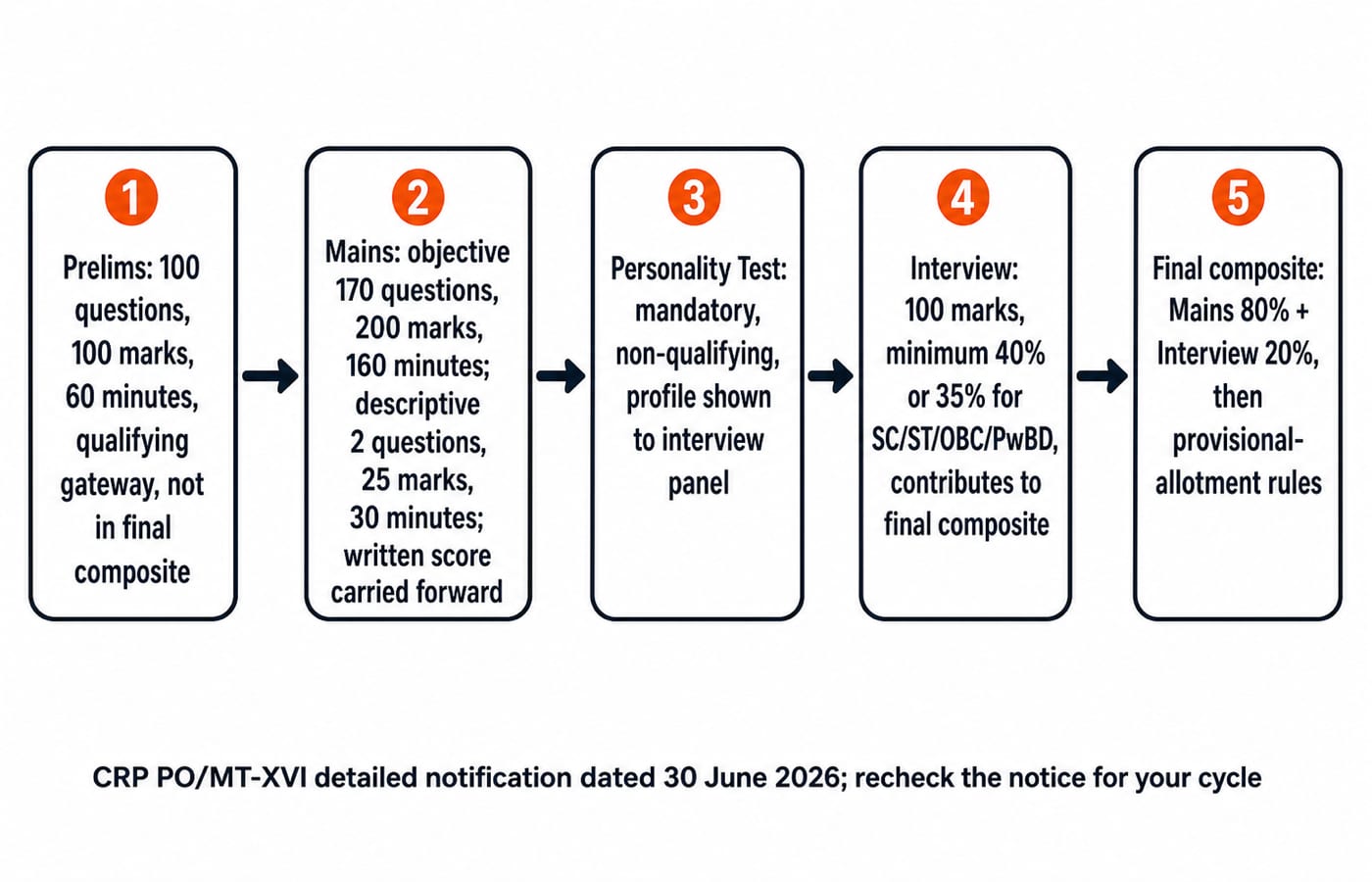
CRP PO/MT-XVI sets Prelims -> Mains -> Personality Test -> Interview -> provisional allotment. Prelims qualifies; Mains carries toward merit. The mandatory, non-qualifying Personality Test supplies an interview profile. Interview qualification and score affect the composite.
Prelims is 100 questions, 100 marks, 60 minutes. Mains has 170 objective questions, 200 marks, 160 minutes, plus 2 descriptive questions, 25 marks, 30 minutes. Totals: 172 questions, 225 marks and 190 minutes. For nationality, age, degree, documents and the role of each selection stage, use IBPS PO Eligibility and Selection Process: Who Can Apply and How Each Stage Works. Its brief final-weighting example belongs to selection context; raw Mains marks still cannot receive the 0.80 weight because IBPS first normalises applicable session scores.
IBPS PO Prelims pattern
Test | Questions | Maximum marks | Medium | Separate time |
|---|---|---|---|---|
English Language | 30 | 30 | English | 20 minutes |
Quantitative Aptitude | 35 | 30 | English and Hindi | 20 minutes |
Reasoning Ability | 35 | 40 | English and Hindi | 20 minutes |
Total | 100 | 100 | 60 minutes |
Clear the IBPS-decided minimum in every test. Strength elsewhere cannot cancel failure.
Flat averages are 20 x 60 / 30 = 40 seconds for English and 20 x 60 / 35 = 34.29 seconds for Quant and Reasoning. Choose quick items first, subject to the final information handout. IBPS PO Prelims covers three areas.
IBPS PO Mains pattern
Test | Questions | Maximum marks | Medium | Separate time |
|---|---|---|---|---|
Reasoning | 40 | 60 | English and Hindi | 45 minutes |
General/Economy/Banking Awareness/Digital/Financial Awareness including RBI circulars | 50 | 60 | English and Hindi | 35 minutes |
English Language | 40 | 20 | English | 35 minutes |
Data Analysis & Interpretation | 40 | 60 | English and Hindi | 45 minutes |
Total | 170 | 200 | 160 minutes |
Each test is separately timed, but the notice does not promise this live order.
Descriptive paper | Questions | Maximum marks | Medium | Time |
|---|---|---|---|---|
Essay and Comprehension | 2 | 25 | English | 30 minutes |
Themes can include economic and social issues, banking and technology trends, current events and ethics. Section averages are Reasoning 60 / 40 = 1.5, awareness 60 / 50 = 1.2, English 20 / 40 = 0.5, and DI 60 / 40 = 1.5. These are not item values. The IBPS PO Mains course supports these four objective areas and descriptive work.
IBPS PO negative marking
For objective tests, one wrong answer loses 0.25 of its assigned marks. Blanks have no penalty; descriptive responses do not use this rule.
For 30 hypothetical one-mark questions, 21 + 5 + 4 = 30. Correct marks: 21 x 1 = 21. Penalty: 5 x (1 x 0.25) = 1.25. Blanks: 4 x 0 = 0. Score: 21 - 1.25 + 0 = 19.75.
For a 2-mark item, one error costs 2 x 0.25 = 0.50 mark, not 0.25. Never use a section average as the item value.
IBPS PO cutoffs and normalisation
Prelims requires every test minimum. Mains requires test minimums and a total minimum for Personality Test and interview shortlisting. IBPS decides them, so avoid safe-score claims.
The notice says applicable session scores use equi-percentile normalisation; calculations use up to two decimals. No home formula reproduces this. Prelims does not enter the composite. Mains carries forward. Personality Test supplies a profile, not points.
IBPS PO final score and 80:20 weighting
The notice assigns 100 interview marks and requires 40%, or 35% for SC, ST, OBC and PwBD candidates. You must qualify even with strong Mains. Mains-to-interview weighting is 80:20.
The weights apply to Mains and interview scores already reduced to a common 100-point scale, not to raw marks. Mains is a 225-mark paper (200 objective plus 25 descriptive), so its raw total is never multiplied by 0.80 directly: IBPS first converts session scores through equi-percentile normalisation, which no home formula reproduces. Interview marks are already out of 100, so they need no conversion.
For an already normalised 100-point Mains score of 72.50 and an interview score of 66.00 out of 100:
Mains contribution:
72.50 x 0.80 = 58.00Interview contribution:
66.00 x 0.20 = 13.20Illustrative composite:
58.00 + 13.20 = 71.20 out of 100
Skipping the normalisation step is the common error. Feeding a raw Mains total straight into the weight gives 163 x 0.80 = 130.40, a number on no IBPS scale, because the composite itself tops out at 100 x 0.80 + 100 x 0.20 = 100. The 71.20 here is hypothetical, not an IBPS score, cutoff or guarantee.
A 5-point gain on that normalised 100-point scale changes the composite by 5 x 0.80 = 4.00 points in Mains, versus 5 x 0.20 = 1.00 in interview. These are not targets.
IBPS PO two-stage practice plan
Pattern fact | Preparation decision |
|---|---|
Three separately timed Prelims tests | Start and close each section independently. |
Quant and Reasoning: 35 questions in 20 minutes | Train a first-pass skip rule. |
Four Mains objective tests over 160 minutes | Practise long, stage-specific blocks. |
Essay and Comprehension | Schedule writing and summarisation, not letter-only drills. |
One-fourth penalty on assigned marks | Log blind guesses and rushed calculations. |
Weekend example: Prelims sprint 60 minutes, two Mains blocks 70, essay and summary 30, error review 20. Check: 60 + 70 + 30 + 20 = 180. Build topic drills from the latest notification and your error log, then reallocate the next session to the weakest measured section.
IBPS PO pattern: the short version
Prelims:
100/100/60for questions, marks, minutes.Mains objective:
170/200/160.Essay and Comprehension:
2/25/30.Wrong objective answer: one fourth of assigned marks.
Personality Test: mandatory, non-qualifying.
Final weighting: Mains 80%, interview 20%.
Recompute: the 21-correct ledger gives 19.75; the already normalised 72.50/66.00 example gives 71.20. Check the latest cycle notice and corrigenda before setting a mock strategy, then choose the Prelims or Mains resource that matches your next stage.
Keep learning
IBPS PO Preparation Mistakes: 7 Errors That Cost Final Selection
Hard work is not enough when attempt counts, new resources and rigid timetables hide weak accuracy. Replace seven common errors with measurable habits.
Updated 4 Oct 20265 min readIBPS Exams
IBPS PO Last 60 Days Plan: Revision, Mocks and Error Repair
Turn the final 60 days into a measured cycle of diagnosis, revision, mocks, retests and tapering, with worked schedules for a realistic 14-hour week.
Updated 29 Sep 20264 min readIBPS Exams
IBPS PO Cutoff Trends: Set a Defensible Target Score
Learn how to separate IBPS PO cutoff history by cycle, stage, category and denominator, then turn comparable Main values into a transparent practice target.
Updated 25 Sep 20265 min readIBPS Exams
IBPS PO Previous Year Analysis: Recurring Question Formats and Attempt Priorities
See what genuinely recurs across IBPS PO papers, solve representative format drills, and turn your own accuracy and speed into a practical attempt priority.
Updated 24 Sep 20265 min readIBPS Exams