IBPS PO Exam Pattern: A Stage-by-Stage Preparation Priority Map
Turn each IBPS PO stage into a clear skill priority. Use worked diagnostics, a mains study split and an evidence-led interview check to plan your next week.
KnowledgeGate Team
Exam prep & CS education
Updated 26 Jul 20265 min read
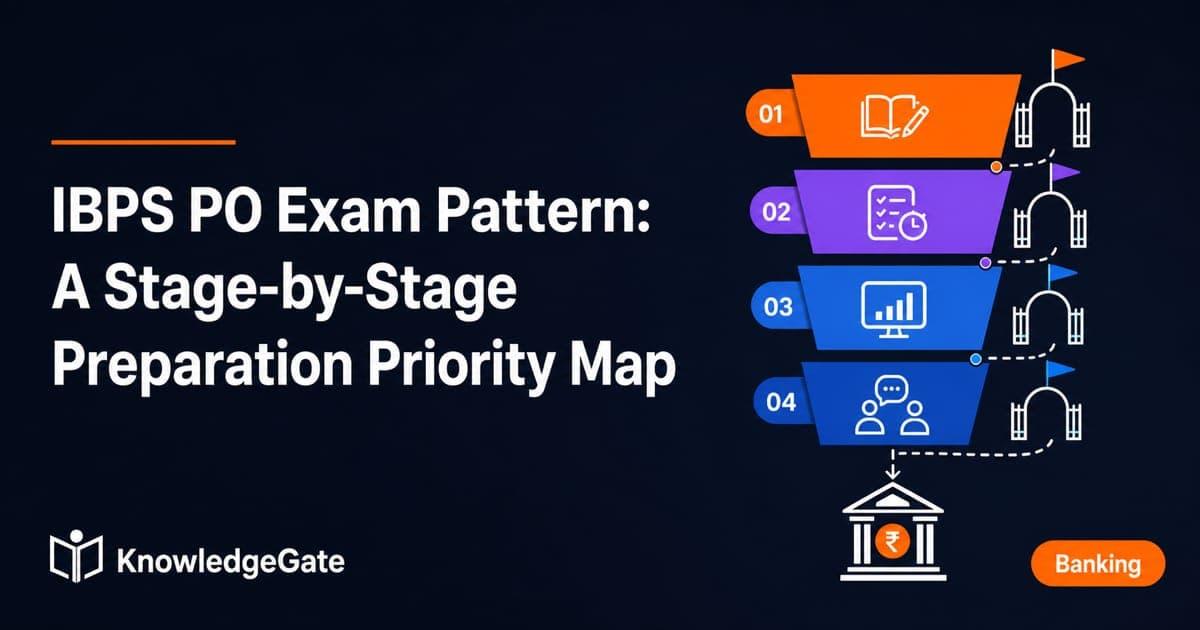
An exam pattern is not a table to memorise. IBPS PO prelims, mains, the personality stage and interview each reward a different behaviour, so each sets a different priority for your week. Every figure below comes from the CRP PO/MT-XVI Detailed Notification dated 30 June 2026; your call letter and handout carry the final word.
1. Read the IBPS PO route as four different gates
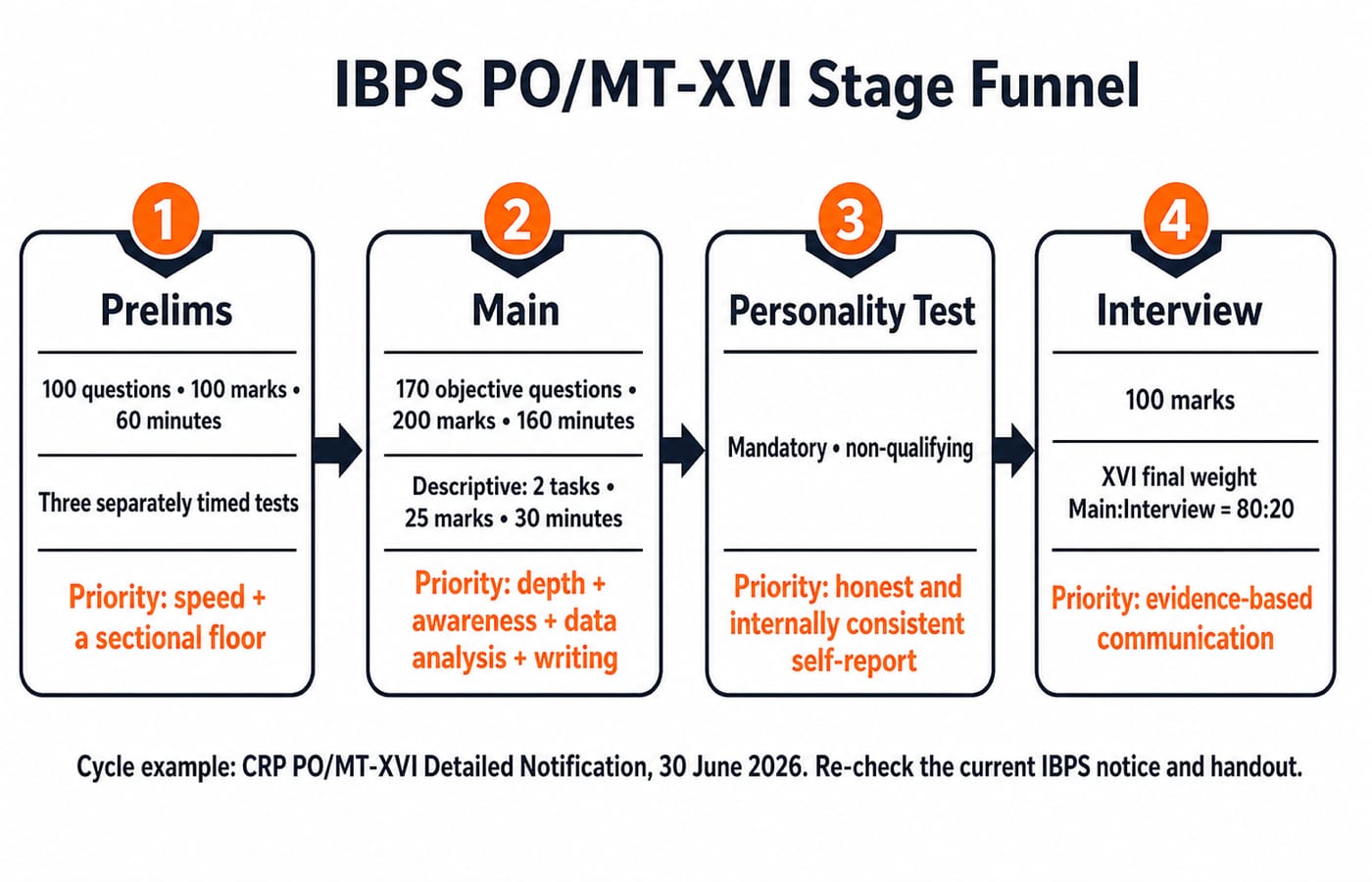
The CRP PO/MT-XVI route runs prelims, main, a mandatory non-qualifying Personality Test, a Common Interview, and provisional allotment. Prelims only screens. Main marks drive the later shortlist and the final merit position. The Personality Test is a self-report whose profile reaches the interview panel before you speak.
Main and Interview carry an 80:20 relative weightage in the final score, and the 100-mark interview has its own qualifying minimum. Four fifths of your position is settled before you enter the room, and the last fifth can still disqualify you.
2. IBPS PO prelims rewards section-wise control, not one heroic total
Prelims sets English at 30 questions for 30 marks, Quantitative Aptitude at 35 for 30, and Reasoning Ability at 35 for 40, each separately timed at 20 minutes. Note the mismatch: a reasoning question is worth more than a quant one. You must qualify in every test at IBPS-decided cut-offs, so one strong total cannot rescue a weak section. Meera logged her last timed mock like this.
Section | Attempted | Correct | Wrong | Blank | Accuracy |
|---|---|---|---|---|---|
English | 24 | 20 | 4 | 6 | 20 / 24 = 83.3% |
Quant | 23 | 17 | 6 | 12 | 17 / 23 = 73.9% |
Reasoning | 28 | 20 | 8 | 7 | 20 / 28 = 71.4% |
She used all 20 minutes everywhere, so selection was her problem, not time. English is holding, so maintain it. Quant costs her the most marks, so arithmetic selection comes first. Reasoning pairs her worst accuracy with her highest attempt count.
3. IBPS PO mains: 170 objective questions, 200 marks and a descriptive paper
The objective main has four separately timed tests: Reasoning, 40 questions for 60 marks in 45 minutes; General, Economy and Banking Awareness including Digital and Financial Awareness and RBI circulars, 50 for 60 in 35 minutes; English, 40 for 20 in 35 minutes; Data Analysis and Interpretation, 40 for 60 in 45 minutes. That is 170 objective questions, 200 marks, 160 minutes, then two English descriptive tasks, 25 marks in 30 minutes.
Reasoning needs endurance across 45 unbroken minutes. Data Analysis and Interpretation needs calculation speed and a reading of the set before any arithmetic. Awareness needs a current-plus-static system. English is only 20 objective marks but returns in the descriptive paper. This is why prelims and mains need different preparation.
A candidate weak in interpretation and awareness might spend 4 hours a week on interpretation, 3 on reasoning, 3 on awareness, 2 on objective English and 2 on the descriptive paper: 4 + 3 + 3 + 2 + 2 = 14 hours. Those weights come from her diagnostic, so redraw them after every mock.
4. Start the two slow-building mains skills early
Awareness recall and timed writing resist a last-week rescue, so they start now, not in October. The descriptive paper pairs an essay with a comprehension task, drawn broadly from economic and social issues, banking and technology trends, current events and ethics. No topic list or word limit is fixed, so rehearse range.
For a 30-minute rehearsal, spend 5 reading and outlining, 17 drafting the essay, 6 on the comprehension, and 2 checking structure, grammar and omissions: 5 + 17 + 6 + 2 = 30 minutes. If you overrun, cut drafting minutes, never the two-minute check.
Collect 12 useful banking, economy, digital-finance and RBI-circular items from Monday to Friday. On Saturday, recall them without notes and explain the weakest four in two sentences each. The IBPS PO mains awareness guide combines static foundations with a current routine.
5. Negative marking makes decision quality a skill
A wrong answer costs one fourth of the marks assigned to that question. A blank costs nothing. That is not a flat 0.25 everywhere. Prelims reasoning carries 40 marks across 35 questions, so a question is worth about 1.14 marks and an error costs about 0.29. A quant question is worth about 0.86, so an error costs 0.21.
English is the one-mark section, so Meera's 20 correct, 4 wrong and 6 blank give 20 - (4 x 0.25) = 19 marks. Leaving those four low-confidence attempts blank would have scored 20. The lesson is not attempt less, it is choose better. After every mock, record why each wrong option looked attractive.
Question/topic | Wrong or blank | Cause | Next drill |
|---|---|---|---|
Percentage change | Wrong | Reversed base value | 10 comparison drills |
Two-row seating puzzle | Blank | Spent 7 minutes without a fixed clue | Practise a 90-second entry check |
Sentence connector | Wrong | Ignored contrast word | Mark logical pivots in 15 sentences |
6. Personality and interview preparation must agree
The Personality Test is mandatory but non-qualifying. The interview carries 100 marks with its own qualifying floor, entering the final score under that 80:20 ratio. A panel that reads a self-report and then meets a different person believes the report, so honest self-knowledge beats a manufactured persona.
Build each answer to a fixed shape: your role, one disagreement you handled, the action you took, the result. Say you led a four-member project for six weeks and the team cut a manual reconciliation from 45 minutes to 20. That answer survives questioning because the number is yours. Take every detail from your record.
Check application claim, personality response, and interview evidence together. “Prefers collaborative problem-solving / agrees / four-member project example” is consistent. “Claims advanced Excel / cannot explain a basic pivot-table task” means prepare honestly or correct the claim where permitted.
7. Turn the pattern into your next seven days
Day 1: Download the CRP PO/MT-XVI notification and handout. Mark anything that differs from the figures above.
Day 2: Take one separately timed prelims diagnostic.
Day 3: Calculate section accuracy and complete the error ledger.
Days 4 and 5: Run two drills for the weakest prelims skill.
Day 6: Complete one mains awareness recall set and one descriptive rehearsal.
Day 7: Review the evidence and allocate the next 14 study hours from your data.
Starting from scratch, browse the IBPS course family. The IBPS PO Prelims course builds the sectional control prelims asks for, and the IBPS PO Mains course covers the depth and descriptive work the second stage adds.
The short version: prelims asks for section-wise control, mains for range plus written performance, and the later stages for consistency between claim and evidence. Set this week's priority from the next gate and the weakest skill your last mock measured.
Keep learning
IBPS Clerk Cutoff Trends: Set a Defensible Target Score
Turn comparable official cutoff values into a practical working target, then use mock accuracy and consistency to decide what to repair next.
Updated 24 Oct 20264 min readIBPS Exams
IBPS SO IT Officer Syllabus: What to Study for Each Section
Separate the official IBPS exam structure from the detailed study map. See what to cover for English, Reasoning, Quantitative Aptitude, Professional Knowledge and Descriptive English.
Updated 21 Oct 20264 min readIBPS Exams
IBPS SO IT Officer Preparation Strategy: A 16-Week Phase-by-Phase Plan
Turn 18 weekly hours into a realistic IBPS SO IT Officer plan, from the first diagnostic to mock repair, tapering and a conditional next-stage bridge.
Updated 17 Oct 20266 min readIBPS Exams
IBPS SO IT Officer Exam Pattern and Marking Scheme: Prelims, Mains and Interview
Understand the CRP SPL-XVI stage sequence, section timings and marks, then use worked score calculations and a 12-hour study plan to prepare for each stage.
Updated 13 Oct 20264 min read133 viewsIBPS Exams