IBPS PO English Preparation Plan: Reading, Grammar and Descriptive Writing
Use three separate feedback loops to improve reading accuracy, repair recurring grammar errors and turn descriptive drafts into clearer resubmissions.
KnowledgeGate Team
Exam prep & CS education
Updated 15 Aug 20266 min read
Accurate objective answers do not guarantee clear prose. Fluent writing does not prevent rushed reading or recurring grammar errors. This eight-hour week gives the three skills separate feedback loops, so a strong one cannot mask a weak one. Every minute count, word count and score here is a practice setting you can scale to your own pace.
IBPS PO English: start with three baselines, not one score
Complete an 85-minute diagnostic in one sitting: 30 minutes for two passages with 10 questions, 20 for 20 grammar-repair items, 30 for one descriptive response and 5 to record the results.
Loop | Result | Extra evidence |
|---|---|---|
Reading | 6/10 | 24 minutes used |
Grammar | 11/20 | 14 minutes used; note each error family |
Writing | 14/20 | 7 minutes spent editing |
The total is 6 + 11 + 14 = 31 out of 10 + 20 + 20 = 50. Yet 31/50 hides three problems. Separately track reading accuracy and time, grammar accuracy and error family, and writing score and editing time. The Bank PO English section strategy covers the section's other question types, cloze, para-jumbles and vocabulary in context. After this diagnostic, the IBPS PO Prelims course builds the same objective drilling into a Prelims-stage schedule.
Run an eight-hour week across three two-week phases
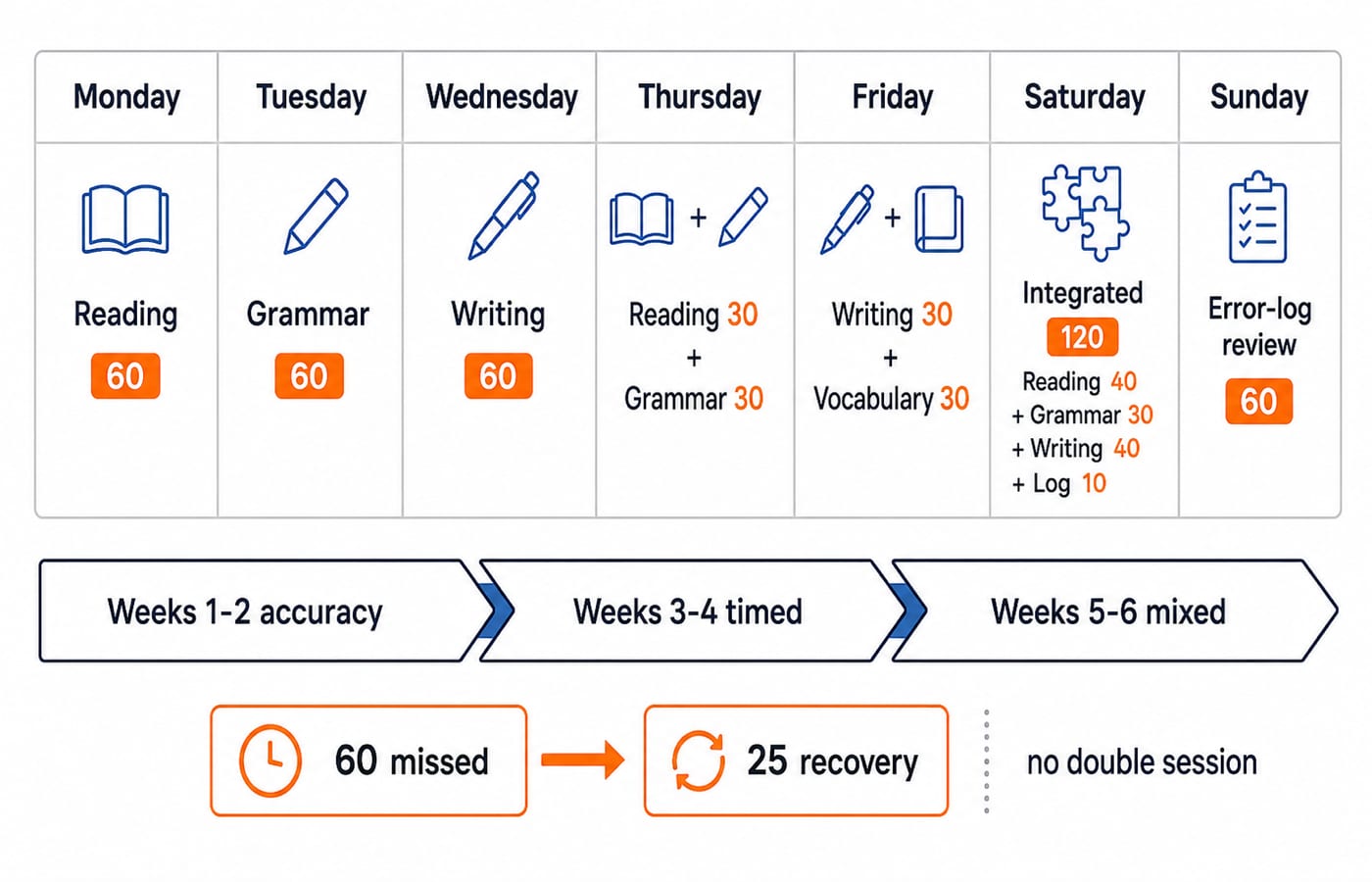
Use this 480-minute model:
Day | Practice |
|---|---|
Monday | Reading 60 |
Tuesday | Grammar 60 |
Wednesday | Writing 60 |
Thursday | Reading 30 + Grammar 30 |
Friday | Writing 30 + vocabulary in context 30 |
Saturday | Integrated 120: Reading 40 + Grammar 30 + Writing 40 + log 10 |
Sunday | Error-log review 60 |
Reading is 60 + 30 + 40 = 130 minutes. Grammar is 60 + 30 + 30 = 120, writing is 60 + 30 + 40 = 130, vocabulary is 30, and review is 10 + 60 = 70. Check: 130 + 120 + 130 + 30 + 70 = 480.
In Weeks 1 and 2, prioritise accuracy and explain every error. In Weeks 3 and 4, time the same material and stop on time. In Weeks 5 and 6, use mixed sets and a Saturday simulation, retaining Sunday review. Descriptive English sits in the Mains stage, as essay and letter writing, so guard the Wednesday and Saturday writing blocks once Prelims is behind you. The Bank PO Prelims versus Mains preparation split works through that stage ordering.
Miss a 60-minute day? Next day, do 15 minutes on that skill and 10 on its error log. Never stack full sessions. If two days go, keep Saturday's set and drop new vocabulary, not review.
Build the reading loop around evidence
Practice passage:
A fictional cooperative bank tested appointment-based service in 12 branches for eight weeks. Average queue time fell from 18 minutes to 11 minutes, but only after staff began helping walk-in customers use the booking desk. In the first fortnight, online appointments merely shifted the queue from the counter to the help desk. The pilot therefore suggests that new technology changes where work happens before it reduces the work itself. Managers who measure only counter queues may report success too early.
Read and mark contrasts for 3 minutes, answer for 5, then verify each response against one evidence phrase for 7.
What is the main idea? Technology improves service only when the surrounding process and measurement change.
What happened in the first fortnight? The queue moved to the help desk rather than disappearing.
What does “only” qualify? The fall from 18 to 11 minutes occurred after staff support began.
Tag misses as missed qualifier, outside assumption, reversed comparison or weak evidence. A Q3 miss triggers six next-day sentences using only, unless, despite and whereas, not random passages.
Repair grammar by rule family and delayed retest
Work these three repairs:
Neither the branch manager nor the clerks was willing to revise their entries.Changewastowerebecause the nearer subject,clerks, is plural.The report, along with the annexures, were submitted yesterday.Changeweretowasbecause the inserted phrase does not alter the singular head noun,report.If the customer would have checked the form, the delay could have been avoided.WriteIf the customer had checked the form.
Attempt 15 mixed items in 12 minutes. Spend 18 minutes tagging misses as subject-verb agreement, modifier, tense or conditional. For each missed family, state the rule and create two contrast pairs, each with correct and incorrect forms. After 48 hours, attempt six fresh family items. Mastery is at least 5/6 correct with reasons.
IBPS PO Mains descriptive writing: plan, draft, edit and resubmit
Practice prompt: A bank wants to replace paper tokens with a mobile queue system. Recommend whether it should adopt the system and explain safeguards for elderly customers and people without smartphones. Give it 35 practice minutes: plan for 5, draft 180 to 220 words in 20, and edit for 10. The word limit and timing IBPS sets for the descriptive paper are in the official notification at ibps.in.
Thesis: the bank should adopt mobile queueing as an additional channel, not the sole method. Reasons: predictable waiting and demand data for counter scheduling. Safeguards: a staffed paper-token desk and telephone bookings without an app. Conclude with a pilot comparing digital and walk-in waits. Score relevance, organisation, grammar and editing at 5 points each, 20 total. This is a quick four-line check for the weekly loop; the full five-criterion descriptive rubric, with essay and letter repairs scored line by line, lives in the essay and formal letter formats guide.
Before: The system will reduce queues. Elderly customers may be confuse. Therefore bank must keeps paper tokens.
After: The system can shorten queues, but some elderly customers may find it confusing. The bank should therefore retain paper tokens.
The revision softens unsupported certainty (will reduce becomes can shorten), replaces the verb confuse with the adjective confusing, restores the plain infinitive after the modal so must keeps becomes should retain, and adds the missing article in The bank. Resubmit within 72 hours, carrying only the two most frequent errors forward.
Use Saturday to compare loops without averaging them away
Use reading 40 minutes, grammar 30, writing 40 and log update 10. Set two weeks side by side, carrying Week 1 straight from the diagnostic:
Check | Reading | Grammar | Writing |
|---|---|---|---|
Week 1 | 6/10 = 60% in 24 min | 11/20 = 55% in 14 min | 14/20 = 70% |
Week 4 | 8/10 = 80% in 18 min | 16/20 = 80% in 12 min | 17/20 = 85% |
Flag reading or grammar below 80%, and writing below 16/20. If several are flagged, give one extra 30-minute block to the weakest percentage and remove 30 minutes of new material, never review. In Week 1, grammar is lowest at 55%, versus reading at 60% and writing at 70%, so grammar gets it. In Week 4, 80%, 80% and 85% meet the floors, so keep the balance.
If a metric stalls across three Saturdays, switch to qualifier drills, one grammar family, or line-level feedback on a revision. For structured English and descriptive-writing work, use the IBPS PO Mains course.
Start the next 14 days with a verifiable commitment
The short version: diagnose separately, complete 480 minutes, review by error type and allocate from Saturday's evidence. Start with two complete cycles. If you are still deciding between bank papers, the Banking & Insurance category lists the others alongside IBPS PO. Once the Wednesday and Saturday writing blocks feel controlled, move to the scored essay and formal letter repairs for the Mains descriptive paper.
Today, book the 85-minute baseline, create the three-column log and schedule seven blocks. If needed, scale every block to 75%. Since 480 × 0.75 = 360 minutes, all three loops and Sunday review still fit six hours.
Keep learning
IBPS SO IT Officer Last 60 Days Plan: Daily Revision and Mock Schedule
Turn the final 60 days into a repeatable cycle of diagnosis, focused revision, timed practice, mock analysis, repair, retesting, and a calm taper.
Updated 25 Oct 20265 min readIBPS Exams

IBPS Clerk Cutoff Trends: Set a Defensible Target Score
Turn comparable official cutoff values into a practical working target, then use mock accuracy and consistency to decide what to repair next.
Updated 24 Oct 20264 min readIBPS Exams
IBPS SO IT Officer Syllabus: What to Study for Each Section
Separate the official IBPS exam structure from the detailed study map. See what to cover for English, Reasoning, Quantitative Aptitude, Professional Knowledge and Descriptive English.
Updated 21 Oct 20264 min readIBPS Exams
IBPS SO IT Officer Preparation Strategy: A 16-Week Phase-by-Phase Plan
Turn 18 weekly hours into a realistic IBPS SO IT Officer plan, from the first diagnostic to mock repair, tapering and a conditional next-stage bridge.
Updated 17 Oct 20266 min readIBPS Exams