IBPS PO Previous Year Analysis: Recurring Question Formats and Attempt Priorities
See what genuinely recurs across IBPS PO papers, solve representative format drills, and turn your own accuracy and speed into a practical attempt priority.
KnowledgeGate Team
Exam prep & CS education
Updated 24 Sep 20265 min read
Old IBPS PO papers are most useful when you group questions by reusable format and operation, then use your own accuracy and time to set an attempt order. A question’s wording can change while its underlying percentage, constraint or inference test remains familiar. Memory-based reports can suggest candidates for the log, but only complete papers or mocks you can name can support a recurrence claim.
1. IBPS PO previous year analysis: what actually repeats
Topic: percentages, seating arrangement, reading comprehension.
Format: table DI, linear puzzle, inference question.
Operation: percentage change, positional elimination, rejecting an over-strong inference.
Decision: first-pass, conditional, or park.
The IBPS PO Paper Analysis: Topic-wise Weightage Method builds a question-count tally from named papers and shifts. Add three columns to that tally: format, underlying operation and your attempt decision. The extra columns separate recurrence from raw weightage and turn the tally into an attempt order.
Shift reports vary; recurrence guarantees nothing. IBPS’s notification for that cycle specified the structure; see the historical CRP PO/MT XIV archive. Take marks, counts, duration, negative marking, dates, vacancies, fees and cutoffs only from the current notification.
2. IBPS PO Prelims recurring formats: the section-by-section map
The IBPS PO Prelims Preparation Course covers these course-aligned areas:
Course-aligned area | Recurring format families | Skill underneath |
|---|---|---|
English Language | reading comprehension inference/context vocabulary, cloze logic, error or phrase correction | careful reading plus grammar in context |
Quantitative Aptitude | table or caselet DI, arithmetic word problems, series or approximation | percentages, ratios, calculation order |
Reasoning Ability | seating or arrangement puzzles, inequalities, syllogism, direction or order singles | constraint placement and quick elimination |
These qualitative families indicate patterns, not counts. New stories can reduce to the same ratio, constraint or inference test.
3. IBPS PO Quant: the wrapper changes, the arithmetic stays
Practice the format with a constructed set: A, B and C process 250, 320 and 425 applications, rejecting 12%, 15% and 20%. Find total accepted and A:C.
A accepted = 250 × 88% = 220.
B accepted = 320 × 85% = 272.
C accepted = 425 × 80% = 340.
Total = 220 + 272 + 340 = 832.
A:C = 220:340 = 11:17, dividing both terms by 20.
The trap is applying one blended rate to 995 instead of each branch’s rate. Percentages feed DI, ratios compare categories, and bases control both.
4. IBPS PO Reasoning: recurring constraints beneath new puzzle stories
Practice the constraint chain with a constructed set: Five interviews J, K, L, M and N run Monday to Friday, one per day. K is immediately before M; J is before L; N is on Friday; J is not on Monday. Which interview is on Monday?
With N fixed on Friday, test the K-M block. Tuesday-Wednesday or Wednesday-Thursday would leave J on Monday to stay before L, which the final clue forbids. Therefore K-M occupy Monday-Tuesday, J-L occupy Wednesday-Thursday, and K is on Monday.
The trap is accepting the first legal block position without testing the remaining order. Take a set when a fixed day and a consecutive block eliminate most placements; park it when several complete arrangements still survive.
5. IBPS PO English: the passage changes, the decision rule repeats
Constructed inference: “Digital payments rose during the quarter even though branch footfall fell, while cash withdrawals remained unchanged.”
A. Customers stopped using cash.
B. Digital usage increased without a fall in cash withdrawals.
C. Every branch lost customers.
D. Cash withdrawals caused the rise in digital payments.
B is correct. A contradicts “unchanged”; C invents a universal; D invents causation. The recurring skill is inference control.
Grammar check: “Every one of the revised estimates need a signature.” The head subject, “one”, is singular, so need becomes needs.
6. IBPS PO Mains layering: familiar skills in denser combinations
Mains can combine familiar operations into denser sets; that does not prove each later paper is harder than the last. A direct calculation can become a set combining selection, calculation and judgement.
Add D: 500 applications, 22% rejected. D accepted = 500 × 78% = 390. The accepted A+B to C+D ratio is:
(220 + 272):(340 + 390) = 492:730 = 246:365, dividing by 2.
The mathematics stays familiar, but steps multiply. Reading can likewise move from one rule to longer inference or writing work.
IBPS’s notification for the cited cycle specified the sections. Relevant courses include:
Course | Included course areas |
|---|---|
IBPS PO Prelims course | English Language, Quantitative Aptitude, Reasoning Ability |
IBPS PO Mains course | Reasoning and Computer Aptitude, Data Analysis and Interpretation, English Language, General/Economy/Banking Awareness, descriptive English |
7. IBPS PO attempt allocation: build a personal evidence log
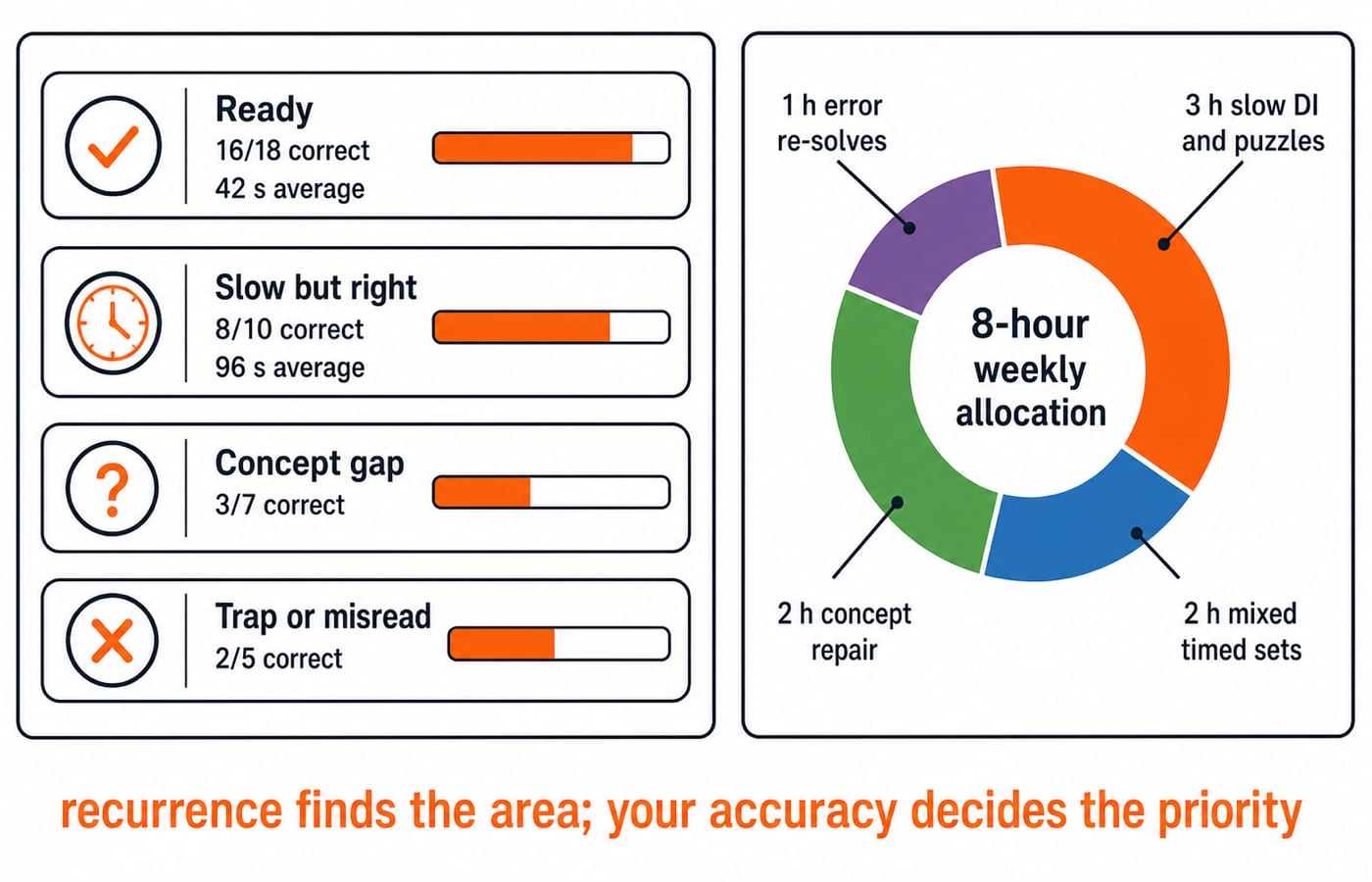
Use a 40-question practice log like this:
Bucket | Attempted | Correct | Average | Accuracy |
|---|---|---|---|---|
Ready | 18 | 16 | 42 s | 16 ÷ 18 = 88.9% |
Slow but right | 10 | 8 | 96 s | 8 ÷ 10 = 80% |
Concept gap | 7 | 3 | not tracked | 3 ÷ 7 = 42.9% |
Trap or misread | 5 | 2 | not tracked | 2 ÷ 5 = 40% |
Weekly: 3 hours for slow recurring DI and puzzles, 2 for concept gaps, 2 for mixed timed sets, and 1 for trap or misread re-solves. Recurrence finds the area; accuracy and time set priority.
Thirty-minute practice drill: Pass 1 uses 14 standalone questions × 50 seconds = 700 seconds = 11 minutes 40 seconds. Pass 2 gives one DI set 8 minutes and one arrangement set 7 minutes. Total = 26 minutes 40 seconds, leaving 3 minutes 20 seconds for flags and checks. Adapt it to the current notification’s official timing.
8. IBPS PO previous year analysis: the short version and next step
Track formats, practise each operation with changed values, and order attempts by accuracy plus time, not a viral list. Bank PO Prelims vs Mains: How to Split Your Preparation gives the phase plan.
Use the linked Prelims course first, then the IBPS PO Mains Preparation Course for denser sets. The IBPS PO & SO IT Exam Preparation category shows the wider line-up. Before using the drill, confirm every current structure and numerical rule in the latest notice on ibps.in.
Keep learning
IBPS PO Preparation Mistakes: 7 Errors That Cost Final Selection
Hard work is not enough when attempt counts, new resources and rigid timetables hide weak accuracy. Replace seven common errors with measurable habits.
Updated 4 Oct 20265 min readIBPS Exams
IBPS PO Last 60 Days Plan: Revision, Mocks and Error Repair
Turn the final 60 days into a measured cycle of diagnosis, revision, mocks, retests and tapering, with worked schedules for a realistic 14-hour week.
Updated 29 Sep 20264 min readIBPS Exams
IBPS PO Cutoff Trends: Set a Defensible Target Score
Learn how to separate IBPS PO cutoff history by cycle, stage, category and denominator, then turn comparable Main values into a transparent practice target.
Updated 25 Sep 20265 min readIBPS Exams
IBPS PO Preparation Strategy: A 16-Week Plan for Prelims and Mains
Turn 16 weeks into a workable IBPS PO routine. This plan shows how to divide study time, analyse drills, repair errors and retain Mains continuity.
Updated 23 Sep 20265 min readIBPS Exams