

IBPS RRB Clerk Paper Analysis Method: Recurrence, Difficulty Drift and Attempt Priorities
Learn how to separate the official RRB Office Assistants pattern from memory-based evidence, count recurring formats correctly, measure workload and build a 12-hour plan.
KnowledgeGate Team
Exam prep & CS education
Updated 12 Nov 20265 min read
An IBPS RRB Clerk paper analysis can turn one recalled shift into a permanent weightage table and five questions from one puzzle into five recurrences. Candidates chase predictions instead of repeatable skills. A useful analysis separates format families, detects rising workload within familiar topics, and converts a labelled-paper audit into study allocation and a controlled attempt order. IBPS sets the official structure; memory-based papers guide preparation, not guarantees.
1. Separate the official baseline from previous-year evidence
Official-source boundary. The 27 September 2025 CRP-RRBs XIV notification supplies historical structure and penalty figures. IBPS reserved the right to modify it; the current notification, handout and later ibps.in notices override it. Topic recurrence is not an IBPS blueprint.
The IBPS RRB Clerk syllabus map sets out the stage and topic inventory; the analysis below tests recurrence and workload within that map.
For Office Assistants (Multipurpose), commonly searched as IBPS RRB Clerk, the 27 September 2025 notification specified Prelims: Reasoning, 40 questions, 40 marks, 25 minutes; Numerical Ability, 40 questions, 40 marks, 20 minutes; total, 80 questions, 80 marks, 45 minutes.
Label an IBPS notice or handout official, a reconstruction with named cycle and shift memory-based, and examples created here illustrative. Reconcile every question to the section total. The IBPS PO topic-wise analysis method covers PO paper recurrence; the RRB Clerk method here applies the audit to the Office Assistant historical baseline, workload measures and 45-minute attempt model.
2. Audit Reasoning as set families plus a rotating standalone basket
Set families include seating, floor or box arrangements, day or month scheduling, and multi-variable puzzles. Standalone types include inequality, syllogism, coding-decoding, alphanumeric series, direction sense, blood relation, order and ranking. One absent shift does not make a type irrelevant.
Illustrative four-paper puzzle and seating volumes are 10, 15, 10, 15, or 2, 3, 2, 3 five-question sets. Appearance is 4/4 = 100%, but report 10 sets and 50 questions, not 50 independent recurrences. Inequality volumes 5, 0, 5, 0 appear in 2/4 = 50% and contribute 10 questions.
For an illustrative six-person floor puzzle, C=4, so A immediately above C gives A=5. F=1, so B immediately above F gives B=2. Floors 3 and 6 remain. D above E gives D=6, E=3. Bottom to top: F-B-E-C-A-D.
3. Audit Numerical Ability through speed work, arithmetic and DI
Use three baskets: speed work covers simplification or approximation, number series and quadratic comparison; arithmetic covers percentage, ratio, average, profit and loss, interest, mixture, partnership, ages, time and work, pipes, and speed-distance-time; DI covers tables, bars, lines and caselets. No basket has a guaranteed shift-wise count.
In an illustrative cooperative-bank table, Branch A has 240 accounts and 35% women's accounts: 240 x 0.35 = 84. Branch B has 320 and 37.5% = 3/8: 320 x 3/8 = 120. Branch C has 360 and 45%: 360 x 0.45 = 162.
Total women's accounts = 84 + 120 + 162 = 366. C exceeds A by 162 - 84 = 78. B:C = 120:162 = 20:27. The percentage concept stayed unchanged, but fraction conversion, three-row aggregation and ratio simplification increased the workload. That is useful difficulty drift.
4. Measure difficulty drift by setup load, not by topic label
The worked floor puzzle has six people, six floors, one placement dimension and five clues. An illustrative two-variable version with six people, six floors and six departments opens a 6 x 6 = 36 person-floor grid plus a 6 x 6 = 36 person-department grid. That is 72 candidate cells before cross-clues, though both are floor puzzles.
For Quant, a three-row table with two values per row exposes 3 x 2 = 6 source values. A six-row caselet needing three per row can require 6 x 3 = 18 extractions or derivations. Record variables, source values, conversions and calculation steps beside each topic tag.
5. Mains keeps the foundations but changes the preparation load
In the same historical notification, Office Assistants Mains had this map:
Section | Questions | Marks | Minutes |
|---|---|---|---|
Reasoning | 40 | 50 | 30 |
Computer Knowledge | 40 | 20 | 15 |
General Awareness | 40 | 40 | 15 |
English or Hindi | 40 | 40 | 30 |
Numerical Ability | 40 | 50 | 30 |
Total | 200 | 200 | 120 |
These figures are historical, not permanent. Prelims foundations remain useful, but Mains can raise variable count, data density and calculation depth. Computer, awareness and the selected language require separate preparation; their importance cannot be inferred from Prelims tallies.
The IBPS Clerk Prelims-to-Mains section map demonstrates the method but covers IBPS Clerk CSA, not RRB Office Assistants. The current RRB notice controls.
6. Convert recurrence plus weakness into a 12-hour weekly allocation
Diagnostics: puzzles 58% accuracy, arithmetic 62%, DI 76%, standalone reasoning 86%, General Awareness recall 55%, Computer Knowledge 78%, and the selected language 80%.
Allocate exactly 12 hours: puzzles 3; arithmetic 2.5; DI 1.5; standalone reasoning 1; General Awareness 1.5; Computer Knowledge 0.5; language 0.5; timed section tests and error review 1.5. Check: 3 + 2.5 + 1.5 + 1 + 1.5 + 0.5 + 0.5 + 1.5 = 12 hours.
Give recurring weaknesses repair time, strengths maintenance, and Mains-only work nonzero time. Use the IBPS Clerk CSA Prelims course only for overlapping Reasoning and Numerical Ability foundations, and the IBPS Clerk CSA Mains course for overlapping higher-level practice. Neither course targets RRB Office Assistants. Select only topics in the current official RRB notice.
7. Let setup time and corrected score decide the attempt order
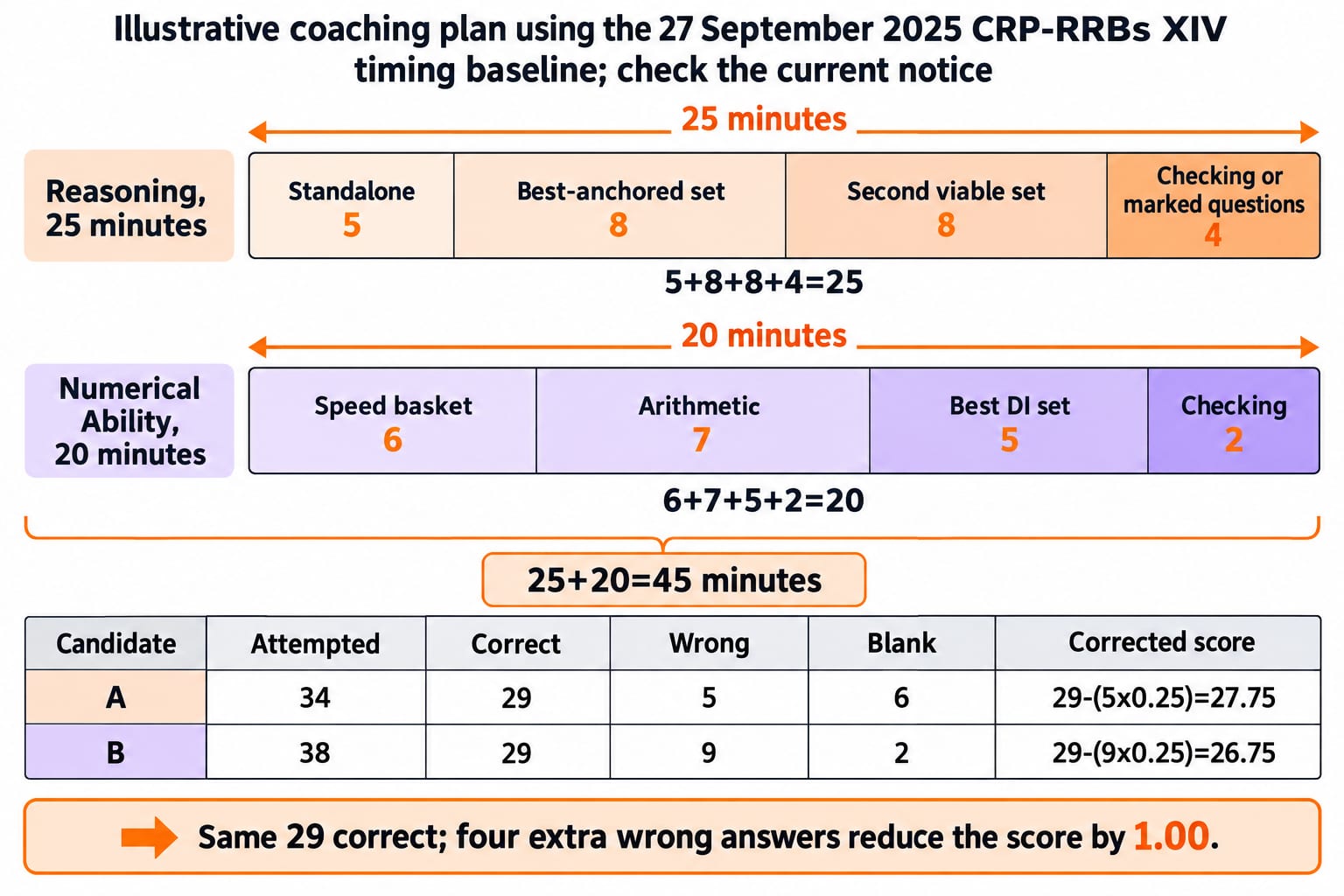
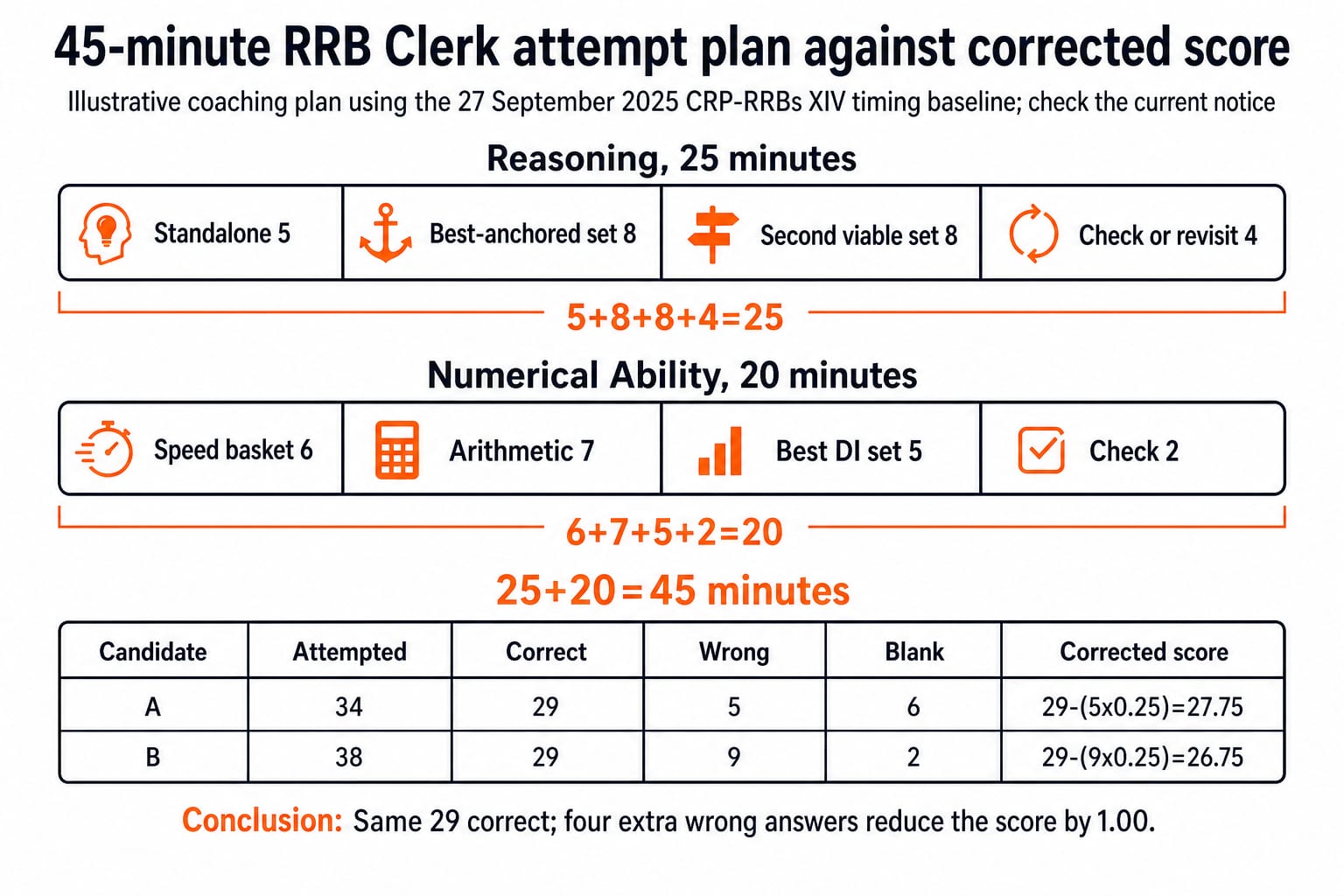
Test this coaching order, not an IBPS prescription. Reasoning, 25 minutes: standalone 5, best-anchored set 8, second viable set 8, checking or marked questions 4. Numerical Ability, 20 minutes: speed basket 6, arithmetic 7, best DI set 5, checking 2.
The notification deducted one-fourth, or 0.25, of the marks assigned to a wrong objective answer; unanswered questions had no penalty. In a one-mark preliminary section, Candidate A attempts 34, with 29 correct, 5 wrong and 6 blank: 29 - 5 x 0.25 = 27.75. Candidate B attempts 38, with the same 29 correct, 9 wrong and 2 blank: 29 - 9 x 0.25 = 26.75. Four extra wrong answers cost one mark.
Start when the first scan reveals an anchor. Revisit parked sets only with enough time to solve them.
8. The short version and next step
Verify the current structure on ibps.in. Use labelled reconstructions, count format appearances separately from question volume, measure workload alongside topic name, allocate time from recurrence and personal accuracy, and validate attempt order in sectionals.
Compare paths in the live Banking and Insurance preparation category, using those Clerk courses only for overlapping foundations and higher-load practice. Courses organise learning. The current IBPS RRB notice decides the exam.
Go deeper with the full courseIBPS PO Prelims
Keep learning

SBI Clerk Previous Year Analysis: Topics That Repeat, Difficulty Drift and Time Allocation
Past papers become useful when you track recurrence, solving cost and your return per minute. Build an audit sheet and a 120-minute remedial plan.
Updated 30 Oct 20264 min readSBI Exams
IBPS PO Previous Year Analysis: Recurring Question Formats and Attempt Priorities
See what genuinely recurs across IBPS PO papers, solve representative format drills, and turn your own accuracy and speed into a practical attempt priority.
Updated 30 Oct 20265 min readIBPS Exams
HPSC PGT Computer Science: A Recurrence-Based Revision Order for the Subject Paper
Use topic recurrence from past HPSC PGT Computer Science papers to order revision, while keeping the official syllabus and current paper structure in control.
Updated 30 Oct 20267 min readTeaching Recruitment (Computer Science)
IBPS SO IT Officer Previous Year Analysis: Find Repeating Topics and Set Prep Priorities
Use an evidence-led IBPS SO IT Officer previous year analysis to rank repeating topics, combine them with your errors, and plan a 14-hour study week.
Updated 30 Oct 20264 min read57 viewsIBPS Exams