IBPS PO Cutoff Trends: Set a Defensible Target Score
Learn how to separate IBPS PO cutoff history by cycle, stage, category and denominator, then turn comparable Main values into a transparent practice target.
KnowledgeGate Team
Exam prep & CS education
Updated 25 Sep 20265 min read
A previous IBPS PO cutoff looks like an obvious target until one table mixes Preliminary and Main scores, categories, sectional thresholds and different denominators. A cutoff is a past qualifying boundary; a target score is a planning margin you choose. This guide builds an apples-to-apples trend table, one transparent target calculation and a mock-score check. Only IBPS can publish the operative cutoff for a cycle, so use history for planning and verify the current notice before acting.
IBPS PO cutoff versus target score: keep four labels attached
Keep four labels with every value: CRP cycle, stage, category and maximum score. Add sectional or total when a PDF publishes both. A bare 75.75 is unusable. CRP PO/MT-XV Main, General total cutoff, 75.75 out of 225 is auditable. If the stages feel blurred, use the IBPS PO Exam Pattern: Stage-by-Stage Prep Priority Map. Those labels keep stages and categories separate.
Completed-cycle IBPS score-method PDFs describe corrected scores after penalties, equating where applicable, rounding to two decimals, and individual-test plus total cutoffs. The current notice may differ and overrides these historical details. Check the IBPS authorised domain before using a live-cycle rule.
Read the IBPS PO cutoff trend without mixing scales
Completed CRP cycle | Stage | Category | Published total cutoff | Maximum | Comparable with |
|---|---|---|---|---|---|
XIV | Preliminary | General | 48.50 | 100 | XV Preliminary only |
XV | Preliminary | General | 49.21 | 100 | XIV Preliminary only |
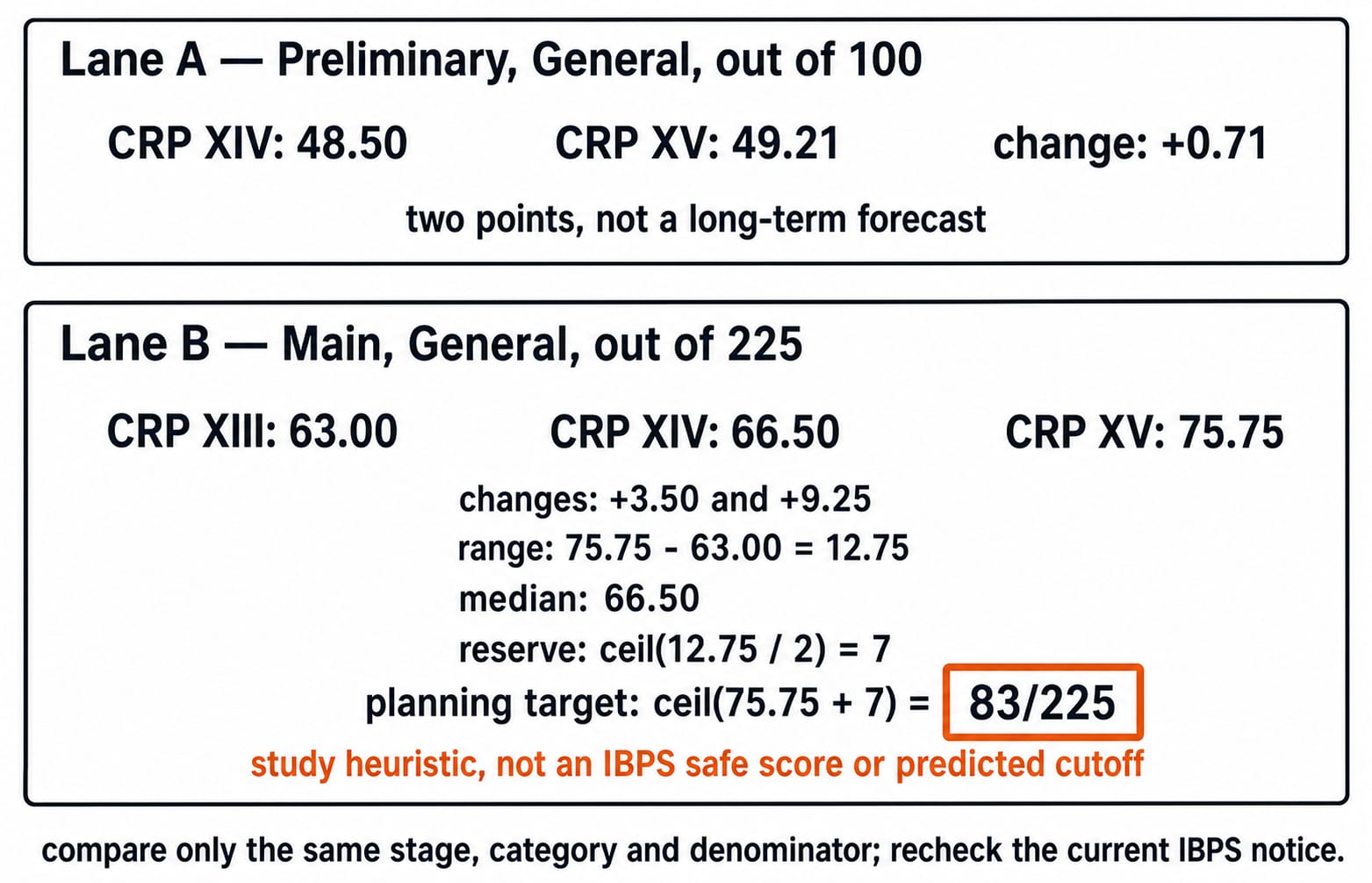
XIII | Main | General | 63.00 | 225 | XIV and XV Main |
XIV | Main | General | 66.50 | 225 | XIII and XV Main |
XV | Main | General | 75.75 | 225 | XIII and XIV Main |
The Preliminary movement is 49.21 - 48.50 = 0.71, but two points do not make a durable forecast. For Main, the changes are 66.50 - 63.00 = 3.50 and 75.75 - 66.50 = 9.25. The three-cycle range is 75.75 - 63.00 = 12.75; the ordered median is 66.50. These are movements, not explanations. Use the IBPS PO Paper Analysis: Topic-wise Weightage Method to tag and compare papers, not to invent a cause for cutoff movement.
Turn the historical range into a defensible planning target
For a General-category Main learner, start with the highest same-scale historical cutoff, 75.75. Define a volatility reserve as half the three-cycle range, rounded up: 12.75 / 2 = 6.375, then ceil(6.375) = 7. Add it: 75.75 + 7 = 82.75, then round up to a planning target of 83 out of 225.
Half-range and rounding are KnowledgeGate planning choices, not IBPS rules. The result is neither a forecast nor a guarantee. Another category needs its own official series. A raw mock is comparable only when its denominator and scoring model stay consistent. Never compare 83/225 as a percentage with Preliminary cutoffs.
Protect sectional floors as well as the total target
CRP PO/MT-XV Main provides a completed-cycle example. Its General/EWS individual-test cutoffs were Reasoning 8.50/60; General/Economy/Banking/Digital/Financial Awareness including RBI circulars 2.00/50; English 13.50/40; Data Analysis and Interpretation 6.00/50; and Descriptive Paper 10.00/25. The General total cutoff was 75.75/225. A future notice may name or weight tests differently.
Candidate A scores 22 + 11 + 13 + 24 + 12 = 82/225. Although 82 beats that historical total cutoff, English at 13 is below 13.50, so the profile misses that completed cycle's individual-test floor. Candidate B scores 20 + 12 + 16 + 23 + 12 = 83/225. Every component exceeds the named historical floor, and the total reaches the planning target. These are fictional guardrail checks, not proof that Candidate B clears another cycle.
Convert 83 into a comparable mock-score rule
Take three full Main mocks from one provider, each scored out of 225: 74, 79, 85. Their ordered median is 79, the target gap is 83 - 79 = 4, and only 1 of 3 reaches 83. One high mock is not stable readiness.
After targeted repair, suppose the scores are 82, 84, 86. The median is 84, 2 of 3 exceed 83, and the weakest result is 1 point short. Use this study rule: at least two of the latest three comparable mocks at or above the target, with every historical-style sectional guardrail protected. It is not an IBPS standard. Changing provider, denominator or model restarts the baseline.
KnowledgeGate has more than 1,800 published IBPS-tagged questions, a broad practice pool rather than an IBPS PO-only or official PYQ count. Use the IBPS PO Mains course for this Main example, or the IBPS PO Prelims course when building a separate Preliminary target.
Reset the target when the evidence changes
Reset for three reasons:
A new official notice changes a stage, component, maximum or scoring rule. Retire the old scale.
IBPS publishes a completed-cycle cutoff. Append it only to the matching stage-and-category series, then recompute the high, median, range and reserve.
You change mock provider or format. Collect three fresh comparable baselines before judging the gap.
This worked series is General only. SC, ST, OBC-NCL, EWS and PwBD learners should copy their corresponding category row from each official PDF and repeat the arithmetic. Do not add or subtract an assumed concession from 83. An expected-cutoff video, memory-based paper or peer score cannot overwrite an official row.
Set your IBPS PO target score in 20 minutes
Use five four-minute blocks:
Minutes 0-4: Open completed-cycle IBPS PDFs. Choose one stage and category.
Minutes 4-8: Copy three comparable rows with their denominators.
Minutes 8-12: Calculate the highest value, median and range.
Minutes 12-16: Choose and label a planning reserve. Write the total target and historical sectional guardrails.
Minutes 16-20: Compare the latest three same-provider mocks and name one repair block.
That is 5 x 4 = 20 minutes. The short version: a cutoff is evidence, not a target. Compare like with like, add a visible margin, protect sectionals, demand repeatable mock evidence and recalculate when IBPS publishes new information. Use the IBPS PO & SO IT Exam Preparation hub to choose the right stage. For every operative rule and cutoff, ibps.in is the final authority.
Keep learning
IBPS PO Preparation Mistakes: 7 Errors That Cost Final Selection
Hard work is not enough when attempt counts, new resources and rigid timetables hide weak accuracy. Replace seven common errors with measurable habits.
Updated 4 Oct 20265 min readIBPS Exams
IBPS PO Last 60 Days Plan: Revision, Mocks and Error Repair
Turn the final 60 days into a measured cycle of diagnosis, revision, mocks, retests and tapering, with worked schedules for a realistic 14-hour week.
Updated 29 Sep 20264 min readIBPS Exams
IBPS PO Previous Year Analysis: Recurring Question Formats and Attempt Priorities
See what genuinely recurs across IBPS PO papers, solve representative format drills, and turn your own accuracy and speed into a practical attempt priority.
Updated 24 Sep 20265 min readIBPS Exams
IBPS PO Preparation Strategy: A 16-Week Plan for Prelims and Mains
Turn 16 weeks into a workable IBPS PO routine. This plan shows how to divide study time, analyse drills, repair errors and retain Mains continuity.
Updated 23 Sep 20265 min readIBPS Exams